Best MBA in Entrepreneurship Programs in North Carolina
Compare 8 accredited MBA in Entrepreneurship programs in North Carolina at 7 schools, with graduate earnings, cost, debt, and completion data from IPEDS and the U.S. College Scorecard.

Which North Carolina MBA actually helps you launch or scale a venture, rather than just add a credential? Cost shapes the answer. Published program totals run from $19,920 at UNC Wilmington's online program to $39,090 at Queens University of Charlotte, while Duke University's entrepreneurship track shows median earnings of $162,879 five years after graduation.
Formats span campus, hybrid, and fully online, and for a founder, a cheaper degree with real startup access can outperform a famous one.
Key Points
- UNC Charlotte is the lowest in-state price here at $8,037, just ahead of UNC Wilmington.
- UNC Wilmington offers a fully online MBA with asynchronous classes, seven-week terms, and no entrance exam.
- Duke's MBA entrepreneurship track shows median earnings of $162,879 five years after finishing.
Best MBA in Entrepreneurship Schools in North Carolina: Ranked
The six North Carolina schools below offer an MBA with an entrepreneurship concentration, on campus, online, or both. Graduation rates and net price refer to the whole institution, not the MBA program, and program-level earnings appear only where they have been published.
Duke University
#1Durham, NC · ~$67,000/yr (est.)
Best for: Aspiring founders and acquirers in tech commercialization
Duke's Fuqua School of Business in Durham offers an Entrepreneurship and Innovation concentration built around experiential courses. The New Ventures sequence takes students from idea discovery through market delivery, and the New Venture Fellows program places MBA students with technologies emerging from Duke labs. Duke's institution-wide graduation rate is about 97%, and its ties to the Research Triangle give students access to local founders and investors.
- Concentration: Entrepreneurship and Innovation, campus-based
- New Ventures: Discover, Develop, and Deliver course sequence
- Fuqua Client Consulting Practicum for hands-on consulting work
- Mentored study with external organizations
- Entrepreneurship through acquisition course
- Healthcare technology commercialization focus
- New Venture Fellows places MBA students with Duke technologies
- Student clubs include ETA Club and Entrepreneurial Leadership Network
University of North Carolina at Charlotte
#2Charlotte, NC · $5,000 – $10,000/yr (est.)
Best for: Corporate intrapreneurs wanting on-campus or online flexibility
UNC Charlotte's Belk College of Business offers a 36-credit MBA with an Entrepreneurship and Corporate Venturing concentration for founders and corporate intrapreneurs. Students can take it on campus or through an online pathway, and a capstone is required. Its institution-wide graduation rate is about 69%, and its tuition is among the lowest of the schools on this list.
- 36 credit hours, with a 12-credit concentration
- Corporate Entrepreneurship course applies venture thinking inside established firms
- Electives include Design Thinking and Innovation
- Electives include Business Models and Business Plans
- Capstone required
- Corporate Venturing certificate offered
- Students may propose a custom concentration
- Hybrid delivery with on-campus and online pathways
University of North Carolina at Chapel Hill
#3Chapel Hill, NC · ~$13,000/yr (est.)
Best for: Founders and funders seeking accelerator and investor access
UNC Kenan-Flagler in Chapel Hill has the deepest venture ecosystem of the six schools. Students build their own path as a founder, funder, or growth executive, with all entrepreneurship courses taken as electives. Resources include Launch Chapel Hill accelerator access, a student-run private equity fund managed with over $4.4 million, and a network of 1,150+ entrepreneurship alumni. The institution-wide graduation rate is about 91%.
- Full-time, campus-based MBA with an Entrepreneurship concentration
- Founder, funder, and growth executive tracks; all courses are electives
- Entrepreneurs Lab (ELab) venture course, with Ted Zoller as faculty director
- Startup-UNC series covers feasibility, business planning, and financing
- Launch Chapel Hill accelerator access
- Student-run private equity fund and Carolina Angel Network connections
- Venture Capital Investment Competition, founded at UNC
- 1,150+ entrepreneurship alumni, including Jason Kilar
- Current venture directory lists 4 active MBA ventures
Lenoir-Rhyne University
#4Hickory, NC · ~$13,000/yr (est.)
Lenoir-Rhyne in Hickory offers a 36-credit MBA with a 12-credit Entrepreneurship concentration. Classes can be taken on campus, online synchronously, or in hybrid form, with three start dates a year. It suits students who want a smaller program with flexible scheduling. The institution-wide graduation rate is about 48%, which is worth weighing.
- 36 credit hours; the 24-credit core covers accounting, marketing, and supply chain
- Concentration includes Creativity and Innovation in Organizations
- Concentration includes Entrepreneurship and Intrapreneurship plus two electives
- Campus, online synchronous, and hybrid options
- Starts in summer, fall, or spring
- Practicum experiences can be completed near home
- ACBSP accredited; foundation competency in accounting, finance, economics, and statistics required
University of North Carolina Wilmington
#5Wilmington, NC · $8,000 – $24,000/yr (est.)
UNC Wilmington delivers its MBA with a specialization in Entrepreneurship and Business Development fully online, taught by on-campus faculty at an AACSB-accredited school. The 36-credit program can be finished in as few as 12 months, with seven-week terms and six start dates a year. UNCW lists in-state tuition at about $19,920, and no GMAT is required. Its institution-wide graduation rate is about 71%.
- Fully online, asynchronous, 36 credits across 12 courses
- Can be completed in as few as 12 months
- Seven-week course terms with six start dates per year
- Topics include venture capital and commercialization
- No GMAT or GRE required, per the program page
- Admission: 3.0 GPA, two years of work experience, two recommendations
- In-state tuition about $19,920 for the full program
- AACSB accredited
Queens University of Charlotte
#6Charlotte, NC · ~$16,000/yr (est.)
Queens University of Charlotte offers a 30-credit hybrid MBA with an Entrepreneurship concentration that combines eight-week online classes with in-person residencies. It emphasizes real-world projects and networking with Charlotte's business community. The program is AACSB accredited and priced at $1,303 per credit. The institution-wide graduation rate is about 61%.
- 30 credit hours across 10 courses, finishable in 11 to 20 months
- Hybrid format: eight-week online classes plus in-person residencies
- Courses include Innovation, Change, & Entrepreneurship
- Real-world business projects and career planning residencies
- $1,303 per credit, $39,090 total program tuition
- Fall, spring, and summer starts
- AACSB accredited
Cost & outcomes by school
Federal data for the highest-earning Entrepreneurship programs, independent of the ranking above. Earnings are this field's master's graduates four years after completing, where the Scorecard reports them.
| School | Earnings | Tuition / yr | Debt | Grads/yr | Format |
|---|---|---|---|---|---|
| University of North Carolina Wilmington NC | — | $8,112 | — | — | Online |
| University of North Carolina at Chapel Hill NC | — | $12,751 | — | — | Campus |
| Queens University of Charlotte NC | — | $15,526 | — | — | Hybrid |
| University of North Carolina at Charlotte NC | — | $8,037 | — | 21 | Hybrid |
| Lenoir-Rhyne University NC | — | $13,020 | — | — | Hybrid |
| Strayer University-North Carolina NC | — | $15,135 | — | — | Hybrid |
| Duke University NC | — | $66,523 | — | — | Campus |
Sources: U.S. Department of Education. Tuition and graduates: IPEDS. Earnings and debt: College Scorecard, this field's master's graduates; a dash means no figure is reported.
Startup Incubators, Accelerators, and Pitch Competitions at Ranked North Carolina MBA Schools
At Duke's Fuqua School of Business, MBA in Entrepreneurship students can compete in the Startup Showcase, which carries a prize pool above $110,000, and apply for Fuqua E-ternship grants of up to $6,000 for founders or $4,000 for non-founder internships between years. Duke Innovation & Entrepreneurship also offers non-dilutive awards, though the school does not identify a separate MBA student venture fund.
UNC Kenan-Flagler runs a fuller venture stack. The 1789 Venture Fund has awarded more than $174,000 in seed funding across 137 teams1, and the student-run fund manages over $4.4 million2. The invitation-only Luby competition builds on 1789, ACC InVenture Prize, or Dreamers Who Do participation; the Luby Trust committed $300,000 from 2024 to 2026, its first two years awarded $200,000 to 16 startups, and past winners have raised over $819,0001. VCIC, founded at UNC in 1998, draws 1,200 MBA students from 60 schools2.
For UNC Charlotte, Lenoir-Rhyne, UNC Wilmington, and Queens University of Charlotte in North Carolina, current public materials do not establish named MBA startup incubators, accelerators, or recurring pitch competitions.
Online and Hybrid MBA in Entrepreneurship Options in North Carolina
UNC Wilmington offers a fully online option, with asynchronous classes, seven-week terms, and no entrance exam. UNC Charlotte, Lenoir-Rhyne, and Queens University of Charlotte are hybrid. Lenoir-Rhyne also offers a fully online route with synchronous classes. Duke University is campus-based; UNC Chapel Hill offers both online and campus formats.
For founders running a business or holding a job, the best MBA programs with online and hybrid formats make it easier to keep income and operations going while you study. The campus programs trade that flexibility for in-person access to incubators, mentors, and pitch nights, which matters most if you are still looking for a team or early backers.
For value, UNC Charlotte has the lowest listed in-state tuition among the online and hybrid programs, with UNC Wilmington close behind at $19,920 total program tuition.
Out-of-state readers should compare out-of-state rates carefully. The public schools charge noticeably more to nonresidents, while Lenoir-Rhyne and Queens list one rate regardless of residency.
Related Articles
North Carolina MBA in Entrepreneurship Programs That Waive the GMAT or GRE
Standardized testing has lost its grip on MBA admissions, but the schools ranked here land in different places, so, even among No-GRE master's programs, read each policy before you assume you can skip the exam.
Where the ranked schools stand
- University of North Carolina at Chapel Hill (Kenan-Flagler), Full-Time MBA: Waiver-optional, not fully test-optional. You submit a GMAT or GRE score or an approved waiver. Published criteria include a 3.2 GPA with quantitative coursework, an advanced degree (JD, MD, PhD, or an MS in a STEM, business, or economics field), at least five years in a quantitative role, a CPA or CFA, or a strong Executive Assessment or MCAT score.1 Waiver requests have their own earlier deadline each round.2
- UNC Chapel Hill (Kenan-Flagler), Online MBA: Applicants with five or more years of full-time experience are automatically exempt; others may request a case-by-case waiver weighing quantitative coursework, grades, and certifications.
Several other ranked schools do not publish a GMAT or GRE policy on their MBA admissions pages. Because these rules shift between application cycles, confirm current waiver criteria and deadlines directly with each program before you apply.
What Does an MBA in Entrepreneurship Cost in North Carolina, and Is Local Demand Worth It?
UNC Charlotte is the most affordable option here at $8,037 in-state, followed closely by UNC Wilmington at $8,112. The residency gap at public schools is large: out-of-state students pay about $15,000 more at UNC Charlotte, about $16,000 more at UNC Wilmington, and about $18,700 more at UNC Chapel Hill. Lenoir-Rhyne, Queens, and Duke charge one rate, with Duke the highest at $66,523. Institution-wide net price figures are approximate averages, not MBA-specific. Demand is the other half of the math. PitchBook-reported North Carolina startup venture capital was about $2.3B in 2025, down more than 40% from 2024 and 15th nationally. StartupBlink's 2026 rankings place the Triangle 41st globally.
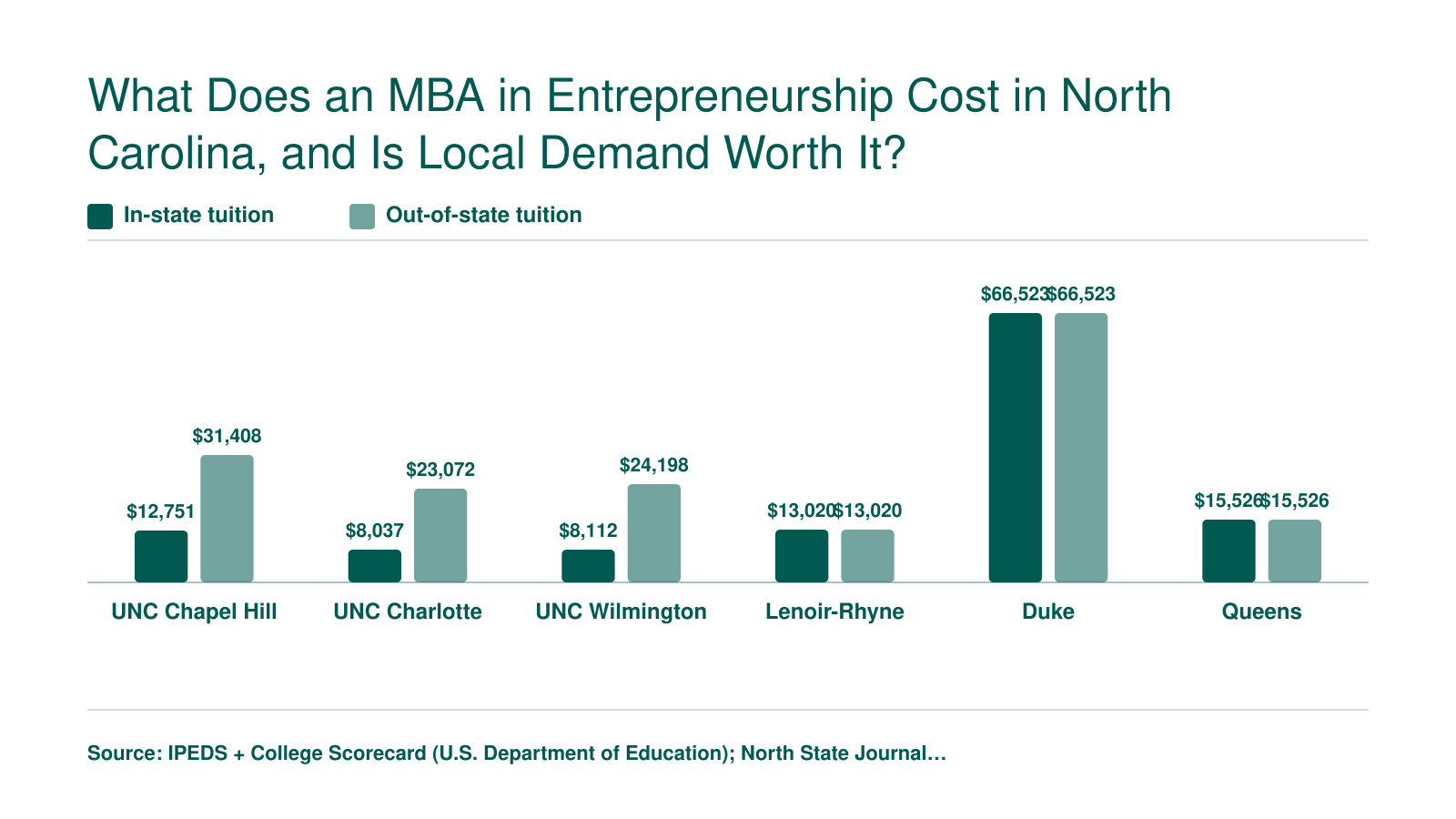
According to Entrepreneurship at Carolina, UNC-Chapel Hill's Innovate Carolina fiscal year 2025 analysis counted 12 new IP-based startups, tying its single-year record. The 1,273 UNC-affiliated startups tracked since 1950 have raised $48.9 billion in cumulative funding. These figures cover the whole university, not only MBA ventures.
Career Outcomes: Earnings and Founder Track Records After an MBA in Entrepreneurship
Founder career paths are the exception to the usual earnings rule. Duke’s MBA entrepreneurship track shows median earnings of $162,879 five years after finishing, but program-level debt and 10-year monthly payment data are not published for most programs here, so a clean debt-adjusted return is unavailable. UNC Kenan-Flagler reports more than 1,150 entrepreneurship alumni and a student-run private equity fund that has committed over $4.4 million across two funds. Those figures describe the venture network rather than MBA founders alone. Duke’s program provides venture resources, but no 2026 MBA-specific launch count or funding total has been released. UNC’s broader innovation ecosystem reports 537 active North Carolina-affiliated startups, though that is a university-wide count. Founders often accept lower early salaries while building equity, so these earnings medians understate the payoff for graduates who start and hold companies. Prospective founders should weigh the equity upside, the cash salary tradeoff, and the lack of comparable program debt data before benchmarking themselves against salaried MBA peers.
North Carolina MBA in Entrepreneurship FAQs
Which MBA in entrepreneurship program is best in North Carolina?
When are application deadlines for North Carolina MBA in entrepreneurship programs this cycle?
What GPA, work experience, and class profile do ranked North Carolina entrepreneurship MBA programs report?
How long does an MBA in entrepreneurship take in North Carolina?
Compare Entrepreneurship programs on the data that matters
Explore more MBA specializations or browse every graduate field.
All MBA programs