Best MBA in Entrepreneurship Programs in Michigan
Compare 3 accredited MBA in Entrepreneurship programs in Michigan, with graduate earnings, cost, debt, and completion data from IPEDS and the U.S. College Scorecard.

Michigan's startup scene now spans mobility, software, and venture-backed services, and an accelerated MBA in entrepreneurship often doubles as a route to operating capital and advisor networks.
The programs ranked here span in-state graduate tuition of $14,760 to $17,736. Federal outcomes data put median earnings a decade after entry between roughly $55,900 and $83,600, a spread wide enough to change a founder's launch timeline.
What separates them is access: campus incubators, student-run funds, hybrid formats, and test waivers intersect with what Michigan employers actually pay.
Key Points
- Central Michigan University charges every student the same $17,187 tuition.
- Michigan Ross runs a 24-month campus MBA with detailed founder resources.
- Test rules at ranked schools run from required with waivers to not required.
Ranked: Best MBA in Entrepreneurship Schools in Michigan
This ranking leans toward programs that pair a reasonable price with strong completion and outcomes, and the field here is three Michigan schools with a documented entrepreneurship focus. Graduation rates below are institution-wide figures for each university, not rates for the MBA itself. Where a school offers entrepreneurship as electives or an emphasis rather than a confirmed formal concentration, we say so.
University of Michigan
#1Ann Arbor, MI · $29,000 – $58,000/yr (est.)
Best for: Founders drawn to venture capital
Ann Arbor's Ross School of Business has the highest institution-wide graduation rate of the three, at about 93 percent, and the highest published graduate tuition, roughly $28,554 in-state and $57,444 out-of-state. Ross lists Entrepreneurship as an elective department within the Full-Time MBA, and its program page presents it as a career path. We could not confirm a formal concentration, certificate, or track by that name in the catalog. The hands-on options are strong: student-run investment funds, startup and venture capital internships, business plan competitions, and a student incubator that is expanding to North Campus for 2026-27.
- Full-time campus MBA in Ann Arbor, starting in fall
- Entrepreneurship is an official elective department, not a confirmed formal concentration
- Student-run investment funds with hands-on investing in companies
- Summer internships with startups or venture capital firms
- Business plan competitions with over $100,000 in prizes
- Zell Scholars aid for second-year students with entrepreneurial interests
- Detroit Neighborhood Entrepreneurs Project consulting for local businesses
Central Michigan University
#2Mount Pleasant, MI · ~$17,000/yr (est.)
Best for: Budget-minded international students
Central Michigan University in Mount Pleasant has the lowest published graduate tuition in this group, about $16,737 for in-state and out-of-state students alike, which stands out for out-of-state applicants. Its institution-wide graduation rate is about 59 percent. The program page lists Entrepreneurship as one of 12 MBA emphasis areas, but we could not confirm a formal concentration or certificate in the catalog. Students can compete for startup funding in the annual New Ventures Competition, and graduate assistantships carry a stipend.
- 36-credit MBA, with an estimated duration of 1 to 2 years
- Entrepreneurship is one of 12 emphasis areas on the program page
- Covers business, financing, legal, and tactical skills for launching a venture
- Annual New Ventures Competition with startup funding
- Graduate assistantships provide a stipend
- Lean Six Sigma Green and Yellow Belt training offered
- Campus-based, with dedicated international student support
Michigan State University
#3East Lansing, MI · $22,000 – $42,000/yr (est.)
Best for: Corporate innovators eyeing venture finance
Michigan State University in East Lansing posts an institution-wide graduation rate of about 81 percent. Its published graduate tuition falls between the other two schools, about $21,432 in-state and $41,508 out-of-state. The Broad College lists Entrepreneurship as a sub-concentration, separate from its four broader MBA focus areas of Finance, Marketing, Supply Chain Management, and Human Resource & Strategic Management. It is a campus-based option that mixes new venture work with finance electives.
- Listed by Broad as an Entrepreneurship sub-concentration of the MBA
- Required entrepreneurship course, MGT 852
- 9 elective credits chosen from the concentration menu
- Electives span venture capital, private equity, brand strategy, and digital marketing
- Campus-based in East Lansing
- Frames opportunity recognition for startups and corporate innovation roles
Cost & outcomes by school
Federal data for the highest-earning Entrepreneurship programs, independent of the ranking above. Earnings are this field's master's graduates four years after completing, where the Scorecard reports them.
| School | Earnings | Tuition / yr | Debt | Grads/yr | Format |
|---|---|---|---|---|---|
| Michigan State University MI | — | $21,772 | — | — | Campus |
| University of Michigan MI | — | $28,886 | — | — | Campus |
| Central Michigan University MI | — | $17,187 | — | 5 | Campus |
Sources: U.S. Department of Education. Tuition and graduates: IPEDS. Earnings and debt: College Scorecard, this field's master's graduates; a dash means no figure is reported.
Startup Incubators, Accelerators, and Venture Funds for Michigan MBA Students
The University of Michigan publishes far more detail about its founder infrastructure than any other campus ranked here, and that transparency is itself worth something to a prospective entrepreneur evaluating an MBA in Entrepreneurship.
What Michigan documents
Ross says it runs more student-run investment funds than any other school in the Best MBA Programs ranking, though it does not name the funds or spell out who may join them. The money trail is easier to follow. The Michigan Business Challenge, open campus-wide to student teams rather than reserved for MBAs, awards finalists between $1,000 and $20,000, with the top business award at $20,000 and the runner-up at $10,000.1 Student Startup Grants run from $300 to $5,000, venture-launch support reaches $10,000 for selected students, and the Desai Accelerator invests up to $50,000. Dare to Dream grants ladder from $500 for shaping an idea to $10,000 for integration.1
Elsewhere in the state
Michigan State's Foundation backs an accelerator serving student and alumni entrepreneurs, though the business school does not confirm MBA-specific access.2 Central Michigan runs a New Venture Competition.3
Use the same filter we do: student-run funds and hands-on launch programs signal real founder support; a pitch night alone does not.
Online and Hybrid MBA in Entrepreneurship Options in Michigan
Across MBA programs in Michigan, major business schools keep adding flexible formats for working professionals, yet entrepreneurship training still centers on campus. Each entrepreneurship listing ranked here is a campus program. The University of Michigan's Ross Full-Time MBA in Ann Arbor runs 24 months, and the Michigan State and Central Michigan entrepreneurship tracks are campus offerings too.
Flexible paths do exist. Ross runs a self-paced Online MBA and a Weekend MBA that meets twice a month for students employed full time. Michigan State offers MSU graduate programs including an in-person Executive MBA in Troy (every other Friday evening and Saturday), a hybrid Executive MBA that meets one weekend a month in East Lansing, and a Professional Online MBA launching in Fall 2026. Central Michigan lists online and on-campus study, full or part time, with evening and weekend scheduling.
These schools don't clearly say whether the entrepreneurship concentration carries into those formats, so ask admissions before you enroll. Online study protects your paycheck. Pitch competitions, student-run funds, and incubator access reward students who show up in person.
Related Articles
Which Michigan MBA Programs Waive the GMAT or GRE?
Test policies at the schools ranked here range from required with defined waivers to not required at all. The table below reflects what each official admissions or FAQ page states for 2026. Policies can change by term, so confirm current requirements with each admissions office before you apply.
| School | GMAT/GRE Requirement | Waiver or Test-Optional Criteria | Notes |
|---|---|---|---|
| University of Michigan Ross Online MBA | Required. Applicants submit the GMAT, GMAT Focus Edition, GRE, or Executive Assessment. | Waiver may be requested with an undergraduate or graduate degree in business, economics, or a STEM-related major and a GPA of 3.4 or higher; a CPA, CFA, or equivalent; a PhD, MD, or JD; or University of Michigan alumni status with a cumulative GPA of 3.2 or higher, regardless of major. | Applicants may instead complete the free Michigan Ross Quantitative Readiness Course and score at least 80% on the final exam. |
| University of Michigan Ross Weekend MBA | Required. Applicants submit the GMAT, GMAT Focus Edition, GRE, or Executive Assessment. | Waivers are available for select candidates, but the official FAQ does not specify eligibility criteria. | Submitting the Executive Assessment instead of the GMAT or GRE requires eight or more years of post-collegiate professional work experience. |
| Michigan State University Broad Full-Time MBA | Not required. Candidates are considered for admission without a GMAT or GRE score. | Listed as a special-admissions option, but the admissions page does not publish specific eligibility criteria. | No minimum score. The average GMAT score is 674, and the GRE is accepted with no preference between the two tests. |
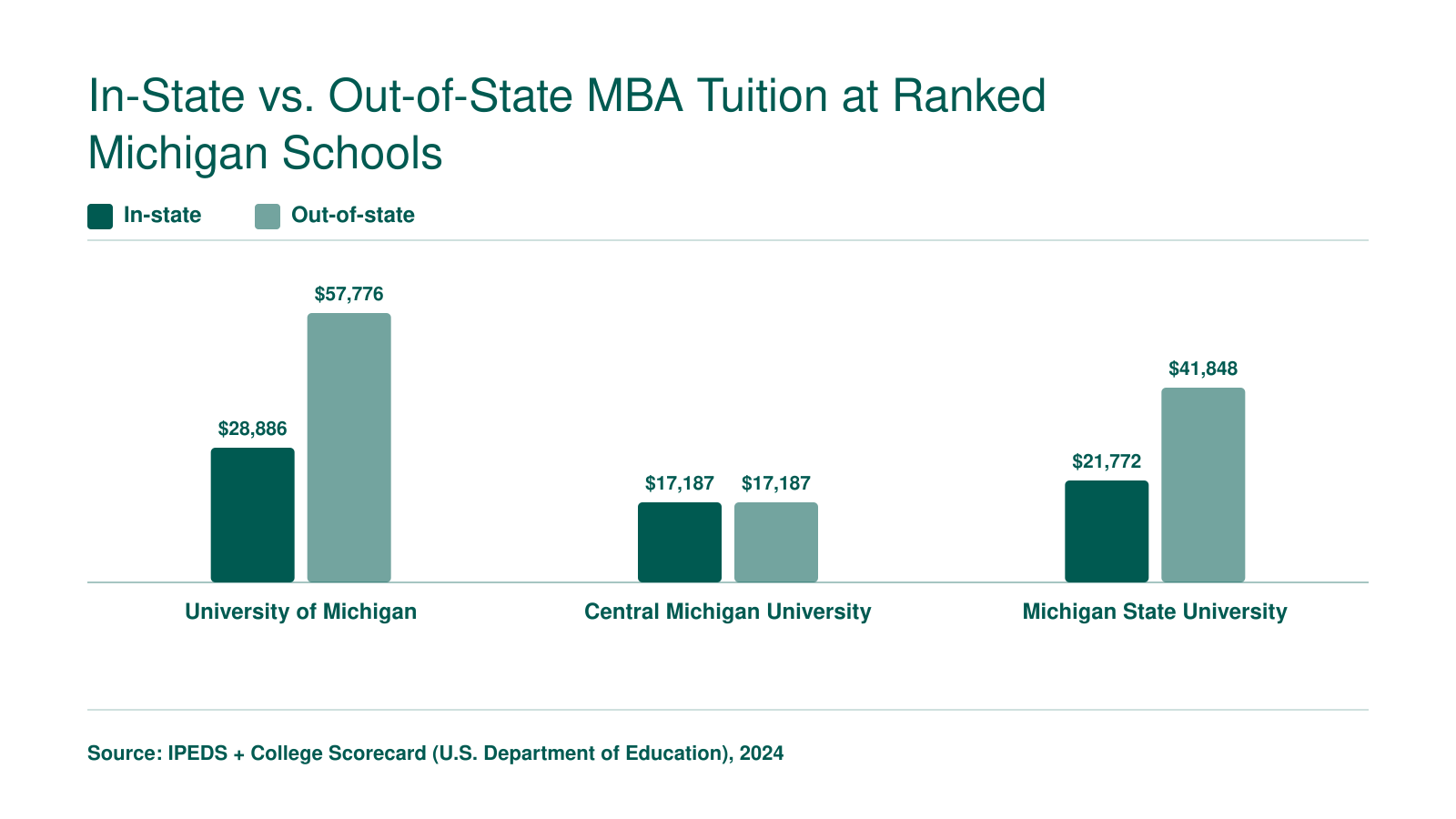
In-State vs. Out-of-State MBA Tuition at Ranked Michigan Schools
University of Michigan shows the widest residency gap, at $28,890 between its in-state and out-of-state rates. Central Michigan University is the lowest-cost option here and charges the same $17,187 to every student. Michigan State University falls between the two, with a $20,076 gap.
Cost and Michigan Employer Demand for MBA Graduates
Cost spreads these programs far wider than their reputations suggest. Michigan Ross lists Fall 2026 full-time tuition of $39,293 per semester in state and $41,793 out of state, or $78,586 and $83,946 for the 2026-27 academic year across a 57-credit degree. Its in-state cost of attendance, which adds housing, books and insurance, is $110,939. Ross Online MBA's most recent published estimate is about $120,000 in state for 57 credits (2025), a figure worth comparing across the Best Online MBA in Entrepreneurship Programs. MSU's Professional Online MBA charges $1,500 per credit, $63,000 for 42 credits, tuition only.1 Its Executive MBA Flex runs $89,000 over 19 months.2
The database tuition figures run lower: about $28,886 in state at Michigan, $17,187 at Central Michigan, and $21,772 in state at MSU. Treat them as baselines, and budget from each school's own page. Institution-wide average net price after aid is roughly $13,138, $17,597 and $19,680 respectively, but that is not an MBA-specific number.
Michigan Demand
MBA graduates find work in automotive and mobility, healthcare systems, manufacturing and tech startups. State labor data shows manufacturing employment gains in 2026, though it names no specific MBA employers.
Value Takeaway
A budget-conscious founder should look first at MSU's online MBA or Central Michigan's lower sticker price when comparing the Most Affordable MBA in Entrepreneurship Programs. Someone aiming at corporate innovation roles may find Ross's higher cost easier to justify.
A Michigan entrepreneurship MBA's value is access: startup incubators, venture funds, and in-state tuition that can keep launch costs low.
How We Rank Michigan Entrepreneurship MBA Programs
Entrepreneurship MBAs now vary so widely in cost and structure that a school's name alone says little about value. To keep comparisons fair, only Michigan programs offering an MBA with entrepreneurship coursework or a concentration were eligible, and campus and online formats are ranked together.
Each program was weighed on graduate tuition and fees, average net price, institution-wide graduation rate, and College Scorecard program-level earnings and debt where those figures are published.
Keep in mind that graduation rates and net price describe the whole institution, not the MBA alone, so treat them as approximate. Program details such as concentrations, No GMAT or GRE Required policies, and incubators were verified on official school pages.
Frequently Asked Questions About Michigan MBA in Entrepreneurship
Does University of Michigan Ross have an entrepreneurship MBA?
Which Michigan MBA programs offer a formal entrepreneurship concentration?
Can you start a business while completing an MBA in Michigan?
Compare Entrepreneurship programs on the data that matters
Explore more MBA specializations or browse every graduate field.
All MBA programs