Best Master of Laws (LLM) Programs in North Carolina
Compare 3 accredited Master of Laws programs in North Carolina, with graduate earnings, cost, debt, and completion data from IPEDS and the U.S. College Scorecard.

Only a handful of North Carolina law schools offer a Master of Laws, so the choice is narrow but not simple. Program tuition for 2026, 2027 ranges from roughly $16,000 to $83,400, the formats split between full campus study and a hybrid model that requires travel, and bar eligibility rules shifted in 2026.
The programs below are ranked on verifiable federal outcomes from IPEDS and College Scorecard, not reputation surveys. For most applicants, the real tension is weighing a bigger name against cost and what the degree actually licenses you to do in this state.
Key Points
- Duke, Wake Forest, and Campbell are the North Carolina schools in our outcomes data.
- Under rules effective January 1, 2026, an LLM alone doesn't qualify foreign-trained lawyers for the NC bar exam.
- Most LLM programs skip the GRE; English proficiency scores matter far more for international applicants.
Best Master of Laws (LLM) Schools in North Carolina: 2027 Rankings
Three North Carolina law schools offer a Master of Laws that appears in our federal outcomes data: two on campus and one hybrid. Graduation rates shown for each school are institution-wide, not specific to the LLM, and net price is an institution-wide average after aid. Program-level earnings or debt are mentioned only where the federal data publishes them.
Duke University
#1Durham, NC · ~$67,000/yr (est.)
Best for: Internationally trained lawyers wanting curriculum breadth
Duke Law's Master of Laws is built for international lawyers who want to specialize in U.S. law, with more than 200 courses in areas such as business, human rights, and criminal law. LLM students take classes alongside JD students and can cross-register at Fuqua, Nicholas, and Sanford. The 2026 cohort drew 79 students from 34 countries and territories, and Duke is the only North Carolina school here with published program-level earnings for its LLM graduates, at roughly $213,500 median one year out.
- On-campus, one-year program for international lawyers
- 200+ courses in business, human rights, criminal law, and more
- Four certificate options for focused research
- Cross-registration at Fuqua, Nicholas, and Sanford schools
- Classes taken jointly with JD students
- Preparation for bar exams in New York, California, and other states
- Alumni network of 12,500+ across 109 countries
- Program-level median earnings of about $213,500 one year after completion
Wake Forest University
#2Winston-Salem, NC · $35,000 – $40,000/yr (est.)
Best for: Applicants seeking mentorship and clinic experience
Wake Forest Law's Master of Laws serves foreign-trained lawyers and pairs coursework in American law with hands-on experience. Each student gets a faculty advisor and a JD mentor, and clinics and the Pro Bono Project put theory into practice. It is a one-year, full-time, fall-entry program with rolling admissions (applications open September 1 and close June 1). Program-level earnings and debt are not published for this program.
- On-campus, one-year, full-time program with fall entry only
- 24 credit hours including core American law and legal writing
- Specializations in business, criminal, intellectual property, or technology law
- Option to design a custom focus
- Thesis or seminar paper requirement
- Faculty advisor plus a JD mentor for each LLM student
- Clinics and Pro Bono Project alongside JD peers
- Rolling admissions, applications open September 1 and close June 1
Campbell University
#3Buies Creek, NC · ~$16,000/yr (est.)
Best for: Working attorneys and judges needing hybrid study
Campbell Law offers a hybrid Master of Laws in Legal Practice through its partnership with Nottingham Law School in the UK. Students combine online study with in-person sessions abroad, giving a comparative view of U.S. and UK legal systems. It is aimed at practicing attorneys and judges who want to advance without leaving their careers. Program-level earnings and debt are not published for this program.
- Hybrid format combining online learning with in-person sessions abroad
- Offered in partnership with Nottingham Law School
- Designed for practicing attorneys and judges
- Comparative focus on U.S. and UK legal systems
- Covers legal practice skills and international law
Cost & outcomes by school
Federal data for the highest-earning Master of Laws programs, independent of the ranking above. Earnings are this field's master's graduates four years after completing, where the Scorecard reports them.
| School | Earnings | Tuition / yr | Debt | Grads/yr | Format |
|---|---|---|---|---|---|
| Campbell University NC | — | $16,347 | — | — | Hybrid |
| Wake Forest University NC | — | $39,141 | — | 48 | Campus |
| Duke University NC | — | $66,523 | — | 21 | Campus |
Sources: U.S. Department of Education. Tuition and graduates: IPEDS. Earnings and debt: College Scorecard, this field's master's graduates; a dash means no figure is reported.
Online and Hybrid Master of Laws Options in North Carolina
"Online" and "hybrid" mean different things in legal education: a hybrid Master of Laws (LLM) mixes distance coursework with required travel or residency, while a fully online degree never puts you in a classroom. That distinction matters in North Carolina, because the delivery formats here are limited.
Duke's LLM and Wake Forest's LLM are both campus-based programs, designed around classes taken alongside JD students in Durham and Winston-Salem. Campbell's LL.M. in Legal Practice, run in partnership with Nottingham Law School and aimed at judges and practicing attorneys, is the hybrid option: it combines online learning with a travel component. No fully online LLM is offered by the schools ranked here.
That is less of a gap than it first appears. Two practical constraints push foreign-trained lawyers toward residential study anyway. Bar admission rules in most states, including requirements North Carolina applicants should verify directly with the state bar, typically expect in-person credit hours at an ABA-approved school. And F-1 student visas limit how much coursework can be completed online, so international students generally cannot satisfy status through a distance program.
GRE Waivers, Deadlines, and Admissions Requirements at Ranked NC Master of Laws Schools
For LLM admissions, the question is rarely "GRE or GMAT" and almost always "which English proficiency test and what score." Most master of laws programs are graduate programs that don't require GRE or GMAT, and the ranked North Carolina schools follow that pattern. If you are a foreign-trained lawyer, the TOEFL or IELTS is the number that actually gates your application.
Wake Forest University School of Law
- Admissions test policy: No GRE, GMAT, or LSAT policy is published on the official LLM admissions process page.
- Deadline: June 1, 2027, for the Fall 2027 (August start) intake.
- English proficiency: TOEFL internet-based minimum of 90, or IELTS 7.0.
- Degree prerequisite: None is stated on the cited admissions-process page.
Duke University School of Law
- Admissions test policy: No GRE, GMAT, or LSAT policy is published in the official LLM admissions FAQ.
- Deadline: January 15; applications may still be considered afterward if space remains.
- English proficiency: Admitted graduate students typically present IELTS 7.0, with pre-2026 TOEFL iBT scores of at least 100.
- Degree prerequisite: None is stated in the cited FAQ.
When a school publishes no test policy, confirm current requirements directly before applying.
Related Articles
Master of Laws Tuition and Net Price in North Carolina
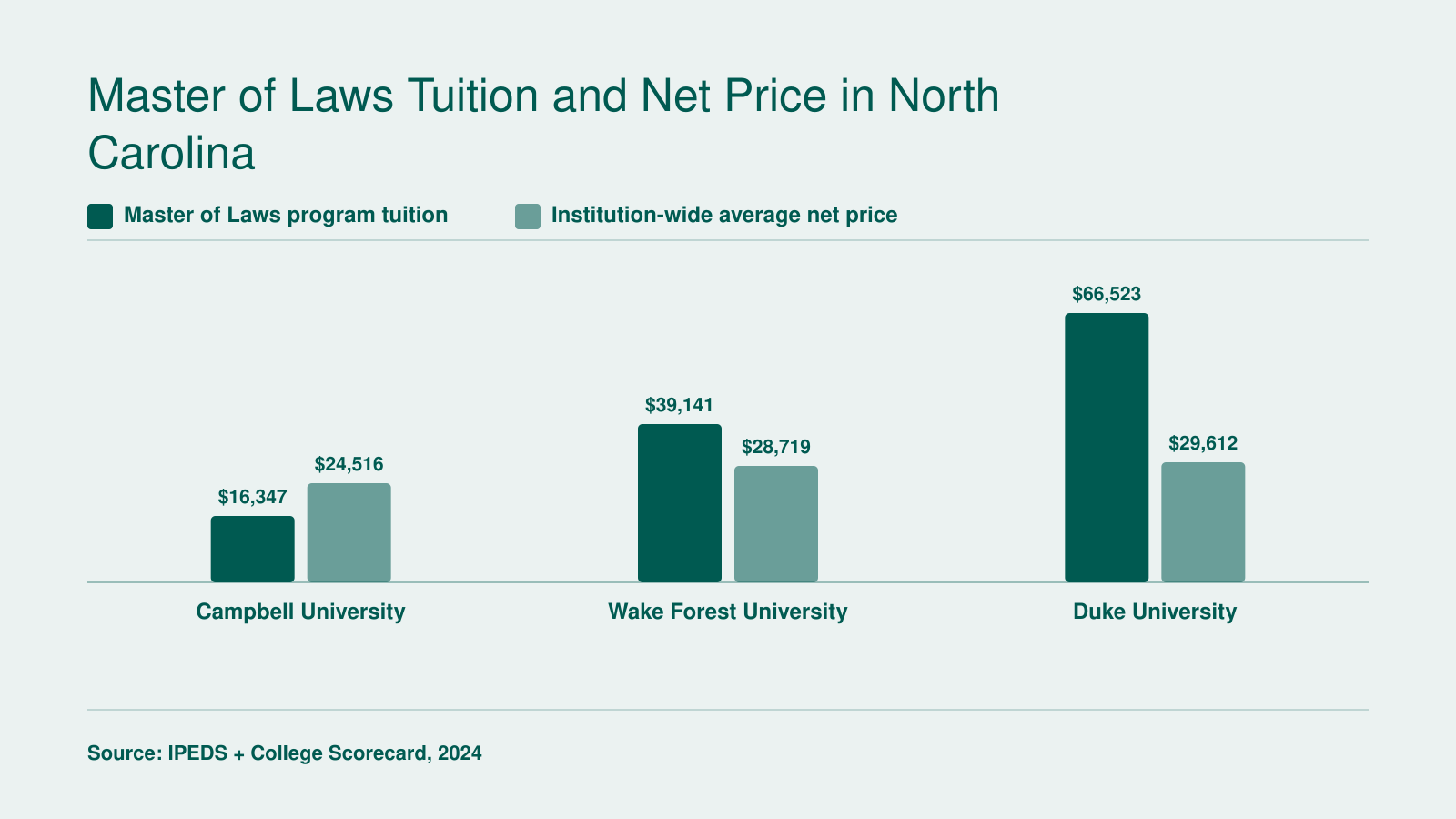
The chart orders the schools here from lowest to highest cost. Program tuition is the figure reported for each school's Master of Laws, and it is the same for in-state and out-of-state students. Net price is an institution-wide average after grant aid, not an LLM-specific number, so treat it as approximate. Published LLM total cost of attendance, named LLM scholarships, and LLM-specific debt or earnings are not available for these schools in our data, so confirm them with each law school's financial aid office.
Can an LLM Make You Eligible for the North Carolina Bar?
Choosing the Right Master of Laws Program: U.S.-Trained vs. Foreign-Trained Lawyers and Specializations
A master of laws is a one-year, post-law-degree program, and the right one depends mostly on where you trained. A general LLM gives you broad coursework in U.S. law with room to build your own schedule. A specialized track fixes much of that schedule around one field, such as tax, intellectual property, or international business law.
If you trained outside the U.S.
Prioritize three things: foundational courses in American law, coursework that supports bar preparation, and visa guidance. Ask each school whether it runs an orientation for LLM students, offers legal writing support, and provides immigration advising for F-1 students. Also ask whether career services staff work specifically with LLM students.
If you hold a U.S. JD
Your priority is a specialty track that matches your practice area. A general degree adds little to a JD. A focused track, taught by faculty in that field, is where the extra year pays off.
Checking Duke, Wake Forest, and Campbell
Track menus and support services at Duke, Wake Forest, and Campbell change from year to year, and we could not verify current specifics for all three. Confirm each school's concentrations, orientation, writing support, and career services on its admissions page, or ask an admissions officer directly, before you apply.
Frequently Asked Questions About Master of Laws Programs in North Carolina
Which North Carolina LLM programs are currently accepting applications?
Do LLM programs in North Carolina qualify international lawyers for bar admission?
What is the difference between a general LLM and specialized LLM programs like Judicial Studies?
Which LLM in North Carolina offers the best value for tuition and cost of living?
Compare Master of Laws programs on the data that matters
Explore more Criminal Justice & Law specializations or browse every graduate field.
All Criminal Justice & Law programs