Duke University MSN Family Nurse Practitioner: What This Guide Covers
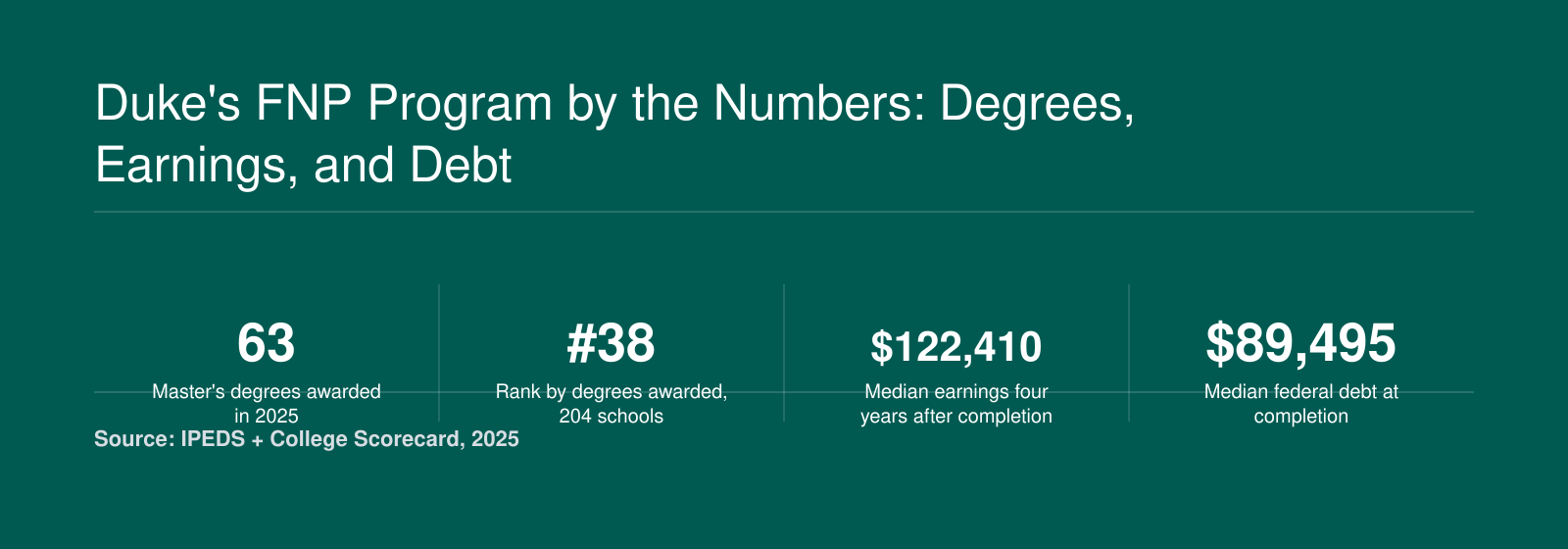
IPEDS counts 63 master's degrees awarded at Duke University under the family nurse practitioner classification in 2025, ranking the program #38 by volume among the 204 U.S. institutions that granted one. It is a mid-sized FNP track at a private nonprofit in Durham, North Carolina, where a year of full-time graduate study averages $66,523 in tuition and fees.
The question is not whether Duke is reputable but whether all-in cost, clinical placement by state, published outcomes, and capacity-based admissions add up to a defensible purchase. Format, cost, prerequisites, curriculum, placement, and comparisons each change the answer.
Certification is national; licensure is not. The clinical map decides where you can work.
Key Points
Duke's MSN FNP runs 49 credits across eight semesters with 784 clinical hours.
Duke charges $2,345 per MSN credit for 2026-27, before program fees.
Median federal debt for Duke's nursing master's graduates: $89,495, versus $42,717 nationally.
The program
Family Nurse Practitioner MSNCampus
Duke University's School of Nursing lists a Family Nurse Practitioner track, coded R-FNP-MSN, at the master's level. The degree designation is MSN, Master of Science in Nursing. The School of Nursing Bulletin for 2026-2027 carries it as a primary program of the school. Admission requirements, credit counts, tuition and delivery format do not appear on this bulletin entry.
How Duke University compares in Family Nurse Practitioner (FNP)
366 schools in our directory offer a master's in Family Nurse Practitioner (FNP), 321 of them with an online or hybrid option.
Duke University
National median (441 schools)
Median earnings, 4 years after the degree
$122,410
$120,338
Median federal debt
$89,495
$42,717
Source: U.S. Department of Education, College Scorecard field-of-study data for master's graduates. Figures cover the whole field family at each school, not one program alone.
Is Duke's FNP Program Online? Format, Length, Credits, and Clinical Hours
Most of Duke's MSN Family Nurse Practitioner coursework is delivered remotely, but you cannot finish the program without travel: three required on-campus intensives bring students to Duke's Durham campus in 2026, and virtual synchronous sessions fill out the online portion. The remote work covers didactic seminars and some live online class meetings; the campus visits are course-focused intensives, not a full semester in residence.
Credits and pace
Duke's 2026 curriculum lists 49 credit hours for the FNP major and an eight-semester sequence for both fall and spring entry, roughly three years. That 49-credit figure is the FNP-specific number; the Duke School of Nursing MSN Bulletin gives a 42-to-49 credit range across majors, so use the higher figure when you plan time and tuition. The 2026 curriculum does not lay out a separate part-time timeline, so ask admissions whether a reduced load is available and how many additional terms it would add.
Clinical hours
The program requires 784 supervised direct-patient-care hours, counted at 56 hours per credit in the 2026 curriculum. Duke attaches those hours to clinical courses across the sequence, so the practical question is which terms carry the heaviest patient-care load. Ask for the term-by-term hour map before you commit, because the split affects when you can work and travel. Duke's placement network includes more than 2,000 partner facilities and practices, which is why clinicals can often be arranged near home rather than all in Durham.
A residential university, not an online mill
Scale matters here. Of Duke's 11,734 graduate students in 2024, 1,334, or 11%, were enrolled exclusively online, and 1,768, or 15%, took some online courses, according to IPEDS / U.S. Department of Education College Scorecard. The other 74% took no online courses. Duke is a residential-first university with a distance-based FNP track, not an online-degree mill.
Verify before you apply
Two checks before applying: confirm the MSN-FNP's CCNE accreditation status directly with Duke and the accreditor, and confirm that the program qualifies graduates for both the ANCC FNP-BC and AANP FNP-C exams. Those are the credentials employers and state boards will look for.
What Duke's MSN-FNP Really Costs: Tuition, Fees, and the Line Items Brochures Skip
Duke University School of Nursing lists its Family Nurse Practitioner (FNP) MSN tuition at $2,345 per credit for 2026-271, plus a $200 per-semester FNP charge with waiver requirements. The costs that move a budget are the ones tied to a distance program that still requires time in Durham.
Line item
Amount
Timing
Tuition
$2,345 per credit (2026-27)
Per credit; total tuition = credits × $2,345
Semester estimate
$16,415 per semester (2026-27)
Per semester
Mandatory fees
$200 per semester FNP charge (2026-27); other university fees vary
Per semester; waiver requirements apply
Intensive travel and lodging
Budget separately
Per intensive
Equipment and compliance
Budget separately
One-time and as incurred: scrubs, stethoscope, background check, drug screen, immunizations, malpractice
Clinical or practicum fee
Confirm with Duke
Per clinical course
All-in total
Build from these rows
Credits × $2,345 + $200 per semester + variable costs
How the Billing Works
Tuition is not a flat program price. Total tuition equals the credit count in your plan multiplied by $2,345, so ask admissions for that credit total before comparing Duke with the most affordable family nurse practitioner MSN programs. The $16,415 semester estimate is a planning figure for MSN study, not a promise that every term costs the same. The $200 FNP charge recurs each semester unless a waiver applies.
The Lines Applicants Underestimate
Most coursework is online, but the program includes course-focused on-campus intensives. Each trip carries airfare, lodging, meals, and time away from work. Clinical compliance adds scrubs, a stethoscope, a background check, a drug screen, immunizations, and malpractice coverage. Duke does not publish a single all-in figure, so the formula in the table is the honest total to build.
For school-wide context only, IPEDS / U.S. Department of Education College Scorecard reports that full-time graduate study at Duke cost $66,523 in tuition and fees on average in 2024. That average covers graduate programs across the university, not the FNP, and individual programs set their own rates.
Getting in: Prerequisites, Deadlines, and What Duke's Selectivity Actually Means
Duke fills its family nurse practitioner seats by capacity rather than a published cut score, so this checklist is the part of the process you can actually control.
Degree and RN license
You need a BSN from a CCNE- or ACEN-accredited program, or an ADN paired with a bachelor's in any field. An active, unencumbered RN license in the state where you plan to practice is required.
Undergraduate GPA
A 3.0 earns preferential consideration. Duke reviews holistically and publishes no hard disqualifying minimum, so a lower GPA is a weakness to explain, not an automatic rejection.
Prerequisite coursework
One general or introductory statistics course, 3 credits, grade of C or better; AP Statistics with a score of 3 or higher satisfies it. No additional FNP-specific prerequisites are published.
Application materials
Apply through Duke's OneLink portal with a $50 non-refundable fee, unofficial transcripts, a statement of purpose, and a résumé. At least one recommendation must come from an MD, DO, PA, or NP in your intended practice area, and uploads must be PDF files of 1.5 MB or less. Applicants without U.S. permanent residency or prior U.S. coursework submit TOEFL (100) or IELTS (7.0).
Deadlines and entry terms
Fall and spring starts, each running eight semesters. Review is rolling: files are read as they are completed and offers continue until seats fill, so earlier is better. Duke publishes no fixed 2026 FNP deadline.
What selectivity actually means here
Duke publishes no FNP acceptance rate and no cohort size, so any percentage you see quoted is an estimate. It also sets no FNP-specific years-of-experience benchmark; the one-year nursing requirement belongs to the acute care MSN track.
Inside the Curriculum: Three Course Buckets and the Optional Specialty Tracks
Forty-nine credits across 8 semesters, with all 784 supervised clinical hours folded into four named practicum courses: that is Duke's MSN Family Nurse Practitioner curriculum as published for 2026.
Three Buckets, One Credit Total
The required sequence divides cleanly, and the parts add up to the 49-credit minimum:
MSN core: 12 credits of graduate nursing coursework.
Advanced-practice foundations: 11 credits carrying the advanced pathophysiology, pharmacology, and health assessment content that underpins FNP practice.
FNP specialty and clinical sequence: 26 credits, including every practicum course below.
Where the 784 Clinical Hours Sit
Clinical time is not a separate summer block. It is distributed across four courses inside the specialty sequence:
N622: 3 credits, 168 hours
N626: 4 credits, 224 hours
N629: 2 credits, 112 hours
N695A: 5 credits, 280 hours
Those four add to exactly 784 hours, which is the total Duke lists for the degree.
The Specialty Tracks Are Certificates, Not Concentrations
Cardiology, endocrinology, oncology, and orthopedics are frequently described as FNP "specialty tracks." Duke's own materials label each one a clinical nursing certificate, listed at 8 credits in the curriculum. They sit alongside the FNP MSN rather than inside it: not required, not part of the 49-credit minimum, and not a concentration designation on the FNP degree itself. Published sources do not establish added clinical hours or a separate tuition rate for any of the four, so treat quoted add-on prices as unverified.
The label matters. A concentration appears on your transcript and signals a clinical focus to employers; a certificate is a separate credential. If you plan to stack one, ask Duke whether those credits apply toward the MSN.
One Entry Path, Fixed Length
The 49-credit program is the BSN-to-MSN route, with Fall and Spring entry across 8 semesters. The certificate tracks serve nurses who already hold a graduate nursing credential; they neither shorten nor extend the FNP MSN, and your specialty interest does not change the 8-semester plan. Duke awarded 63 master's degrees in this field in 2025, per IPEDS completions data.
The U.S. Bureau of Labor Statistics projects nurse practitioner employment will grow 41% between 2025 and 2035, a pace that dwarfs the average across occupations. For anyone weighing a clinical master's, that forecast is the strongest argument that the degree's cost is recoverable.
Clinical Placement: Which States Duke Places Students in and Who Finds the Preceptor
Most FNP program pages say clinicals are arranged for you and stop there. Duke's version is more specific, and the specifics are where plans break.
The State List, Including the Exclusions
For 2026, Duke's MSN clinical authorization covers 48 states plus Washington, D.C., and U.S. territories. Two gaps matter: New York is pending, and Louisiana is not authorized. Washington gets a separate line of its own, since Duke holds approval for Washington residents completing practice experiences in the FNP track. If you live or work in a state that is not covered, resolve that before you deposit.
Even inside the authorized footprint, geography is not guaranteed. Duke tells students they may need a site outside their home state, or travel up to 120 miles within their state or into another one. In rare cases, a student relocates to North Carolina for rotations.
Who Finds the Preceptor
Duke coordinates placement through a network of more than 2,000 partner facilities, and coordinators match students with nurse preceptors at affiliated sites. A precepted placement cannot be confirmed until a School of Nursing affiliation agreement exists, so an eager preceptor at an unaffiliated clinic is not yet a yes.
Preceptors need a current license in the state where the rotation happens and appropriate education and experience; physician preceptors, for instance, must be board certified in their specialty. Duke also requires the preceptor's practice to carry a certificate of insurance before assignment. Students complete background checks, drug screening, and immunizations, and nothing begins until the clinical placement office approves it.
Deadlines and What You Pay For
Clinical paperwork goes to the placement office by the dates it requests; no universal calendar deadline is published. Delaware, Oregon, and Rhode Island require rotation details at least 45 days before the semester starts, and a slow response can cost you a site another student in your area takes first. Travel and housing during rotations are yours to arrange and fund.
If a Preceptor Falls Through
Contact the placement office if the experience cannot begin within one to two weeks of the approved start date. Coordinators then work with you and faculty to secure a replacement preceptor or site. The approved placement itself is final.
Duke's FNP Program by the Numbers: Degrees, Earnings, and Debt
Duke's family nurse practitioner program is mid-sized by national standards but expensive to complete, and its graduates earn only modestly above the national midpoint for the field. These figures come from IPEDS and the U.S. Department of Education College Scorecard, and they frame every cost and value question that follows.
Certification Pass Rates, On-Time Completion, and Attrition: The Numbers Duke Discloses
Certification pass rates have become a marketing battleground in nurse practitioner education, and the figures schools publish are rarely comparable from one program to the next. Duke's MSN Family Nurse Practitioner program names ANCC's FNP-BC and AANP's FNP-C as the certifications its graduates sit for, yet the sources reviewed here contain no consolidated Duke-reported first-time pass rate, on-time completion rate, or attrition rate.1 Treat that as a research assignment rather than a verdict, and go collect the numbers directly.
What each source can actually answer
Duke School of Nursing program and bulletin pages: your starting point for curriculum, the under-three-year advertised duration, and the five-calendar-year ceiling for finishing MSN requirements. They explain structure; they typically do not post cohort outcome tables.
CCNE accreditation records: the accreditor requires programs to disclose student achievement data covering certification pass rates, completion, and attrition. Ask the school for its current CCNE-required disclosure.
ANCC and AANP: these boards control exam eligibility and publish national pass statistics, but neither publishes school-level rates. Use them to confirm which exam fits your state and employer, not to rank Duke.
BLS.gov: occupational context for nurse practitioners, including wages and projected growth. Nothing program-specific.
Questions worth putting in writing
Ask admissions or the school's accreditation liaison for first-time ANCC FNP-BC and AANP FNP-C pass rates across the last three cohorts, with the denominator and the definition of "first-time" spelled out. Then request on-time completion and attrition by cohort, and ask which clock "on time" measures: the handbook allows five years, while the program advertises finishing in under three. Get it by email, and check the reporting year, because aggregated all-MSN figures and older rates circulate as though they were current.
What FNPs Earn: North Carolina and National Wage Benchmarks
Two yardsticks, one career: an occupation-level wage survey tells you what nurse practitioners across a state or metro earn, while a program-level earnings figure tells you what graduates of one school's nursing master's programs were earning four years out. Confusing the two is the most common mistake applicants make when a school advertises a salary number.
The Occupation-Level View
The Bureau of Labor Statistics publishes nurse practitioner wages under SOC 29-1171 in its Occupational Employment and Wage Statistics release, and the May 2025 edition is the current reference. It reports a national median alongside 10th, 25th, 75th and 90th percentile annual wages, then breaks the same occupation out for North Carolina and for the Raleigh-Durham-Chapel Hill metro area. Read the percentile spread, not just the middle. The distance between the 10th and 90th percentile is where practice setting and state scope-of-practice rules show up most visibly: primary care clinics and specialty practices pay differently, and states granting full practice authority tend to lift the ceiling for FNPs who build their own panels.
The Program-Level View
Duke's own number comes from a different instrument. The U.S. Department of Education's College Scorecard reports median earnings of $122,410 four years after completion for master's graduates in the registered nursing, nursing administration, nursing research and clinical nursing field family at Duke, against a national median of $120,338 across 441 reporting schools. That covers the whole field family at the school, not the FNP track alone, and it reflects graduates several years into practice rather than a first-year salary.
Used together, the two numbers do different jobs. BLS tells you what the market pays an FNP in Durham or Charlotte; the federal earnings figure tells you whether Duke's graduates land above or below the national middle for their field. Because BLS revises its estimates, confirm which release year you are reading before comparing a state figure to a national one.
How Duke Compares With In-State and Online FNP Options
These three options use three different cost structures, so compare them on the price basis each one publishes rather than on the sticker number alone. Duke bills full-time graduate study by the year at private rates, and that premium is the price of a defined campus cohort, clinical placement infrastructure, and a large alumni network. Duke suits students who will use that support and can carry the private rate, UNC Chapel Hill suits North Carolina residents who want a public per-credit price and can plan around a variable credit load, and Chamberlain suits students who want one national online rate and a fixed credit plan.
Duke University MSN-FNP
UNC Chapel Hill MSN
Chamberlain University online MSN-FNP
Published tuition rate
$66,523 per year, average full-time graduate tuition and fees, school-wide figure (IPEDS / U.S. Department of Education College Scorecard, 2024)
$598 per credit hour for North Carolina residents (UNC Chapel Hill, 2026)
Billing unit
Academic year of full-time enrollment; individual programs set their own rates
Credit hour, with residency and program affecting the rate
Estimated total at the published rate
$66,523 for each full-time year, using the school-wide graduate average (2024)
About $19,734 to $28,106 across a 33 to 47 credit curriculum, before fees (calculated from the 2026 resident rate)
What the published figure includes
Tuition and fees only, reported as an institutional graduate average
Tuition only; fees vary by residency, classification, and courses (2026)
Duke FNP: Fast Answers to the Four Questions Applicants Ask First
Duke's family nurse practitioner track draws applicants from every state, and the same four questions come up first. Here are direct answers, with pointers to the fuller detail later in this guide.
Is Duke's FNP program fully online, or do I have to come to Durham?
It is distance-based, not fully online. Most didactic coursework happens online, with some synchronous sessions, but this is not one of the fully online MSN programs; you must travel to Durham for mandatory on-campus intensives that include face-to-face instruction, simulation, and hands-on practice. Duke announces intensive dates several months ahead so you can plan. Format and workload details are covered in the format section.
How long does Duke's MSN FNP take to complete?
Eight semesters, for either fall or spring entry, which Duke describes as under three years. For those comparing accelerated FNP programs, the FNP major requires 49 credit hours plus 784 supervised clinical hours, and part-time pacing is not the standard path. The semester-by-semester sequence is laid out in the curriculum section below.
What's the all-in price tag, including travel to intensives and equipment?
For 2026-2027, tuition is $2,345 per credit hour, or $114,905 across 49 credits, plus a one-time $1,500 clinical placement fee, for a published subtotal of $116,405. Airfare, lodging, meals, books, uniforms, and health or background requirements are not included in any Duke figure. The cost section itemizes each line.
Can I complete Duke's FNP clinical hours near my home state?
Duke says yes in practice: its placement team works to arrange clinical experiences close to home, drawing on more than 2,000 partner facilities and practices. That is assistance with convenient placement, not a guarantee for every home state, and state rules can affect site approval. Placement steps are explained in the clinical placement section below.