Accelerated Master's in Theology Programs
Compare 300+ accredited fastest Theology programs, with graduate earnings, cost, debt, and completion data from IPEDS and the U.S. College Scorecard.

Compressing a bachelor's and a theology master's into roughly five years instead of six changes the economics of seminary preparation, but only when shared graduate credits count. Future ministers, chaplains, teachers, and students aiming for doctoral study can start graduate work in their senior year and cut a full year of tuition and living costs.
The tension is accreditation. A shorter MA or MTS saves time, yet the credential holds value only if the program meets ATS and regional standards.
Key Points
- Clergy earned a median annual wage of $60,810 in May 2025.
- Graduate courses taken in senior year can reduce total degree cost.
- ATS and regional accreditation safeguard transfer, aid, and doctoral admission.
Accelerated Master's in Theology Programs
-
#1
College of Saint Benedict
Master of Theology
$23,283grad tuition / yr24 credits1 yearVisit program site →54score
How we rank. Each program is scored on graduate figures only: the field's master's earnings and debt, graduate tuition and the number of master's graduates, normalized across all programs in this field. Data comes from the U.S. Department of Education's IPEDS and College Scorecard; no school pays for placement.
Compare the top programs
| Rank | School | Earnings | Tuition / yr | Debt | Grads/yr | Format |
|---|---|---|---|---|---|---|
| 1 | College of Saint Benedict MN | — | $23,283 | — | — | Hybrid |
Sources: U.S. Department of Education. Tuition and graduates: IPEDS. Earnings and debt: College Scorecard, this field's master's graduates; a dash means no figure is reported.
Cost, debt & payoff
Median earnings of this field's master's graduates (4 yrs after completing) vs. their median federal loan debt · U.S. College Scorecard
Across these programs the median graduate earns about $60,861 and finishes with roughly $41,000 in debt — a ratio that clears a common rule of thumb (keep debt below first-year salary). Tuition and debt vary widely school to school, so sort the ranking by "Most affordable" or "Lowest debt" to weigh cost against outcomes.
What Is an Accelerated Master's in Theology, and How Does the 4+1 Model Work?
Accelerated theology pathways are not one standard product, and the fine print differs sharply from school to school. In the basic 4+1 model, undergraduates take graduate theology courses in their senior year, and those credits count toward both the bachelor's and the theology master's programs.
Shared-credit limits
- Loyola University Chicago: Shared credit is capped at 50% of the graduate hours, excluding undergraduate courses at the 300 level or below. Students apply after 90 credit hours and aim for five years total, against a customary six.
- Franciscan University of Steubenville: Students apply after 60 credits with a 3.0 QPA and may take up to three graduate courses, no more than two a semester. About 27 graduate credits remain after the bachelor's.1
- University of Dallas: Students apply in their final semester and may transfer up to 12 graduate hours with a B or better. Double-counting 6 hours requires a 3.66 GPA after 90 undergraduate credits. Time saved is 6 to 12 months.2
Is five years realistic?
Yes, for students who meet eligibility by junior year. Loyola and Franciscan both build the plan around five years.
The catch
Eligibility is conditional. If your GPA slips below a school's minimum, or you leave the major, the shared credits may no longer count toward both degrees. In practice you would likely finish the master's on the standard timeline, so confirm the policy before relying on the savings.
MA vs. MTS vs. Mdiv: Which Degrees Can You Accelerate?
Three graduate degrees dominate theology study: the Master of Arts (MA) in Theology, the Master of Theological Studies (MTS), and the Master of Divinity (MDiv). They differ mainly in credit load, purpose, and how easily they fit into an accelerated bachelor's-to-master's path, including Online Master's in Theology options.
Credit Load and Purpose
- MA in Theology: ATS sets a 36-credit floor, though some programs require more.1 It may be academic or professional, so it suits both scholars and practitioners.
- MTS: Often around 48 credits2, it provides broad theological foundations for further study or specialized ministry.
- MDiv: Requires at least 72 credits and frequently 90 or more.1 Its purpose is religious leadership, and it is the standard degree for congregational ministry and ordination in many traditions.
Acceleration Reality
Accelerated 4+1 pathways are most common for the MA and MTS because their shorter credit counts leave room to overlap undergraduate and graduate coursework, a structure often found in Most Affordable Master's in Theology programs. The MDiv is rarely offered as a true 4+1 because its depth and credit load do not fit neatly into a combined program. Some schools award advanced standing to reduce MDiv credits, but that is an institutional policy, not a universal accelerated route.
What Accelerated Theology Master's Programs Cost
Accelerated theology master's programs can lower total cost when graduate-level credits are taken during the senior year of a bachelor's degree. The table below shows published per-credit graduate tuition and, where available, how each program handles shared credits and delivery format. Figures reflect 2025-26 or 2026-27 published rates; the Canadian program in the table reports tuition per 0.5 course rather than per credit.
| School | Accelerated Pathway | Shared Graduate Credits | Graduate Tuition per Credit | Format |
|---|---|---|---|---|
| Loyola University Chicago | Students take four MA-level courses during the senior year; up to 50% of graduate-level credits may count toward both undergraduate and graduate degrees. | Up to 15 credit hours may be shared between the bachelor's and master's programs. | $1,270 USD per credit hour | Not stated in source |
| Biola University | Not stated in source | Not stated in source | $745 USD per credit | Not stated in source |
| Princeton Theological Seminary | Not stated in source | Not stated in source | $785 USD per credit | Hybrid |
| University of St. Thomas | Not stated in source | Not stated in source | $700 USD per credit | Not stated in source |
| Santa Clara University Jesuit School of Theology | Not stated in source | Not stated in source | $1,006 USD per unit | Not stated in source |
| Martin Luther University College at Wilfrid Laurier University | Not stated in source | Not stated in source | $666 CAD per 0.5 course | Part-time |
Related Articles
Accreditation: ATS, Regional Bodies, and Why Both Matter
The practical tradeoff is time saved versus a credential that later qualifies you for the positions you want. An accelerated theology MA can cut time to graduation, but accreditation determines whether that shorter route holds up for transfer, doctoral admission, federal aid, and denominational ordination.
Two separate stamps
Regional bodies such as HLC, MSCHE, and SACSCOC evaluate the whole institution, covering operations and every program.1 The Association of Theological Schools (ATS) Commission on Accrediting is a specialized accreditor for theological education, approving postbaccalaureate theology and ministry programs. Neither replaces the other: regional accreditation does not substitute for ATS in graduate theology, and ATS does not stand in for institution-wide accreditation.1
Check status fast
Use the ATS member directory and the U.S. Department of Education's Database of Accredited Postsecondary Institutions and Programs (DAPIP). In about two minutes you can confirm both the school's regional status and whether the theology program holds ATS approval.1
Ordination rules still vary
Many mainline Protestant bodies expect an ATS-accredited MDiv, not simply an MA, and some require additional polity coursework or candidacy.2 Military chaplaincy commonly calls for an ATS-accredited MDiv as well.1 An accelerated MA may serve academic or ministry roles, but it may not satisfy ordination requirements for certain denominations.
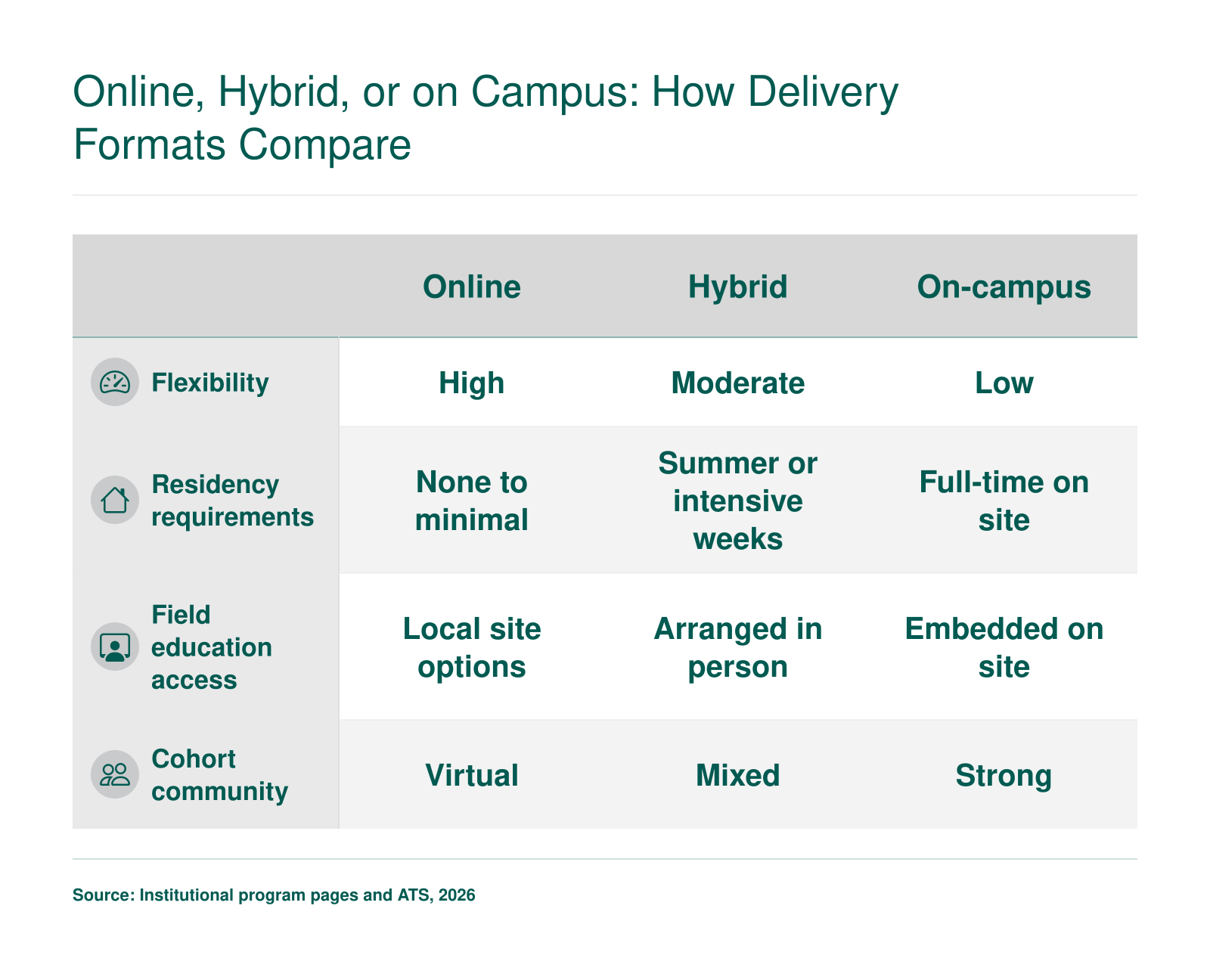
Online, Hybrid, or on Campus: How Delivery Formats Compare
Accelerated theology master's programs vary by delivery, and the right format depends on how you balance schedule flexibility with in-person formation and supervised ministry. ATS standards now permit fully online degrees, though some MDiv and formation-heavy pathways still require campus residencies.
Admission Requirements for Accelerated Theology Pathways
Strong accelerated theology applications are built around verifiable thresholds: GPA, credit standing, and prerequisite coursework, plus supporting materials.
- GPA thresholdsConcordia and Villanova set a 3.0 cumulative GPA; Loyola Marymount requires a 3.0 overall undergraduate GPA and a 3.0 in the master's program. Loyola Chicago does not publish a minimum cumulative GPA.
- Class standing and completed creditsLoyola Chicago expects junior standing, 60 credit hours completed, and 15 Loyola credits at B or above; Concordia requires 45 credits before applying and 60 before beginning.
- Prerequisite courses and majorsLoyola Chicago is limited to theology majors and lists Theo 100, Theo 185, Old Testament, New Testament, and Theo 317/318; Villanova requires a BA in Theology and Religious Studies.
- Other application materials and deadlinesA faculty recommendation and statement of purpose are commonly part of the file. Deadlines include Loyola Chicago's March 1 and Loyola Marymount's November 1 for Spring 2027.
- Program-specific eligibilitySamford's accelerated BA-to-MDiv is open to selected undergraduates in Biblical Studies, Christian and Religious Studies, Christian Ministry, or Human Development and Family Science, and does not require a prior theological background.
Financial Aid and Scholarships for Theology Graduate Students
A congregational fellowship from the Forum for Theological Exploration can pair a church contribution of $2,000 to $5,000 with a matching award; applicants generally need a 3.0 GPA, pastoral intent, and a congregation nomination.
Before borrowing, check your 4+1 billing. Some programs charge graduate credits taken during senior year at the undergraduate rate, and existing undergraduate aid may cover those credits if funds remain.1 Confirm the exact treatment in writing with the aid office.
Denominational and church aid is often the most direct route. Iliff School of Theology scholarships list a $2,500 United Methodist Scholarship, and Assemblies of God Theological Seminary scholarships advertise a full-tuition award for qualifying students. Diocesan sponsorships and local church grants may also stack with institutional aid.
Once you are classified as a graduate student for federal aid, Pell Grant eligibility ends. Graduate students may borrow Direct Unsubsidized Loans and Grad PLUS Loans, but use them after scholarships and assistantships.
What Clergy Earn Nationally
Clergy earned a median annual wage of $60,810 in May 2025, according to the most recent federal estimate.
Theology programs by state
Common Questions About Accelerated Theology Master's Programs
Can you complete a bachelor's and master's in theology in five years?
Does an accelerated MA in theology qualify you for ordination?
What happens to shared graduate credits if you leave the accelerated pathway?
Can an accelerated theology MA lead to a PhD?
Compare Theology programs on the data that matters
Explore more Religion & Theology specializations or browse every graduate field.
All Religion & Theology programs