Best Online Master of Divinity (MDiv) Programs
Compare 180+ accredited online Divinity programs, with graduate earnings, cost, debt, and completion data from IPEDS and the U.S. College Scorecard.

A residential Master of Divinity usually means moving to a seminary town for three years. An online MDiv lets you keep your job, congregation, and address. Yet many programs sold as online still require week-long campus intensives that working pastors and chaplaincy candidates struggle to schedule.
Every program ranked here can be completed entirely online, and hybrid formats were excluded. Accreditation, ordination fit, residency rules, net price, earnings, and admissions each get a close look.
The degree is long: the MDivs here typically require 72 to 82 credit hours. Clergy earn a median $60,810, per the Bureau of Labor Statistics, so any debt taken on for that credit load has to fit that salary.
Key Points
- Every ranked 2027 MDiv program below is fully online.
- Clergy earn a median annual wage of $60,810 nationally.
- About 25 percent of U.S. congregations had part-time clergy in 2020.
The 10 Best Fully Online Master of Divinity Programs for 2027
These 10 fully online Master of Divinity programs stand out for combining doctrinal depth with practical ministry preparation. The list below includes only programs that can be completed entirely online, so hybrid residencies and required on-campus intensives are not part of this ranking. Each school is ordered by a blended view of quality and outcomes across federal data and program-level details, not by any single metric.
Grace School of Theology
#1The Woodlands, TX · $5,000 – $10,000/yr (est.)
Best for: Called to pastoral or parachurch ministry
Grace School of Theology offers a 95-credit fully online Master of Divinity built around deep exegetical study in Hebrew and Greek, systematic theology rooted in grace theology, and practical ministry skills such as preaching and evangelism. The interdisciplinary concentration lets students customize eight credit hours across areas like biblical counseling, church planting, or pastoral ministry, and two field practicums add hands-on ministry experience. Graduates are prepared for church leadership, teaching, parachurch work, or doctoral study.
- 5 concentration options
- 95 total credit hours
- 2.0 GPA minimum
- Deep exegetical study with Hebrew and Greek
- Strong systematic theology rooted in grace theology
- Combines theology with practical ministry skills
- Designed for church, teaching, or parachurch service
- Prepares for Doctor of Ministry study
Holy Apostles College and Seminary
#2Cromwell, CT · ~$8,000/yr (est.)
Best for: Catholics serving in parish ministry
Holy Apostles College and Seminary offers a fully online Master of Divinity in the New Evangelization for Catholics preparing for parish ministry, Catholic schools, and lay leadership. The program is accredited by the Association of Theological Schools and recommended by the Newman Guide, with small classes and personalized faculty attention. Tuition is $438 per credit hour, and monthly payment plans are available.
- Association of Theological Schools accredited
- $438 per credit
- 100% online graduate programs
- Same tuition online or campus
- Newman Guide recommended college
- Personalized attention from faculty
- Transfer credits accepted
- Monthly payment plans available
Martin Luther College
#3New Ulm, MN · ~$6,000/yr (est.)
Best for: Ministry-certified educators pursuing biblical depth
Martin Luther College offers a fully online Master of Arts in Theological Studies rather than a traditional MDiv, designed for ministry-certified teachers and staff ministers who want deeper biblical and doctrinal study. The program welcomes other college graduates with sufficient theology coursework and emphasizes Christocentric interpretation, ethical reflection, counseling, and personal philosophy of ministry. It does not qualify for a called ministry role but prepares students for teaching, evangelism, and congregational leadership.
- 3.0 GPA minimum
- Prerequisite courses required
- 100% online degree program
- Designed for ministry-certified staff ministers and teachers
- Interpret biblical text Christocentrically
- Construct a personal philosophy of ministry
- Open to other college graduates
- Requires 18 undergraduate theology credits
Fordham University
#4Bronx, NY · ~$27,000/yr (est.)
Fordham University's fully online Master of Arts in Christian Spirituality offers a spiritual direction concentration grounded in Catholic and Jesuit traditions. The 36-credit program includes full-time and part-time options, a thesis or capstone, and access to the New York Theological Consortium alongside an international learning community. Scholarships and tuition waivers help make the program accessible for those pursuing spiritual direction, retreat facilitation, chaplaincy, or faith formation leadership.
- 3 concentration options
- 36 total credit hours
- 12 total courses
- Full-time and part-time options
- Thesis or capstone option
- Pathway to accredited spiritual director
- Only offered online
- Study at New York Theological Consortium
Franciscan University of Steubenville
#5Steubenville, OH · ~$11,000/yr (est.)
Franciscan University of Steubenville offers a Master of Arts in Theology and Christian Ministry for lay, priestly, or religious vocations, with online, on-campus, and hybrid delivery options. The 36-credit program costs $620 per credit hour and includes a catechetics specialization or a canon law track with Catholic University of America. Online learners receive exclusive Verbum access, and rolling admissions with three sessions per year make the program accessible.
- 2 concentration options
- $22,320 total program tuition
- $620 per credit
- 36 total credit hours
- Rolling admissions
- 3 start dates per year
- Exclusive Verbum access online
- Study abroad in Austria
Midwestern Baptist Theological Seminary
#6Kansas City, MO · ~$8,000/yr (est.)
Midwestern Baptist Theological Seminary offers a flagship Master of Divinity available fully online or on campus, with 16 concentrations including biblical counseling, church planting, missions, and worship ministries. The program includes Hebrew and Greek, hermeneutics, preaching, and pastoral ministry, plus hands-on practicums and internships. Students can study synchronously or asynchronously with new classes every 4 to 8 weeks, and qualifying options include free first-year tuition through For the Church Cohorts.
- 16 concentration options
- 81 total credit hours
- Synchronous and asynchronous options
- SBC church member tuition discount
- Fully online or on-campus delivery
- New classes start every 4 to 8 weeks
- Advanced standing cuts degree time one-third
- Free tuition for first year
International Baptist College and Seminary
#7Chandler, AZ · $5,000 – $10,000/yr (est.)
International Baptist College and Seminary offers a 96-credit Master of Divinity designed for men called to pastoral ministry, with training in Greek and Hebrew, hermeneutics, historical and systematic theology, and expository preaching. The program emphasizes a mentoring culture of ministers teaching ministers and integrates personal spiritual formation with practical ministry skills. Graduates are prepared for roles as pastors, missionaries, church planters, evangelists, and chaplains.
- 96 total credit hours
- Prerequisite courses required
- Capstone required
- Financial aid available
- Scholarships available
- Prepares for senior pastorate
- Biblical languages and theology courses
- Open only to male students
Baptist University of Florida
#8Graceville, FL · ~$6,000/yr (est.)
Baptist University of Florida offers a 90-credit fully online Master of Divinity that combines spiritual formation, biblical studies, and original-language exegesis in Hebrew and Greek. Coursework spans systematic theology, apologetics, church history, evangelism, missions, and pastoral leadership, with homiletics and pastoral care sharpening practical skills. The program has three entry terms a year and prepares graduates for pastoral ministry, missions, chaplaincy, or doctoral study.
- 90 total credit hours
- 3 start dates per year
- Starts fall, spring, or summer
- Fully online delivery
- Free tuition, housing, and textbooks on campus
- Prepares for ministry, missions, and doctoral study
- Pastorate and preaching emphasis
- Biblical languages instruction
Indiana Wesleyan University
#9Marion, IN · ~$11,000/yr (est.)
Indiana Wesleyan University's fully online Master of Divinity is built for local church ministry, weaving Bible, theology, and church history into every praxis course. The 75-credit program costs $551 per credit with a tuition lock, and students may choose specializations such as Pastoral Ministry, Leadership, Pastoral Care, Spiritual Formation, Biblical Studies, or Worship Arts. Optional one-week on-campus sessions and travel courses to Israel, Greece, and London add community and global perspective, while prior master's degree holders may finish in 48 credits.
- 7 concentration options
- $551 per credit
- Locked tuition rate
- 75 total credit hours
- 2.5 GPA minimum
- Military benefits accepted
- Employer reimbursement supported
- 48-credit path with prior master's
Bob Jones University
#10Greenville, SC · ~$11,000/yr (est.)
Bob Jones University Seminary offers a Master of Divinity with an Advanced Track for students who already hold a Bible or ministry-related bachelor's degree, reducing the standard 91 credits to 73. The fully online program covers biblical content, Hebrew and Greek exegesis, systematic theology, church history, expository preaching, and biblical counseling, with options for evening flex and livestream classes. At $350 per credit, it is an affordable choice, and financial aid is available for both men and women preparing for pastoral, chaplaincy, missionary, or translation roles.
- 5 concentration options
- $350 per credit
- As little as 24 to 36 months
- 73 total credit hours
- 2.0 GPA minimum
- Evening flex and livestream classes
- Solid foundation in biblical languages
- Open to women for ministry training
Cost & outcomes by school
Federal data for the highest-earning Divinity programs, independent of the ranking above. Earnings are this field's master's graduates four years after completing, where the Scorecard reports them.
| School | Earnings | Tuition / yr | Debt | Grads/yr | Format |
|---|---|---|---|---|---|
| The King's University TX | $100,714 | $10,530 | $41,000 | 52 | Hybrid |
| Lenoir-Rhyne University NC | $95,302 | $13,020 | — | 12 | Hybrid |
| Church Divinity School of the Pacific CA | $94,644 | $17,660 | — | 22 | Hybrid |
| Luther Seminary MN | $81,169 | $18,760 | $41,000 | 80 | Hybrid |
| Faith International University WA | $73,387 | $7,350 | — | 24 | Online |
| Indiana Wesleyan University IN | $69,914 | $10,620 | $42,191 | — | Online |
| Moody Bible Institute IL | $69,835 | $9,702 | $25,442 | 92 | Online |
| Dallas Theological Seminary TX | $69,603 | $20,412 | $26,509 | 256 | Hybrid |
| Midwestern Baptist Theological Seminary MO | $68,891 | $8,477 | $27,450 | 385 | Online |
| Liberty University VA | $56,700 | $8,730 | $34,166 | 1,194 | Hybrid |
| Bridges Christian College LA | — | $1,500 | — | — | Online |
| East Texas Baptist University TX | — | $7,980 | — | — | Online |
Sources: U.S. Department of Education. Tuition and graduates: IPEDS. Earnings and debt: College Scorecard, this field's master's graduates; a dash means no figure is reported.
Cost, debt & payoff
Median earnings of this field's master's graduates (4 yrs after completing) vs. their median federal loan debt · U.S. College Scorecard
Across these programs the median graduate earns about $60,267 and finishes with roughly $41,000 in debt — a ratio that clears a common rule of thumb (keep debt below first-year salary). Tuition and debt vary widely school to school, so check the per-school figures in the table above before you shortlist.
How We Ranked Fully Online Mdiv Programs
Fully online delivery has moved from a niche accommodation to a mainstream option at many seminaries, yet the word "online" still covers very different formats. Our ranking of the best online MDiv programs starts with that filter. Only programs delivered fully online were eligible, and hybrid programs that require campus intensives were excluded.
What Went Into the Ranking
Four inputs were combined into a composite, each chosen because it bears on cost and outcomes:
- Published tuition: the advertised graduate price for the degree.
- Average net price: what students typically pay after grant aid is applied.
- Graduation rate: the share of students who finish at the institution.
- Earnings and debt: College Scorecard program-level figures, where they are published.
Limits Worth Knowing
Graduation rates and net price are institution-wide. They describe the whole school, including undergraduates and on-campus students, not the online MDiv cohort alone. Some small MDiv programs also have no published Scorecard earnings, so for those schools we relied on the cost and completion figures the data does show. Use the numbers to build a shortlist, then ask each admissions office for program-specific completion and aid details.
What the Ranking Does Not Measure
This ranking says nothing about denominational fit, theological tradition, or faculty reputation. For many students those factors outweigh price, especially if ordination is the goal, because a denomination may only recognize degrees from certain schools or traditions. An affordable master of divinity program that your church will not accept is not a bargain. The next sections cover accreditation, denominational requirements, and residency so you can weigh those questions alongside the cost data.
Accreditation and Denominational Fit: ATS, Regional, and Ordination Requirements
Accreditation for master of divinity programs works on two layers, and you need to check both before you enroll. The first is institutional accreditation, awarded by a regional or national body that vouches for the school as a whole. The second, specific to theological education, is the Association of Theological Schools (ATS) Commission on Accrediting.
Why ATS Matters
An ATS stamp signals that your MDiv meets peer standards most denominations recognize, and it is often the credential chaplaincy employers and endorsing boards look for. Institutional accreditation alone does not carry the same weight in ministry hiring. One caution: ATS approval is granted program by program and delivery mode by delivery mode. A seminary can hold ATS accreditation while a newly launched online track is not yet fully covered, so confirm that the specific online MDiv you want carries ATS distance-education approval.
Accreditation and Affiliation Among the Schools Here
Several programs on this list carry ATS accreditation alongside a regional accreditor:
- Denver Seminary: ATS and HLC, evangelical Christian.
- Midwestern Baptist and Southeastern Baptist: ATS-accredited and affiliated with the Southern Baptist Convention.
- Liberty University: ATS and SACSCOC, non-denominational evangelical.
- United Theological Seminary: ATS and HLC, United Methodist, and recognized for UMC ordination requirements.
- Fuller Theological Seminary: ATS and WSCUC, multi-denominational.
- Reformed Theological Seminary: ATS and SACSCOC, Presbyterian.
Ordination Rules Vary Widely
Many denominations require an MDiv from an approved or ATS-accredited seminary, and Christian ministry master's program accreditation and ordination requirements may include added polity or denominational coursework. The United Methodist Church, the Presbyterian Church (U.S.A.), and the Episcopal Church typically expect an ATS MDiv, though exact requirements shift by conference, presbytery, or diocese, and some add field-education or residency components. The Southern Baptist Convention is different: ordination is decided church by church, and many Baptist congregations ordain without requiring ATS accreditation at all.
Because affiliation, accreditation, and ordination eligibility are three separate questions, do not assume a program qualifies you. Confirm the specific degree and delivery mode with your denomination's ordaining body before you enroll.
100% Online vs. 'Online With Intensives': Residency and Live-Class Requirements
Three Formats You Will Run Into
- Fully asynchronous: No set meeting times and no campus visits. You work through lectures and assignments on your own schedule within weekly deadlines.
- Online with scheduled live sessions: Still no travel, but some or all classes meet by video at fixed times, so time zone matters.
- Online with required intensives: Coursework is remote, but you must show up on campus for residencies, immersives, or travel seminars. Only the first two formats qualify as fully online.1
What Schools Publish
Denver Seminary describes its fully online MDiv as requiring no residency. Gordon-Conwell's MDiv offers a 100% online route, and Westminster's online General Ministry track is fully online, with no required intensive identified for either.3 Gordon-Conwell's Digital Live option is live online, but no class schedule is published.
Candler's MDiv is hybrid, with five residency periods and live instruction in most courses, mostly daytime Eastern.2 Boston University requires at least one immersive. United Theological's online seminary degree programs require two Gathering Weeks. Milligan's online MDiv requires one to two residency weeks a year. Liberty runs 8-week courses, and some may use intensive or scheduled-meeting formats, so check its course registration tool.
On this list, Midwestern Baptist advertises both synchronous and asynchronous options, and Bob Jones offers evening flex and livestream classes. Indiana Wesleyan lists one-week on-campus courses alongside online study. Exact weekly meeting times are rarely posted publicly, so confirm them directly.
Field Education Is Not Residency
Supervised ministry, field education, and clinical pastoral education usually happen in person, near your home, at a church or chaplaincy site. That is a different thing from a campus residency. You do not travel to the seminary, but you do need a local site and a qualified supervisor. Note that United also requires two early-October Contextual Ministry retreats, which are separate from its Gathering Weeks.
Questions to Ask Admissions
- Are any live sessions required, and on which days and in which time zone?
- Is there an orientation, and is it online or on campus?
- How are exams proctored, and can I use a local proctor?
- Who approves my field site and supervisor, and can I use my current church?
- Do any required courses use intensives, travel seminars, or retreats, even occasionally?
Related Articles
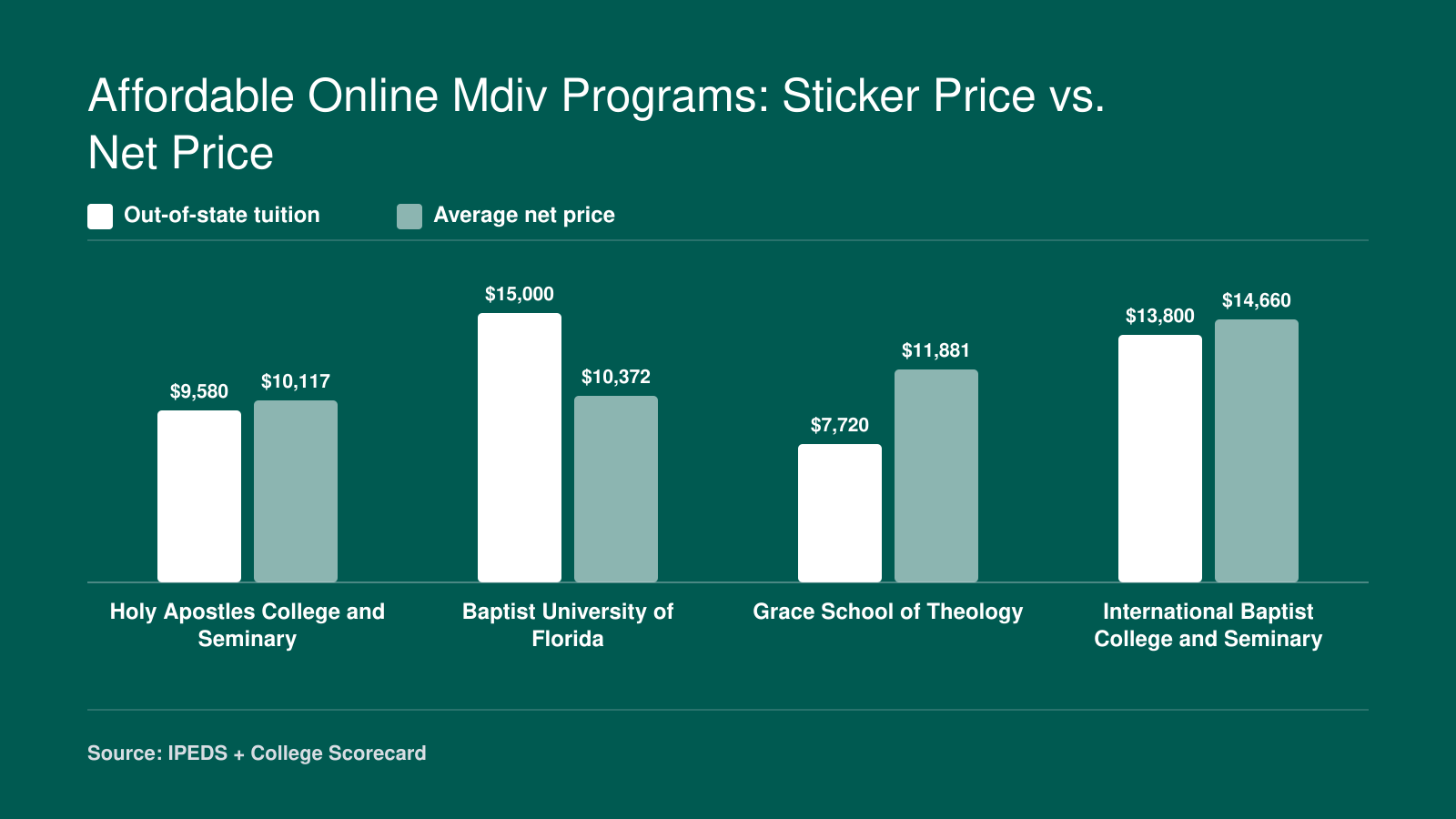
Affordable Online Mdiv Programs: Sticker Price vs. Net Price
Published out-of-state tuition is only part of the picture. The average net price is an institution-wide figure after grants and scholarships, so it often runs below the sticker tuition, though it can also include books and living costs. Per-credit rates across the programs reviewed range from roughly $310 to $790, and a typical MDiv requires 72-90+ credits, while technology, graduation, and clinical pastoral education fees may apply on top.
Master of Divinity Salary: What Clergy Earn Nationally
Clergy earn a median annual wage of $60,810, according to the U.S. Bureau of Labor Statistics.
Online Mdiv Admission Requirements (No Theology Background Needed)
Several fully online MDiv programs below admit students from any accredited bachelor's field; theology prerequisites are typically built in after enrollment.
- Bachelor's degree and GPAA regionally accredited bachelor's is the baseline. Reported minimum GPAs range from 2.0 (Liberty) to 3.0 (Boston University), with 2.5–2.75 common; applicants with graduate credits may be reviewed on master's work.
- Test scoresGRE scores are usually not required. Campbellsville explicitly requires no GRE/GMAT, and several programs below rely on transcripts, references, and statements instead.
- Faith-based references and statementsPlan for one to three references, often pastoral, church, or academic, plus a spiritual autobiography or statement of purpose. Lipscomb asks for three letters and a 750–1,000-word essay; Liberty requires one pastoral reference; Grace requires a statement of faith, while United does not. Some ordination tracks may also seek denominational endorsement.
- Transfer credit and advanced standingPrior MA, MTS, or theological coursework can shorten the MDiv. Lipscomb accepts up to 48 transfer credits and 24 advanced-standing credits; Campbellsville accepts up to 24 transfer credits, with advanced standing up to 54 in certain cases.
- Language and theology prerequisitesNo theology degree is required at Lipscomb, Liberty, United, or Campbellsville. Andrews notes students without an undergraduate religion or theology degree may need seminary-level prerequisites; confirm whether Greek and Hebrew are built into your track or required beforehand.
About 25 percent of U.S. congregations were led by part-time clergy in 2020, according to congregational research from the Hartford Institute for Religion Research. If your future ministry may come with a second job, an affordable, low-debt online MDiv that you can complete while working keeps your finances in line with that reality.
Divinity programs by state
Online Mdiv FAQs
These FAQs cover the questions online Master of Divinity applicants ask most often, from time to degree and residency expectations to accreditation and career outcomes. Use them as a starting point while you compare the programs on this page.
How long does an online Master of Divinity take?
Which online MDiv programs have no residency requirement?
What is the difference between a Master of Divinity and a Master of Theological Studies?
What can you do with an online Master of Divinity degree?
Are online MDiv programs accredited?
Compare Divinity programs on the data that matters
Explore more Religion & Theology specializations or browse every graduate field.
All Religion & Theology programs