Best Online Master's in Educational Leadership Programs
Compare 450+ accredited online Educational Leadership programs, with graduate earnings, cost, debt, and completion data from IPEDS and the U.S. College Scorecard.

Teachers can earn a principal-track master's online without leaving the classroom, but the license still hinges on supervised field hours and a state exam. Among the 14 ranked online MSW programs, clinical requirements run from 160 hours in Texas to 450 at CUNY Brooklyn College, and several let you complete them at your current school.
Cost spreads wider. Listed in-state program tuition ranges from about $6,200 at Texas A&M University-Central Texas to $71,500 at the University of Southern California. Average net price spans $1,300 to $32,740, though it is an institution-wide estimate, not a program bill.
Portability is the quieter risk: approval in one state does not guarantee a license in another.
Key Points
- Published program tuition runs from about $6,200 to $11,600.
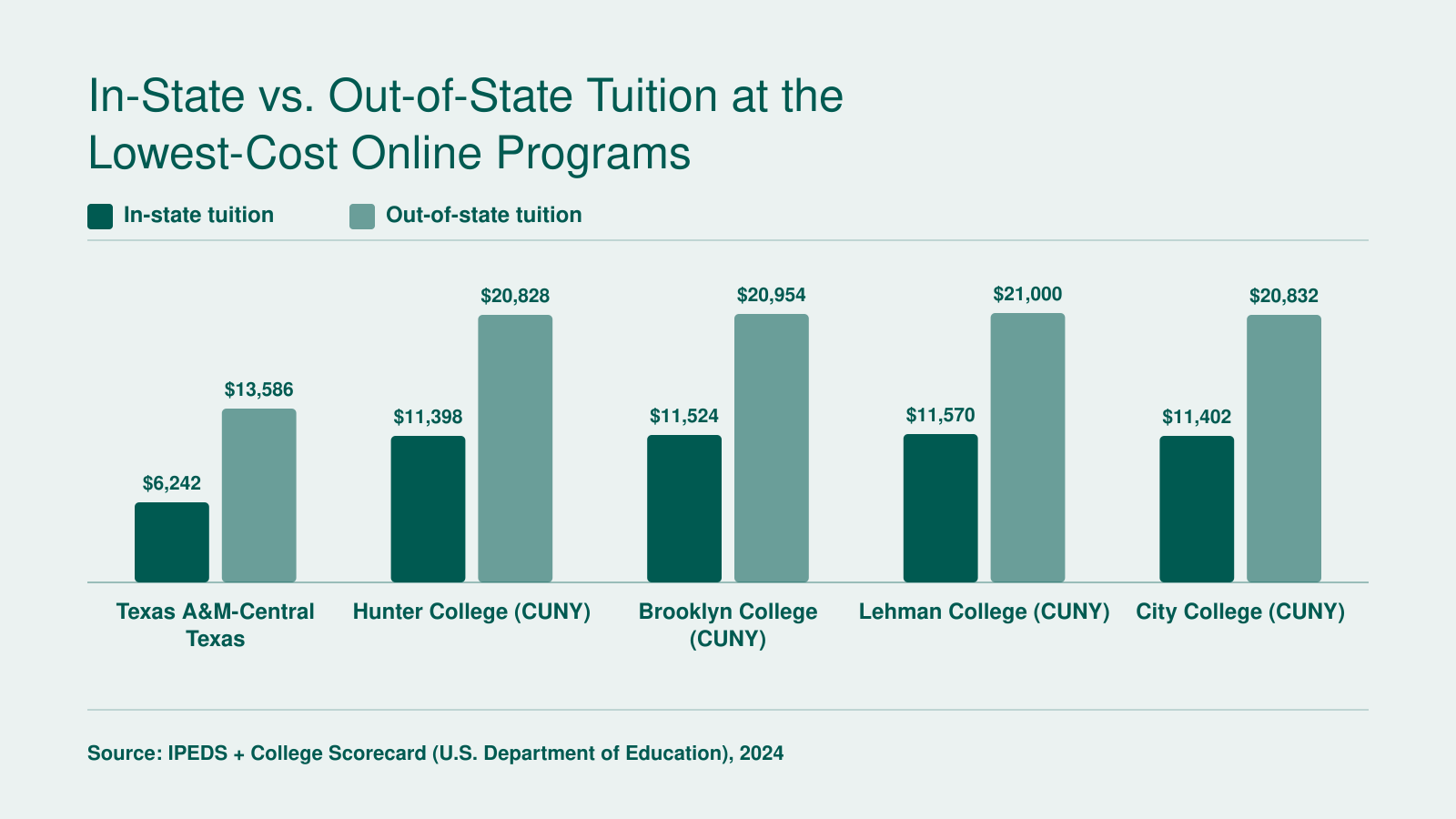
- Out-of-state residency adds $7,344 to $9,430 at the five cheapest programs.
- Federal earnings data for these programs isn't published, so compare cost first.
The 10 Best Online Master's in Educational Leadership Programs for 2027
The programs below are online-delivery-eligible master's degrees in educational leadership. Each card summarizes graduate tuition, net price, graduation rate, format, concentration, and confirmed accreditation. Working educators can compare the details that matter most for cost and career fit.
University of Florida
#1Gainesville, FL · ~$13,000/yr (est.)
Best for: Ed-tech and policy-focused educators
The University of Florida's online M.Ed. in Educational Leadership takes a systems-leadership angle, with core coursework in educational leadership and electives in digital transformation, research methods, or policy. Students can finish in about two years at six credits per semester, but the track does not include school building leadership certification. It is a strong fit for educators eyeing ed tech, K-12 policy, nonprofit leadership, or AI-adjacent school roles.
- 18 core credits in educational leadership, 15 cross-departmental electives, and 3 practicum credits
- Typical load of 6 credits per semester finishes the degree in about two years
- Spring, summer, and fall start dates with applications due February 1, June 1, and October 15
- Requires a bachelor's degree and a 3.0 upper-division GPA
- Average class size of 10 to 15 students
- Does not include school building leadership certification
University of Virginia
#2Charlottesville, VA · ~$24,000/yr (est.)
Best for: Virginia teachers pursuing administrative licensure
UVA's M.Ed. in Administration and Supervision is built for working educators moving into school administration. It offers a 30-credit route for first-time master's students and a 24-credit route for those with a prior master's, both with an embedded internship and eligibility for PreK-12 administrative licensure. The part-time online cohort includes evening classes and an annual summer residency in Charlottesville.
- 30-credit route for first-time master's students; 24-credit route for those with a prior master's
- Embedded administrative internship and eligibility for PreK-12 administrative licensure
- Part-time online evening classes with a cohort model
- Annual summer residency in Charlottesville, Virginia
- Requires work experience and prepares for the School Leaders Licensure Assessment
- Ranked #6 education school nationally
San Jose State University
#3San Jose, CA · ~$10,000/yr (est.)
Best for: Equity-minded California teachers seeking principal credential
San Jose State's MA in Educational Leadership focuses on emancipatory K-12 school leadership and runs fully online through Zoom and Canvas. Students start each July and finish in three semesters, with pathways that include the preliminary administrative services credential. Admission requires two years of full-time school experience and a preadmission interview.
- 30-unit master's delivered fully online through Zoom and Canvas
- Starts every July and finishes in three semesters
- Three pathways: individualized plan, preliminary administrative services credential, or transfer coursework
- Requires bachelor's degree in any major and two years of full-time school experience
- Requires three recommendations, a four-page written statement, and a preadmission interview
- Named a UCEA Innovative Program in 2020
Florida State University
#4Tallahassee, FL · ~$11,000/yr (est.)
Florida State offers an online MS in Educational Leadership and Policy with two tracks: Educational Leadership/Administration and Education Policy and Evaluation. The leadership track prepares Florida PK-12 educators for Level 1 certification and includes field-based assignments; the policy track focuses on policy analysis and evaluation. The university holds regional accreditation from the Southern Association of Colleges and Schools Commission on Colleges and state program approval from the Florida Department of Education.
- Prepares Florida PK-12 educators for Level 1 certification
- Field-based assignments completed at your own school
- No entrance exam required; fall, spring, and summer starts
- Cohort model with dedicated advisors
- Ranked #1 in Florida Educational Leadership Examination pass rates
- 33 to 36 credit hours
- Focuses on policy analysis and evaluation rather than school administration
- One of two majors within the online MS in Educational Leadership and Policy
- 33 to 36 credit hours, fully online
- U.S. News ranked No. 12 nationally
- Contact: Kimberly Howell
Vanderbilt University
#5Nashville, TN · ~$58,000/yr (est.)
Vanderbilt's online M.Ed. in Educational Leadership and Organizational Effectiveness serves working professionals across PreK-12, postsecondary, and international settings. The 30-credit program emphasizes guiding change, strengthening systems, and data-informed decisions, with fall, spring, and summer entry. It is directed by Professor Eve Rifkin and delivered online for working educators.
- 30 total credit hours with fall, spring, and summer admission terms
- Serves PreK-12, postsecondary, and international education settings
- Open to professionals from schools, districts, colleges, universities, and nonprofits
- Focuses on guiding change efforts and data-informed decisions
- Program director: Professor Eve Rifkin
Lehigh University
#6Bethlehem, PA · ~$29,000/yr (est.)
Lehigh's online M.Ed. in Educational Leadership (K-12) is a 30-credit, five-semester program with hybrid or fully online formats and live weekly evening sessions. Students can add Pennsylvania Principal Certification, and the cohort model supports practicing teachers moving toward principal or district-level roles. The program offers transfer credit and educator-focused scholarships.
- 30 total credit hours, completed in about 1.5 years or five semesters
- Hybrid or fully online modalities with live weekly evening sessions
- Optional Pennsylvania Principal Certification
- Cohort model and six optional tracks
- Transfer prior graduate-level credits accepted
- 15% Pennsylvania educator discount
University of Minnesota-Twin Cities
#7Minneapolis, MN · ~$22,000/yr (est.)
University of Minnesota-Twin Cities' M.Ed. in Leadership in Education is a 30-credit, 11-course program with no thesis, built around strategic alignment, teacher capacity building, organizational change, continuous improvement, and goal achievement. Half the credits are electives, giving working K-12 educators room to specialize. It offers fall, spring, and summer starts and fellowship or scholarship support.
- 30 credits across 11 courses, with no thesis or capstone required
- Half of the credits come from electives, including 14 elective credits for personalization
- Fall, spring, and summer start dates
- 2.8 GPA minimum and two letters of recommendation
- No entrance exam required for admission
- Careers include instructional coach, principal, director of special education, and teacher leader
Indiana University-Bloomington
#8Bloomington, IN · $12,000 – $33,000/yr (est.)
Indiana University Bloomington's M.S.Ed. in Educational Leadership is fully online and embeds an Indiana principal's license in the coursework. It prepares experienced teachers for building-level administrator, superintendent, and director of exceptional needs roles. The program offers personalized academic support, 24/7 tech support, and no GRE requirement for U.S. degree holders.
- 100% online M.S.Ed. with fall, spring, and summer start dates
- Indiana principal's license embedded in the coursework
- No GRE required for U.S. degree holders
- Personalized academic support and 24/7 tech support
- Military benefits and employer tuition reimbursement accepted
- Financial aid, fellowships, and assistantships available
University of San Diego
#9San Diego, CA · ~$31,000/yr (est.)
The University of San Diego's online M.Ed. with a School Leadership specialization is a 30-credit, 20-month program grounded in social justice. It uses seven-week courses taken one at a time, includes a capstone action research project, and prepares K-12 educators for state administrative credential exams. The program has fall, spring, and summer starts.
- 30 credits and 10 courses completed in 20 months
- Seven-week courses taken one at a time
- Five foundation courses plus five specialization courses in school leadership
- Capstone action research project
- 100% online format with fall, spring, and summer starts
- Prepares for state administrative credential exams
The College of New Jersey
#10Ewing, NJ · ~$18,000/yr (est.)
The College of New Jersey's Educational Leadership: Instruction master's is a fully online, 30-credit program delivered through the Regional Training Center. Courses run about five weeks and are offered year-round, with asynchronous or live-virtual options. It does not lead to principal or supervisor certification and requires three years of experience under a valid New Jersey certificate.
- 30 credits across 10 courses plus a 0-credit culminating project
- Fully online through the Regional Training Center
- Asynchronous or live-virtual delivery, with courses running about five weeks year-round
- Requires three years of experience under a valid standard New Jersey certificate or equivalent
- Minimum 3.0 GPA for admission
- No internship required and no principal or supervisor certification
Cost & outcomes by school
Federal data for the highest-earning Educational Leadership programs, independent of the ranking above. Earnings are this field's master's graduates four years after completing, where the Scorecard reports them.
| School | Earnings | Tuition / yr | Debt | Grads/yr | Format |
|---|---|---|---|---|---|
| CUNY Hunter College NY | $131,961 | $11,398 | $23,186 | 71 | Hybrid |
| Western Washington University WA | $129,722 | $13,878 | — | 12 | Hybrid |
| CUNY Brooklyn College NY | $119,900 | $11,524 | $21,817 | 45 | Hybrid |
| University of Massachusetts Global CA | $118,581 | $13,680 | — | 33 | Online |
| CUNY Lehman College NY | $116,546 | $11,570 | — | 16 | Hybrid |
| National University CA | $110,083 | $16,416 | $23,388 | 103 | Online |
| Fordham University NY | $106,668 | $26,752 | $21,199 | 9 | Online |
| University of Alaska Southeast AK | $101,064 | $12,033 | $26,860 | 11 | Hybrid |
| Berry College GA | $94,473 | $13,646 | $16,142 | 1 | Online |
| Western Governors University UT | $84,521 | $9,320 | $12,772 | 623 | Online |
| Lamar University TX | $70,026 | $8,642 | $20,500 | 770 | Online |
| Eastern New Mexico University NM | — | $5,706 | — | — | Online |
Sources: U.S. Department of Education. Tuition and graduates: IPEDS. Earnings and debt: College Scorecard, this field's master's graduates; a dash means no figure is reported.
Cost, debt & payoff
Median earnings of this field's master's graduates (4 yrs after completing) vs. their median federal loan debt · U.S. College Scorecard
Across these programs the median graduate earns about $69,836 and finishes with roughly $28,370 in debt — a ratio that clears a common rule of thumb (keep debt below first-year salary). Tuition and debt vary widely school to school, so check the per-school figures in the table above before you shortlist.
Principal Certification Through an Online Program: State Rules and Portability
An online master's in educational leadership can fulfill the graduate coursework most states expect, but principal certification is decided state by state. A program that is fully online and accredited may still lead to a license in some states and not in others. Walden's online M.S. in Education, Educational Leadership and Administration, for example, lists Ohio among its approved states for principal preparation, so candidates outside Ohio should confirm the program's status before enrolling.
NC-SARA reciprocity is often misunderstood. State authorization reciprocity lets institutions offer online courses across member states, but it does not provide reciprocity for professional licensure.1 A program can be authorized to enroll students in a given state under SARA while still not meeting that state's principal certification requirements. Prospective students should therefore check program-level licensure disclosures rather than assuming SARA approval covers certification.
Federal rules tied to 34 CFR 668.43 require institutions to notify students in writing within 14 days if an online program would not meet licensure requirements in the student's state.2 Schools such as Arkansas State publish state authorization pages that explain which jurisdictions are approved for educational leadership licensure. State-approved online programs differ in length and credit load. Arkansas State University's online M.S. in Educational Leadership runs 33 credits and about 20 months, while Regis University's M.Ed. in Educational Leadership is 30 credits and approved by the Colorado Department of Education. Regis also expects about three years of relevant work experience, so program-level state approval and work history can be admission or certification factors.3 Most candidates must also pass the School Leaders Licensure Assessment (SLLA), which is a common state-required exam for principal licensure.4
Because principal certification is not portable, candidates who plan to move should compare the state where they will work, not where the program is headquartered. Many online educational leadership programs market nationally, but their state authorization pages list only the jurisdictions where the curriculum has been reviewed for principal preparation. Reading those disclosures before applying is the lowest-cost way to avoid earning a degree that does not lead to licensure.
Fully Online or Hybrid? Live Sessions, Campus Visits, and Field Hours
A program can call itself "online" and still ask you to log in at 7 p.m. on Tuesdays or spend a semester in a school building. Three things separate a truly flexible degree from one that is not quite 100% online: scheduled synchronous class sessions, required campus residencies, and in-person internship hours. The internship is the one almost no program can remove, because principal licensure depends on it.
Internship Hours Vary Widely
Requirements differ more than most applicants expect. Southern Maine's accelerated online educational leadership program lists 240 fieldwork hours, and Arizona State's online M.Ed. in Educational Leadership lists 270 clock hours over a full year (2025-2026). Bowling Green's practicum works out to 225 contact hours.1 Mississippi College requires 320 practicum hours under a certified administrator,2 Eastern University 360,3 Mount Olive 500,4 and Canisius 600 for its internship.5 William Paterson's 75 hours are meant to cover only part of New Jersey's 300-hour state requirement.6
Loyola University Maryland's M.Ed. in Educational Leadership is the clearest on placement: students complete the internship in their own school setting, across a fall and spring semester. Most other programs do not say publicly whether your current school counts, though internships generally run under a mentor administrator. Treat that as something to confirm in writing.
Asynchronous vs. Synchronous
Asynchronous coursework (Clemson University's educational leadership master's program, Canisius,5 Arizona State, Texas Tech,9 and Bowling Green, which is mostly asynchronous1) suits teachers whose afternoons disappear into coaching, tutoring, and meetings. You still face weekly deadlines, but not a fixed clock. Synchronous sessions, offered in blended formats at Montclair State,7 Loyola Maryland, and Nevada, Reno,8 trade that freedom for a cohort you actually know, which helps when you later need references and district contacts.
Questions to Ask Admissions
- Live sessions: Are any classes scheduled at set times, and are they recorded?
- Residency: Is any campus visit required, and when?
- Placement: Can I complete my internship at my current school under a mentor principal, or must it be in a different setting?
- Hours: How many total hours does my state require, and how many does the program count?
- Timing: Must the internship fall in specific semesters, such as not in summer?
Before You Apply: License, Experience, and Test Requirements
Requirements vary by state and school, but most online programs with principal licensure ask for the following. Confirm each item with the program before you apply.
- Bachelor's degree and GPAA regionally accredited bachelor's is standard, with minimums commonly between 2.75 and 3.0, though schools differ on whether they count your full transcript or only your last 60 credit hours.
- Valid teaching licenseLicensure tracks usually require a current, active certificate in your state, while non-licensure tracks may admit applicants without one.
- Teaching experienceTwo years of full-time teaching is the most common benchmark, but some programs ask for 3 to 5 years, and licensure tracks often hold you to a stricter definition than admission does.
- Administrator or principal recommendationExpect 1 to 3 letters, with licensure programs often requiring one from your current principal or direct supervisor.
- GRE policyMany programs do not require the GRE, and others make it optional or ask for it only in limited cases, such as when an applicant lacks an accredited U.S. degree.
- Resume and statement of purposeMost programs want both, and licensure applicants should highlight leadership roles such as department chair, mentor teacher, or committee lead.
Related Articles
What an Online Educational Leadership Master's Costs: Per-Credit Rates, Fees, and Net Price
The price of an online educational leadership master's is the tuition you pay per credit, multiplied by the credits required, plus the fees layered on top. Published program tuition among the ranked schools runs from about $6,200 to $11,600 for in-state students (Texas A&M-Central Texas at the low end, the CUNY colleges near the top). Out-of-state figures stretch from about $9,300 at Western Governors, which charges one flat rate, to roughly $26,700 at Florida State. Treat these as published program figures that may not be on identical bases.
Net price is a different number. It is an institution-wide average of what students pay after grant aid, so it is not a quote for this program. Use it as a rough signal about a school's aid generosity, not as your bill.
Per-Credit Rates and Program Totals
- LSUS: $378 per credit, 34 credits, about $12,867 total.
- University System of Georgia: University System of Georgia FY 2026 eTuition Rates lists $309 per credit. Credit totals vary by campus program.
- Texas Tech: Texas Tech Online M.Ed. in Educational Leadership lists $415 to $500 per credit, depending on residency classification.
- American Public University: $470 per credit, 36 credits, plus an $85 per-course technology fee.1
- LSU Online: $490 per credit, 39 credits, about $19,110. Other sources list different LSU figures, so confirm with the school.
- Saint Thomas: $500 per credit, 36 credits, about $18,900.2
- Saint Mary's University of Minnesota: Saint Mary's University of Minnesota Educational Leadership Tuition lists $615 per credit, 30 credits, about $18,450, plus $100 per term in technology fees (2025-2026).
- George Mason: George Mason M.Ed. in Leadership and Human Development lists $779 in-state and $979 out-of-state for 2026-2027, plus $25 to $84 in course fees.
The Flat E-Tuition Effect
Many public universities charge online students one e-tuition rate regardless of residency, and some private programs do too. LSU, LSUS, Georgia, and Saint Thomas all describe this approach, which can erase the out-of-state premium entirely. Texas Tech and George Mason, by contrast, publish residency-based rates.
Run the Total-Cost Math
The real comparison number is per-credit rate × credits + fees. At APU, 36 × $470 is $16,920. If the program is twelve 3-credit courses (an assumption, so verify), the technology fees add about $1,020, for roughly $17,940. Add licensure exam fees and books before comparing.
In-State vs. Out-of-State Tuition at the Lowest-Cost Online Programs
Residency can add $7,344 to $9,430 to the listed program tuition at these five lowest-cost options. Texas A&M University-Central Texas has the smallest gap at $7,344, while the four CUNY programs (Hunter, Brooklyn, Lehman, and City College) each show a $9,430 difference between in-state and out-of-state rates. Many online programs charge one flat rate regardless of residency, so ask each admissions office whether the out-of-state figure applies to your online section. Also note that these five programs are hybrid, with on-campus sessions or in-school fieldwork, so they are not fully remote. Tuition excludes fees and clinical costs.
Federal data shows that, for many graduates, the total cost of an online educational leadership master's is often less than one year of additional earnings in a principal role.
Educational Leadership programs by state
Educational Leadership Master's Questions, Answered
These answers cover the questions prospective students ask most about cost, licensure, scheduling, and employer perception. Requirements vary by state and by program, so confirm specifics with your state education agency and the program before you apply.
How much does an online master's in educational leadership cost?
Which online educational leadership programs lead to principal licensure?
Can I complete an online educational leadership degree while teaching full time?
What is the difference between an M.Ed. and an M.S. in educational leadership?
How long does an online master's in educational leadership take to complete?
Are online educational leadership degrees respected by employers?
Is a master's in higher education administration a substitute for a K-12 educational leadership degree if I want to become a principal?
Will my school district help pay for an educational leadership master's?
Compare Educational Leadership programs on the data that matters
Explore more Education & Teaching specializations or browse every graduate field.
All Education & Teaching programs