Accelerated Master's in Educational Leadership Programs
Compare 590+ accredited fastest Educational Leadership programs at 450+ schools, with graduate earnings, cost, debt, and completion data from IPEDS and the U.S. College Scorecard.

A teacher ready to step into a principal's office faces a tradeoff between speed and cost. Some accelerated programs finish in 12 months; the University of Evansville and Mississippi Christian University both run a full year of coursework, while Florida Atlantic stretches to 22 months of hybrid study.
Price swings just as widely. A fully online Master's in Educational Leadership With No GRE Required can run under $10,000 at Cairn University, while graduate tuition at campus-based Stetson tops $57,000 before scholarships pull the net price down.
Formats range from asynchronous online to cohort-based campus terms, and nearly all bundle a state-specific internship. That clinical placement, not the classroom, is where licensing rules bite hardest.
Key Points
- Accelerated programs in 2027 cost roughly $10,000 to $16,500 total.
- Georgia College & State University grads earn $94,009 median after five years.
- Out-of-state online students may face extra principal certification requirements.
The 10 Best Accelerated Master's in Educational Leadership Programs for 2027
These accelerated programs use short terms, online or hybrid delivery, and state-specific internship placements to move working educators into leadership roles quickly. Below are the ten programs that stood out for 2026, ordered by speed, price, and measurable outcomes. Every program on this list is designed for teachers who need credible licensure preparation without pausing their careers.
Loyola University Maryland
#1Baltimore, MD · ~$20,000/yr (est.)
Best for: Maryland educators seeking principal licensure online
Loyola's online synchronous M.Ed. in Educational Leadership is built for educators who want to become transformative school and district leaders through a social justice lens. Courses run in eight-week blocks, with a full-year internship and one-on-one coaching from current or former superintendents and principals. The Maryland State Department of Education-approved program leads to Maryland licensure as Supervisor of Instruction, Assistant Principal, or Principal.
- 30 total credit hours
- Synchronous online classes
- Full-year internship in your school
- Full-time and part-time options
- Faculty are current or former superintendents
- MSDE-approved program aligned with Maryland Blueprint
- Starts fall, spring, and summer
Duquesne University
#2Pittsburgh, PA · $25,000 – $30,000/yr (est.)
Best for: Working professionals needing flexible one-course pacing
Duquesne's online Master of Science in Educational Leadership uses accelerated eight-week courses taken one at a time, so working teachers can keep their jobs while earning the degree. The PreK-12 track covers ethical leadership, data-driven decision making, financial analysis, and a leadership practicum plus capstone. Faculty average 20 years of experience, and graduates move toward principal, curriculum coordinator, or district administrator roles.
- 30 total credit hours
- Accelerated 8-week courses
- Online one course at a time
- Leadership practicum and capstone
- PreK-12 Urban Education concentration
- Rolling admissions
- Starts fall and spring
- Faculty with 20 years experience
Florida Atlantic University
#3Boca Raton, FL · $7,000 – $18,000/yr (est.)
Best for: Florida teachers seeking principal certification partnership
FAU's ELITE program is a state-approved accelerated partnership that blends synchronous online classes with mentorship from your own school principal. The 22-month path prepares working Florida educators for the Florida Educational Leadership Examination and leads to eligibility for the Florida Professional Educator's Certificate. District leaders in St. Lucie, Martin, Okeechobee, and Osceola counties help teach courses and build your professional network for assistant principal roles.
- 22-month accelerated master's degree
- Synchronous online instruction
- Mentored by your school principal
- Prepares for Florida Educational Leadership Exam (FELE)
- State approved partnership program
- Eligibility for Assistant Principal position
- Partnership with multiple Florida districts
Georgia College & State University
#4Milledgeville, GA · $8,000 – $28,000/yr (est.)
Georgia College's fully online M.Ed. in Educational Leadership runs as a one-academic-year cohort with two six-hour online courses each semester across fall, spring, and summer. Candidates complete a 250-hour residency supervised by university professors and partner mentors, and admission requires a valid teaching certificate and the GACE Ethics Test 380. Graduates meet coursework, residency, and certification requirements for Tier 1 Educational Leadership through the Georgia Professional Standards Commission.
- Complete in one academic year
- 36 total credit hours
- Fully online cohort program
- 250-hour residency
- GACE Ethics Test 380 required
- Valid teaching certificate required
- Two six-hour courses per semester
- Prepares for Tier 1 certification
McDaniel College
#5Westminster, MD · ~$10,000/yr (est.)
McDaniel's Master of Science in Educational Leadership is an online program with eight-week sessions and both asynchronous and synchronous virtual meetings. It requires an active teaching license and a bachelor's degree with a 3.00 GPA, plus a special education prerequisite or co-requisite. The MSDE- and MHEC-approved, AAQEP-accredited curriculum includes a 16-week internship and leads to Administrator I licensure.
- 33 total credit hours
- 8-week online sessions
- Synchronous and asynchronous options
- 3.0 GPA minimum
- Active teaching license required
- Special education prerequisite or co-requisite
- AAQEP accredited through 2029
- Prepares for Administrator I licensure
University of Evansville
#6Evansville, IN · ~$29,000/yr (est.)
Evansville's fully online Master of Science in Education with a focus on Educational Leadership uses accelerated five-week courses and can be completed in 12 months. The 30-credit program includes a 240-hour internship under a mentor principal and a Research and Inquiry capstone. It prepares licensed teachers with at least two years of experience for Indiana principal licensure, and carries no application fee or GRE requirement.
- 30 total credit hours
- Accelerated five-week courses
- 240-hour internship with mentor principal
- No GRE required
- $0 application fee
- 100 percent online
- Prepares for Indiana principal licensure
- 2.8 GPA minimum
Nova Southeastern University
#7Fort Lauderdale, FL · ~$25,000/yr (est.)
Nova Southeastern's fully online Master of Science in Educational Leadership can be finished in as little as one year with eight-week courses. The non-certification leadership degree offers a 300-hour internship, problem-based learning projects, virtual reality practice, and a weeklong summer symposium. It suits educators moving into K-12, higher education, nonprofits, corporate learning, or educational agencies.
- As little as one year
- 30 total credit hours
- 8-week course format
- 300 clinical hours
- No GRE required
- Rolling admissions
- Non-certification leadership degree
- Weeklong summer symposium
Mississippi Christian University
#8Clinton, MS · ~$16,000/yr (est.)
This online M.Ed. in Educational Leadership is an accelerated program designed for licensed teachers seeking K-12 administrative roles. It covers six dimensions of leadership and includes 320 hours of field experience under certified administrators. Eight-week terms allow completion in as few as 10 to 12 months full-time, and graduates become eligible for the Class AA administrator license after passing the School Leaders Licensure Assessment.
- 36 total credit hours
- Accelerated 8-week terms
- 320 clinical hours
- 2.8 GPA minimum
- 100% online program
- Eligible for K-12 administrator endorsement
- Prepares for School Leaders Licensure Assessment
- Full-time and part-time options
Cairn University-Langhorne
#9Langhorne, PA · ~$11,000/yr (est.)
Cairn's online Master of Science in Educational Leadership and Administration is grounded in a biblical worldview and taught by faculty with real-world principal experience. Students complete asynchronous seven-week terms while receiving mentorship from licensed principals. The 39-credit program includes pathways to ACSI and Pennsylvania principal certification and offers discounted tuition for Christian school educators.
- 39 total credit hours
- $580 per credit
- Asynchronous online classes
- Accelerated 7-week course terms
- Mentorship from licensed principals
- Pathways to ACSI and PA certification
- Discounted tuition for Christian school educators
- $25 application fee
Stetson University
#10DeLand, FL · ~$18,000/yr (est.)
Stetson's Master of Education in Educational Leadership is a one-year, face-to-face cohort held on Saturdays for working educators. Students complete a 180-hour internship in their own school and an action research project, then sit for the Florida Educational Leadership Examination. An In-Service Tuition Scholarship offers a 40 percent tuition reduction for eligible educators, and the program leads toward principal, assistant superintendent, dean, or instructional coach roles.
- 1-year program
- Saturday classes for working professionals
- 180-hour school-based internship
- Cohort-based structure
- Prepares for Florida FELE
- 40% tuition scholarship for in-service educators
- Capstone required
- Starts fall and spring
Cost & outcomes by school
Federal data for the highest-earning Educational Leadership programs, independent of the ranking above. Earnings are this field's master's graduates four years after completing, where the Scorecard reports them.
| School | Earnings | Tuition / yr | Debt | Grads/yr | Format |
|---|---|---|---|---|---|
| University of Massachusetts Global CA | $118,581 | $13,680 | — | 33 | Online |
| Franklin University OH | — | $12,090 | — | — | Online |
| Eastern Washington University WA | — | $14,106 | — | — | Online |
| The University of Texas Permian Basin TX | — | $9,276 | $18,335 | 22 | Online |
Sources: U.S. Department of Education. Tuition and graduates: IPEDS. Earnings and debt: College Scorecard, this field's master's graduates; a dash means no figure is reported.
Cost, debt & payoff
Median earnings of this field's master's graduates (4 yrs after completing) vs. their median federal loan debt · U.S. College Scorecard
Across these programs the median graduate earns about $69,836 and finishes with roughly $28,370 in debt — a ratio that clears a common rule of thumb (keep debt below first-year salary). Tuition and debt vary widely school to school, so check the per-school figures in the table above before you shortlist.
What Earned a Spot on This List: Speed, Price, and Measurable Outcomes
Does a well-known university name get you into a principal's office any sooner? Not on its own. Prestige does not shorten an internship or lower a tuition bill. Cost, completion, and earnings data are better guides to which online master's in educational leadership programs move a working teacher forward without overspending.
What Mattered
- Speed: Every program here offers a one-year, accelerated, or compressed-term pathway, such as 8-week or 5-week courses.
- Tuition: Figures reflect graduate-level rates, not undergraduate pricing, so the cost matches the degree you would actually enroll in.
- Net price: This is an average of what students paid after grants and scholarships, not a quote. Your own bill depends on your aid package and any district tuition benefits.
- Graduation rate: These rates cover the whole institution, not the master's in educational leadership program alone. Read them as a signal of how well a school carries students to the finish line.
- Earnings and debt: Where federal program-level figures for graduates exist, median earnings and typical debt are part of the picture.
What Was Left Out
Reputation surveys and marketing claims did not count. A peer-prestige score says nothing about whether your state will accept a program's clinical hours or whether the raise that follows a leadership role will cover the loan. For a teacher fitting coursework around a full classroom schedule, verifiable cost and outcome numbers are what actually change the decision.
Accelerated Educational Leadership Master's Tuition: Per-Credit Rates, Fees, and Practicum Costs
Expect an accelerated educational leadership master's to cost roughly $10,000 to $16,500 in total, based on programs that publish a full figure: American College of Education lists $9,976, while Auburn University at Montgomery estimates $14,973 to $16,461. Term-priced programs can fall outside that band, depending on how quickly you finish.
Per-Credit vs. Flat-Rate Pricing
American College of Education bills per credit. Its M.Ed. in Educational Leadership runs 34 semester credits at $235 tuition plus a $54 technology and library fee, or $289 per credit, with $50 application and $100 conferral fees on top. That adds up to the $9,976 total. Western Governors University works differently. Its M.S. in Educational Leadership charges a flat $4,625 per six-month term1, plus about $200 for e-books and resources, or $4,825.2 You can add courses within a term at no extra charge, so your total depends on how many terms you need. One WGU education page shows a 2026 rate of $5,450 for some programs2, so confirm which rate applies before you budget. WGU also requires a current state professional license and is not accepted in Alabama, Connecticut, Georgia, Hawaii, Iowa, Kansas, or Minnesota.2
Costs Competitors Skip
Tuition is rarely the whole bill. Ask about these line items:
- Program fees: Mississippi College adds $50 per credit across 36 credit hours.
- Practicum: Hours range from 80 at UTRGV3 to 320 at Mississippi College.
- Exams: UTRGV requires attempted state exams 268 and 368.3 Mississippi College graduates need Praxis 5412 from September 1, 2026.
- Background checks and supervision fees: These vary by school and district, so request them in writing.
Some programs absorb these charges. UTSA lists no additional fees and no out-of-state premium4, and Emporia State says all fees are included.
The Spread Across Ranked Schools
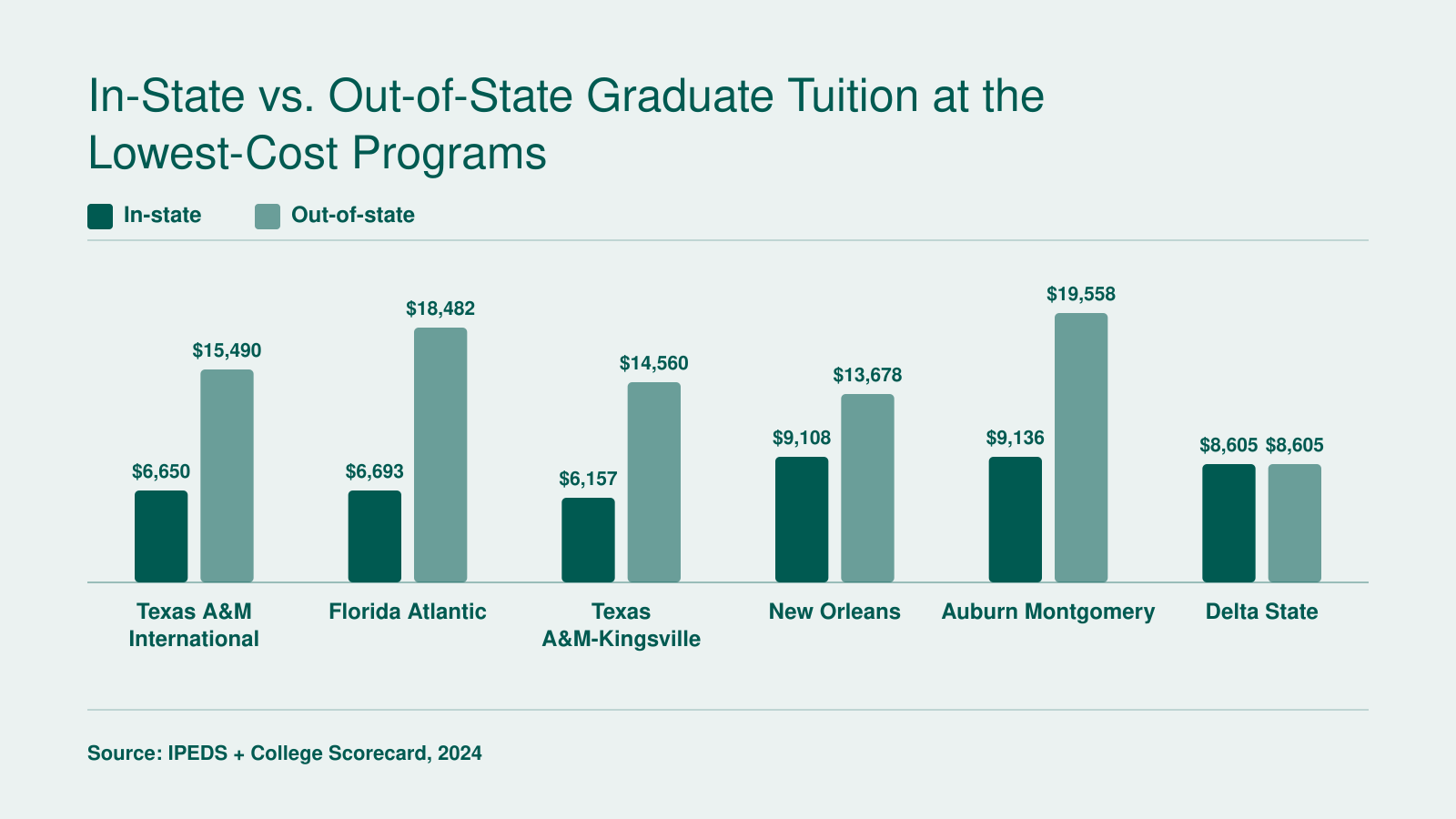
In the ranked schools, listed in-state tuition runs from $6,157 at Texas A&M University-Kingsville to $15,390 at Old Dominion. Out-of-state tuition spans $8,605 at Delta State, which charges the same rate to everyone, to $36,174 at Old Dominion. Institution-wide average net price, which reflects the whole school and not this degree, ranges from $3,637 at Texas A&M International to $16,261 at Emporia State.
To find the cheapest online educational leadership programs without risking licensure, start with schools that charge one rate regardless of residency. Then confirm the program is approved for principal certification in the state where you plan to work.
In-State vs. Out-of-State Graduate Tuition at the Lowest-Cost Programs
The chart compares published in-state and out-of-state graduate tuition and fees for the lowest-cost programs shown. At Delta State, online students pay the same rate regardless of residency, so the two bars are equal. These are sticker prices before financial aid, not net price.
Related Articles
CAEP and Regional Accreditation: The Filter That Protects Your License
George Washington University, Arkansas State, Southeastern Oklahoma State, the University of Tampa, and the University of West Florida all carry CAEP accreditation on their educational leadership programs. That designation matters more than most applicants realize, because it governs whether your degree actually leads to a license.
Two Kinds of Accreditation
Institutional (regional) accreditation applies to the whole university. It confirms the school meets basic quality standards, qualifies students for federal financial aid, and lets credits transfer. Nearly every legitimate program below holds it through a regional body such as HLC or SACSCOC.
Programmatic accreditation is narrower. The Council for the Accreditation of Educator Preparation (CAEP) evaluates the specific preparation program that trains teachers and administrators. A university can be regionally accredited while its leadership program is not CAEP-accredited, and that gap is exactly where licensure problems start.
Why State Approval Is the Real Gatekeeper
Some state boards accept any regionally accredited degree for administrator licensure. Others require completion of a CAEP-accredited or state-approved preparation program. Arkansas State, for example, is both CAEP-accredited and Arkansas state-approved; UWF is CAEP-accredited and approved by the Florida Department of Education through Spring 2030. State approval, not just CAEP, is often the credential your licensing office checks.
The Red Flag
Watch for fast, inexpensive programs that advertise regional accreditation but say nothing about state approval for principal preparation. A regionally accredited degree that your state board will not accept for licensure is a dead end. Before applying, verify each program's status directly on the CAEP website, and confirm approval with the licensing board in the state where you intend to work, not where the school sits.
Will an Online Degree Earn You Principal Certification in Your State?
Most states will consider an online educational leadership degree if it comes from an accredited institution and an approved preparation program. The catch is location. A program based in another state often triggers extra requirements, and nothing guarantees that an online master's qualifies everywhere.
Where Out-of-State Programs Run Into Trouble
Receiving states commonly add one or more of these hurdles:
- Exams: Many states require their own test or a national one, such as the SLLA/PRAXIS 6990, even when you already hold a degree.
- Coursework: Gaps between your program and the state's approved-program standards may mean extra classes.
- Teaching years: Minimum classroom experience varies by state.
- Internships: Some states insist that field experience follow their own supervision and placement rules.
How Four States Differ
Texas asks for a master's degree, a valid classroom teaching certificate, two years of teaching, and an approved principal program1, plus the TExES 268 and PASL 368 exams.2 Out-of-state educators may qualify for a test exemption, but only with at least two years in the certificate area; three or more verifiable years may make you eligible, and documentation is required.3
California generally expects a clear teaching or services credential first. The comparison cited here uses five years of full-time experience, plus CalAPA or CPACE as the assessment.4 Whether a particular online master's meets the state's approved-program rule is something you must confirm.
Florida's route centers on the FELE subtests.4 Ohio requires the OAE 015 and two years of successful teaching under the appropriate license.4
Reciprocity Is Partial
The NASDTEC Interstate Agreement can open a pathway, but it does not transfer a credential automatically.5 Receiving states may still require verification, background checks, exams, coursework, or supervised experience. Certificate type matters too: Idaho's alternative administrator certificate is not recognized under NASDTEC.6
Check Before You Enroll
Federal rules now require online programs to publish state authorization or licensure disclosures. Find that page for each school you consider, confirm it addresses principal licensure in your state, and then verify the details with your state education agency.
Master's in Educational Leadership Prerequisites: What You Need Before You Apply
Admission requirements vary by program and by whether you’re pursuing a licensure or non-licensure track. Check each program’s current catalog directly, because several steps below are conditional or state-specific.
- Bachelor's degree and GPAAll programs require a bachelor’s degree from an accredited institution. Minimum GPA standards vary: ACE’s licensure track sets 2.75 for full admission and 2.50 for provisional, while Arcadia lists 3.0 as preferred; non-licensure tracks may set lower minimums.
- Teaching certificateLicensure-track programs usually require a current professional teaching license. WGU and the University of Cincinnati explicitly require one; ACE generally requires an initial license or comparable school-services credential. Non-licensure tracks may not require a license.
- Teaching experienceMany programs expect two to three years of teaching experience, but admission and licensure requirements can differ. WGU requires three years and the University of Cincinnati requires two; ACE lists two or three depending on state. Arcadia does not require work experience for admission, though certification tracks may impose separate rules.
- Letters of recommendationRequirements vary. WGU asks for one confidential letter and Arcadia asks for two; some programs do not publish a letter requirement, so confirm directly. A principal or supervisor reference is not universally required, but check if your program expects one.
- GRE policyMany accelerated online programs waive or omit the GRE. Arcadia and LSU Shreveport explicitly require no GRE/GMAT; other programs do not always publish their policy, so verify before applying.
- Internship site and mentorPlan for access to a school site and, often, a mentor administrator. ACE’s Texas licensure track requires 160 clinical hours and a mentor who is a licensed principal or assistant principal; other programs may have similar, though unpublished, expectations.
Top Program-Level Earnings After Graduation
The highest program-level median earnings among the schools compared belongs to Georgia College & State University’s Educational Leadership M.Ed. (Tier I). Its graduates recorded median earnings of $94,009 five years after finishing.
Online vs. On-Campus Accelerated Formats: Schedules, Practicum, and Residencies
Yes, you can earn a master's in educational leadership online, and most of the accelerated programs below are fully online. A hybrid option with required in-person summer coursework is also available for students who want some face-to-face time.
| Feature | Online Accelerated | On-Campus Accelerated |
|---|---|---|
| Typical course length | Six-week courses at Eastern Washington University; eight-week courses at Duquesne, Mississippi College, UL Monroe, Liberty, and George Washington University. UNT practicum courses run 16 weeks. | Lehigh University's hybrid track combines online coursework with required in-person summer sessions within a cohort structure. |
| Live class meetings | Lehigh's fully online M.Ed. includes synchronous live sessions one evening per week. Many other courses are asynchronous. | On-campus cohorts meet in person on a set schedule, including Lehigh's required summer coursework. |
| Practicum or fieldwork hours | Mississippi College requires 320 total practicum hours. UL Monroe requires a minimum of 120 clock hours of on-site work. Fieldwork happens in a real school, usually the student's own district. | Lehigh's hybrid track requires in-person summer coursework in addition to the same school-based practicum expectations for licensure. |
| Residency expectations | Fully online programs at UNT, Duquesne, Liberty, and George Washington University do not require on-campus residencies. | Lehigh's hybrid track requires in-person summer coursework as part of the program. |
| Start dates | Eastern Washington has seven start dates per year. UL Monroe and UNT Online have five start dates annually. Lehigh has three start dates per year. | Lehigh's hybrid track follows the same three start dates per year across fall, spring, and summer. |
Educational Leadership programs by state
Compare Educational Leadership programs on the data that matters
Explore more Education & Teaching specializations or browse every graduate field.
All Education & Teaching programs