Accelerated MBA in Sustainability Programs
Compare 30+ accredited fastest MBA in Sustainability programs at 20+ schools, with graduate earnings, cost, debt, and completion data from IPEDS and the U.S. College Scorecard.

A traditional sustainability MBA runs about two years. An accelerated one promises the same degree in 12 to 18 months, and that gap in time is where most of the confusion starts. Many schools advertise speed, many advertise sustainability, and few program pages show both in plain terms.
This is a verification guide, not a ranked list, and it makes no claim about how many true one-year options exist. Individual programs are named only where their own pages state the format.
A fast label still has to hold up against credits, terms, and accreditation.
Key Points
- Accelerated sustainability MBAs finish a full MBA in 12 to 18 months.
- AACSB and EQUIS accredit the school, not the sustainability concentration.
- William Paterson's online ESG MBA costs $18,597 with all fees included.
Accelerated MBA in Sustainability Programs
-
#1
Southern New Hampshire University
Master of Business Administration (MBA) with a concentration in Sustainability and Environmental Compliance
$21,387grad tuition / yrNo GRE required30 credits1 yearVisit program site →54score -
#2
Samford University
Environment and Business Management (MSEM and Master of Business Administration joint degree)
$21,797grad tuition / yrNo GRE required36 credits1 yearVisit program site →54score -
#3
University of South Dakota
Business Administration
$7,118grad tuition / yr 3grads / yrNo GRE required12 monthsVisit program site →53score
How we rank. Each program is scored on graduate figures only: the field's master's earnings and debt, graduate tuition and the number of master's graduates, normalized across all programs in this field. Data comes from the U.S. Department of Education's IPEDS and College Scorecard; no school pays for placement.
Compare the top programs
| Rank | School | Earnings | Tuition / yr | Debt | Grads/yr | Format |
|---|---|---|---|---|---|---|
| 1 | Southern New Hampshire University NH | — | $21,387 | — | — | Online |
| 2 | Samford University AL | — | $21,797 | — | — | Online |
| 3 | University of South Dakota SD | — | $7,118 | — | 3 | Online |
Sources: U.S. Department of Education. Tuition and graduates: IPEDS. Earnings and debt: College Scorecard, this field's master's graduates; a dash means no figure is reported.
What Counts as a True Accelerated Sustainability MBA
An accelerated sustainability MBA is a full MBA in Sustainability, ranging from 30 to 48 credits, finished in about 12 to 18 months instead of the usual two years, with sustainability built into the core rather than added on. Published lengths vary by school. The University of Vermont's Sustainable Innovation MBA runs 12 months and 45 credits, full-time and in person. Colorado State's Impact MBA runs 16 months and 44 credits over three semesters.1 Southern Oregon's online sustainability MBA lists as few as 16 months and 45 credits in 7-week courses. Tomorrow University's Impact MBA offers 12, 18, and 24 months at 60, 90, and 120 ECTS.
What the Workload Looks Like
Colorado State says classes meet four to five days a week. Vermont uses four 8-week modules plus a three-month summer capstone. Most pages skip weekly study hours. The one explicit figure comes from Bard's two-year, 60-credit MBA: 15 credits per term, about 6 online class hours and 21 coursework hours weekly.2 Fewer months for similar credits means a heavier load than that.
Dedicated Program or Electives
A standard two-year MBA with sustainability electives differs from a program designed around the subject. Drexel's MBA requires 48 quarter credits overall3, and Catawba's sustainability concentration is 12 credit hours. Check how much of the degree is actually sustainability.
What to Check on an Admissions Page Before Believing a 12-Month Claim
A 12-month label on a program page is a claim, not a guarantee. Check these details before planning your year.
- Credit load vs. claimed lengthCompare total credits to the stated pace. Southern Oregon's 45-credit program is heavier than William Paterson's 30-credit MBA, and Anaheim's 36-unit program is described as about 18 months, not 12, despite six-week terms.
- Term structure and summerConfirm whether terms are 6-week, 8-week, or 15-week, and ask if summer enrollment is required to finish in 12 months. Anaheim's six-week terms still produce an 18-month timeline, so a 12-month path would demand a heavier per-term load.
- Sustainability-specific core vs. electivesCheck how deeply sustainability is integrated. Anaheim requires 4 specialized courses out of 12 total, Southern Oregon folds 12 concentration credits into 33 core credits, while William Paterson splits 15 concentration and 15 elective credits without a separate sustainability core.
- Degree title on transcriptAsk how the credential appears. Some programs show an MBA in Sustainability, while others show an MBA with a sustainability concentration or specialization, such as Maine's MaineMBA or Nexford's specialized track.
- Foundations and prerequisitesLook for non-credit foundation modules that may extend your timeline. Maine lists self-paced foundations in accounting, economics, finance, and statistics; William Paterson may require up to 9 leveling credits if undergraduate business courses fell below a B.
- Transfer credit and waiversCheck transfer credit and course waiver policies, since prior business coursework may reduce the total load. Many accelerated pages leave these details unstated, so ask directly before applying.
Accreditation: AACSB, EQUIS, and AMBA Checks That Take Five Minutes
Accreditation for an accelerated sustainability MBA lives at the school or program level, not in the sustainability concentration itself. AACSB and EQUIS accredit business schools, while AMBA accredits specific postgraduate programs such as MBA programs, MBM, or DBA. A sustainability focus is accredited only through the parent school or the named MBA format, never as a standalone concentration.
Verify current status directly. Use the AACSB accredited-school search and confirm the record says accredited, not member; membership does not denote accreditation. Check the EFMD EQUIS accredited-school list rather than a membership or applicant page. For AMBA, search the accredited-programme directory and confirm the exact MBA format, full-time, part-time, or executive, is listed. Triple accreditation means a school holds all three; it does not make every MBA format AMBA-accredited.
Employers and tuition-assistance policies commonly want regional accreditation plus AACSB because the school-level credential covers the business degrees they recognize. If a program page simply says "accredited" without naming a body, treat that as a red flag. A named, current directory record is the check that takes five minutes.
According to LinkedIn's Global Green Skills Report 2025, the global share of hiring involving green skills grew 7.7% from 2024 to 2025, while the share of workers with green skills grew just 4.3%. Demand is rising nearly twice as fast as the supply of talent, which helps explain the value of a sustainability-focused MBA.
Comparing Total Cost, Fees, and Financial Aid
William Paterson's online ESG MBA lists $18,597 in total tuition at $619.90 per credit, with all fees included. Southern Oregon's Corporate Sustainability concentration lists $19,350 at $430 per credit, but its tuition page adds a $60 application fee, $85 graduation fee, and $65 course fee. Always multiply the per-credit rate by total credits, then add fees. Credit counts differ across sustainability master's programs, so the headline rate misleads in any sustainability MBA tuition comparison.
The accelerated MBA pages from the University of Southern Indiana ($13,950, 30 credits, 12 months)1 and the University of Miami ($96,705, 35 credits, 2026-2027 rates)2 are general accelerated online MBAs, not sustainability-specific degrees. William & Mary's 49-credit estimate of $71,932 is before a $150 graduation fee and $650 residency course fee.3 Catawba describes its online sustainability MBA as under $22,000 without publishing an exact total.
Why Pace Changes the Math
An accelerated format raises per-term cost but can cut total cost: fewer terms of fees and less time away from full pay.
Funding Levers
- Scholarships: Catawba lists sustainability awards, with a $3,000 minimum for admitted students at a 3.5 GPA who show a sustainability commitment.
- Employer aid: IRS Section 127 allows up to $5,250 per year in tax-free tuition assistance.
- Federal loans: Graduate loans are available, but borrow after exhausting the other two.
Related Articles
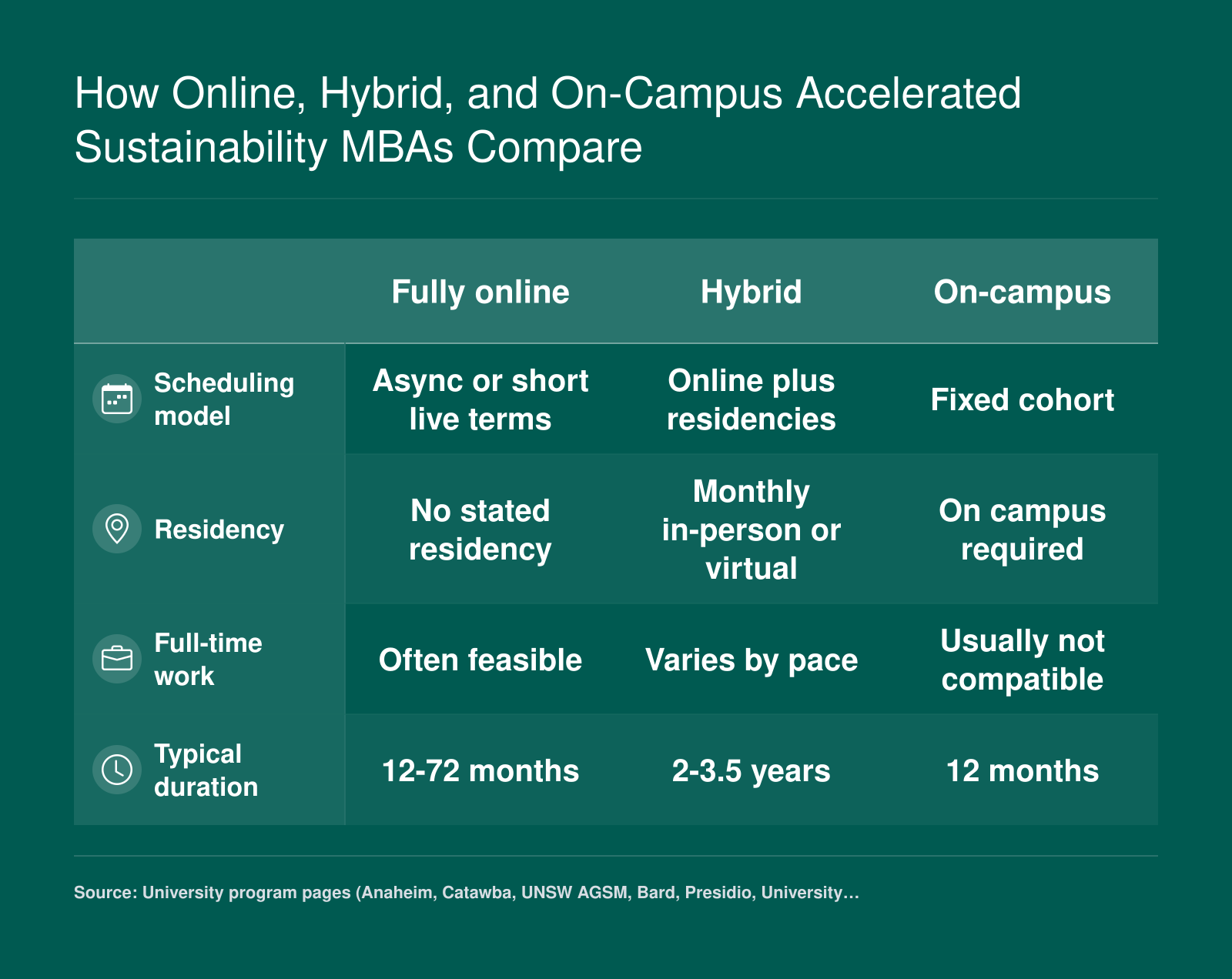
How Online, Hybrid, and On-Campus Accelerated Sustainability MBAs Compare
Fully online sustainability MBAs are not one schedule. Anaheim runs six-week online terms with live seminars, Catawba is asynchronous for working professionals, and UNSW AGSM offers flexible part-time study. Hybrid programs add in-person or virtual residencies, while on-campus accelerated MBAs often run as fixed full-time cohorts.
Career Paths and ROI: ESG, Consulting, and Corporate Sustainability Roles
A sustainability MBA, like an accelerated master's in sustainability, typically feeds a handful of job families: sustainability manager, ESG analyst, sustainability consultant, sustainable supply chain manager, and a longer track toward chief sustainability officer.
Pay is hard to pin down because the federal government has no dedicated sustainability manager category. One career source maps the title to Managers, All Other (SOC 11-9199), where the May 2025 median was $141,900. That residual group likely overstates typical sustainability pay. For context, all management occupations had a median of $126,520, against $50,980 for all occupations.1 These are occupational figures, not program outcomes.
For program-specific results, check three places:
- College Scorecard: field-of-study earnings for the degree.
- Employment report: the school's own, with its reporting year.
- Project partners: capstone or consulting-client lists. NYU Stern's Stern Solution Projects, for example, place MBA students on real sustainability challenges for companies.2
Is it worth it? That depends on employer sponsorship, career switching or upskilling, and whether the program includes live client work. A career switcher with no sponsor and no client projects carries the most risk.
Sustainability programs by state
Accelerated Sustainability MBA FAQs
Which MBA programs are AACSB accredited for sustainability?
Do sustainability MBA graduates get jobs in ESG or sustainability consulting?
Do I need an environmental science background to apply?
Is an MS in Sustainability a better choice than an accelerated MBA?
Compare Sustainability programs on the data that matters
Explore more MBA specializations or browse every graduate field.
All MBA programs