Best Master's in Applied Behavior Analysis (ABA) Programs in Utah
Compare 5 accredited Applied Behavior Analysis programs in Utah at 4 schools, with graduate earnings, cost, debt, and completion data from IPEDS and the U.S. College Scorecard.

Utah's ABA master's programs are few, and each one ties coursework to BCBA exam eligibility differently. Utah Valley University runs a hybrid M.Ed. at about $17,640 in total program tuition. The University of Utah and Utah State University both build ABA into special education degrees, with median graduate debt of $19,000 and $14,340 respectively.
With so few choices, the real tension is format, fieldwork structure, and cost, not name recognition. A wrong fit can mean extra supervised hours after graduation.
Key Points
- University of Utah graduates earn median $65,640 one year after completion.
- BCBA certification satisfies Utah's Behavior Analyst License requirements.
- Utah Valley University offers a hybrid livestream ABA option in 2027.
Best Master's in ABA Programs in Utah: Ranked List
Utah's ABA master's landscape is small but focused, with three public universities offering verified coursework toward BCBA eligibility. These programs range from a hybrid livestream option at Utah Valley University to a fall-start online M.Ed. at the University of Utah and a research-oriented M.S. at Utah State University.
Utah Valley University
#1Orem, UT · $10,000 – $15,000/yr (est.) · BCBA pass rate 83% (3-yr weighted avg)
Best for: Rural Utah students wanting livestream access
Utah Valley University's M.Ed. in Applied Behavior Analysis is a 37-credit, six-semester sequence with an ABAI Verified Course Sequence. Students complete 1,500 supervised practicum hours, often at the Melisa Nellesen Center for Autism, and attend classes one day per week. Admission requires a bachelor's degree, a 3.0 GPA, and a graduate committee interview; the GRE is not required. The university reports a recent BCBA pass rate of 83%.
- 37-credit, six-semester sequence including summers
- ABAI Verified Course Sequence for BCBA eligibility
- 1,500 supervised practicum hours, 18 to 20 hours weekly
- Melisa Nellesen Center for Autism serves as practicum site
- Bachelor's degree and 3.0 GPA required
- Graduate committee interview required
- No GRE required
- $379.46 per credit; $17,640.02 total with fees
University of Utah
#2Salt Lake City, UT · $9,000 – $28,000/yr (est.) · BCBA pass rate 78.6% (2-yr weighted avg)
Best for: Working educators seeking asynchronous BCBA prep
The University of Utah's M.Ed. in Special Education with an ABA emphasis is built around an ABAI Verified Course Sequence and a two-semester experiential learning sequence. The program has campus and online paths, with a fall cohort start. Median earnings one year after completion are $65,640, and median debt is $26,100. The university reports a recent BCBA pass rate of 78.6%.
- ABAI Verified Course Sequence for BCBA eligibility
- Fall cohort start with rolling review until filled
- Two-semester experiential learning sequence
- No entrance exam required; test optional
- 32 credit hours over two years for online path
- 3.0 GPA and three recommendation letters required
- Thesis required
- Person-centered, quality-of-life focus
Utah State University
#3Logan, UT · $8,000 – $25,000/yr (est.)
Best for: Research-oriented students pursuing BCBA Pathway 2
Utah State University's M.S. in Special Education with Applied Behavior Analysis coursework combines ABAI Verified Coursework with clinical and research experience. The fall-start sequence can be completed in two to three years and supports BCBA Pathway 2 eligibility. Admission requires a 3.0 GPA, three recommendation letters, and a $55 application fee.
- 2- to 3-year master's sequence with fall start only
- ABAI Verified Coursework for BCBA Pathway 2 eligibility
- 3.0 GPA and three recommendation letters required
- $55 application fee
- Clinical and research experience
- Early decision January 15; final deadline March 15
Cost & outcomes by school
Federal data for the highest-earning Applied Behavior Analysis programs, independent of the ranking above. Earnings are this field's master's graduates four years after completing, where the Scorecard reports them.
| School | Earnings | Tuition / yr | Debt | Grads/yr | Format |
|---|---|---|---|---|---|
| University of Utah UT | $80,164 | $8,724 | $26,100 | 71 | Campus |
| Utah State University UT | — | $7,828 | — | — | Campus |
| Brigham Young University UT | — | $8,416 | — | 15 | Campus |
| Utah Valley University UT | — | $10,224 | — | 9 | Hybrid |
Sources: U.S. Department of Education. Tuition and graduates: IPEDS. Earnings and debt: College Scorecard, this field's master's graduates; a dash means no figure is reported.
Online and Hybrid ABA Master's Options in Utah
Master's Programs in Utah split into two kinds: asynchronous coursework you fit around a job, and livestream classes that keep a fixed schedule.
Format by school
- University of Utah: Two tracks. The on-campus M.S. in Special Education with an ABA emphasis, and a fully online, asynchronous Professional M.Ed. that starts each fall.
- Utah Valley University: Listed as hybrid. The M.Ed. in Applied Behavior Analysis runs in-person and remote livestream cohorts, with rural and out-of-state applicants prioritized for remote seats. Classes are synchronous, not self-paced.
- Utah State University: Listed as campus-based. Some secondary sources describe online delivery, but its program page does not confirm that, so ask the department before assuming it.
Fieldwork for online students
UVU practicum runs 18 to 20 hours a week, and sites must be preapproved by the Program Director and Internship Coordinator. Some students use the on-campus Nellesen Center for Autism. Published materials do not make clear whether remote students are placed or must arrange a qualified site themselves, and they cite both 1,000 practicum hours and 1,500 supervised experience hours, so confirm the current requirement. The University of Utah lists a two-semester experiential sequence, but its sources do not say whether online students are placed or must secure their own supervisor.
Who fits which format
Working RBTs with a local supervisor and a flexible schedule suit online ABA master's programs like Utah's asynchronous M.Ed. Students who want structure and live interaction suit UVU's livestream cohort. Full-time students near campus will find the on-campus tracks simplest.
Which Utah ABA Master's Programs Waive the GRE?
Application requirements vary by program. The table below lists each Utah ABA program's published GRE policy, deadline, and GPA or prerequisite notes. Policies can change from year to year, so confirm current requirements with the admissions office before applying.
| Program | GRE Policy | Application Deadline | Minimum GPA / Prerequisites |
|---|---|---|---|
| Utah State University: M.S. with ABA Coursework | No GRE required | March 15; early decision January 15 for fall | 3.00 GPA in last 60 credits; cover letter describing ABA experience, reasons for applying, and career goals |
| University of Utah: Master's with Applied Behavior Analysis Emphasis | No published policy | Not published | Not published |
| Utah Valley University: M.Ed. in Applied Behavior Analysis | No GRE required | Priority January 8 at 5:00 p.m.; final March 5 at 5:00 p.m. | 3.0 GPA; bachelor's degree from an accredited institution; complete application and interview with the School of Education Graduate Committee |
How Long Does an ABA Master's Program Take in Utah?
The fastest path to BCBA exam eligibility isn't always the shortest ABA master's program; it's the one that folds supervised fieldwork into the degree rather than leaving the BACB's 1,500-hour concentrated or 2,000-hour standard fieldwork requirement for after graduation.
At Utah Valley University, the M.Ed. in ABA is a 37-credit, six-semester sequence including summers. Students complete 10 courses (30 credits) plus 7 practicum credits and accrue 1,500 supervised clinical hours at an approved site, typically 18 to 20 hours per week for 16 weeks each semester. That integrated practicum is designed to satisfy the concentrated supervised fieldwork requirement, with 1 hour per week of university supervision plus site supervision.
University of Utah's ABA graduate specialization requires 32 credits and includes two 1-credit practicum courses plus a second-year, two-semester experiential sequence, though the published material does not state a typical completion time, a part-time or accelerated ABA master's program option, or whether those hours count toward BACB supervised fieldwork.
Utah State University describes a two- to three-year M.S. sequence with BCBA Pathway 2 coursework, but does not publish total credits or confirm that supervised fieldwork is built into the degree.
A realistic total timeline is about two years when practicum is integrated, as at UVU, or two to three years of coursework plus fieldwork if you arrange hours separately.
Related Articles
Utah Behavior Analyst Licensure
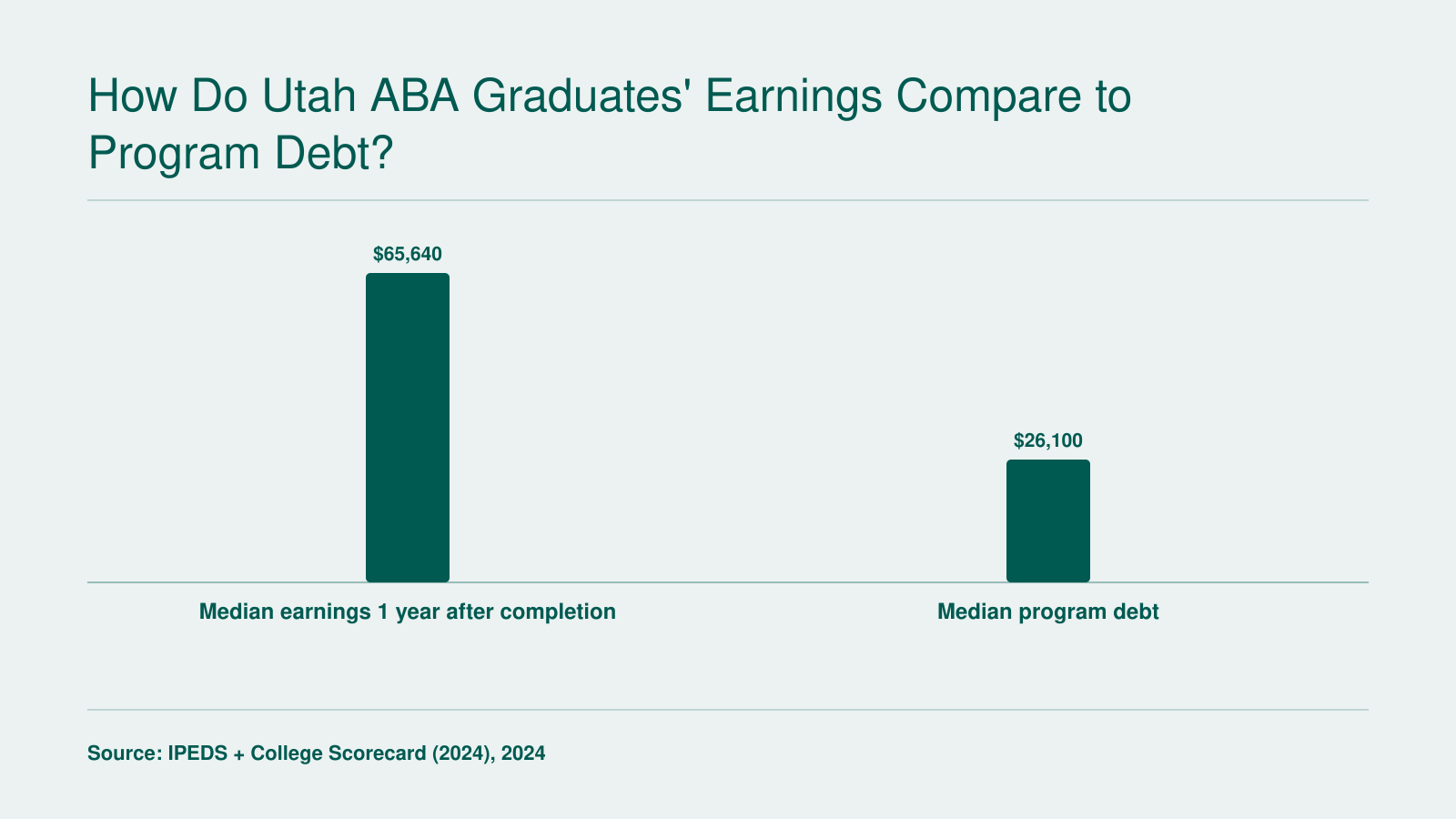
How Do Utah ABA Graduates' Earnings Compare to Program Debt?
Among Utah ABA programs with published program-level outcome figures, University of Utah graduates earn a median of $65,640 one year after completion, while median program debt is $26,100. That puts first-year earnings at about 2.5 times the median debt.
Common Questions About ABA Master's Programs in Utah
Is an ABA master's degree worth it in Utah?
How long does it take to become a BCBA in Utah?
Can I count hours from my current RBT job toward BCBA fieldwork while enrolled?
Can I sit for the BCBA exam with a related master's degree, such as special education or psychology, plus a verified course sequence?
Compare Applied Behavior Analysis programs on the data that matters
Explore more Psychology specializations or browse every graduate field.
All Psychology programs