Accelerated Master's in Media Communication Programs
Compare 90+ accredited fastest Media Communication programs at 80+ schools, with graduate earnings, cost, debt, and completion data from IPEDS and the U.S. College Scorecard.

An accelerated master's in media communication delivers both degrees in roughly five years instead of six, and the shared-credit structure can cut the bill along with the calendar. Undergraduates take graduate courses in senior year that count toward the bachelor's and the master's, so the tuition for those credits is paid only once.
The formats have multiplied: 4+1 dual-degree tracks, standalone one-year master's, and fully online options, including accelerated master's in strategic communication programs and accelerated master's in social media programs. The tension is commitment. Declaring a concentration early and finishing the full sequence is what makes the savings real, and the job market for media roles still rewards portfolio work over the credential's speed.
Key Points
- UConn and University of Arizona let up to 12 undergraduate credits double-count.
- Published 2026 tuition varies by how many credits you shared.
- BLS May 2025 median wages show media communication pay nationally.
Accelerated Master's in Media Communication Programs
-
#1
Calvin University
Master of Media and Strategic Communication
$11,113grad tuition / yr1 yearVisit program site →59score -
#2
University of North Carolina at Chapel Hill
Master of Arts in Media and Communication
$88,174median earnings $12,751grad tuition / yr 18grads / yr30 credits1 yearVisit program site →57score -
#3
Indiana State University
Communication (Accelerated MA)
$8,596grad tuition / yr 5grads / yr1 yearVisit program site →51score -
#4
Morehead State University
Communication, MA
$10,512grad tuition / yr 10grads / yr30 credits1 yearVisit program site →51score
How we rank. Each program is scored on graduate figures only: the field's master's earnings and debt, graduate tuition and the number of master's graduates, normalized across all programs in this field. Data comes from the U.S. Department of Education's IPEDS and College Scorecard; no school pays for placement.
Compare the top programs
| Rank | School | Earnings | Tuition / yr | Debt | Grads/yr | Format |
|---|---|---|---|---|---|---|
| 1 | Calvin University MI | — | $11,113 | — | — | Campus |
| 2 | University of North Carolina at Chapel Hill NC | $88,174 | $12,751 | — | 18 | Campus |
| 3 | Indiana State University IN | — | $8,596 | — | 5 | Campus |
| 4 | Morehead State University KY | — | $10,512 | — | 10 | Online |
Sources: U.S. Department of Education. Tuition and graduates: IPEDS. Earnings and debt: College Scorecard, this field's master's graduates; a dash means no figure is reported.
Cost, debt & payoff
Median earnings of this field's master's graduates (4 yrs after completing) vs. their median federal loan debt · U.S. College Scorecard
Across these programs the median graduate earns about $72,252 and finishes with roughly $39,737 in debt — a ratio that clears a common rule of thumb (keep debt below first-year salary). Tuition and debt vary widely school to school, so sort the ranking by "Most affordable" or "Lowest debt" to weigh cost against outcomes.
What Is an Accelerated Master's in Media Communication?
As media roles consolidate around integrated strategy, universities now treat the Master's in Media Communication as an earlier, faster decision. In the accelerated model, undergraduates take graduate-level courses during senior year that count toward both the bachelor's and the master's degree. The most common version is the 4+1 pathway: roughly five years total for both credentials. That is different from a standalone one-year master's, which is open to any bachelor's holder but does not share undergraduate credit. Program names vary: mass communication, integrated media communications, strategic communication, and media studies often cover the same core territory. Students should expect a heavier senior-year course load, an early application process, and one compressed graduate year after the bachelor's degree. Moving quickly can lower cost, but it narrows the window for electives and internships, so the pace works best when students know their media concentration early.
4+1, One-Year, and Online Formats Compared
A 4+1 campus track, a standalone one-year master's, and an online accelerated option each compress a media communication degree, but they serve different schedules and budgets. The grid below compares typical lengths, credit loads, and delivery formats using examples from specific universities.
| Dimension | 4+1 Campus Track | Standalone One-Year Master's | Online Accelerated Option |
|---|---|---|---|
| Example program | Arkansas State University MS in Strategic Communication (students with 60 undergraduate credits can take up to 12 graduate credits) | American University MA in Strategic Communication; University of Oregon Master's in Immersive Media Communication; Columbia University MS in Strategic Communication | University of Delaware MA in Strategic Communication; Michigan State University MA in Strategic Communication; Northwest Missouri State University MA in Strategic Communication; Arkansas State University MS in Strategic Communication; Loyola University Maryland MA in Emerging Media |
| Typical completion time | One additional year after the bachelor's degree | 12 months (Columbia offers a 12-month completion option) | 10 to 18 months depending on the program |
| Credit requirement | 30 credits, with up to 12 graduate credits shared during the undergraduate program | 30 to 36 credits; University of Oregon's immersive program requires 46 credits | 30 to 46 credits; most programs in this group require 30 |
| Delivery format | On-campus undergraduate coursework with graduate classes taken in the senior year | On campus at Columbia; fully online at American University and University of Oregon | Fully online, often asynchronous with 7- or 8-week accelerated terms |
| Best suited for | Current undergraduates who want to save time and tuition by sharing credits | Career changers or recent graduates who can study full time for 12 months | Working professionals balancing a job with asynchronous or short-term online courses |
Accelerated Media Communication Master's Tuition Costs
The table below shows published 2026 graduate per-credit tuition and total master's credits for several accelerated and online strategic communication programs. Total tuition depends heavily on how many graduate credits a student completed as an undergraduate, so actual cost can be lower than simply multiplying the per-credit rate by total credits.
| University | Program | Format | Graduate Tuition per Credit | Total Master's Credits |
|---|---|---|---|---|
| Northwest Missouri State University | Master of Arts in Strategic Communication | Online | $432 | 30 |
| Avila University | Online Master of Arts in Strategic Communication | Online | $650 | 30 |
| Franklin University | Master of Science in Communications with a Specialization in Strategic Communication | Online | $690 | 33 |
| University of Hartford | Master of Arts in Strategic Communication | N/A | $793 | 30 |
| Michigan State University | Master of Arts in Strategic Communication | Online | $978.25 | 30 |
| University of Delaware | Master of Arts in Strategic Communication | Online | $1,149 | 30 |
Does an Accelerated Media Communication Master's Save Money?
How much can a 4+1 actually cut from the bill? The mechanics are straightforward. At UConn, up to 12 graduate credits can double-count through the accelerated communication masters credit overlap toward both degrees. At the University of Arizona, up to 12 graduate credits can double-count and shared credits are billed at the undergraduate rate while you are still enrolled as an undergraduate.1 Oakland University allows the same 12-credit share at undergraduate tuition.2 Western Michigan University also bills shared graduate-level courses at the undergraduate rate, including within its undergraduate flat rate.3 Once the bachelor's is conferred, the remaining graduate credits switch to graduate rates, and the savings come from that shared window. Arizona still requires at least 12 graduate credits in graduate status after bachelor's requirements, which preserves some graduate-rate cost.1
Loyola University Chicago, for example, charges $1,270 per graduate credit.4 If a program lets you share just six credits at the undergraduate rate, you avoid roughly $7,620 in graduate tuition. Add one fewer semester of rent, food, and fees, and the total gets materially smaller, the same arithmetic behind the Most Affordable Master's in Media Communication rankings. Then there is the opportunity cost: finishing about a year sooner puts you in the workforce and earning salary that much earlier. That early income can far outweigh any tuition difference alone.
Admission Requirements for 4+1 Media Communication Programs
Eligibility hinges on GPA, credit standing, and a junior-year application.
- Minimum GPACincinnati requires 3.2 overall and 3.4 in communication; UConn and Eastern New Mexico require 3.0; Northern Iowa accepts 2.75 overall or in the last 60 hours.
- Credit standingCincinnati and Eastern New Mexico require 90 semester hours; UConn asks for COMM 2000Q plus two additional 2000-level COMM courses.
- Application timingApply junior year. Cincinnati's deadline is the second Monday in March; UConn uses April 15 for fall and November 15 for spring; Northern Iowa lists February 1 and October 1.
- Supporting materialsExpect a statement of purpose, transcripts, and three recommendation letters. Cincinnati wants one from UC Communication faculty; Northern Iowa requests a 10-30 page writing sample. GRE scores are often not required.
- Shared credit gradesEastern New Mexico requires a B or higher in graduate-level courses taken as an undergraduate; Loyola allows up to 12 senior-year credits.
Related Articles
Curriculum and Specializations: PR, Advertising, Digital Media, and Journalism
Speed rewards early commitment. The sooner you pick a concentration, the more of your senior-year credits can count toward both degrees. Core work looks similar across schools: communication theory, research methods, and a capstone, applied project, or thesis. La Salle's 4+1 includes Communication Theory and Research.1 ASU's Master of Mass Communication ends in an applied project or capstone.2 Miami offers a 30-credit thesis track and a 36-credit non-thesis track.3
- Public relations: Purdue's online Strategic Communication and Public Relations track suits agency and corporate roles.4
- Advertising: UF's on-campus thesis option covers advertising5, and Miami lists a separate Master's in Advertising.
- Digital media: Purdue's online Digital Media and Communication Technologies track fits content and platform work.4
- Journalism: Fordham offers Multiplatform Journalism6, and UF's on-campus thesis option includes journalism.5
Digital and strategic tracks are easiest to find in Online Master's in Media Communication programs. UF's online lineup includes social media and audience analytics.5 Journalism and advertising show up more often on campus. Before applying, confirm that your shared senior-year courses fit your concentration. Nebraska's pathway, for example, applies only specific graduate courses to both degrees.
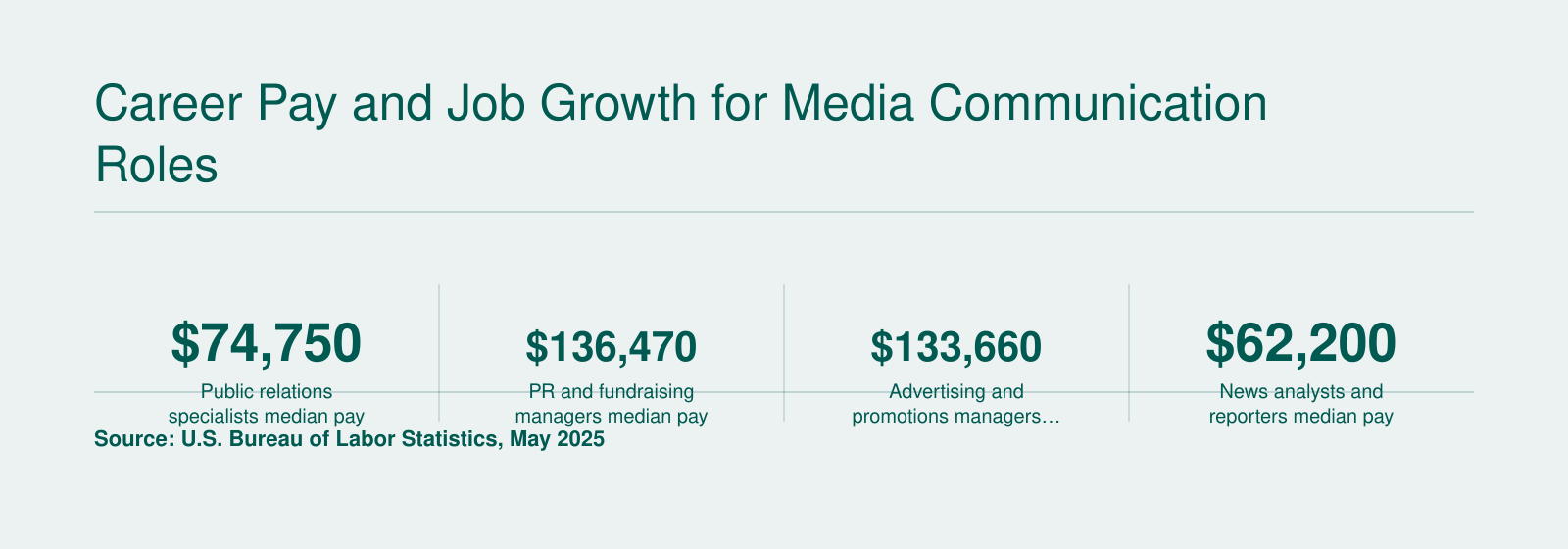
Career Pay and Job Growth for Media Communication Roles
The figures below show national median annual wages reported by the U.S. Bureau of Labor Statistics for May 2025 and projected job growth from 2025 to 2035. Occupational wages reflect workers across the country, not the earnings of graduates from any specific program, so treat them as broad career context rather than a promise of what a particular master's will pay.
Media Communication programs by state
Frequently Asked Questions About Accelerated Media Communication Master's Programs
Financial aid and credit questions are among the most common for students considering a 4+1 media communication program. These answers reflect general federal and institutional policies, but always confirm details with your program's financial aid office.
How many credits can be shared in a 4+1 media communication program?
Does undergraduate financial aid cover graduate courses taken in senior year, and when does a student switch to graduate aid status?
Are graduate assistantships available to accelerated students in the master's year?
What happens to shared credits if you leave the accelerated track before finishing the master's?
Compare Media Communication programs on the data that matters
Explore more Communications & Media specializations or browse every graduate field.
All Communications & Media programs