Most Affordable Master's in Media Communication Programs
Compare 90+ accredited most affordable Media Communication programs at 80+ schools, with graduate earnings, cost, debt, and completion data from IPEDS and the U.S. College Scorecard.

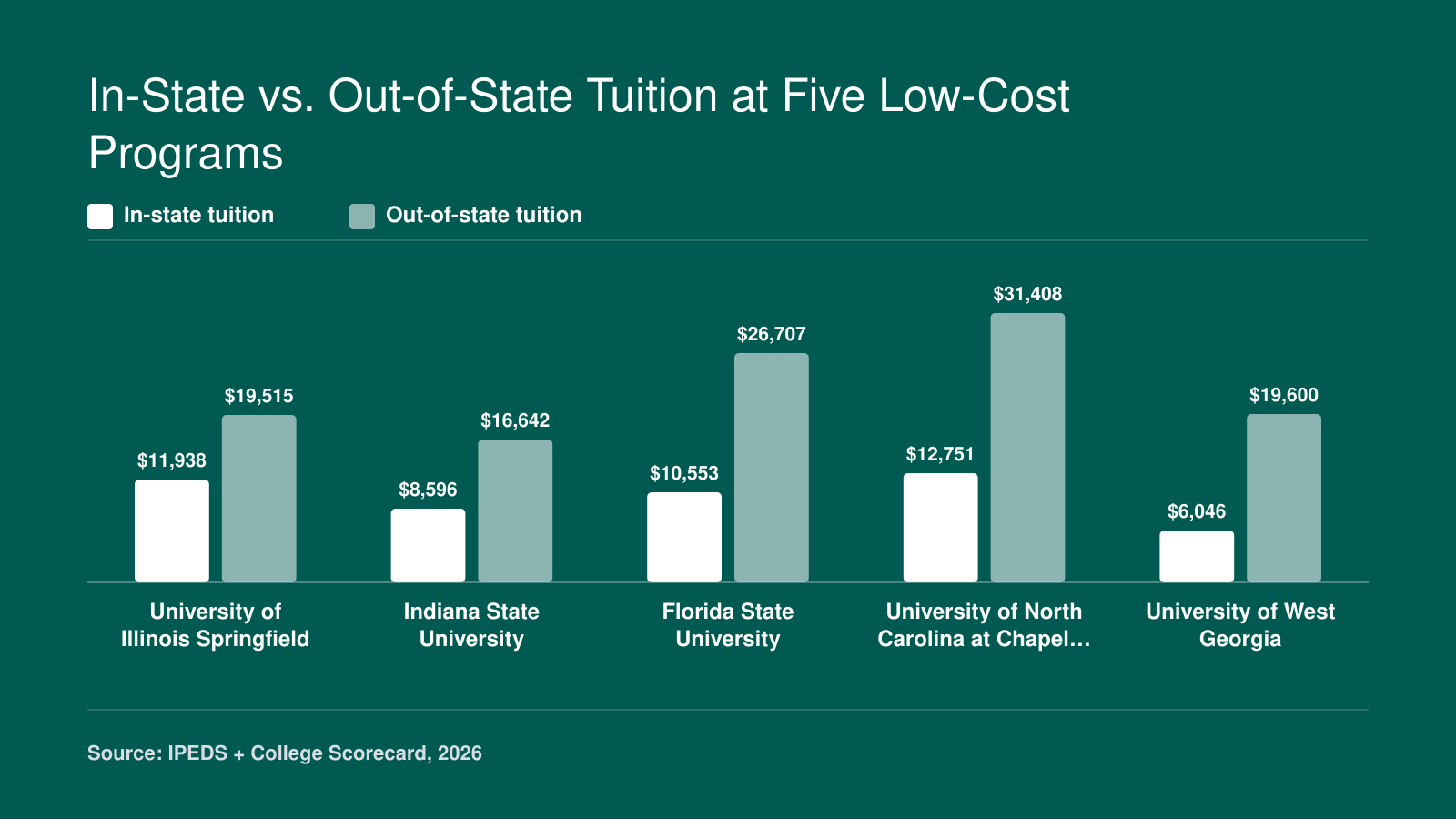
What does a media communication master's cost at a public university? Among the schools ranked here, published graduate tuition runs from $6,046 at the lowest in-state rate to $31,408 at the highest out-of-state rate, a gap of more than $25,000.
Several programs are fully online, and some price online study separately from residency, which can erase the nonresident premium. Check that before ruling out a school in another state.
For most of these degrees, residency moves the final bill more than the school's name does.
Key Points
- Net price after aid weighs most heavily in this ranking.
- George Washington reports the highest median earnings among ranked programs.
- Employer tuition assistance covers up to $5,250 tax-free per year.
10 Most Affordable Master's in Media Communication Programs
This list weighs cost after aid most heavily, but completion and graduate outcomes break ties. The programs below stood out for real published tuition prices, flexible online or campus formats, and clear paths into media and communication careers. Use each entry to compare what you would actually pay in state and out of state.
Florida State University
#1Tallahassee, FL · ~$11,000/yr (est.)
Best for: Research-focused campus students
Florida State University's campus-based graduate program in media and communication studies combines communication theory, research methods, media criticism, and digital content. Students choose a thesis or creative project track, or a coursework-only track, with a cognate minor from more than 20 departments. No GRE is required, and assistantships are available each semester. The school graduates 86% of students.
- 33 total credit hours
- No GRE required for admission
- Thesis or capstone option
- Cognate minor area draws from 20+ university departments
- Covers political communication, rhetoric, and persuasion
- 4-semester program
- Financial aid available
- 36 total credit hours
- No entrance exam required
- Starts fall, spring, and summer
- 4K video production skills
- Prepares for NGO careers
- Capstone: thesis or creative project
- Scholarships available
- Film production background not required
University of North Carolina at Chapel Hill
#2Chapel Hill, NC · ~$13,000/yr (est.)
Best for: Career changers wanting hands-on journalism
UNC Chapel Hill's Hussman School of Journalism and Media offers an MA in Media and Communication with three areas: Journalism, Strategic Communication, and Theory and Research. The 30-credit journalism track can be completed in one year, and the strategic communication path emphasizes advertising, PR, and marketing roles. With about 45 students enrolled annually, the program provides focused, hands-on training and a final faculty-guided project. The school graduates 91% of students.
- Choose among Journalism, Strategic Communication, or Theory and Research
- One-year completion possible
- Final project with faculty panel guidance
- Annual enrollment around 45 students
- 30 total credit hours
- Summer bootcamp in reporting or video journalism
- Three journalism specializations: interactive design, public life, video
- Up to two elective courses outside school
- Prepares for newsrooms, digital media, documentary filmmaking
- 33 total credit hours
- 8 total courses
- Prepares for advertising, PR, and marketing roles
- Internship or practicum experience
- Capstone project in summer
- Virtual evening summer course
University of Illinois Springfield
#3Springfield, IL · ~$12,000/yr (est.)
Best for: Public service minded online learners
The University of Illinois Springfield offers a 32-credit MA in Communication that can be completed fully online. Students choose between interpersonal communication and journalism/media studies concentrations and finish with a thesis, project, or comprehensive exams. The Graduate Public Service Internship places students in state government with a tuition waiver and monthly stipend. The school graduates 53% of students.
- 32 total credit hours
- Fully online option available
- Interpersonal communication or journalism/media studies concentrations
- Thesis, project, or comprehensive exam options
- Graduate Public Service Internship with tuition waiver and monthly stipend
- $60 application fee
- 98% of students receive financial aid
University of West Georgia
#4Carrollton, GA · ~$6,000/yr (est.)
University of West Georgia's 30-credit MS in Digital and Social Media Communication is fully online with no out-of-state tuition charges. The curriculum covers content creation, analytics, strategic communication, and digital law, ending with a capstone project and portfolio. Admission requires a bachelor's degree, two recommendations, a personal statement, and a portfolio. The school graduates 43% of students.
- 30 total credit hours
- Fully online with no out-of-state tuition charges
- 10 total courses
- Capstone project develops a real-world digital strategy and portfolio
- Curriculum covers content creation, analytics, strategic communication, digital law
- $55 application fee
- Prior learning credit accepted
- 3.0 GPA minimum
Indiana State University
#5Terre Haute, IN · ~$9,000/yr (est.)
Indiana State University's accelerated MA in Communication is a 4+1 pathway for its Communication BA students, letting them begin graduate work in senior year and finish the MA one year after the BA. The campus program offers concentrations in Public Relations and Media Studies, with multimedia production and podcast studios. The school graduates 43% of students.
- 4+1 pathway for Communication BA students
- Begin graduate work in senior year
- Concentrations in Public Relations and Media Studies
- Multimedia and podcast studios
- Internships and community engagement
- Prepares for doctoral, law, or MBA study
Middle Tennessee State University
#6Murfreesboro, TN · ~$12,000/yr (est.)
Middle Tennessee State University's MS in Media and Communication is an on-campus degree for career advancement or doctoral preparation. Students build a foundation in media theory and research methods, then customize electives in advertising, journalism, PR, sports media, or political communication. A thesis or professional project capstone builds a portfolio, and graduates have landed at Apple and Sherwin-Williams. The school graduates 54% of students.
- 12 total courses
- Starts fall, spring, or summer
- Thesis or capstone professional project
- Customizable electives in advertising, journalism, PR, sports media, political communication
- Small graduate class sizes
- Graduate assistantships available
- Alumni at Apple and Sherwin-Williams
The University of Texas at Arlington
#7Arlington, TX · ~$11,000/yr (est.)
UT Arlington's MA in Communication offers areas in Communication Studies and Mass Communication, with thesis and non-thesis options. The non-thesis path requires 36 credit hours and comprehensive exams; the thesis path uses 24 coursework hours plus a six-hour thesis. A GRE may be required, but waivers apply for UTA communication graduates with a 3.2 GPA. The school graduates 54% of students.
- Areas in Communication Studies and Mass Communication
- Non-thesis: 36 credit hours with comprehensive exam
- Thesis: 24 coursework credits plus 6-hour thesis
- GRE required; waiver for UTA graduates with 3.2 GPA
- 3 letters of recommendation
- Fellowships based on highest GPA
Stephen F. Austin State University
#8Nacogdoches, TX · ~$8,000/yr (est.)
Stephen F. Austin State University's online MA in Mass Communication is a generalist degree covering advertising, public relations, broadcasting, and journalism. Students choose a 30-credit thesis track, a 30-credit media project, or a 36-credit non-thesis path with comprehensive exams. The program is fully online, with internships and assistantships adding real-world experience. The school graduates 53% of students.
- Three tracks: 30-credit thesis, 30-credit media project, 36-credit non-thesis
- Fully online
- Broad exposure to advertising, PR, broadcasting, journalism
- Internships and assistantships available
- Thesis or capstone option
Southern Illinois University-Carbondale
#9Carbondale, IL · $10,000 – $15,000/yr (est.)
Southern Illinois University Carbondale's MA in Media Theory and Research provides an interdisciplinary foundation in media theory, research methods, and new media technologies. The 30-credit degree typically takes two years and culminates in a thesis defense, with access to production facilities and research or teaching assistantships. The school graduates 62% of students.
- 30 total credit hours
- Two-year program
- Thesis required with defense
- Interdisciplinary curriculum across arts, humanities, social sciences
- State-of-the-art production facilities
- Research and teaching assistantships
- GRE required
- $65 application fee
Texas A & M University-Corpus Christi
#10Corpus Christi, TX · ~$7,000/yr (est.)
Texas A&M University-Corpus Christi offers a 36-credit MA in Communication with tracks in Organizational Leadership and Strategic Communication. The Strategic Communication track includes media critique, crisis communication, PR strategies, and emerging media, with a comprehensive exam or optional thesis. The school graduates 40% of students.
- Two tracks: Organizational Leadership or Strategic Communication
- 36 total credit hours
- Strategic track covers media critique, crisis and public relations
- Comprehensive exam is default exit requirement
- Thesis option takes 6 credit hours
- Graduate assistantships available
Cost & outcomes by school
Federal data for the highest-earning Media Communication programs, independent of the ranking above. Earnings are this field's master's graduates four years after completing, where the Scorecard reports them.
| School | Earnings | Tuition / yr | Debt | Grads/yr | Format |
|---|---|---|---|---|---|
| Johns Hopkins University MD | $107,409 | $64,730 | $39,737 | 262 | Online or campus |
| University of North Carolina at Chapel Hill NC | $88,174 | $12,751 | — | 18 | Campus |
| Lasell University MA | $80,449 | $12,150 | $30,634 | 7 | Online or campus |
| University of West Georgia GA | — | $6,046 | — | — | Online |
| Valdosta State University GA | — | $6,316 | — | 11 | Campus |
| Florida Atlantic University FL | — | $6,693 | — | 12 | Campus |
| The University of Texas at El Paso TX | — | $7,166 | — | 7 | Campus |
| Texas A & M University-Corpus Christi TX | — | $7,179 | — | 6 | Campus |
| Grambling State University LA | — | $7,416 | — | — | Campus |
| Stephen F. Austin State University TX | — | $7,829 | $34,558 | 8 | Online |
| University of Wyoming WY | — | $8,422 | — | 11 | Campus |
| University of Nebraska-Lincoln NE | — | $8,434 | — | — | Online |
Sources: U.S. Department of Education. Tuition and graduates: IPEDS. Earnings and debt: College Scorecard, this field's master's graduates; a dash means no figure is reported.
Cost, debt & payoff
Median earnings of this field's master's graduates (4 yrs after completing) vs. their median federal loan debt · U.S. College Scorecard
Across these programs the median graduate earns about $72,252 and finishes with roughly $39,737 in debt — a ratio that clears a common rule of thumb (keep debt below first-year salary). Tuition and debt vary widely school to school, so check the per-school figures in the table above before you shortlist.
Behind the Numbers: How Cost, Aid, and Accreditation Shaped This List
Average net price after aid counted most on this list of accredited media communication master's programs. Graduate tuition, institution-wide completion, and College Scorecard program-level earnings and debt followed.
What Net Price Tells You
Net price reflects the institution-wide average after grants and scholarships. It is a starting estimate, not a personal quote. Your own bill depends on your residency, your credit load, and the aid you actually receive, so confirm it with each school's bursar or financial aid office before you apply to an affordable online master's in communications.
Accreditation: What Matters for Aid
Every school ranked here holds institutional accreditation from a recognized regional accreditor. That status is what makes you eligible for federal aid and lets other institutions and employers recognize your credits. The accreditors include SACSCOC (which covers Auburn, Alabama, and Florida), WSCUC (University of Southern California), MSCHE (Penn State), and NWCCU (University of Nevada, Reno).
Where ACEJMC Fits
ACEJMC is different. It accredits individual journalism and mass communication units, not whole universities, and it requires the institution to hold recognized accreditation first. Its 2026 list includes Auburn, Alabama, USC, Florida, Penn State, Nevada Reno, and CUNY's Newmark Graduate School of Journalism. South Carolina's journalism school has been continuously accredited since 1954, and Kansas's since 1948. Treat ACEJMC as a plus for journalism-focused paths, not a requirement. Check each program's own unit status, since it can differ from the university's.
In-State vs. Out-of-State Tuition at Five Low-Cost Programs
Public universities often set one tuition rate for residents and a higher rate for nonresidents. The chart below compares those two rates for five low-cost media communication master's programs. For online students, the out-of-state bar may not apply if a program charges a flat e-tuition rate, so check the program's online cost before comparing. Some western and southern states also offer regional tuition exchange discounts such as WICHE WRGP or SREB Academic Common Market, but eligibility is program-specific.
Fees, Transfer Credits, and Capstones: What Changes Your Final Bill
The published per-credit rate is just a starting point; fees, transfer rules, and the final project track determine what you actually pay for an online master's in communication.
Fees and Books
Technology charges, student fees, and course materials sit on top of tuition. Here is a hypothetical example: 30 credits at $600 is $18,000. Add $75 per term in technology fees across six terms ($450) and $600 in books, and the bill reaches $19,050. A program with a lower rate but heavier fees can end up costing more, so compare technical communication master's program cost with fees and books before choosing.
Transfer and Waivers
Transferring credits can remove a full semester of tuition, but the rules are tight. Penn State Harrisburg accepts up to 9 equivalent graduate credits earned with a B or better within five years.1 UW-Milwaukee allows up to 122, and Louisville and New Mexico State cap transfers at 634. Oklahoma limits transfers to 25% of the degree.5 Texas A&M does not transfer internship coursework at all.6 Foundation-course waivers vary by school, so ask for yours in writing.
Thesis vs. Capstone
A thesis can stretch your timeline if research runs long. Penn State Harrisburg requires 27 degree credits before thesis or project registration,1 and Louisville's thesis carries 6 credits.3 UW-Milwaukee offers a portfolio alternative.2 UNC's capstone runs through two summer sessions, with evening meetings that let you hold a daytime internship.7
Compare the cost of the completed degree, not the cost per credit.
What Graduates Earn After Finishing
George Washington University reports the highest program-level median earnings among the programs ranked here.
Related Articles
Studying Online vs. on Campus: The Affordability Trade-Offs
Your format choice changes what you ultimately pay, not just the list price. Each option shifts expenses, aid eligibility, and access to production equipment.
Pros
- Online study can remove relocation and commuting costs, and some schools charge flat tuition regardless of state residency.
- Keeping a full-time job while online reduces lost income, while on-campus study may unlock assistantships with tuition waivers and studio access.
- Campus enrollment offers in-person networking and equipment access that support digital media production coursework.
Cons
- Online programs may add per-credit distance or technology fees, and remote assistantships are often limited.
- Remote learners usually have less access to cameras, editing suites, and other production equipment.
- On-campus study often means living costs, lost full-time income, and out-of-state rates for nonresidents.
IRS Section 127 lets employers provide up to $5,250 per year in tax-free educational assistance, which can cover a large share of annual tuition in an affordable program. That amount does not roll over, so use it each year (IRS.gov).
Media Communication programs by state
Affordable Media Communication Master's: Your Questions Answered
Costs and aid vary by program, residency, and format.
Which school offers the cheapest media communication master's right now?
Can I finish an affordable media communication master's completely online?
What do application fees cost, and do international students pay more?
How large are typical graduate assistantships, scholarships, or tuition waivers for communication master's students?
Compare Media Communication programs on the data that matters
Explore more Communications & Media specializations or browse every graduate field.
All Communications & Media programs