Accelerated Master's in Social Media Programs
Compare 20 accredited fastest Social Media programs, with graduate earnings, cost, debt, and completion data from IPEDS and the U.S. College Scorecard.

A full-time, one-year social media master's and a part-time degree stretched over two years often cover the same 30 credits. The difference is how tightly the schedule is packed, and whether a full-time job survives it.
Most accelerated master's in media communication programs depend on conditions: year-round terms, heavy course loads, or transfer credit. These programs are presented for verification rather than ranking, so no program count is claimed.
Marketing and communications employers still weigh a portfolio of campaign results more heavily than the speed of the degree.
Key Points
- "Accelerated" often means shorter terms, not fewer credits.
- Per-credit tuition times required credits reveals cost spread.
- Marketing managers earned a $166,790 median wage in May 2025.
Accelerated Master's in Social Media Programs
-
#1
Emerson College
Marketing, M.A. Online (MAM)
$93,412median earnings $35,382grad tuition / yr $41,000median federal debt 54grads / yr32 credits1 yearVisit program site →61score -
#2
The University of Tampa
M.A. in Social and Emerging Media
$13,240grad tuition / yr 11grads / yrNo GRE required1 yearVisit program site →51score
How we rank. Each program is scored on graduate figures only: the field's master's earnings and debt, graduate tuition and the number of master's graduates, normalized across all programs in this field. Data comes from the U.S. Department of Education's IPEDS and College Scorecard; no school pays for placement.
Compare the top programs
| Rank | School | Earnings | Tuition / yr | Debt | Grads/yr | Format |
|---|---|---|---|---|---|---|
| 1 | Emerson College MA | $93,412 | $35,382 | $41,000 | 54 | Online |
| 2 | The University of Tampa FL | — | $13,240 | — | 11 | Campus |
Sources: U.S. Department of Education. Tuition and graduates: IPEDS. Earnings and debt: College Scorecard, this field's master's graduates; a dash means no figure is reported.
Cost, debt & payoff
Median earnings of this field's master's graduates (4 yrs after completing) vs. their median federal loan debt · U.S. College Scorecard
Across these programs the median graduate earns about $76,552 and finishes with roughly $34,333 in debt — a ratio that clears a common rule of thumb (keep debt below first-year salary). Tuition and debt vary widely school to school, so sort the ranking by "Most affordable" or "Lowest debt" to weigh cost against outcomes.
Why 'Accelerated' Isn't Always What It Seems
An accelerated master's in social media is usually a standard 30-credit degree with shorter course terms, and the fastest timeline often depends on conditions. Those can include full-time enrollment, year-round study, or credit earned before you start.
Arkansas State's online master's in social media management, an M.S. in Strategic Communications with a Social Media Management emphasis, states "as few as 10 months."1 That pace comes from 7-week fall and spring courses, 5-week summer courses, and six starts a year.2 Finishing in 10 months means taking courses back to back with no breaks, which is a heavy load alongside a job.
Other pages tell a different story. American University's online Strategic Communication master's uses 8-week courses, but its page describes two courses per semester and completion within 20 months.3 The University of Delaware's general online M.A. advertises 10 accelerated courses,4 yet its Digital and Social Media specialization page lists 18 months.5
Accelerated coursework is not the same as a one-year degree. Read the timeline on the exact program page you plan to apply to.
Enrollment can also change. Some advertised programs have closed or paused, so confirm current availability with admissions rather than relying on older lists.
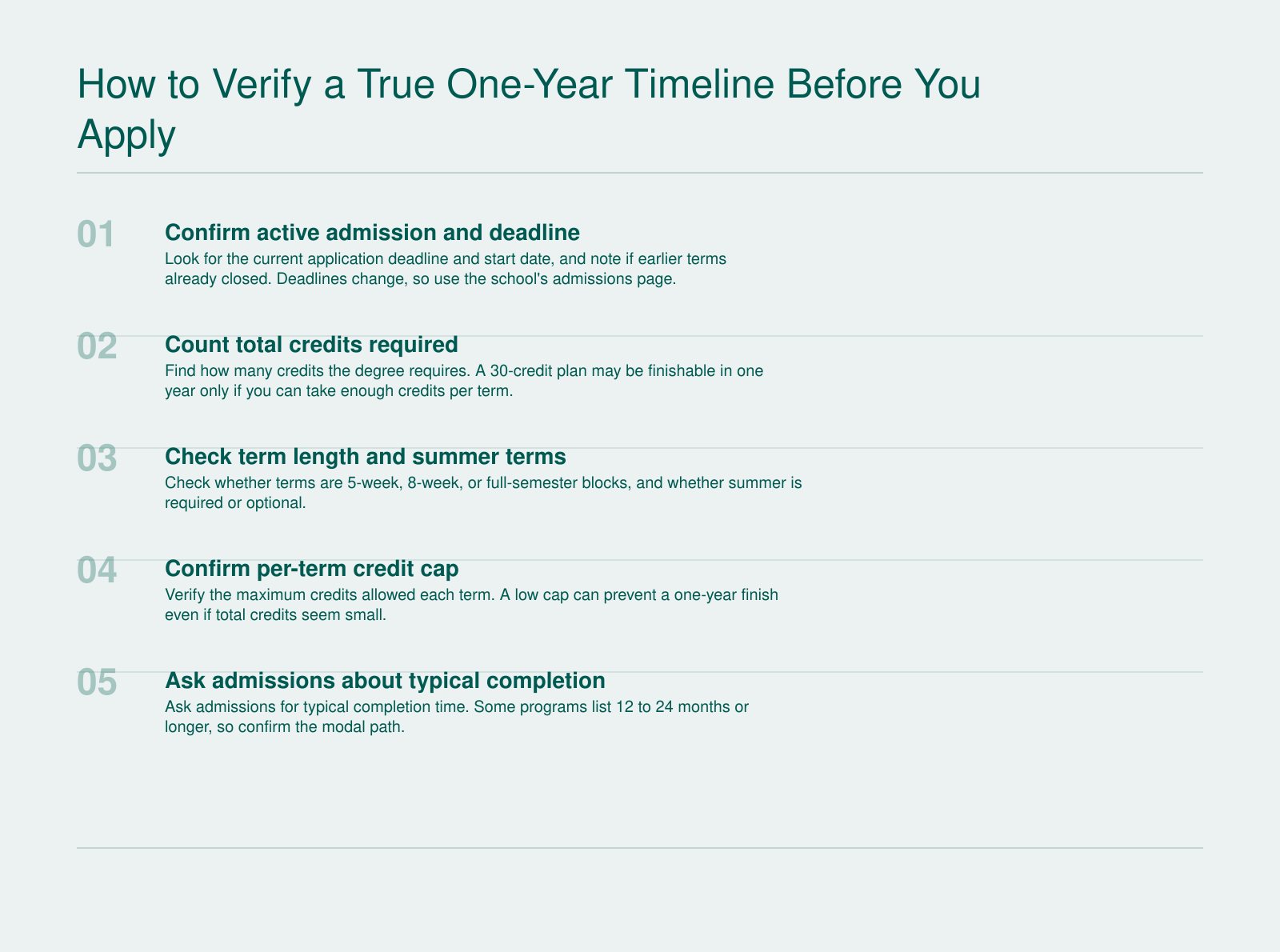
How to Verify a True One-Year Timeline Before You Apply
Accelerated does not always mean one year. Verify the timeline on each school's own admissions page, because deadlines, credit caps, and summer rules can change without notice.
What an Accelerated Social Media Master's Really Costs
Per-credit tuition times required credits is the only reliable starting point for the total cost of a master's degree, and the published figures show how wide the spread runs. Arkansas State's online M.S. in Strategic Communications (Social Media Management) charges $350 per credit for in-state and out-of-state students alike, with fees included, so 30 credits comes to about $10,500.1 Lindenwood's online master's in social media marketing lists $670 per credit for 30 credits, roughly $20,100 before any fees. Liberty's 33-credit M.S. in Social Media Management lists 2026-27 rates from $310 to $665 per credit depending on student category, which works out to roughly $10,230 to $21,945. Rates can change yearly.
When a tuition page doesn't say fees are included, ask about: - Technology or online course fees - Program or capstone fees - Graduation or diploma fees - Travel for any required residency
Accelerated pacing can trim the total by cutting the number of terms you pay per-term fees. It also concentrates cost. Heavier course loads mean bigger bills each term, and your enrollment pattern can affect your financial aid eligibility. Before committing, request a written net-price estimate and ask whether your employer's tuition assistance caps annual benefits, a limit that bites harder on a compressed schedule.
Accreditation Checklist for Social Media Master's Programs
Before you pay an application fee, verify both institutional and program-level status.
- Confirm institutional accreditationLook for a recognized regional or institutional accreditor, such as the Middle States Commission on Higher Education or the Higher Learning Commission, and verify it in the U.S. Department of Education or CHEA database.
- Match the exact program and formatACEJMC accredits submitted degrees and concentrations only. Check that your exact degree, concentration, campus, and delivery format appear in the accreditor's directory. No social-media-specific accreditor exists.
- Check business-school programsIf the degree is housed in a business school, AACSB accreditation may apply to eligible business programs, but it does not automatically cover a communication degree.
- Remember financial aid depends on thisFederal financial aid eligibility depends on institutional accreditation, not on programmatic accreditation.
- Watch for red flagsBe cautious of national-only or unrecognized accreditors, and treat missing campus or program details, pressure to enroll quickly, or no verifiable accreditor directory entry as diploma-mill warning signs.
Related Articles
Online, Hybrid, or In-Person: Delivery Formats and Workload
Fully online options do exist, but delivery format drives how much of a one-year pace is realistic while working. Asynchronous courses give the most scheduling control, while required live sessions, residencies, and internship hours add fixed commitments. The table below contrasts the main formats from program pages.
| Format | Live session requirement | Residency or internship | What it means for a working student |
|---|---|---|---|
| Fully online asynchronous | No set login times. Drexel states no required weekly class time; Liberty uses 8-week courses with no set login times, with some exceptions. | Drexel: no campus attendance required; internship may be remote or virtual. Liberty: no general residency stated; practicum or internship exceptions may apply. | Highest week-to-week flexibility. One-year pace depends on credit load and self-direction, not a fixed lecture schedule. |
| Online with optional recorded live sessions | Mostly asynchronous. UNC Hussman records optional live Zoom sessions, so students are not required to be online at a specific time. | UNC requires a two-day orientation and a weeklong summer residency between first and second years; no internship stated. | Weekly study is flexible, but the summer residency adds a travel and calendar commitment that can affect a tight one-year plan. |
| Online with required weekly live sessions | University of Oklahoma combines asynchronous work with mandatory weekly live sessions, weeknights 7 to 9 p.m. CT; alternate assignments exist if you cannot attend. | No general residency stated on the official page used here. | Plan for 15 to 20 hours per week. Fixed evening sessions are predictable for working professionals but less flexible than asynchronous options. |
| Hybrid or capstone with internship hours | Lasell offers 100% online or hybrid delivery; no scheduled live-session requirement stated. | Lasell capstone options include an internship requiring at least 150 supervised hours; Middle Tennessee State lists internship opportunities but does not state one is required. | Hybrid campus components and a supervised internship capstone can extend the timeline unless hours are built into the accelerated calendar. |
Admissions Requirements and Transfer Credit Limits
Admissions pages vary, so verify the exact GPA basis, test policy, and required materials for each program you shortlist.
- Minimum GPAMany programs look for a 3.0, but thresholds range from about 2.5 to 3.0 and may be based on overall, last 60 credits, or junior/senior years. Lower GPAs can sometimes be offset by holistic or committee review.
- GRE policyGRE scores are commonly waived or optional. Pace, Oregon, Texas State, and UT Martin do not require them, and Denver treats them as optional. Related work experience can strengthen an application where it is considered.
- Supporting materialsExpect a resume, a statement of purpose (often 500–1,000 words), and two to four recommendations. Writing or portfolio samples are common: UT Martin requires a 1,000-plus-word sample, Oregon asks for three, and Georgetown and Pace request prior work samples.
- Work experienceFormal work experience is usually not required, but related professional or student media experience can improve an application, especially where programs score experience or allow internships to substitute.
- Transfer creditTransfer caps are often six to nine credits. Penn State, for instance, accepts up to nine graduate communication credits earned with a B or better within the past five years; prior graduate credit or certificates can shorten the timeline within that limit.
What Social Media and Marketing Leaders Earn
Marketing managers earned a median annual wage of $166,790 in May 2025, while public relations managers earned $146,910, according to the U.S. Bureau of Labor Statistics.
Social Media vs Digital Media vs Marketing Master's: Which Path Fits?
Degree titles in this space overlap so much that the label on the diploma tells you less than the curriculum behind it.
A master's in social media marketing centers on platform strategy, community, and content. USC's Digital Social Media MS requires analytics and research methodology plus a final project capstone, and Quinnipiac's program pairs social media practice with social media analytics and a capstone portfolio1. Digital media degrees lean toward production, design, and media operations. Fitchburg State's 36-credit online Digital Media MS ends with a real-world capstone. Digital marketing degrees cover more business ground: Rutgers addresses content monetization, user experience, analytics, and customer-journey management2, while ASU's audience engagement program adds SEO, search-engine marketing, and paid and organic social.3
Whatever the title, look for four things employers value: analytics, paid social, content strategy, and a capstone or portfolio. Paid social is often a single component of a social degree rather than its core.
A dedicated social media degree suits specialists. Broader master's in marketing or PR degrees keep management options open. accelerated master's in marketing formats may also be easier to find in broader digital marketing programs, so confirm the timeline on each program's own page.
Social Media programs by state
Accelerated Social Media Master's FAQs
Is an accelerated social media master's worth it?
What is the fastest accelerated master's in social media?
Can transfer credits or a graduate certificate shorten an accelerated program even further?
Does studying at an accelerated pace affect federal financial aid or employer tuition reimbursement?
Compare Social Media programs on the data that matters
Explore more Communications & Media specializations or browse every graduate field.
All Communications & Media programs