Best Online Master's in Journalism Programs
Compare 20 accredited online Journalism programs, with graduate earnings, cost, debt, and completion data from IPEDS and the U.S. College Scorecard.

University of Illinois Springfield lists online tuition of $6,148, while New York University's journalism master's carries a net price above $37,000. That gap, for a degree with the same label, is the first thing a working reporter, producer, or career-switcher should register. Yes, you can earn a master's in journalism 100% online through online master's programs, with no campus visit required.
Every program here is fully online, and hybrid formats are excluded. Some still schedule live class sessions, so the tradeoff is less about location than about time and money.
Newsroom pay rarely rises in step with a graduate credential, which makes net price and realistic earnings the numbers that matter most.
Key Points
- This 2027 ranking includes only fully online programs with no campus residency
- University of Florida's online journalism master's costs $484.48 per credit
- Emerson College has the highest published program-level median earnings
Top 10 Fully Online Journalism Master's Degrees, Ranked
These are the best fully online journalism master's programs, ranked with an emphasis on real graduate earnings and graduation outcomes rather than prestige. Each program below can be completed without an on-campus residency, though live class meetings may be part of the schedule. We include tuition, net price, and institution-wide graduation rates so you can weigh cost against career fit.
University of Florida
#1Gainesville, FL · ~$13,000/yr (est.)
Best for: Working reporters balancing live online classes
The University of Florida pairs a 37-credit online Master of Arts in Mass Communication with a digital journalism and multimedia storytelling concentration. The program is designed for working journalists and producers, blending recorded lectures with live class meetings and a capstone project. The school graduates 91% of students; graduate tuition is $6,381 in-state and $28,659 out-of-state, with a net price of $6,541.
- Digital Journalism and Multimedia Storytelling concentration
- $17,926 total program tuition, $484 per credit
- 37 credit hours, 16-month full-time path
- 100% online with live class meetings
- No GRE required; 3.0 upper-division GPA expected
- Capstone project required
New York University
#2New York, NY · ~$43,000/yr (est.)
Best for: Career changers without journalism experience
New York University offers an online Master of Arts in Journalism through the Arthur L. Carter Journalism Institute, with tracks in American Journalism, Business and Economic Reporting, and Cultural Reporting and Criticism. The American Journalism online master's can be completed part time in 15 months while working full time, and prior journalism experience is not required. The school graduates 88% of students; tuition is $62,796, with a net price of $37,050.
- Tracks in American Journalism, Business and Economic Reporting, and Cultural Reporting and Criticism
- GRE not required for most tracks
- Full-time and part-time options available
- 30 credit hours, 8 total courses
- Cohort-based with synchronous online classes
- Complete part time in 15 months while working full time
- Writing sample and three references required
- No prior journalism experience required
- Starts fall and spring
The University of Alabama
#3Tuscaloosa, AL · ~$12,000/yr (est.)
Best for: Aspiring journalists wanting rolling admissions
The University of Alabama offers a fully online Master of Arts in Journalism & Media Studies with a journalism concentration. It serves career changers and current media professionals through rolling admissions and a 31-credit curriculum ending in a master's project or exams. The university is accredited by SACSCOC; the school graduates 73% of students, and tuition is $12,180 in-state and $34,172 out-of-state, with a net price of $22,420.
- Journalism concentration
- 31 credit hours
- Fully online option with rolling admissions
- 3.0 GPA minimum; resume and CV required
- Master's project or exams to graduate
- 90% of professional-track graduates start media jobs within six weeks
University of Kansas
#4Lawrence, KS · $12,000 – $27,000/yr (est.)
The University of Kansas delivers a fully online Master of Science in Digital and Integrated Marketing Communications, a communications degree that leans into digital marketing, branding, and strategic writing rather than traditional newsroom reporting. It is built for working professionals, with part-time, synchronous and asynchronous course options. The school graduates 69% of students; tuition is $12,102 in-state and $30,432 out-of-state, with a net price of $18,059.
- Digital Marketing Communications concentration
- Part-time, synchronous and asynchronous formats
- Built for working professionals
- Forbes Best Online Marketing Master's 2024
- Emphasizes branding, digital marketing and leadership
University of South Carolina
#5Columbia, SC · ~$14,000/yr (est.)
The University of South Carolina offers a Master of Mass Communication online or on campus, with concentrations in Multimedia Journalism and Strategic Communication Management. The program blends theory with hands-on portfolio work and suits working professionals seeking management or journalism roles. The school graduates 79% of students; tuition is $12,688 in-state and $35,972 out-of-state, with a net price of $22,811.
- Multimedia Journalism and Strategic Communication Management concentrations
- Online and on-campus options
- Combination degree with Juris Doctor available
- Fall, spring and summer deadlines
Emerson College
#6Boston, MA · $35,000 – $40,000/yr (est.)
Emerson College's online Master of Arts in Journalism and Media Innovation trains multimedia storytellers with a focus on data-driven investigation and digital technology. Asynchronous classes and no entrance exam make it accessible for working professionals, and students with five or more years of experience can expedite the degree. The school graduates 77% of students; tuition is $57,056, with a net price of $49,180.
- Asynchronous online classes
- No entrance exam required
- Multimedia storytelling and data-driven investigation focus
- Expedited option for professionals with five-plus years
University of Illinois Springfield
#7Springfield, IL · ~$12,000/yr (est.)
The University of Illinois Springfield offers an online Master of Arts in Communication with a journalism and media studies concentration. The 32-credit degree can be completed in about two years and includes a thesis, final project, or comprehensive exams. The school graduates 53% of students; tuition is $12,252 in-state and $22,017 out-of-state, with a net price of $9,833.
- Journalism and media studies concentration
- 32 credit hours, two-year program
- Fully online option
- Thesis, final project, or comprehensive exams
- $6,148 online tuition per year
- Graduate Public Service Internship with tuition waiver and stipend
St Bonaventure University
#8Saint Bonaventure, NY · ~$16,000/yr (est.)
St. Bonaventure University's online Master of Arts in Digital Journalism is a 30-credit, asynchronous program that can be finished in about 1.5 years, including a three-course capstone. The curriculum covers digital reporting, media law, social storytelling, data journalism, and coding for the web. The school graduates 67% of students; tuition is $41,735, with a net price of $27,074.
- 30 credit hours, about 1.5 years
- 100% online and asynchronous
- $24,450 total program tuition, $815 per credit
- No GRE or GMAT; no application fee
- Capstone digital journalism project
- Covers data journalism and coding with HTML, CSS, JavaScript
Kent State University
#9Kent, OH · ~$12,000/yr (est.)
Kent State University's fully online Master of Arts in Media and Journalism with a Journalism Education concentration was designed for licensed secondary school teachers and advisers, as well as newsroom professionals seeking graduate credentials to teach. The program emphasizes multimedia storytelling technology and First Amendment rights strategies. The school graduates 64% of students; tuition is $13,232 in-state and $23,082 out-of-state, with a net price of $20,787.
- Journalism Education concentration
- Fully online
- First fully online journalism educator MA
- Built for licensed secondary school teachers
- Home to Center for Scholastic Journalism and Knight Chair
University of Memphis
#10Memphis, TN · $10,000 – $15,000/yr (est.)
The University of Memphis offers an online Master of Arts in Journalism and Strategic Media with concentrations in News and Storytelling, Integrated Strategic Media, and Visual Media. The 33-credit curriculum includes core media theory, research methods, and a capstone project, practicum, or thesis. The school graduates 51% of students; tuition is $10,728 in-state and $15,384 out-of-state, with a net price of $12,397.
- News and Storytelling concentration
- Focus on investigative reporting and multimedia storytelling
- Prepares for reporter and editor roles
- Integrated Strategic Media concentration
- Emphasis on strategic communication and media management
- Prepares for media professions
- Visual Media concentration
- Focus on visual media production
- Online or on-campus flexibility
Cost & outcomes by school
Federal data for the highest-earning Journalism programs, independent of the ranking above. Earnings are this field's master's graduates four years after completing, where the Scorecard reports them.
| School | Earnings | Tuition / yr | Debt | Grads/yr | Format |
|---|---|---|---|---|---|
| Kent State University OH | $83,464 | $12,483 | $27,036 | 20 | Online |
| St Bonaventure University NY | $82,191 | $16,087 | $27,582 | 8 | Online |
| University of Missouri MO | $77,057 | $13,681 | $20,877 | 38 | Hybrid |
| University of Nebraska-Lincoln NE | $73,130 | $8,434 | — | 13 | Hybrid |
| University of South Florida FL | $69,612 | $10,428 | $36,404 | 11 | Hybrid |
| University of Florida FL | — | $12,737 | — | — | Online |
| The University of Alabama AL | — | $11,980 | — | 33 | Online |
| University of Memphis TN | — | $11,628 | — | 16 | Online |
| Stony Brook University NY | — | $14,222 | — | 3 | Hybrid |
Sources: U.S. Department of Education. Tuition and graduates: IPEDS. Earnings and debt: College Scorecard, this field's master's graduates; a dash means no figure is reported.
Cost, debt & payoff
Median earnings of this field's master's graduates (4 yrs after completing) vs. their median federal loan debt · U.S. College Scorecard
Across these programs the median graduate earns about $71,658 and finishes with roughly $46,786 in debt — a ratio that clears a common rule of thumb (keep debt below first-year salary). Tuition and debt vary widely school to school, so check the per-school figures in the table above before you shortlist.
Our Scoring Formula: 100% Online Delivery Weighed Against Real Outcomes
Does the degree ever require you to set foot on campus? That was the first question we asked of every journalism master's program we considered, and any program that answered yes was cut. That means no required residency, no weekend intensives, and no hybrid formats. Every program below can be completed 100% online from wherever you report, edit, or produce.
What Moves a Program Up the List
Programs that cleared the online-only screen were ordered by a mixed quality composite built on outcomes you can verify:
- Net price after aid: the cost of master's in journalism programs once grants and scholarships are applied, not the sticker tuition.
- Graduation rate: a signal of whether students who start actually finish.
- Graduate earnings and debt: College Scorecard figures on what graduates earn and borrow, used where the federal data is published.
That is a deliberate break from prestige-driven lists, which lean on reputation surveys and name recognition. A famous journalism school can still be a poor deal if its graduates carry heavy debt into an industry where pay is often modest.
Caveats Worth Knowing
Two inputs have limits. Graduation rates are institution-wide, not specific to the journalism program, so they describe the whole university. Net price is an average across students after aid, not a quote for you. Your actual cost depends on your aid package, state residency, and course load. Federal earnings data covers some programs and not others, so the remaining measures carry more of the comparison for schools without it.
Use the order as a starting shortlist, then confirm the details with each school. The ranked list below shows how the programs stack up.
Truly 100% Online? Residencies, Live Sessions, and Proctoring
Flexibility is the reason most working reporters look at online degrees, from a journalism master's to a broader online master's in media communication, yet "online" on a landing page can still hide campus visits and fixed class times. So, can you earn a journalism master's fully online? Yes. But read the delivery details closely before you assume it fits your shift schedule.
Asynchronous vs. scheduled live classes
Program pages for Emerson College and St. Bonaventure University both describe asynchronous online classes. The University of Florida's digital journalism track is labeled 100% online but with live classes, so expect set meeting times. The University of Kansas lists synchronous and asynchronous options, which means you should ask which sections you would actually take. The University of Alabama, the University of Illinois Springfield, and Kent State all advertise a fully online option, but the pages we reviewed do not say whether courses are live. South Carolina and Memphis offer both online and campus versions, so confirm you are looking at the online track.
Outside the ranked schools, the University of Arizona's M.A. in Studies of Global Media states that all classes are asynchronous. Its Bilingual Journalism M.A. is currently face-to-face, with an online version only planned.
Capstones and orientations
Capstones are listed as required at Florida, St. Bonaventure, and Memphis. Illinois Springfield offers a thesis or capstone option, and Alabama lists a master's project or exams. None of those pages establish a campus defense, and none confirm an optional or mandatory orientation, so ask admissions directly rather than assuming.
A three-question screen
- Campus visit: Is any residency, immersion weekend, or in-person defense required, even once?
- Scheduling: Are classes synchronous, and at what hours and time zone?
- Fieldwork: Is reporting done locally, with your own sources, or must you travel?
Check state authorization
Some online programs cannot enroll residents of certain states because of state authorization rules. Confirm your state is eligible before you spend money on applications, and get the answer in writing if you can.
Cheapest Online Master's in Journalism: Three Lowest-Net-Price Picks
Advertised per-credit rates rarely tell the full cost story. The University of Florida's 37-credit online master's in journalism lists $484.48 per credit, and other programs may add per-semester technology or distance-education fees while leaving book and software costs unpublished. The net price below is an institution-wide average after financial aid, and some public universities charge a flat online rate regardless of residency; before enrolling, request an itemized cost estimate from the bursar that separates tuition, fees, and book or software estimates.
| School | Format | Graduate Tuition (In-State) | Graduate Tuition (Out-of-State) | Average Net Price |
|---|---|---|---|---|
| University of Florida | Online | $12,737 | $30,130 | $6,541 |
| University of Illinois Springfield | Online | $11,938 | $19,515 | $9,833 |
| University of Memphis | Online | $11,628 | $15,840 | $12,397 |
Journalism Master's Degree Salary: What Graduates Earn by School
Newsroom reporting and strategic communication draw from the same degree but rarely pay the same. The journalism and mass communication degree programs on this list with published program-level figures show how far the earnings can spread depending on which path you walk out into.
What Graduates Actually Earn
Among programs with reported earnings, the University of Kansas stands out early. Its Master of Science in Digital & Integrated Marketing Communications shows a median of about $66,000 one year after finishing, the highest first-year figure in the group and a reminder that marketing-leaning communications tracks tend to reward graduates faster than traditional reporting roles.
Five years out, the numbers climb. Kent State graduates reach a median near $71,700, St. Bonaventure around $68,600, and Emerson roughly $73,100 five years after finishing. Regent University graduates land near $49,800 four years after completing, the lowest among programs with a published figure. The spread between the top and bottom earners here runs more than $23,000, and it tracks closely with concentration: strategic and digital communications sit at the high end, as do many communication management master's programs, while traditional journalism and faith-based reporting tracks sit lower.
Earnings Against Debt
Earnings only matter next to what you borrowed. St. Bonaventure pairs its roughly $68,600 five-year median with median graduate debt around $27,600, and nearly every graduate (about 96 percent) earns above the poverty line. Kent State shows a similar profile: about $71,700 at five years against $24,500 in median debt. Emerson carries a higher sticker but still returns strong earnings. As a rule of thumb here, the public programs deliver the tighter debt-to-earnings math.
Employment data reinforces the picture where it exists. St. Bonaventure reports that essentially all graduates were working one year after completing, and Kent State sits near 94 percent employed at the same mark.
School-Reported Outcomes
Schools publish their own figures too, though they measure different things. Northwestern's Medill reports a 95 percent employment rate for its Class of 2025, split roughly 46 percent into news reporting, 21 percent into broadcast production, and about 11 percent each into communications and sports. That figure counts part-time, fellowship, and freelance work, not full-time placement alone. The University of Georgia's Grady College reported 64 percent of its Class of 2024 in full-time work, with master's salaries ranging from $34,000 to $82,500, though that range rests on just 14 respondents across its graduate programs.
The takeaway: communications and marketing tracks pay more, sooner, and the best value sits where solid earnings meet modest debt.
Top Program-Level Earnings Figure
The highest published program-level median earnings figure among the ranked programs belongs to Emerson College.
Investigative, Broadcast, or Digital Media: Matching a Concentration to Your Career
Which journalism concentration actually leads to the job you want? The track you pick shapes the skills you build and the roles you qualify for, so it pays to match the concentration to a concrete career goal rather than a vague interest.
Digital and multimedia journalism
This is the most common track among the programs here. The University of Florida's Digital Journalism and Multimedia Storytelling emphasis and St. Bonaventure's Master of Arts in Digital Journalism teach social media, data, and interactive production. These skills map to roles like data reporter, multimedia producer, and audience engagement editor, positions newsrooms are hiring for aggressively.
Choose this if you want to work across platforms and your goal is a hybrid newsroom job that blends reporting with digital production and analytics.
Strategic and marketing communication
Several programs lean toward the communications side of the field, a space that includes online master's in strategic communication programs. The University of Kansas offers Digital Marketing Communications, and the University of South Carolina runs a Strategic Communication Management track. These prepare you for communications manager, brand strategist, or public relations roles rather than traditional reporting.
Choose this if you see yourself inside a company, agency, or government office shaping messaging instead of chasing deadlines in a newsroom.
Investigative and news storytelling
The University of Memphis offers a News and Storytelling concentration, and NYU's journalism tracks include business and economic reporting and cultural criticism. These feed roles like investigative reporter, beat specialist, and feature writer.
Choose this if deep reporting and long-form accountability work is the point of the degree for you.
A note on broadcast tracks
If you are searching for a master's in broadcast journalism online, remember that broadcast and video work still demands real equipment and portfolio production completed from home. Before enrolling, confirm exactly what gear and editing software the program expects you to own, since camera, audio, and editing requirements can add meaningful cost on top of tuition.
Choose a broadcast-leaning program only if you are ready to build a demo reel remotely and invest in the hardware to do it.
Related Articles
What You'll Need to Apply: Portfolios, GRE Policies, and Deadlines
Admissions requirements vary among the programs below. A bachelor’s degree in any field is typical; writing samples, GRE policies, work experience, and deadlines differ by school.
- Bachelor’s degree and minimum GPAA journalism major is not required. Where published, Hofstra lists a 2.75 overall minimum; Missouri requires a 3.0 in the last 60 undergraduate hours.
- Portfolio or writing samplesNew York University asks for three writing samples, Georgetown treats two samples as optional, and Hofstra encourages clips but does not require them. Emerson does not publish a portfolio requirement in its admission materials.
- GRE policyThe University of Florida, Georgetown, and NYU do not require the GRE; Hofstra makes it optional. Georgetown also states that GRE or GMAT scores are neither required nor reviewed.
- Work experience, recommendations, and materialsMissouri requires at least three years of journalism or strategic-communications experience, excluding internships and school media. NYU lists three letters of recommendation. A statement of purpose and current résumé are typically part of the checklist; confirm each program’s site for specifics.
- Deadlines and start termsGeorgetown admits for fall only, with an April 1 priority and June 15 final deadline. Florida’s fall 2026 priority is April 1 and final June 1. Emerson offers fall, spring, and summer starts; its fall priority is March 1 and final July 1. Hofstra uses rolling admission with no hard deadline. Missouri sets session-specific deadlines, such as June 13 for the fall 16-week or first 8-week term.
Debt vs. Earnings: Where the Payback Math Works
Graduate debt varies less than later earnings across these online journalism programs. The chart compares each school's median debt at completion with median earnings for graduates 10 years after entry. A debt-to-earnings ratio below 1 means a year of earnings exceeds total debt, a faster payback sign.
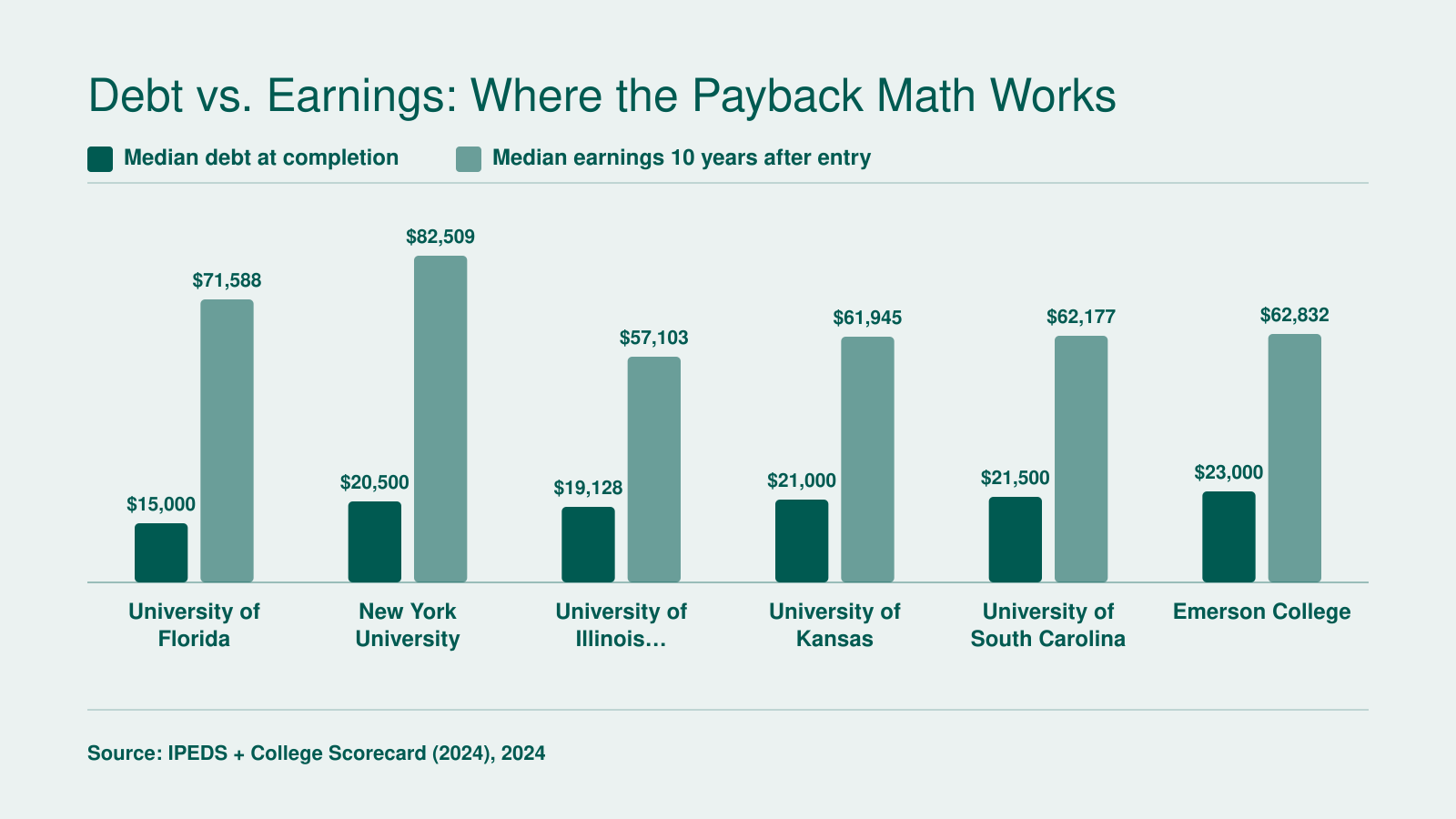
The best value in an online journalism master's is the program whose net price stays in proportion to what its own graduates actually earn, and a bigger name isn't always the better value.
Journalism programs by state
Compare Journalism programs on the data that matters
Explore more Communications & Media specializations or browse every graduate field.
All Communications & Media programs