Most Affordable Master's in Journalism Programs
Compare 110+ accredited most affordable Journalism programs at 70+ schools, with graduate earnings, cost, debt, and completion data from IPEDS and the U.S. College Scorecard.

Newsroom pay is modest, so a journalism master's only makes sense when the bill stays low. Average net prices at the schools ranked here run from $9,812 at the University of South Florida to $19,857 at the University of Texas at Austin, roughly double.
Those are institution-wide averages after aid, not program quotes, but the spread is real. A reporter on a newsroom salary feels a $10,000 gap through years of loan payments.
Key Points
- ACEJMC accredits roughly 120 programs but reviews only professional master's programs.
- Missouri graduates earn median $67,508 five years after finishing.
- CUNY Newmark charges $6,136.45 per term plus mandatory fees.
Top 10 Affordable Master's in Journalism Programs, Ranked by Real Cost
Price tags lie, so this list starts from what students actually pay after aid, then checks whether the school finishes what it starts. Each card pairs the institution-wide average net price with the school's graduation record and a real program detail, so you can compare value instead of sticker shock. Use the concentration notes and delivery formats below to find the journalism master's that fits your budget and life.
University of South Florida
#1Tampa, FL · ~$10,000/yr (est.)
Best for: Cost-conscious media pros seeking online flexibility
The University of South Florida blends digital journalism and design into a practical master's that can be completed in as little as one year. Students may choose a fully online route or mix online coursework with face-to-face classes at the St. Petersburg campus. The curriculum covers web publishing, social media, multimedia production, information graphics, and audience analytics. Alumni work as editors, writers, reporters, content creators, and senior managers.
- Fully online option available
- Can be completed in as little as one year
- Online or blended coursework formats
- Face-to-face classes at St. Petersburg campus
- Covers web publishing and design
- Social media and multimedia production skills
- Information graphics and analytics coursework
- Alumni roles include editors, writers, reporters
Arkansas State University
#2Jonesboro, AR · $7,000 – $13,000/yr (est.)
Best for: Aspiring researchers wanting thesis or project option
Arkansas State's journalism major sits inside a Master of Science in Mass Communications, giving students room to blend reporting with communication research. The 30-credit program offers journalism or radio-television emphasis, plus electives in crisis communication, integrated marketing, or diversity and media. Students can choose a thesis or project route, making it a fit for those considering doctoral study or advanced media roles. The flexible curriculum suits working professionals and full-time students alike.
- 30 total credit hours
- Journalism or radio-television emphasis
- Thesis or project option available
- 2.8 GPA minimum for admission
- Prepares for doctoral studies
- Focus on research and scholarship
- Courses in media ethics and civic reporting
- Flexible curriculum with advisor-approved electives
University of Nevada-Reno
#3Reno, NV · ~$7,000/yr (est.)
Best for: Aspiring media innovators exploring three tracks
The University of Nevada, Reno offers a Master of Arts in Media Innovation with three distinct tracks: Strategic Communications, News Innovation, and Media Studies. The 30-credit program starts with storytelling foundations in writing and multimedia, then pushes into the future of media and civic engagement. Students complete a project with a 3.0 GPA and can tap the Center for Advanced Media Studies for research grants and events. Graduates move into public radio, PR agencies, marketing firms, and nonprofits, with many continuing to doctoral programs.
- Strategic Communications track
- 30 total credit hours
- 3.0 GPA minimum
- Careers in public radio and news organizations
- Focus on journalism's role in civic knowledge
- CAMS grants support graduate research
- Storytelling foundations in writing and multimedia
- News Innovation track
- Graduates work in public radio
- Prepares for Ph.D. programs
- Research arm CAMS supports grants
- Focus on civic knowledge and innovation
- Longstanding journalism tradition since 1922
- Media Studies track
- 30 total credit hours
- 3.0 GPA minimum
- CAMS research grants available
- Three specialization tracks
- Graduates work in media
University of North Texas
#4Denton, TX · $9,000 – $16,000/yr (est.)
The University of North Texas houses the Frank W. Mayborn Graduate Institute of Journalism, a nationally accredited professional program. The 36-credit master's combines media theory, ethics, and research methods with advanced reporting and multimedia skills, and it requires a thesis. Evening and late-afternoon classes, plus some online options, suit working professionals, while the Dallas-Fort Worth media market opens internship doors. Students can pursue interests from broadcast and business journalism to investigative reporting and public relations.
- 36 total credit hours
- Thesis required
- Nationally accredited professional master's
- Classes offered late afternoons and evenings
- Located in Dallas-Fort Worth media market
- Internships in advertising, PR, and news
- Foreign language requirement
- Core courses in media ethics and research
- Thesis or non-thesis option
- 36 total credit hours
- Nationally accredited professional master's
- Individualized degree plans
- Evening classes for working students
- Internships in fifth largest media market
- Career interests include broadcast and investigative
Stony Brook University
#5Stony Brook, NY · ~$14,000/yr (est.)
Stony Brook's Master of Science in Journalism blends traditional reporting with a solutions journalism focus, preparing students to cover real community needs. The 33-credit program covers legal ethics, inclusive engagement, multimedia storytelling, and narrative design, with hands-on work in a newsroom, broadcast studio, and podcasting studio. Full-time and part-time enrollment are available, with evening classes and some synchronous online offerings. No journalism background is required, and GRE scores are optional.
- Solutions journalism focus
- 33 total credit hours
- ACEJMC accredited program
- Test optional (GRE)
- No journalism background required
- Full-time and part-time options
- Evening classes and synchronous online offerings
- Hands-on newsroom, broadcast, and podcast studios
University of Oklahoma – Hudson College of Public Health
#6Norman, OK · ~$9,000/yr (est.)
The University of Oklahoma's Gaylord College offers a Master of Arts in Journalism and Mass Communication with four emphasis areas, including Journalism, Media Management, Creative Media Production, and Strategic Communication. The 33-credit curriculum mixes theory, research methods, and advanced professional skills, with evening classes for working professionals. Students choose a thesis, professional project, or comprehensive exam route. The program emphasizes hands-on learning through electives like advanced multimedia journalism, sports public relations, and documentary producing.
- Journalism emphasis
- 33 total credit hours
- Thesis or capstone option
- Curriculum mixes theory, research, professional skills
- Evening classes available
- Five-year completion limit
- Full-time typically four semesters
- Media Management emphasis
- 32 total credit hours
- Rolling admissions
- Starts fall
- Thesis, project, or exam route
- $0 application fee
- Evening classes for professionals
- Graduate certificate in media management
- Creative Media Production emphasis
- 32 total credit hours
- 3.0 GPA minimum
- Thesis required
- Complete in four regular semesters
- Thesis, project, or exam routes
- Evening classes for working professionals
- State-of-the-art Gaylord Hall facility
The University of Texas at Austin
#7Austin, TX · ~$12,000/yr (est.)
The University of Texas at Austin's Moody College of Communication offers a professional-track MA for career changers, covering reporting, visual storytelling, media law, and the business of news. The 30-credit, full-time program runs over two semesters and includes a required summer internship at outlets like the Texas Tribune, Sports Illustrated, or NBC News. Small cohorts and industry faculty provide intensive editing and mentorship. A separate research and theory track serves students aiming for doctoral work or academic careers.
- For career changers entering journalism
- 30 total credit hours
- Required summer internship
- Full-time, two-semester program
- Fall admission only; apply by December 1
- 18 hours of required core courses
- 12 hours of elective courses
- Hands-on training with industry faculty
- Research and theory focus
- Prepares for doctoral study
- Faculty with distinguished research records
- Fall admission only; apply by December 1
- No spring admissions
- Dual degree programs available
Northern Illinois University
#8Dekalb, IL · $5,000 – $10,000/yr (est.)
Northern Illinois University's master's in journalism takes a critical, theory-driven approach to media, law, and ethics in a fast-changing landscape. The curriculum examines public affairs reporting, global journalism, emerging technologies, and press problems through conceptual, legal, and ethical lenses. On-campus learning allows close mentorship from graduate faculty. The program suits students aiming for journalism, media analysis, or communication leadership.
- Focus on global journalism and emerging technologies
- Examines legal and ethical issues in media
- Courses on public affairs reporting
- Seminar on press and world affairs
- On-campus learning with close mentorship
- Prepares for journalism and media analysis
University of Arizona
#9Tucson, AZ · ~$15,000/yr (est.)
The University of Arizona offers an accelerated one-year, 33-unit Master's in Journalism with Professional or Journalism Studies emphases. The curriculum covers advanced reporting, multimedia storytelling, media law, ethics, and research methods, with electives like media and terrorism or information sleuthing. Students complete a master's project or internship, and the cohort-based format builds strong professional networks. Arizona residents and qualifying Western Regional Graduate Program students may receive resident tuition pricing.
- One-year, 33-unit program
- Professional or Journalism Studies emphasis
- Capstone: master's project or internship
- Cohort-based format
- Courses cover ethics and diversity
- Electives include media and terrorism, information sleuthing
- Hands-on learning through Arizona Sonora News
University of Maryland-College Park
#10College Park, MD · ~$18,000/yr (est.)
The University of Maryland's Philip Merrill College of Journalism offers both a research-focused MA in Journalism and a professional Master of Journalism with multiplatform or broadcast concentrations. The 30-credit programs emphasize advanced reporting, digital storytelling, and data analysis, with small classes taught by Pulitzer and Emmy award-winning faculty. Students gain real-world experience through Capital News Service and the Howard Center for Investigative Journalism. The program's proximity to Washington, D.C., unlocks internships at top media outlets.
- Research-oriented thesis program
- 30 total credit hours
- GRE optional
- Apply by January 15
- Pulitzer-winning faculty
- Access to Capital News Service
- Howard Center for Investigative Journalism
- Located near Washington, D.C.
- Multiplatform Journalism concentration
- 30 total credit hours
- Full-time enrollment
- Cohort-based structure
- Capstone required through Capital News Service
- Portfolio reviewed by faculty and professionals
- Career pathways: Audience Engagement, Investigative, Data
- Optional fourth semester at Howard Center
- Broadcast Journalism concentration
- 30 total credit hours
- Capstone required
- Capital News Service capstone
- Flexible curriculum with many electives
- Specializations in broadcast and multiplatform
Cost & outcomes by school
Federal data for the highest-earning Journalism programs, independent of the ranking above. Earnings are this field's master's graduates four years after completing, where the Scorecard reports them.
| School | Earnings | Tuition / yr | Debt | Grads/yr | Format |
|---|---|---|---|---|---|
| Georgetown University DC | $90,356 | $61,670 | — | 16 | Campus |
| Kent State University OH | $83,464 | $12,483 | $27,036 | 20 | Online |
| St Bonaventure University NY | $82,191 | $16,087 | $27,582 | 8 | Online |
| Columbia University in the City of New York NY | $78,880 | $57,973 | $69,000 | 230 | Campus |
| University of Missouri MO | $77,057 | $13,681 | $20,877 | 38 | Hybrid |
| Hofstra University NY | $74,266 | $31,120 | — | 8 | Campus |
| University of Nebraska-Lincoln NE | $73,130 | $8,434 | — | 13 | Hybrid |
| Arizona State University AZ | $72,390 | $13,587 | $35,778 | 43 | Campus |
| University of Georgia GA | $70,926 | $11,002 | $22,394 | 74 | Campus |
| University of South Florida FL | $69,612 | $10,428 | $36,404 | 11 | Hybrid |
| Columbia College Chicago IL | — | $2,544 | — | — | Campus |
| University of Nevada-Reno NV | — | $7,032 | — | 15 | Campus |
Sources: U.S. Department of Education. Tuition and graduates: IPEDS. Earnings and debt: College Scorecard, this field's master's graduates; a dash means no figure is reported.
Cost, debt & payoff
Median earnings of this field's master's graduates (4 yrs after completing) vs. their median federal loan debt · U.S. College Scorecard
Across these programs the median graduate earns about $71,658 and finishes with roughly $46,786 in debt — a ratio that clears a common rule of thumb (keep debt below first-year salary). Tuition and debt vary widely school to school, so check the per-school figures in the table above before you shortlist.
Sticker Price vs. What You'll Actually Pay After Aid
Tuition is only the starting point when you compare the cost of master's in journalism programs. At the Craig Newmark Graduate School of Journalism at CUNY, students pay $6,136.45 per term, but full-time mandatory fees add $1,382.90 in each of the first two semesters and $591.45 in the third, with another $2,000 to $3,000 budgeted for personal equipment and software.1 At the University of Maryland, where tuition runs about $913 per credit, a 12-credit semester also carries a $738 campus fee.2 Federal data list the university's overall average net price at $15,678, showing how aid and fees can shift the real cost away from the sticker price.
To estimate your own total, multiply the per-credit rate by total credits, add per-semester fees times expected semesters, then add one-time costs like orientation, practicum, or equipment fees. The University of Arizona charges a flat $100 per credit program fee,3 while UNC-Chapel Hill lists technology fees of $23.17 or $208.50 plus a possible $200 practicum and $500 orientation fee.4
Graduate students should not assume undergraduate net price figures transfer directly. Pell grants and some need-based aid are less available at the graduate level, so assistantships and loans usually make up the difference.
Online Journalism Graduate Programs: Residency Rules and Part-Time Pacing
The clearest affordability lever in online journalism master's programs is whether a public university charges a flat e-tuition rate to all online students, but individual policies are not always published. Among programs that do report a per-credit rate, University of Florida charges $484.48 per credit for its 37-credit Digital Journalism and Multimedia Storytelling track, or about $17,926 in tuition before fees. At six credits per term, that schedule runs roughly six full terms plus a lighter final term.
| School | Online Per-Credit Rate | Out-of-State Online Students Pay | Total Credits | Typical Part-Time Completion |
|---|---|---|---|---|
| University of Florida | $484.48 per credit | Not published | 37 credit hours | 24 or 30 months |
| University of Alabama | $480 per credit | Not published | 31 credit hours | Not published |
| University of Missouri | Not published | Not published | 33 credit hours | 2 to 3 years |
| University of Missouri, Interactive Media | Not published | Not published | 33 credit hours | 2 to 3 years |
| University of Missouri, Media Management | Not published | Not published | 33 credit hours | 2 to 3 years |
Related Articles
ACEJMC reports roughly 120 accredited programs overall, but it accredits units (schools, colleges, departments), not every degree they offer, and it reviews only professional master's programs. Separately, regional accreditation applies institution-wide and is what generally makes a school eligible for federal student aid.
Prerequisites, Portfolios, and Capstones at Low-Cost Programs
- Bachelor's, GPA, and application basicsApplicants typically need an accredited bachelor's, a statement of purpose, and recommendation letters. GPA floors vary: UC Berkeley and Illinois list 3.0; Arizona State uses 3.00; Memphis has no formal minimum.
- Writing samples or clipsUC Berkeley requires 2–3 work samples and Illinois requires writing samples; Alabama requests journalistic clips if available.
- Journalism backgroundPrior journalism coursework is not required at UC Berkeley or Memphis; Memphis offers prerequisite courses for newcomers that must be completed with a B or better.
- Testing policiesGRE/MAT policies vary; Memphis lists GRE or MAT among acceptable criteria but does not confirm a waiver, and other programs do not publish a GRE requirement.
- Final project formatCapstone formats differ: Memphis requires a capstone, with professional projects or practicums on professional tracks and thesis or peer-reviewed research for research paths; Alabama uses a capstone or comprehensive exam for Plan II and distance learners.
Which Low-Cost Programs Pay Off for Graduates
A cheap degree only pays off if the paycheck covers the loan. These figures are program-level, and each comes with its own time window.
Earnings Against Debt
University of Missouri graduates report median earnings of $67,508 five years after finishing, against median debt of $20,877 and a $237 monthly payment over 10 years. St. Bonaventure shows $68,594 at five years, with $27,582 in debt and a $314 payment. Kent State reports $71,715 at five years, $27,036 in debt and a $308 payment. USF's figure is $69,612 four years after finishing, with $36,404 in debt and a $414 payment.
The picture tightens at higher debt. DePaul graduates earn $60,656 five years out but carry $44,065 in debt and a $501 payment. Oregon reports $54,051 at five years against $46,786 in debt and a $532 payment.
Kansas reports $66,011 one year after finishing, and Maryland reports $65,744 five years after finishing, but neither shows a debt figure here. Point Park and Illinois do not have comparable program-level earnings to quote.
A Rule of Thumb
Keep total borrowing below what you expect to earn in your first year after the degree. Missouri's one-year-out earnings of $55,800 sit well above its median debt, while Oregon's debt exceeds its one-year-out earnings of $40,157. Check that gap before you enroll.
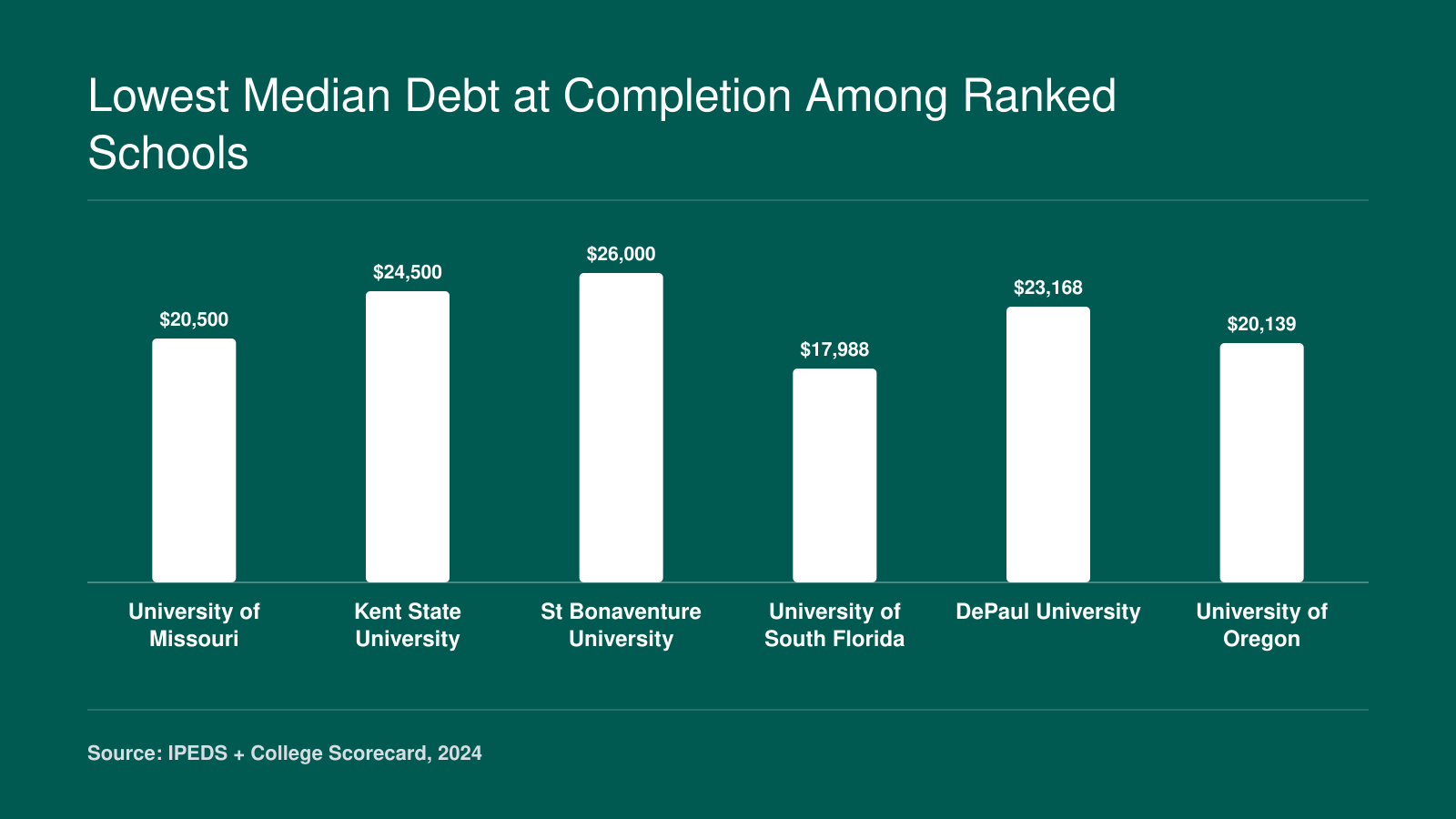
Lowest Median Debt at Completion Among Ranked Schools
These are medians for students who completed their programs, so half of borrowers finished with less debt and half with more. Programs without a published debt figure are shown without a bar.
Journalism programs by state
Quick Answers on Cost and Value
What is the cheapest online master's in journalism?
Does every online journalism master's charge in-state tuition to students in other states?
Does a low-cost journalism master's pay off if newsroom salaries are modest?
Compare Journalism programs on the data that matters
Explore more Communications & Media specializations or browse every graduate field.
All Communications & Media programs