Accelerated Master's in Political Psychology Programs
Compare 5 accredited fastest Political Psychology programs, with graduate earnings, cost, debt, and completion data from IPEDS and the U.S. College Scorecard.

A bachelor's and a political psychology master's in about five years is the pitch, but the pathway is narrower than the pitch suggests. In the typical 4+1 model, senior-year graduate courses count toward both degrees, which trims a year of tuition and time.
Verified accelerated options in this field are rare, so treat this as a method for confirming policies yourself, not a ranked list. Most schools that offer one publish the rules only in the graduate catalog.
Key Points
- Shared-credit savings equal shared credits times the graduate per-credit rate.
- Verify accelerated-credit policies from the program's official graduate catalog page.
- Political psychology has no programmatic accreditor, so confirm institutional accreditation.
Accelerated Master's in Political Psychology Programs
-
#151score
How we rank. Each program is scored on graduate figures only: the field's master's earnings and debt, graduate tuition and the number of master's graduates, normalized across all programs in this field. Data comes from the U.S. Department of Education's IPEDS and College Scorecard; no school pays for placement.
Compare the top programs
| Rank | School | Earnings | Tuition / yr | Debt | Grads/yr | Format |
|---|---|---|---|---|---|---|
| 1 | Stony Brook University NY | — | $14,222 | — | — | Campus |
Sources: U.S. Department of Education. Tuition and graduates: IPEDS. Earnings and debt: College Scorecard, this field's master's graduates; a dash means no figure is reported.
What Is an Accelerated Master's in Political Psychology?
How can a master's in political psychology overlap with a bachelor's degree? In the accelerated model, often called 4+1 and common in accelerated political science master's programs, undergraduates take graduate-level courses in their senior year, and those courses count toward both degrees. The master's then wraps up about a year after the bachelor's.
How ASU's Shared Credits Work
Arizona State University's MA in Political Psychology (Accelerated) allows up to 12 shared credits for 2026-2027: no more than 3 at the 400 level and 9 at the 500 level. Internship, independent study, and Junior Fellow courses are ineligible. ASU's broader graduate policy sets a 15-hour ceiling, with grades of B or better, but the program pages cite 12.1
The pathway is for declared Political Science BA or BS students, online or in person. Students apply in the second semester of year three with a 3.6 cumulative ASU GPA and at least 75 credits, and need 90 credits before graduate coursework begins. Listed deadlines are May 15 or October 15. Graduate courses start in year four, and the bachelor's must be finished within one calendar year of acceptance, which leads into year five. ASU's pages give this timing framework rather than a semester-by-semester course map.
Versus a Standard Master's
A standard program means a separate application after graduation, no shared credits, and typically 1.5 to 2 additional years. Before committing, ask admissions what happens to shared credits if you leave the master's portion.
How to Find Verified Accelerated Political Psychology Programs
True accelerated or combined political psychology pathways are rare, so search patiently rather than browse a list of affordable political psychology master's programs. Use this method to confirm what a school actually offers before you build a plan around it.
Search the Catalog, Then the Departments
Start in the university's online course catalog and search terms like "accelerated," "4+1," "BA/MA," or "combined degree" alongside "political psychology." Then open both the political science and psychology department pages, since these degrees often live across two units. Many schools pair political science master's programs with a psychology component rather than offering a standalone political psychology concentration. Texas Woman's University, for example, lists an accelerated Political Science B.A./M.A. with a Political Psychology course (POLS 5413), though its catalog does not establish a dedicated concentration.1
Confirm the Policy and Your Eligibility
Finally, verify the terms on the graduate school's accelerated-program policy page, not a brochure. Ask the department directly whether your own undergraduate major qualifies, because many 4+1 tracks limit feeder majors and set credit thresholds (Texas Woman's University requires 90 completed credit hours before graduate coursework begins).1
Do not rely on third-party directories that name programs without linking to the school's own policy. If a listing cannot point you to the official catalog, treat it as a lead to verify, not a fact.
Admissions Page Checklist: What to Verify Before You Apply
Check the published program page and graduate catalog for each item, not a third-party summary.
- GPA requirementsConfirm cumulative and any major-specific GPA thresholds and how each is calculated; one accelerated pathway requires a 3.6 cumulative GPA using only home-university coursework.
- Credit standingVerify the credit threshold before applying and before starting graduate coursework; one example uses 75 credits at application and 90 before graduate work.
- Eligible majors and formatConfirm your bachelor's major and delivery mode are accepted, such as an on-ground or online political science BA/BS, and whether the application is internal.
- Deadlines and entry termNote the application deadline and graduate start term; one program lists May 15 for fall and October 15 for spring.
- Shared credits and grade floorLook for maximum shared credits, excluded course types, and the minimum grade in shared courses; one policy allows 3 credits at the 400 level and 9 at the 500 level, while internship, independent-study, and Junior Fellow credits do not count.
- Materials, GRE, and competitivenessConfirm the document checklist, personal statement, transcripts, letters, and whether GRE is required, optional, or not accepted. Also assess research methods or statistics coursework, faculty recommendations, and fit with faculty research interests.
Related Articles
Shared Credits and Cost: How to Estimate Your Savings
Shared credits are where accelerated master's programs save you money, and the math is simple enough to run before you apply.
The Basic Formula
Shared credits × graduate per-credit rate = tuition you don't pay separately in the master's year. Schools differ on whether shared courses taken as an undergraduate are billed at the undergraduate or the graduate rate. ASU's published tuition pages don't spell out that rule for accelerated students, so ask the program directly before you count on the savings.
An Illustrative Estimate
Suppose a program let you count 12 credits toward both degrees. That figure is ASU's stated policy for the accelerated program, not hypothetical. ASU's Fall 2026 general resident graduate rate is $719 per credit for 1 to 9 credits1, so 12 shared credits would equal about $8,628 in graduate tuition you wouldn't pay a second time.
ASU Online lists $605 per credit for most online graduate programs in 2026-27, plus program fees. At that rate, the same 12 credits come to $7,260.
Treat both numbers as estimates as of October 2026. Neither is confirmed as the political psychology MA's own price, and ASU notes that some graduate programs charge program-specific tuition.
Beyond Sticker Price
Add mandatory fees and any online program fees to your estimate. Then confirm whether graduate assistantships or scholarships are open to accelerated students. For the most accurate figure, use each school's tuition calculator, such as ASU's Tuition and Cost of Attendance Estimator, and check its net price page rather than relying on per-credit rates alone.
Every credit that counts toward both degrees is a credit you don't pay for twice, so your savings equal shared credits times the per-credit graduate rate.
Accreditation and Program Quality
Institutional accreditation is the baseline
Within the broader set of Psychology Master's Programs, political psychology degrees have no dedicated programmatic accreditor.1 What matters is whether the university itself is accredited by a body recognized by the U.S. Department of Education or the Council for Higher Education Accreditation. Institutional accreditation reviews the whole institution: academic programs, student support, and operations. You can confirm a school's status in the Department of Education's database of accredited institutions or CHEA's directory.1 Arizona State University, for example, is accredited by the Higher Learning Commission, an ED-recognized accreditor of degree-granting colleges and universities.2
APA accreditation does not apply here
APA accreditation is programmatic and voluntary, covering clinical, counseling, school, and combined psychology practice programs along with internships and residencies.3 A general social science master's is not APA-accredited, and it does not need to be.4 Treat any marketing that implies otherwise as a warning sign.
Quality signals worth checking
- Faculty: Look for published work in political psychology, not adjacent fields only.
- Methods training: Required research methods and statistics coursework.
- Capstone: A thesis or applied project option.
- Outcomes: Posted placement or alumni destination information.
Online vs. Campus Accelerated Pathways
ASU online and campus political science pathways both use accelerated sessions, but the calendars and student experience differ in ways that matter for scheduling and cost. Verify the policies below before applying, because shared-credit billing and advising can vary by format.
| Comparison | ASU Online Pathway | ASU Campus Pathway |
|---|---|---|
| Fall and spring session length | 7.5 weeks per class; summer classes are 6 weeks | Session A and Session B are each 7.5 weeks; Session C runs 15 weeks plus final exams |
| Semester structure | Each semester is split into Session A and Session B | Each semester is split into Session A and Session B, with a full-semester Session C option |
| Accelerated timeline | Political science bachelor's plus master's can be completed in as little as 5 years; approval is typically granted during the junior year | Tempe political science offers an Accelerated Master's pathway to the Master of Arts in political science; high-achieving students begin graduate coursework while finishing the bachelor's |
| Shared-credit billing | Confirm in the ASU Online tuition and cost calculator whether shared graduate credits bill at the online undergraduate or graduate rate | Confirm on the campus tuition schedule whether shared graduate credits bill at the on-campus undergraduate or graduate rate |
| Advising and faculty access | Approval timing is typically junior year; confirm format-specific advising load with the online program | Confirm format-specific advising and faculty access with the Tempe political science department |
| Research and networking | Political economy online pathway advertises internships and the Arizona Legislative Internship Program | Political economy campus pathway advertises internships and the Arizona Legislative Internship Program |
| Format transferability | Confirm with ASU whether online shared credits can apply toward a campus master's | Confirm with ASU whether campus shared credits can apply toward an online master's |
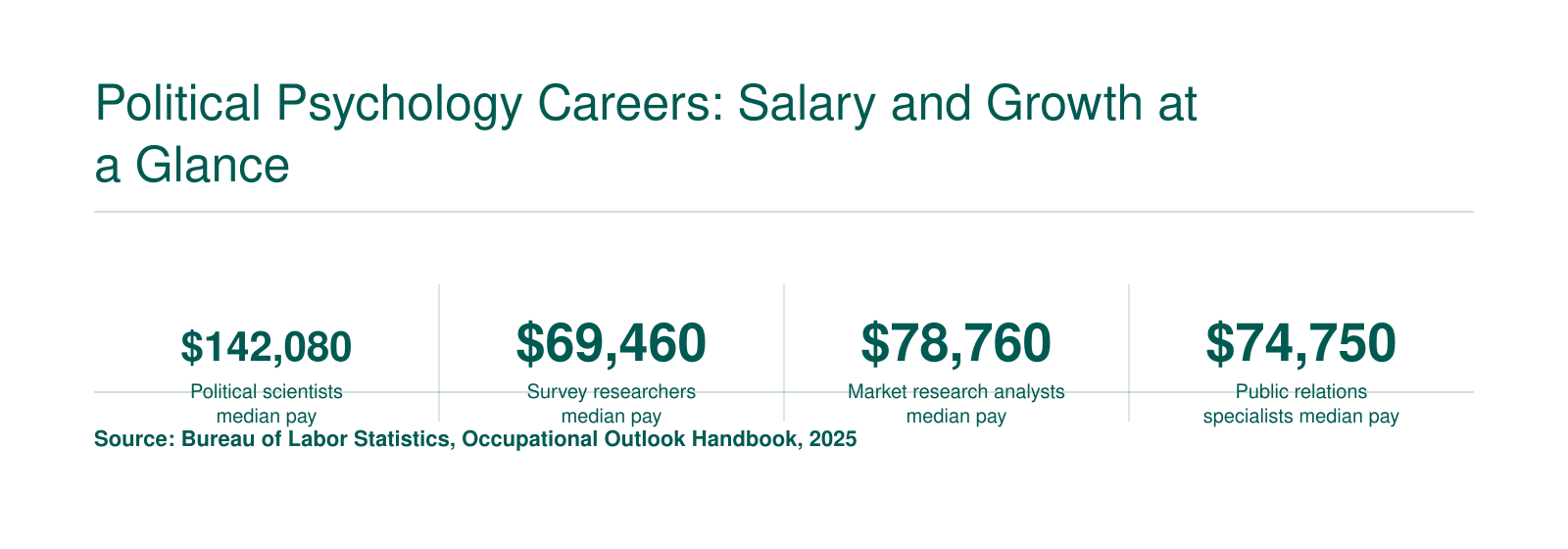
Political Psychology Careers: Salary and Growth at a Glance
The BLS does not track political psychology as a separate occupation, so graduates often land in adjacent roles. Common employers include campaigns, polling firms, think tanks, government agencies, and advocacy groups. Figures are BLS 2025 medians and 2025-2035 projections.
Political Psychology programs by state
Accelerated Political Psychology Master's FAQ
Is an accelerated political psychology master's worth it?
Can I complete an accelerated political psychology master's online?
What happens to my shared credits if I decide not to finish the master's?
Do I need to be a political science major to qualify?
Compare Political Psychology programs on the data that matters
Explore more Psychology specializations or browse every graduate field.
All Psychology programs