Best Master's in Political Psychology Programs
Compare 5 accredited Political Psychology programs, with graduate earnings, cost, debt, and completion data from IPEDS and the U.S. College Scorecard.

Political psychology now drives campaign targeting, misinformation research, and public opinion modeling. Voter behavior work is expanding as polarization makes polling less predictable, yet true standalone master's programs remain scarce. The programs ranked here mix dedicated degrees with strong university concentrations.
Tuition and format vary sharply among these options. The online path removes some geographic limits, but the credential's value depends on whether the curriculum includes enough quantitative methods. For most applicants, the practical question is whether a one- or two-year master's can compete with PhDs for analyst roles.
Key Points
- Dedicated political psychology master's programs are rare, so verify every detail on official university pages.
- Arizona State offers an online M.A., while Stony Brook runs a one-year on-campus M.A./M.S.
- Terminal master's students usually self-fund, unlike PhD students, so budget early and pursue assistantships and waivers.
Top Political Psychology Master's Programs for 2027
Dedicated political psychology master's programs are rare in the United States, so this list includes only programs we could confirm on official university pages. Both entries below are terminal master's degrees, not certificates or doctoral-track programs, though each can prepare you for PhD study. One is in-person and one is fully online.
Stony Brook University
#1Stony Brook, NY · ~$14,000/yr (est.)
Best for: Research-minded students eyeing PhD study
Stony Brook's Master of Arts in Political Psychology is a terminal, in-person degree built around the overlap of psychology and political science, with coursework on emotions and politics, moral politics, public opinion, and research methods. It can be finished in one calendar year, and the faculty hold doctorates in political science and psychology. The department also runs a political psychology lab, which gives students a place to see experimental research in practice. Graduates head into campaigns, government, polling, media, and nonprofits, and the program also positions students for PhD study.
- Terminal MA, completed in one calendar year (12 months)
- In-person format with small classes and close faculty contact
- Summer capstone follows fall and spring coursework
- Coursework covers emotions, moral politics, and public opinion
- Training in statistics and research methods
- Political psychology lab with 21 participant stations, directed by Andrew Engelhardt
- GRE waived for the 2026 cycle; fall entry only
- Deadlines: July 15 domestic, May 1 international; any undergraduate major accepted
Arizona State University
#2Tempe, AZ · ~$14,000/yr (est.)
Best for: Campaign professionals studying online
Arizona State's Master of Arts in Political Psychology is a terminal degree offered fully online, which makes it the more flexible option for people already working in politics or advocacy. The curriculum centers on persuasion, experimental design, and voter mobilization, and ends in a capstone project. Admission does not require an entrance exam, and applicants may hold a bachelor's or master's degree in any field. Students are prepared for campaign management, political consulting, lobbying, government, and nonprofit work rather than a research-first track.
- Terminal MA delivered fully online
- 30 total credit hours with a required capstone
- Start sessions in fall, spring, and summer; next listed start is January 11, 2027
- Minimum 3.0 GPA, calculated from the final 60 hours of the first bachelor's degree
- No admission exam; personal statement or letter of intent required
- Coursework in persuasion, experimental design, and voter mobilization
- Accelerated bachelor's plus master's pathway available
- Not STEM-OPT eligible; western-state reduced tuition may apply, so confirm with ASU
Cost & outcomes by school
Federal data for the highest-earning Political Psychology programs, independent of the ranking above. Earnings are this field's master's graduates four years after completing, where the Scorecard reports them.
| School | Earnings | Tuition / yr | Debt | Grads/yr | Format |
|---|---|---|---|---|---|
| University of Nebraska-Lincoln NE | — | $8,434 | — | — | Campus |
| Arizona State University AZ | — | $10,843 | — | — | Online |
| Arizona State University AZ | — | $13,587 | — | — | Online |
| Stony Brook University NY | — | $14,222 | — | — | Campus |
| University of Minnesota-Duluth MN | — | $21,630 | — | — | Campus |
Sources: U.S. Department of Education. Tuition and graduates: IPEDS. Earnings and debt: College Scorecard, this field's master's graduates; a dash means no figure is reported.
What Is a Master's in Political Psychology?
A master's in political psychology is a graduate degree that examines why people think, feel, and act the way they do in politics. It treats voting, partisanship, prejudice, protest, and political leadership as products of the mind, using ideas from social psychology, political science, and sociology. Researchers in the field ask how cognition, emotion, group identity, and personality shape political attitudes and behavior.
Political Psychology vs. Political Science
The two fields overlap, but they start from different places. Political science studies institutions and systems: legislatures, elections, parties, and policy. Political psychology studies the individual and group minds operating inside those systems. A political scientist might analyze how an electoral rule affects turnout. A political psychologist asks why a particular voter feels anger toward the other party and how that feeling changes their choices.
What the Curriculum Covers
Coursework is heavily methodological, because the field depends on testing claims with evidence. Expect to see:
- Core skills: research methods and statistics, plus survey design.
- Theory courses: attitudes and persuasion, and intergroup relations.
- Applied research: experimental methods, often paired with a thesis or capstone.
Check the Degree Type Before You Apply
Many of the best-known political psychology programs are PhD specializations housed inside a psychology or political science department. They may admit doctoral students only, or award a master's along the way rather than as a standalone credential. Before you commit time to an application, confirm that a program offers a terminal master's, and check whether it sits in a psychology, political science, or interdisciplinary department. That affects your coursework, your advisors, and what the degree prepares you to do.
Political Psychology Master's Program Tuition Compared
Most programs below do not publish a per-credit rate in their official program materials, so treat this table as a map of where the gaps are. To verify costs, check each program page, the bursar or student accounts tuition schedule, and the graduate catalog for the current academic year. Compare the per-credit rate, in-state versus out-of-state or online rates, required credits, and mandatory fees. Then estimate your total as per-credit rate times required credits, plus mandatory fees. Start with official sources such as the Arizona State University Online tuition pages and Stony Brook's Student Financial Services and Graduate School pages, and confirm program-specific fees directly rather than relying on third-party summaries. For broader context, use NCES College Navigator for institutional cost comparisons, the BLS Occupational Outlook Handbook for wage data, and the American Political Science Association and International Society of Political Psychology for career and program information. Before you commit, ask the program coordinator or graduate admissions whether online or out-of-state rates apply and whether your cohort has additional mandatory fees.
| School | Format | Total Credits | Tuition per Credit or Year | Estimated Total Tuition | Notable Fees |
|---|---|---|---|---|---|
| Arizona State University Online (MA in Political Psychology) | Online | 30 credit hours | Not published in the available official result; ASU directs students to a tuition calculator | Not published; use the ASU tuition calculator | Applicable fees are included in the calculator estimate; no amount is published |
| Stony Brook University (MA in Political Psychology) | Not specified in the available result (12 months: fall, spring, and summer) | 30 credits | Not published; Stony Brook directs students to Student Financial Services | Not published | Not itemized; confirm with Student Financial Services |
| Keele University (MSc Applied Social and Political Psychology) | Full-time, part-time, or modular at Keele Campus | 180 Level 7 credits | UK students: £10,000 full-time or £5,500 part-time per year; international students: £18,800 full-time per year (2023/24 figures) | UK students: £10,000 full-time; international students: £18,800 full-time; part-time is £5,500 per year over two years | Fees may increase in subsequent years by an inflationary amount |
| Arizona State University (Accelerated Master's in Political Psychology) | Accelerated master's pathway; delivery mode not specified | N/A | Not specified in the available result | Not published | Application fee required when instructed; amount not published |
| University of Nebraska at Omaha (M.S. in Political Science) | Online and on-campus | N/A | Described as competitive and the lowest among 15 Nebraska higher-education institutions; no rate published | Not published | Not published in the available official result |
Online vs On-Campus Political Psychology Master's Programs
Is an online political psychology master's as good as a one-year on-campus degree? As with many online psychology master's degrees, it depends on what you need the degree to do. The two models compared here, Arizona State University's online M.A. and Stony Brook University's on-campus M.A./M.S., both require 30 credits and a capstone, but they differ sharply in pacing and in how you get to research.
Schedule and Pacing
ASU's online program uses 7.5-week classes across 10 courses. Its 2026-27 handbook says students taking 9 credits in both fall and spring typically finish in about two years, and they must stay enrolled in at least one graduate credit each fall and spring until completion.1 The next start date listed in the sources is January 11, 2027, and I could not confirm a 2026 start. The published sources also don't say whether coursework is fully asynchronous or includes live sessions, so ask admissions before assuming either.
Stony Brook compresses nine courses into 12 months. Students attend in person for fall and spring, then spend the summer on a master's thesis supervised by a research faculty member. Course length and the credit split by term are not specified in the sources I reviewed.
Research Access and Networking
Stony Brook's structure puts you beside faculty and cohort members, with hands-on research and a supervised thesis built in. That helps if you want a strong writing sample and a faculty recommender. The sources don't describe a separate lab course or required lab placement, so confirm what research access looks like in practice.
ASU includes Experimental Design and ends with a PPS 550 Capstone in your final semester.1 No in-person lab is described, and networking will largely depend on your own initiative.
Who Each Format Fits
- Online: Working professionals in campaigns, government, or advocacy, roles common in political communication master's programs, who need to keep their jobs and can spread coursework over two years.
- On-campus: Students who can step away from work for a year and want close faculty mentorship, a thesis, and a stronger case for PhD admission.
If a doctorate is the goal, the thesis route is generally the safer bet. If you want to advance in your current career, the online format's flexibility is hard to beat.
Related Articles
Paying for Your Degree: Assistantships, Waivers, and Scholarships
A PhD in political psychology usually comes with a funding package. A terminal master's usually does not. Plan to cover most of the cost yourself, then go after the exceptions.
What Departments Actually Offer
ASU's 2026-27 Political Psychology M.A. handbook lists no teaching or research assistantships. Students can seek graduate services assistant or student-worker jobs through university employment, but the handbook does not say those roles cover tuition.1 Students from western states may qualify for the Western Regional Graduate Program rate of 150% of Arizona resident tuition, though eligibility is not guaranteed. UIC describes its political science M.A. as self-funded.2
Some related political science master's programs do offer support:
- UNO: A limited number of graduate assistantships for full-time, on-campus students, with tuition waived.3
- Eastern Illinois: Typically five to six assistantships with a full tuition waiver and, in 2023-24, a nine-month stipend of $1,097 per month. Assistants still pay mandatory course fees, and only fully admitted students are considered.4
Even when you win a waiver, expect student, parking, and lab fees to remain. Rutgers-Camden's psychology funding guide notes that merit-based waivers go mostly to PhD candidates.5
Filling the Gap
Most master's students combine federal graduate loans, savings, and employer tuition benefits.5 If you work in government, polling, or advocacy, or are comparing best master's in public policy programs, check your employer's education policy before you apply. Departmental scholarships and professional association awards can trim the bill, but treat them as supplements, not a plan.
Ask Before You Commit
Email the graduate director with one direct question: are master's students eligible for research assistant lines on faculty grants? The answer is rarely posted online, and asking early tells you whether funding is realistic before you accept an offer.
Admissions Requirements and Application Deadlines
Requirements are fairly consistent across the programs with verified 2026 details: any undergraduate major is accepted, and a 3.0 GPA is the usual bar. Confirm every detail on the official program page before you apply.
- Bachelor's degreeStony Brook requires a bachelor's from a regionally accredited institution or a foreign equivalent. Arizona State University Online accepts a bachelor's or a master's degree in any field.
- Minimum GPAStony Brook sets 3.0 and may admit applicants below that conditionally in exceptional cases; they must reach 3.0 after 6 graduate credits. ASU Online asks for 3.00 in the last 60 hours of a first bachelor's, or 3.00 in a prior master's. ASU's accelerated pathway, open only to current ASU Political Science undergraduates, requires a 3.6.
- Statement of purpose, transcripts, and recommendationsStony Brook asks for transcripts, a personal statement, and letters of recommendation. ASU Online lists an application fee, transcripts, and a personal statement. Neither school's official pages specify the number of letters or whether a separate writing sample is required, so check before assuming either way.
- English proficiencyASU Online requires non-native English speakers to demonstrate proficiency regardless of residency. International applicants elsewhere should check the school's accepted tests and score minimums.
- GRE policyStony Brook waives the GRE for the 2026 cycle, and ASU Online requires no admission exam. ASU's accelerated pathway states no GRE requirement.
- DeadlinesStony Brook admits for fall only: July 15 for domestic applicants and May 1 for international applicants. ASU Online's 2026-27 handbook lists July 25 for fall, December 11 for spring, and April 18 for summer, though it labels them "priority" dates, so confirm whether later applications are accepted. ASU's accelerated pathway closes October 15 for spring and May 15 for fall.
- Prior courseworkNeither program's official page makes statistics or psychology a stated prerequisite. Stony Brook's committee does weigh the rigor of your prior coursework, your GPA trend, and any professional experience, so recent quantitative or social science classes can strengthen a file.
What Can You Do With a Master's in Political Psychology?
What jobs do political psychology master's graduates actually get? Most move into roles where understanding how people form opinions meets the ability to measure them: campaign strategist, polling and survey researcher, policy analyst, government or intelligence analyst, communications or messaging consultant (a path also tied to communication management master's programs), and nonprofit researcher.
Where Program Alumni Go
Published outcome data is thin, so treat program claims as signals rather than guarantees. Stony Brook says its M.A. graduates typically pursue either employment or doctoral study. It lists employment settings that include political campaigns, government agencies, media outlets, polling firms, and nonprofits, with an emphasis on data collection and analysis. Its placement page names individual alumni, including a research scientist at the Center for Human Services Research (2013), a senior analyst at IRI Group (2016), and an assistant professor at Austin Peay State University (2011). Others continued to doctoral programs at Columbia, Maryland, Pittsburgh, Florida State, and Stony Brook itself.
Arizona State describes preparation for government, private-sector, and nonprofit careers and lists titles such as campaign manager, campaign strategist, community organizer, legislative aide, lobbyist, and political analyst. It does not publish named alumni outcomes or an employer list, and neither school reports graduate salaries.
What the Closest Occupations Pay
These Bureau of Labor Statistics figures describe entire occupations, not the earnings of political psychology graduates:
- Survey researchers: $69,460 median in 2025 ($33.40 per hour). Employment is projected to decline 5% from 2025 to 2035, though about 600 openings are expected each year.1
- Market research analysts: $78,760 median in 2025.2
- Political scientists: $142,080 median in 2025, with employment projected to decline.3
Is Political Psychology a Good Degree?
It can be, if you leave with methods skills. Employers pay for survey design, experimental analysis, and statistical modeling, skills developed in applied psychology master's programs, not for familiarity with theories of partisanship. The Stony Brook placements above are analyst and research roles for a reason. Before enrolling, check how many required courses cover quantitative methods and whether you will design and run your own study. A program heavy on theory and light on data work leaves you competing in a shrinking survey research field without the tools that set candidates apart.
Political Scientist Median Pay
Political scientists earned a median annual wage of
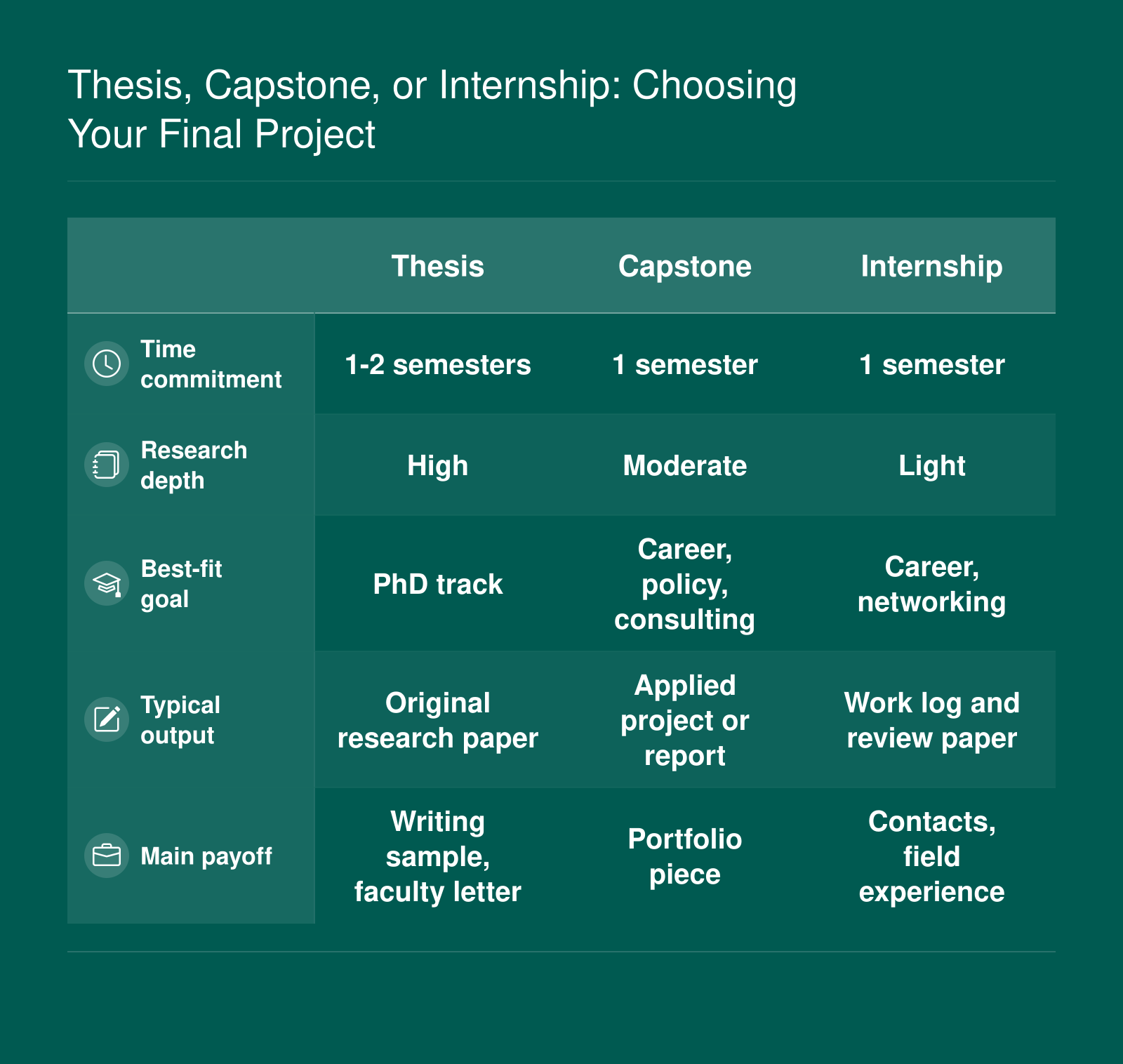
Thesis, Capstone, or Internship: Choosing Your Final Project
Most political psychology master's programs let you finish with a thesis, a capstone or applied project, or an internship paired with a literature review. If you plan to apply to a PhD, choose a thesis for the writing sample and faculty recommendation. If you are headed straight into a career, choose a capstone or internship for portfolio work and professional contacts.
Political Psychology programs by state
Political Psychology Master's Programs: Common Questions
These answers cover the questions prospective students ask most often. For school-by-school detail, use the ranking and the tuition comparison on this page.
Which universities offer political psychology master's programs online?
How much does a master's in political psychology cost?
Do I need an undergraduate degree in psychology to apply?
Are one-year political psychology master's programs in the UK or Europe a good alternative for US students?
Compare Political Psychology programs on the data that matters
Explore more Psychology specializations or browse every graduate field.
All Psychology programs