Accelerated Master's in Political Science Programs
Compare 180+ accredited fastest Political Science, Government programs, with graduate earnings, cost, debt, and completion data from IPEDS and the U.S. College Scorecard.
A year of graduate tuition plus a year of forgone salary is the real cost of the standard two-year route, and an accelerated master's in political science is built to erase it.
These accelerated political science master's programs, usually 4+1 or five-year pathways, let undergraduates count a block of graduate credits toward both the bachelor's and the master's.
The programs below are ordered by speed to degree; cost, credit-sharing limits, online availability, and admissions timing for Master's in Political Science With No GRE Required follow. Nearly all are campus-based, which matters if the senior-year graduate seats require you to be there in person.
Key Points
- CU Denver allows up to 15 shared graduate political science credits.
- None of the ranked programs here are online or hybrid.
- St. John's University reports $78,918 median earnings five years after graduating.
Fastest Accelerated Political Science Master's Programs for 2027
These 10 accelerated and one-year political science master's pathways are ordered by how quickly they can move a student from bachelor's coursework to a completed graduate degree. The top entries are true bachelor's-to-master's accelerators, while the later paths earn their place through one-year completion structures and focused research training.
Brown University
#1Providence, RI · $65,000 – $70,000/yr (est.)
Best for: Brown undergraduates seeking a fifth-year master's
Brown's one-year Master of Arts in Political Science is built around eight graduate-level courses, with a rare fifth-year accelerator reserved for Brown undergraduates. Students can count up to two graduate courses taken as undergrads toward the degree, which speeds the path without sacrificing research depth. The program emphasizes political theory, methodology, international political economy, American politics, and more. Graduates typically move into research, public service, legal studies, or consulting.
- One-year, eight graduate-level courses
- Accelerated fifth-year option for Brown undergraduates
- Up to two graduate courses count as undergrad
- No transfer credits accepted
- Covers theory, methodology, American politics, and more
Claremont McKenna College
#2Claremont, CA · ~$72,000/yr (est.)
Best for: Government majors pursuing an accelerated BA/MA
Claremont McKenna College partners with Claremont Graduate University for an accelerated BA/MA in Political Science that lets government majors begin graduate work as seniors. Senior-year courses can count toward both the bachelor's and master's degrees, with concentrations available in public policy, international studies, or politics. The program pairs a liberal arts foundation with specialized graduate training for careers in government, international affairs, law, and the nonprofit sector.
- Accelerated BA/MA joint program with Claremont Graduate University
- Senior-year courses count toward both BA and MA
- Concentrations: public policy, international studies, politics
- Prepares for government, international affairs, law, nonprofit
University of Massachusetts-Amherst
#3Amherst, MA · $15,000 – $20,000/yr (est.)
Best for: Five College students seeking a no-GRE pathway
UMass Amherst offers an accelerated Master of Arts in Political Science with six fields: American politics, comparative politics, international relations, political theory, public policy, and public law. The 4+1 pathway is open to undergraduates from UMass Amherst and the other Five College Consortium schools, and it does not require a GRE score. Students gain methods training from statistical modeling to textual analysis and can join interdisciplinary research clusters.
- Six academic fields available
- Accelerated MA path available
- Open to Five College Consortium undergraduates
- No GRE required
- Methods training from statistical modeling to textual analysis
- Fall deadlines: December 15 and April 15
Florida State University
#4Tallahassee, FL · ~$11,000/yr (est.)
Florida State's Master of Applied American Politics and Policy (MAAPP) is a 36-credit program with a full-time one-year completion option and a combined bachelor's/master's pathway. The curriculum is built around political management, communication, campaigns, policy analysis, and a 300-hour practicum in Tallahassee. Evening classes and no entrance exam make it accessible for working students, and graduates have taken roles in campaigns, lobbying, and legislative affairs.
- 36-credit curriculum with full-time one-year option
- Combined bachelor's/master's pathway available
- No entrance exam required
- 300-hour political work practicum
- Evening courses for working professionals
- Located in Tallahassee, Florida's capital
Columbia University in the City of New York
#5New York, NY · ~$58,000/yr (est.)
Columbia's one-year Master of Arts in Political Science offers advanced training in political theory, comparative politics, international relations, and research methods. The program is designed to build strong analytical and methodological skills for doctoral study or careers in government, nonprofits, and international organizations. Students work with distinguished faculty and benefit from New York City's policy environment.
- One-year Master of Arts
- Training in political science research methods
- Covers political theory, comparative politics, international relations
- Prepares for doctoral study or policy careers
University of Chicago
#6Chicago, IL · ~$69,000/yr (est.)
The University of Chicago's one-year Master of Arts Program in the Social Sciences includes a Political Science pathway alongside seven other options. Students complete nine courses and a thesis or capstone project under the guidance of an Instructional Professor. The degree prepares students for doctoral study and careers, with optional graduate certificates and interdisciplinary coursework.
- One-year, nine-course degree
- Political Science is one of eight pathways
- Thesis or capstone required
- Guided by an Instructional Professor
- Optional graduate certificates available
Massachusetts Institute of Technology
#7Cambridge, MA · ~$62,000/yr (est.)
MIT's one-year Master of Science in Political Science provides applied research training in one of six fields, including American politics, comparative politics, international relations, models and methods, political economy, and security studies. The rigorous program requires a 3.5 GPA, 66 units, and a master's thesis, with cross-registration available at Harvard. Graduates are prepared for leadership roles in government, business, and public policy.
- One-year intensive master's
- 66 total credit hours
- Six graduate subjects minimum
- Thesis required
- 3.5 GPA minimum
- Cross-registration at Harvard University
Brandeis University
#8Waltham, MA · $60,000 – $65,000/yr (est.)
Brandeis offers a one-year Master of Arts in Politics with five concentrations: American politics, world politics, international relations, political theory, and democracy and cultural pluralism. The curriculum includes core field seminars, specialized courses, and a directed study culminating in a master's project. Small classes, one-on-one mentoring, and access to the Boston Area Graduate Consortium are signature strengths.
- One-year Master of Arts in Politics
- Five concentrations available
- Eight courses plus directed study and master's project
- Access to Boston Area Graduate Consortium
- Small classes and dedicated mentoring
Lehigh University
#9Bethlehem, PA · ~$29,000/yr (est.)
Lehigh's one-year Master of Arts in Political Science blends political theory, policy analysis, governance, and international relations. Students can specialize in environmental, health, or global development policy and complete internships or research projects with government agencies and nonprofits. Lehigh's Bethlehem location offers access to policy hubs in Philadelphia, D.C., and New York City.
- One-year Master of Arts in Political Science
- Specializations: environmental, health, global development policy
- Internships and research projects with agencies and nonprofits
- Small class sizes
- Access to policy hubs in Philadelphia, D.C., and NYC
Syracuse University
#10Syracuse, NY · $45,000 – $50,000/yr (est.)
Syracuse offers a one-year MA in Political Science with 30 credits and a 3.0 GPA minimum. Students choose a quantitative or qualitative methodology course and can tailor the degree through interdepartmental electives or an optional six-credit thesis. The program emphasizes research skills, writing proficiency, and disciplinary competence for careers in government, teaching, or the private sector.
- One-year, 30-credit degree
- 3.0 GPA minimum
- Quantitative or qualitative methodology course
- Interdepartmental electives allowed
- Optional thesis (6 credits)
Cost & outcomes by school
Federal data for the highest-earning Political Science, Government programs, independent of the ranking above. Earnings are this field's master's graduates four years after completing, where the Scorecard reports them.
| School | Earnings | Tuition / yr | Debt | Grads/yr | Format |
|---|---|---|---|---|---|
| James Madison University VA | $86,137 | $13,464 | — | 14 | Campus |
| Florida State University FL | $76,608 | $10,553 | $24,550 | 35 | Campus |
| Ohio University OH | — | $9,720 | — | 25 | Campus |
Sources: U.S. Department of Education. Tuition and graduates: IPEDS. Earnings and debt: College Scorecard, this field's master's graduates; a dash means no figure is reported.
Cost, debt & payoff
Median earnings of this field's master's graduates (4 yrs after completing) vs. their median federal loan debt · U.S. College Scorecard
Across these programs the median graduate earns about $74,802 and finishes with roughly $34,561 in debt — a ratio that clears a common rule of thumb (keep debt below first-year salary). Tuition and debt vary widely school to school, so check the per-school figures in the table above before you shortlist.
How Credit Sharing Shortens a Political Science Master's by a Year
CU Denver's political science master's programs let qualified students count up to 15 graduate political science hours toward both degrees1, the high end of a range that elsewhere runs as low as 8 credits at the University of Rhode Island.2 That shared pool of credits is the entire mechanism behind the 4+1 model.
How the Overlap Works
Students typically apply during their junior year, then enroll in graduate seminars as seniors. Those seminars count twice: once toward the bachelor's and again toward the master's. Loyola University Chicago applies 12 of its 30 required master's hours3 this way through 400- and 500-level work, while the University of Louisville double-counts 9 to 12 credits4 depending on the graduate option chosen. At the University of Missouri, up to 15 credits are dual-enrolled before a student moves into the final graduate year.5
The Rules That Govern Shared Credits
Schools fence the overlap with conditions. Grade floors are common: UMass Amherst requires a B or better in counted courses, CU Denver sets a B-1, and Idaho State disqualifies students who earn three grades below that mark in advanced coursework.6 Pass/fail and S/U grading usually will not transfer.1 Course level matters too, since only designated 500- or 600-level seminars qualify. The master's itself still demands its full load, generally 30 to 36 credits, so the degree is not shortened, only front-loaded.
The Time You Save
Because a year of graduate work happens during the undergraduate degree, students finish the master's in roughly five years total instead of the six a separate bachelor's and master's would take.
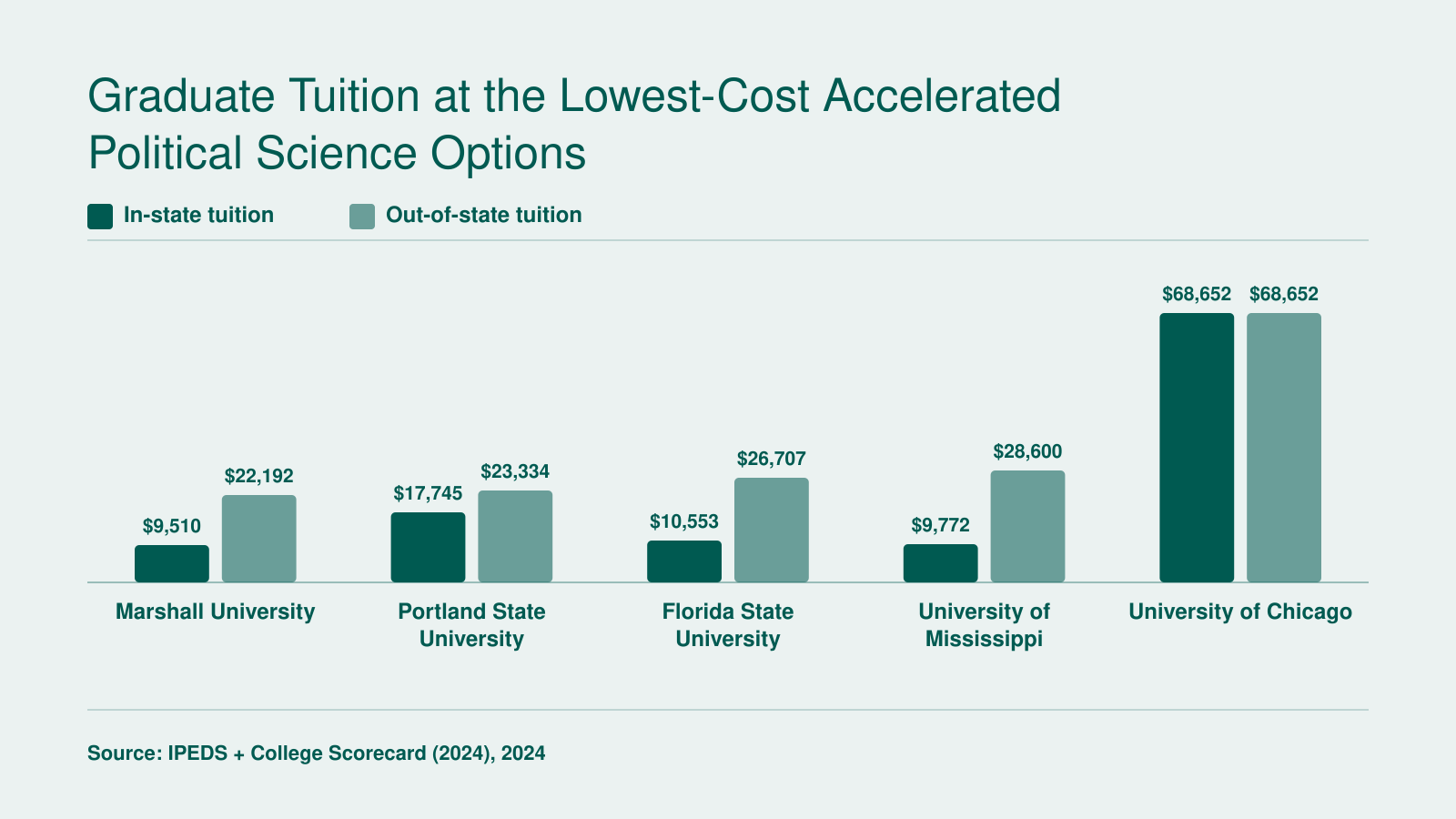
Graduate Tuition at the Lowest-Cost Accelerated Political Science Options
This grouped bar chart compares published graduate tuition, in state versus out of state, for the options with the lowest net-price estimates in this ranking. Skipping one full graduate year saves roughly one year of that tuition, plus living costs and a year of lost earnings. The net-price estimates elsewhere on this page are institution-wide averages after aid, not personalized quotes.
Related Articles
Can You Finish an Accelerated Political Science Master's Online?
None of the schools ranked above list online master's programs or hybrid formats. Every one is campus-based, and even where graduate coursework can move online, the accelerated pathway may still ask you to take senior-year courses in person.
Official program pages point to three pathways that do offer online or hybrid graduate delivery:
- University of Nebraska Omaha: The MS in Political Science can be completed online, on campus, or blended, and up to 9 graduate hours count toward both degrees. The school cautions that a course may be offered only on campus or only online in a given term.
- Indiana State University: The 4+1 route leads to a Master of Public Administration, not a political science master's. It can be finished 100 percent online in five years.1
- University of Rhode Island: Its 4+1 also ends in an MPA, a 36-credit asynchronous program with 7-week terms. Up to 12 eligible undergraduate credits can be double-counted.2
What You Give Up Online
Online accelerated political science master's programs buy flexibility at the cost of access. Campus programs sit closer to internships, legislative fellowships, and faculty research. Florida State, for example, builds a 300-hour political practicum into its Tallahassee program. Searching for an online master's in political science makes sense if you are already working. If you are not, in-person access may be worth more.
What You Need to Apply: GPA, Timing, and Materials
- Minimum GPAMost programs expect a 3.0–3.5 overall; some add a higher major GPA. Boise State asks 3.0/3.3, Loyola Chicago 3.3/3.5, and Temple 3.5/3.5.
- Application timingMost students apply in spring of junior year. UMass lists Dec. 15, Apr. 15, and Nov. 15; Duke’s formal deadline is mid-February; ASU is rolling.
- Credit standingJunior standing (60–90 credits) is typical. ASU requires 60 completed hours, Loyola Chicago 60–90, and Boise State 75.
- Required materialsPrepare a transcript, two or three faculty letters, a statement of purpose, and a writing sample. UMass requires three letters and a sample; Temple asks for a statement and two letters.
- GRE policiesPolicies vary. UMass and Temple do not require it; Duke is optional at pre-application but requires GRE later; Saint Louis asks for GRE or LSAT.
Earnings After a Political Science Master's
The strongest program-level figure is $78,918 median earnings five years after finishing, reported for St. John's University-New York.
Political Science, Government programs by state
Quick Answers Before You Apply to a 4+1 Political Science Pathway
Accelerated political science pathways move quickly, so eligibility and culminating experience details matter before you apply. These answers cover transfer status, thesis versus non-thesis options, and what happens if your GPA slips.
Can transfer students or students from partner colleges join an accelerated political science master's pathway?
Do accelerated political science master's programs offer a thesis or non-thesis track?
What happens if your GPA drops below the threshold during the senior year?
Compare Political Science, Government programs on the data that matters
Explore more Social Work & Social Sciences specializations or browse every graduate field.
All Social Work & Social Sciences programs