Best Master's in Political Science Programs in Virginia
Compare 7 accredited Political Science, Government programs in Virginia, with graduate earnings, cost, debt, and completion data from IPEDS and the U.S. College Scorecard.

A political science master's in Virginia can mean a Charlottesville seminar room or an asynchronous online cohort from Lynchburg; both feed a policy job market anchored by Washington, D.C., and Richmond. Graduate tuition among ranked programs spans roughly $8,700 to $23,500 before aid and residency discounts.
That gap can exceed early career earnings differences. Campus, online, and hybrid formats carry different scheduling constraints, and most programs here do not confirm a GRE requirement, so the comparison is price, format, and access to federal and state policy employers.
Key Points
- The University of Virginia's one-year nonthesis Politics M.A. ranks first, with a graduation rate near 96%.
- Liberty University's M.S. in Political Science is fully online, with asynchronous 8-week courses.
- James Madison's master's tuition jumps from about $13,500 for residents to roughly $31,000 for non-residents.
Best Master's in Political Science Schools in Virginia
The University of Virginia is the best overall pick: its one-year, nonthesis M.A. in Politics lets you choose from four subfields at a school whose institution-wide graduation rate is about 96%. Virginia Tech and George Mason follow with thesis-based and thesis-or-capstone formats, and the list also includes an online option and a program based in Florence, Italy. Net price figures shown with each school are institution-wide averages, and graduation rates are likewise institution-wide, not program results.
University of Virginia
#1Charlottesville, VA · ~$24,000/yr (est.)
Best for: Students wanting a one-year terminal degree
The University of Virginia pairs a selective, research-heavy department with a compact one-year terminal M.A. in Politics. Students pick American Politics, Comparative Politics, International Relations, or Political Theory and can tap research networks such as the Miller Center, the Center for Politics, and the Quantitative Collaborative. The program is self-funded, and the institution-wide graduation rate is about 96%.
- 30 credits, including six research credits
- Four subfields: American, Comparative, International Relations, Political Theory
- Nonthesis: a final examination replaces a thesis or capstone
- At least three of five substantive courses in the chosen subfield
- Applications accepted October 1 to March 1
- Self-funded: students cover tuition, fees, and living costs
Virginia Polytechnic Institute and State University
#2Blacksburg, VA · ~$19,000/yr (est.)
Best for: Future doctoral applicants seeking thesis training
Virginia Tech offers a thesis-based M.A. with a strong social science methods core, suited to students aiming at doctoral study or research-oriented government and nonprofit roles. Cohorts are small, at 10 to 15 full-time students a year, and the program advertises assistantships and fellowships. The institution-wide graduation rate is about 86%.
- 30 credits: 9 required, 12 elective, 9 thesis and research
- Thesis required; no nonthesis or capstone option is published
- No formal concentrations published
- Required: PSCI 5115, PSCI 5116 (methods) and PSCI 5214 (theory)
- 3.0 GPA minimum; starts spring, summer, or fall
- Graduate assistantships and fellowships available
- Accelerated B.A.-to-M.A. path allows up to 12 graduate credits in senior year
James Madison University
#3Harrisonburg, VA · ~$13,000/yr (est.)
Best for: Transatlantic policy students studying in Italy
James Madison University runs its M.A. in Political Science with a European Union Policy Studies concentration as a 10-month residential program in Florence, Italy, taught in English. It is a distinctive fit for students targeting diplomacy, EU governance, or transatlantic policy work. The program has anticipated a few assistantships worth roughly $10,000 each, and the institution-wide graduation rate is about 80%.
- 33 credits over 10 months, residential in Florence, Italy
- Concentration: European Union Policy Studies
- Coursework in economic and social policy, foreign policy, internal security
- Data visualization for policy professionals
- 3.0 GPA minimum and two letters of recommendation
- Priority assistantship deadline February 15, 2027; final deadline May 24, 2027
George Mason University
#4Fairfax, VA · $15,000 – $20,000/yr (est.)
George Mason University's M.A. in Political Science sits in Fairfax with access to Washington-area government and policy internships. Students can concentrate in International Security, American Government and Politics, Comparative Politics, or International Relations, and finish with a thesis or capstone. Admissions are rolling, and the institution-wide graduation rate is about 68%.
- 36 credits
- Four concentrations: International Security, American Government and Politics, Comparative Politics, International Relations
- Thesis or capstone option
- Rolling admissions; starts fall or spring
- Up to 9 credits in fields such as history or public policy
- Internship credit and an accelerated BA/MA option
Liberty University
#5Lynchburg, VA · ~$9,000/yr (est.)
Liberty University offers the only fully online, asynchronous political science master's in this group built around eight-week courses and frequent start dates. It suits working professionals and military-affiliated students who want flexibility and a Christian worldview framing. The institution-wide graduation rate is about 65%.
- 36 credits, 100% online with no set login times
- General concentration
- 8-week courses with up to 8 start dates per year
- Transfer up to 50% of the degree total
- Military tuition discount of $290 per credit hour
- SACSCOC accredited
Regent University
#6Virginia Beach, VA · ~$18,000/yr (est.)
Regent University in Virginia Beach offers an M.A. in Government with the widest concentration menu on this list, including Israel Studies, National Security Studies, and Political Campaign Strategies and Management. Students can study on campus or fully online, and military benefits are supported. The institution-wide graduation rate is about 57%.
- 33 credits
- Six concentrations: American Government, International Relations, Israel Studies, Law and Public Policy, National Security Studies, Political Campaign Strategies and Management
- Campus or fully online option
- 8- and 15-week sessions
- Next session starts January 11, 2027
- Military benefits and tuition assistance counseling
Virginia Union University
#7Richmond, VA · ~$18,000/yr (est.)
Virginia Union University, a historically Black university in Richmond, offers a 30-credit, two-year M.A. with three specialized tracks, including an American Legal System track aimed at law school preparation. Students choose between a thesis path and a nonthesis path built on research papers. The institution-wide graduation rate is about 34%, the lowest on this list, so weigh support services and funding carefully.
- 30 credits over two years
- Tracks: American Government, American Legal System, International Relations
- Thesis path: 24 graded credits, six research credits, defended thesis
- Nonthesis path: 30 graded credits and two original research papers
- 2.7 GPA minimum and three letters of recommendation
- 500-word personal statement required
- International Relations track focuses on African policies
Cost & outcomes by school
Federal data for the highest-earning Political Science, Government programs, independent of the ranking above. Earnings are this field's master's graduates four years after completing, where the Scorecard reports them.
| School | Earnings | Tuition / yr | Debt | Grads/yr | Format |
|---|---|---|---|---|---|
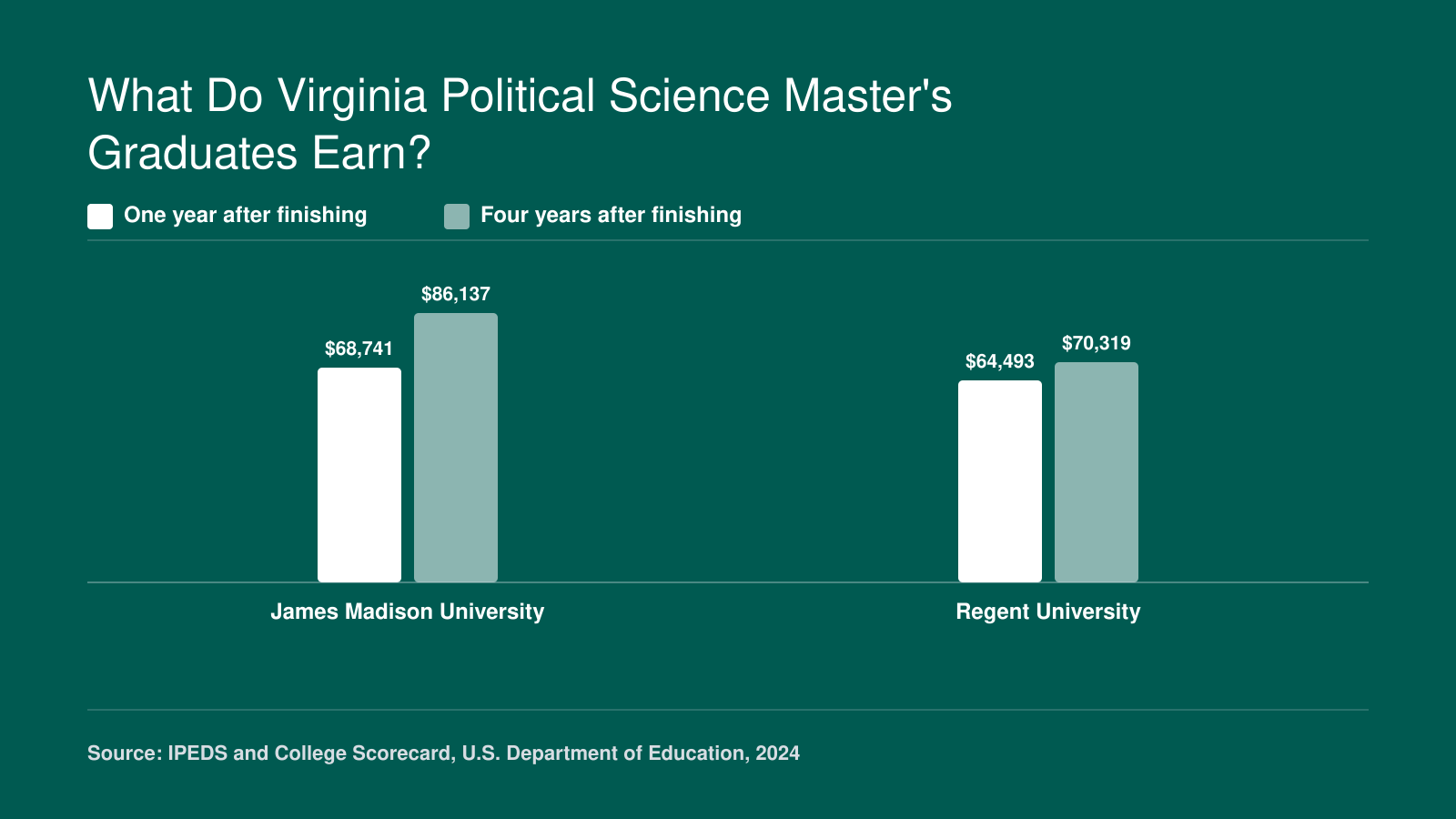
| James Madison University VA | $86,137 | $13,464 | — | 14 | Campus |
| Regent University VA | $70,319 | $17,869 | $33,200 | 27 | Hybrid |
| Liberty University VA | — | $8,730 | — | 33 | Online |
| George Mason University VA | — | $17,964 | — | 18 | Campus |
| Virginia Polytechnic Institute and State University VA | — | $18,564 | — | 8 | Campus |
| Virginia Union University VA | — | $17,518 | — | 1 | Online |
| University of Virginia VA | — | $23,526 | — | 3 | Campus |
Sources: U.S. Department of Education. Tuition and graduates: IPEDS. Earnings and debt: College Scorecard, this field's master's graduates; a dash means no figure is reported.
Online and Hybrid Political Science Master's Options in Virginia
Virginia now offers more online political science master's programs than many students expect. Liberty University's Master of Science in Political Science is fully online, with asynchronous 8-week courses and no campus residency requirement. Regent University's M.A. in Government is hybrid, and a fully online option is available through 8- and 15-week sessions. Virginia Union University's Political Science M.A. is online, with thesis or capstone tracks and three concentrations. Virginia Tech's Political Science M.A. is offered on campus in Blacksburg and fully online through its asynchronous OLMA format. For accelerated entry, Virginia Tech allows current political science majors with a 3.5 GPA to earn up to 12 graduate credits that double-count, pending advisor approval. George Mason's on-campus M.A. also lists an accelerated BA/MA option, though shared credit details are not published. So yes, you can complete a political science master's fully online through Liberty, Regent, Virginia Union, or Virginia Tech's OLMA, among the online master's programs in Virginia.
Which Virginia Political Science Master's Programs Waive or Make the GRE Optional
No program on this list is confirmed to require the GRE, and none publishes formal waiver criteria, so treat this as a set of master's programs with no GRE required. Here is how they sort.
- GRE required: None confirmed.
- GRE optional: The University of Virginia's two-year Politics M.A. does not require it. The department says it weighs scores less heavily than other factors, though very high scores can help. Virginia Tech's Political Science M.A. and its accelerated B.A.-to-M.A. both list the GRE as recommended, not required.
- GRE waived with criteria: None. Waivers are not described because submission is not mandatory.
- GRE not mentioned: UVA's one-year non-thesis Politics M.A. lists a transcript, personal statement, and letters, but no GRE policy. For James Madison University, George Mason University, Liberty University, Regent University, and Virginia Union University, no published GRE policy was available, so we won't guess.
Before paying to register for the exam, email the department and confirm the current policy. These rules change.
Related Articles
Political Science Master's Tuition, Financial Aid, and Certification in Virginia
Tuition figures below come from federal data, and net price is an approximate institution-wide average, not a program-specific cost. Virginia Tech offers competitive assistantships and fellowships through the admissions application, but funds only a small share of applicants (about 15% by one department account). James Madison University lists paid assistantships, while UVA's one-year M.A. in Politics is self-funded. A political science master's is not a licensure-track degree in Virginia, so graduates who want to teach social studies in public schools need a Virginia Department of Education teaching license through a separate route, which requires a bachelor's degree, prescribed coursework, and Praxis assessments such as 5581.
| School | In-state graduate tuition | Out-of-state graduate tuition | Approximate net price | Funding notes |
|---|---|---|---|---|
| Virginia Union University | $17,518 | $17,518 | $13,235 | Financial aid and scholarships available |
| George Mason University | $17,964 | $40,308 | $17,915 | Not reported here |
| Regent University | $17,869 | $17,869 | $19,923 | Financial aid, scholarships, military benefits |
| University of Virginia | $23,526 | $37,628 | $21,565 | One-year M.A. is self-funded |
| James Madison University | $13,464 | $30,984 | $23,322 | Paid assistantships |
| Virginia Polytechnic Institute and State University | $18,564 | $35,092 | $24,953 | Assistantships and fellowships, competitive |
| Liberty University | $8,730 | $8,730 | $29,357 | Military tuition discount |
Admission Requirements and Application Deadlines for Virginia Political Science Master's Programs
Most programs here ask for the same core materials, but details vary and some schools publish little. Confirm every date on each program's admissions page, since sources do not always confirm the 2026–27 cycle.
- Bachelor's degree and transcriptsEvery program expects a completed bachelor's degree and official transcripts. Liberty University, Regent University, George Mason University, and Virginia Union University do not have admission details in our research, so check their pages directly.
- Minimum GPAVirginia Tech sets a 3.0 minimum. The University of Virginia's two-year M.A. in Politics states no formal minimum, though successful applicants typically hold 3.5 or higher. James Madison University does not publish a figure in our sources.
- Statement of purposeThe University of Virginia requires a statement for its two-year and one-year programs. Virginia Tech's accelerated B.A.-to-M.A. route asks for 250–500 words. The standard Virginia Tech M.A. requirement is not specified.
- Writing sampleThe University of Virginia's two-year program wants one analytic sample of about 20 pages, and a senior or master's thesis may substitute even if longer. Virginia Tech's accelerated route also requires one.
- Recommendation lettersVirginia Tech's accelerated route requires three letters, preferably addressing scholarly potential. Counts for the other programs are not stated.
- Fall deadlines and funding priorityVirginia Tech: August 1 domestic, April 1 international, and February 15 for assistantship consideration. University of Virginia: March 1 (the one-year program accepts applications October 1–March 1). James Madison University's published dates cover 2027–28: February 15, 2027 priority for assistantships, May 24, 2027 final.
- Spring admissionVirginia Tech offers spring entry, with a January 1 domestic and September 1 international deadline. No spring deadline was identified for the University of Virginia or James Madison University.
What Do Virginia Political Science Master's Graduates Earn?
Median earnings below are for graduates of each school's own political science master's program, measured one year and four years after finishing. George Mason University reports a five-year median of $71,787. Graduates commonly work as legislative staff, policy analysts, federal agency employees, and campaign staff, and some go on to doctoral study.
How We Rank Virginia's Political Science Master's Programs
Program pages sell a vision, while federal data shows what graduates actually paid and earned. This ranking leans on the second. We weigh graduate tuition and net price, the institution-wide graduation rate, and College Scorecard earnings and debt outcomes for graduates.
Campus and online programs sit in one list, so a fully online option is measured against a residential one on the same terms.
The data has limits. Those two measures describe the whole institution, not the political science program itself; program-level figures are not available for every school. Treat them as context, not a promise about your own cohort. Official claims about "career-ready" graduates or "powerful networks" are rarely backed by numbers you can check, so they carry no weight in the order of the schools here.
Frequently Asked Questions About Political Science Master's Programs in Virginia
What is the best political science master's program in Virginia?
How do UVA and Virginia Tech compare on tuition and curriculum?
What is the total cost of a political science master's in Virginia?
Can a political science master's lead to a PhD or a federal job in the D.C. area?
Compare Political Science, Government programs on the data that matters
Explore more Social Work & Social Sciences specializations or browse every graduate field.
All Social Work & Social Sciences programs