Best Master's in Political Science Programs in Ohio
Compare 5 accredited Political Science, Government programs in Ohio, with graduate earnings, cost, debt, and completion data from IPEDS and the U.S. College Scorecard.

What makes an Ohio political science master's worth the tuition when annual costs run from $9,720 to $53,980? Ohio's programs put students near the Statehouse in Columbus, county government, campaigns, and policy nonprofits hiring for research and constituent work.
Campus political science master's options, including one-year tracks, are compared on cost, debt, and graduate-earnings signals. Most programs here are GRE-optional; Case Western Reserve still requires exam scores. For Ohio residents, the gap between the lowest public in-state rate and Case Western Reserve tops $44,000 a year.
Key Points
- Ohio University has the lowest in-state tuition here at $9,720.
- A full assistantship at Ohio University pays at least $4,200 per term.
- Ohio requires no license to work in political science.
Best Political Science Master's Programs in Ohio: Ranked List
Ohio has a small set of standalone political science master's programs, and they differ more in length, funding and exam requirements than in name. Graduation rates below describe each university as a whole, not the political science program. Higher Learning Commission accreditation is institutional, so it covers the university rather than this specific degree.
Case Western Reserve University
#1Cleveland, OH · ~$54,000/yr (est.)
Best for: Students wanting faculty-mentored research training
Case Western Reserve University is a private research university in Cleveland that graduates about 87% of its students institution-wide. Its Master of Arts in Political Science can be finished in as little as one year and covers American politics, comparative politics, international relations and research methods. Faculty mentoring in specialized techniques such as elite interviewing sets it apart, and the department reports limited institutional funding that can cover up to half of tuition. Students choose a thesis or a comprehensive examination.
- 30 credit hours, completable in as little as one year
- Thesis or comprehensive examination option
- Core areas: American, comparative, international, research methods
- Entrance exam listed (GRE), with minimum scores specified
- Three letters of recommendation minimum, $50 application fee
- Internships and postgraduate placements, including Fulbright
- Limited departmental funding can cover up to half of tuition
University of Cincinnati
#2Cincinnati, OH · ~$15,000/yr (est.)
Best for: Part-time students with weekday availability
The University of Cincinnati is a public university that graduates about 75% of its students institution-wide, and it is accredited by the Higher Learning Commission as an institution. Its M.A. in Political Science sits in the School of Public and International Affairs and offers both full-time and part-time study, with classes on weekday afternoons. Research strengths include cybersecurity and security studies, and a joint M.A./J.D. with the College of Law is available. Its separate MPA holds NASPAA accreditation, but that does not extend to this M.A.
- Thesis or professional paper to finish the degree
- Full-time and part-time options, fall start
- Weekday afternoon classes
- Joint M.A./J.D. with the College of Law
- Graduate certificates in Public Opinion and Survey Research or Asian Studies
- Taft Research Center travel grants for research and conferences
- GRE listed, with a test-optional note on the program page
- Three letters of recommendation minimum; assistantships and scholarships available
Ohio University
#3Athens, OH · ~$10,000/yr (est.)
Best for: Aspiring law school and doctoral applicants
Ohio University in Athens graduates about 65% of its students institution-wide and has held Higher Learning Commission accreditation since 1913, most recently reaffirmed in 2024-2025. Its Political Science M.A. is a 32-credit, one-year program that replaced a two-year, 58-credit format in fall 2022. Students pick from five concentrations and finish with a research paper, applied policy project or thesis. Applicants who apply by December 15 get priority for funding that can combine a tuition scholarship with an assistantship.
- 32 credit hours, completable in 12 months
- Five concentrations: American Government, Comparative Politics, International Relations, Political Theory, Politics and Law
- Capstone as research paper, applied policy project or thesis
- Fall entry only; December 15 priority date for full funding
- Assistantships with stipend and tuition scholarships available
- Related academic or political experience may be considered for admission
- Prepares for law school, doctoral study, campaigns, nonprofits and government
Kent State University
#4Kent, OH · ~$12,000/yr (est.)
Kent State University graduates about 64% of its students institution-wide. Its M.A. in Political Science is delivered in person on the Kent campus and has a clear concentration structure. Students can follow a thesis or non-thesis path and prepare for work as policy analysts, consultants and researchers, or for doctoral study.
- 30 credit hours, in-person on the Kent campus
- Three concentrations: American Politics and Policy, Conflict Analysis and Management, Transnational and Comparative Politics
- Thesis or non-thesis path
- 2.8 GPA minimum, three letters of recommendation
- Fall start; February 15 priority deadline
- Core courses in quantitative and qualitative methods
University of Akron
#5Akron, OH · $10,000 – $15,000/yr (est.)
The University of Akron graduates about 52% of its students institution-wide, the lowest rate among these five schools, and it offers the lowest net price of the group. Its on-campus M.A. in Political Science has rolling admissions and a 2.5 GPA minimum, which makes it more accessible than the others. Electives in terrorism, counterterrorism, human rights and national security suit students headed toward security, intelligence or policy careers.
- 30 credit hours, on campus
- Rolling admissions, 2.5 GPA minimum
- Two letters of recommendation minimum
- Culminates in an Essay of Distinction and a comprehensive exam
- Core: Scope and Theories of Political Science, Seminar in International Politics
- Electives in terrorism, counterterrorism, human rights, national security
- Certificate in Applied Politics available alongside the degree
Cost & outcomes by school
Federal data for the highest-earning Political Science, Government programs, independent of the ranking above. Earnings are this field's master's graduates four years after completing, where the Scorecard reports them.
| School | Earnings | Tuition / yr | Debt | Grads/yr | Format |
|---|---|---|---|---|---|
| Ohio University OH | — | $9,720 | — | 25 | Campus |
| University of Akron OH | — | $10,125 | — | 11 | Campus |
| Kent State University OH | — | $12,483 | — | 2 | Campus |
| University of Cincinnati OH | — | $14,902 | — | 2 | Campus |
| Case Western Reserve University OH | — | $53,980 | — | 1 | Campus |
Sources: U.S. Department of Education. Tuition and graduates: IPEDS. Earnings and debt: College Scorecard, this field's master's graduates; a dash means no figure is reported.
Application Deadlines, GPA Minimums, and Required Materials
Requirements below come from the Ohio University and Kent State University admissions pages for fall 2026. Confirm every date with the department before you apply.
- Bachelor's degree and GPABoth schools require a bachelor's degree. Ohio University sets a 3.0 GPA for unconditional admission and generally expects 18 undergraduate hours in political science. Applicants below 3.0 may be admitted conditionally and must submit GRE scores. Kent State's minimum is 2.750.
- Statement, letters, and transcriptsOhio University and Kent State each require transcripts, three recommendation letters, a résumé, and a statement of purpose (Kent State calls it a goal statement). Kent State also requires a writing sample, while Ohio University treats one as optional.
- Ohio University deadlinesDecember 15 is the priority date for full departmental financial aid. February 15 is the recommended completion date and the second aid round. It is not a hard cutoff, but later applicants are generally considered without departmental aid.
- Kent State deadlineFebruary 15 is Kent State's published priority deadline for fall. Its catalog does not say whether applications are accepted after that date, so ask the department.
- Doctoral-only departmentsSome Ohio departments grant an MA only to students already enrolled in their PhD track. That is not a standalone terminal master's. Its PhD deadlines and materials, such as the GRE, do not apply to a master's applicant.
- Case Western, Cincinnati, and AkronCase Western Reserve, the University of Cincinnati, and the University of Akron were not checked for deadlines or GPA cutoffs here. Check each graduate admissions page for current dates, and ask whether funding has its own earlier deadline.
Which Ohio Master's in Political Science Programs Waive or Make the GRE Optional?
Where each program stands
- GRE required: Case Western Reserve lists an entrance exam for its political science M.A., accepts the GRE alongside English proficiency testing, and publishes minimum scores it expects applicants to clear.
- GRE optional or conditional: The University of Cincinnati's M.A. is test optional. Ohio University also treats the GRE as optional and reviews scores if you send them, though its admissions materials indicate applicants whose overall GPA falls below 3.0 may still be asked to test. The two statements are not fully reconciled on Ohio University's own pages, so confirm directly if your GPA is near that line.
- No published policy: Kent State and the University of Akron set GPA floors for admission (2.750 and 2.5 respectively) but do not post a standing GRE requirement or waiver rule.
Ask before you pay
Where no policy appears, check the Master's in Political Science Programs With No GRE Required guide and email the graduate coordinator rather than assuming. At many No-GRE master's programs, waivers, when departments grant them, usually hinge on undergraduate GPA, an earlier graduate degree, or several years of relevant work. A registration fee plus prep costs is real money, and a one-line reply can save it.
Related Articles
Online, Hybrid, and One-Year Political Science Master's Programs in Ohio
Current program listings steer Ohio students in political science master's programs toward campus-based study rather than fully online or hybrid tracks. Case Western Reserve University, University of Cincinnati, Ohio University, Kent State University, and University of Akron each list their political science master's program as on-campus. The available Ohio University 2026-27 catalog does not specify whether individual courses require synchronous meetings or a separate campus residency.
Ohio University offers the clearest option among accelerated political science master's programs: its Political Science M.A. is a 32-semester-hour program that can be completed in two semesters of full-time enrollment, with fall-only entry and up to 8 hours of approved related or transfer credit. Case Western Reserve University also describes its Political Science MA as a one-year, 30-credit option.
The Best Online Master's in Political Science Programs are better suited to working professionals who need asynchronous or reduced-residency scheduling, but the current Ohio listings lean toward campus delivery instead.
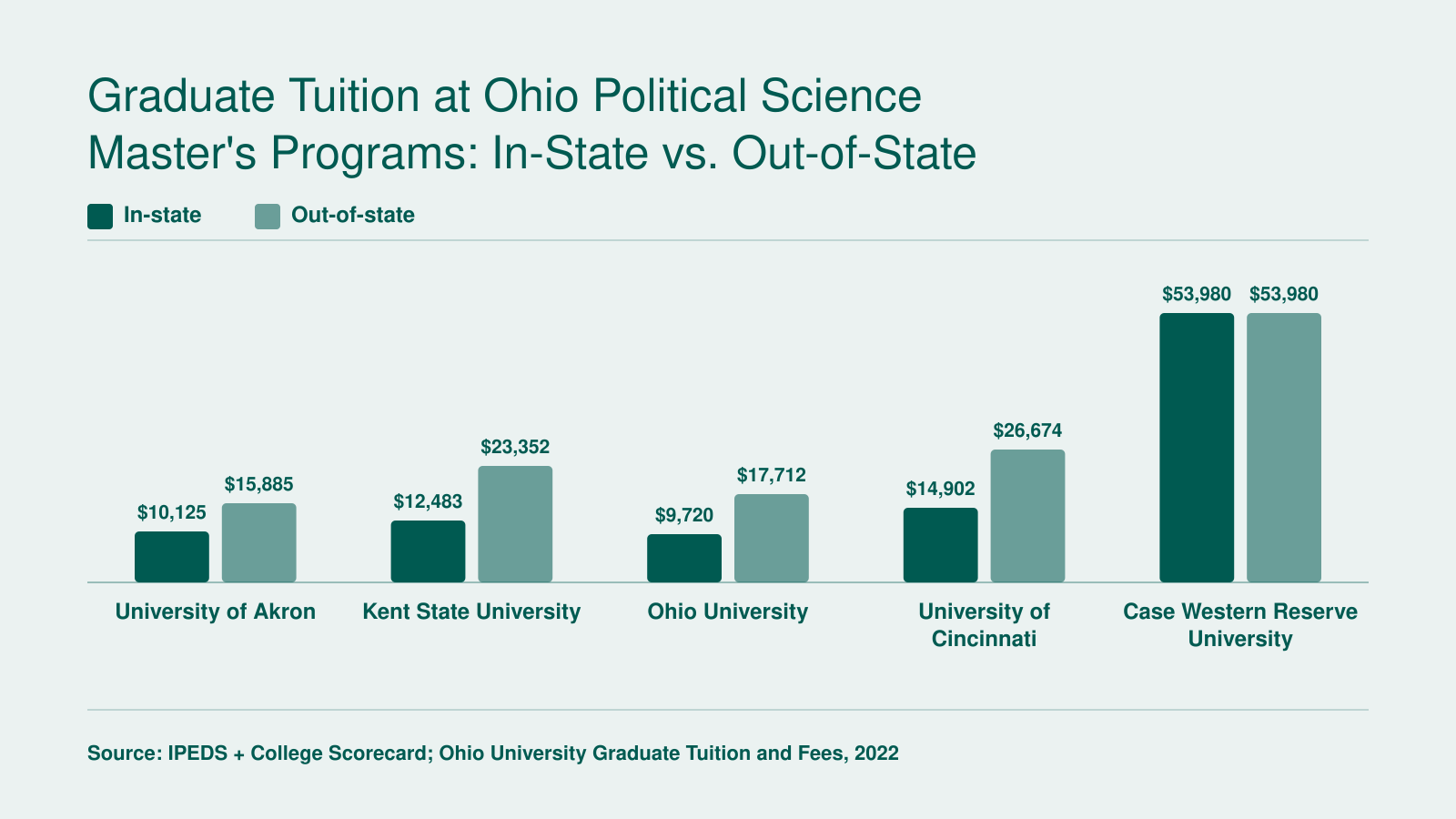
Graduate Tuition at Ohio Political Science Master's Programs: In-State vs. Out-of-State
Ohio University has the lowest in-state tuition here at $9,720, while the University of Akron has the lowest out-of-state figure at $15,885. The University of Cincinnati shows the largest residency gap, $11,772, followed by Kent State at $10,869. Case Western Reserve charges $53,980 to everyone, as a private school. For a current rate, Ohio University's 2026-27 Athens graduate tuition is $608 per credit for Ohio residents (including the $78 general fee) and $1,128 for nonresidents. Net price figures are institution-wide averages, not program quotes, so confirm costs with each bursar.
Graduate Assistantships and Funding for Political Science Master's Students in Ohio
Ohio University's 2026-27 schedule pays a full graduate assistantship at least $4,200 per term for 15 to 20 hours of work a week. The appointment may also carry full tuition and nonresident-surcharge scholarships plus at least $215 toward general fees. A half appointment pays $2,100 per term for 8 to 10 hours, with half tuition coverage. Master's students qualify, not just doctoral candidates, as long as they register for 12 credits in fall and spring (9 in summer). The tuition scholarship covers regular instructional fees but not overload hours above 18 credits a semester.
At the other master's programs in Ohio, ask each department whether teaching or research assistantships go to terminal master's students. Political science departments often reserve funding for PhD students, and that one answer can move your total cost more than any tuition gap in the Most Affordable Master's in Political Science Programs rankings.
Other routes worth pursuing:
- Departmental scholarships: Ask what the program awards at admission.
- Paid internships: Paid legislative or government placements can offset living costs.
- Employer tuition assistance: Public-sector and nonprofit employers sometimes cover part-time study.
Ohio Licensure and Certification for Political Science Graduates
Is a Master's in Political Science Worth It? Careers and Earnings in Ohio
A master's in political science is a one- to two-year graduate degree in government, policy, and research methods. It pays off mainly when it opens a specific job or a next degree. The only program-level earnings figure available for these schools is Ohio University's: graduates of its Political Science M.A. have a median of $54,270, measured five years after finishing. That rests on a very small group of graduates, so treat it as a rough marker. The other schools here do not report program-level earnings, and we won't substitute campus-wide numbers. Ohio University's program tuition is $9,720 in-state, and the one-year, 32-credit format keeps time out of the workforce short.
Realistic Ohio career paths
- Government: legislative aide at the Statehouse, or staff in city and county offices.
- Policy and advocacy: policy analyst, campaign staff, or nonprofit advocacy roles.
- Teaching: community college instruction.
- Further study: a PhD or law school. Cincinnati offers a joint MA/JD with its College of Law.
The verdict
The degree suits career-changers aiming at government or policy work, and students headed to law school or a doctorate. It is strongest with a funded assistantship, such as the competitive ones Ohio University lists, because that cuts the cost side. If you want a high salary with no clear public-sector target, the evidence is thin.
Compare Political Science, Government programs on the data that matters
Explore more Social Work & Social Sciences specializations or browse every graduate field.
All Social Work & Social Sciences programs