Best Master's in Political Science Programs in Pennsylvania
Compare 7 accredited Political Science, Government programs in Pennsylvania, with graduate earnings, cost, debt, and completion data from IPEDS and the U.S. College Scorecard.

Choosing a political science master's among Master's Programs in Pennsylvania means weighing price against program design. In-state tuition runs from $11,790 at East Stroudsburg to $28,840 at Lehigh, and structure varies just as widely: Lehigh's one-year professional MA versus Pitt's research track built toward a Ph.D.
Geography favors every option. Harrisburg keeps state government close, Washington, D.C., is within reach, and campus and online formats are compared side by side.
Assistantships mostly go to doctoral students, so terminal master's students usually cover the bill themselves.
Key Points
- East Stroudsburg is the cheapest option here at $11,790 in-state.
- Temple makes the GRE optional, while Penn State requires the General Test.
- Pennsylvania's 253-member General Assembly is the nation's largest full-time legislature.
Top Political Science Master's Schools in Pennsylvania, Ranked
Six Pennsylvania universities offer a master's in political science that made this list, and all six teach on campus. They range from a one-year professional program to research-heavy tracks built as a step toward a Ph.D. Graduation rates below describe each university as a whole, and net price figures are institution-wide approximations, not quotes for graduate students.
Lehigh University
#1Bethlehem, PA · ~$29,000/yr (est.)
Best for: Policy-minded students wanting internship access
Lehigh in Bethlehem offers a full-time, on-campus political science master's that blends theory, policy analysis, governance, and international relations, with internships and research projects tied to government agencies and nonprofits. Specializations include environmental, health, and global development policy. Lehigh lists a Community Fellowship that covers 21 of the 30 credits for eligible students, and the university graduates about 88% of its students.
- 30 credits, completed in 12 months for full-time students
- Five concentration options, including environmental, health, and global development policy
- Internships and research projects with government agencies and nonprofits
- Community Fellowship funds 21 of 30 credits for eligible students
- Apply by March 1 for priority funding consideration; admission is rolling
- Small classes with close faculty mentorship
- Catalog lists the degree as an M.A. in Politics and Policy
Villanova University
#2Villanova, PA · $20,000 – $25,000/yr (est.)
Best for: Working professionals needing evening classes
Villanova's MA suits working professionals: seminars are capped at 15 students and meet in the evening, with full-time and part-time enrollment. Students cover American politics, international relations, comparative politics, and political theory, and graduates have gone on to Ph.D. programs and to roles in government, intelligence, and NGOs. The university graduates about 92% of its students.
- 30 credits across 10 courses, finished with a comprehensive capstone exam
- Four areas: American, international relations, comparative, political theory
- Seminars limited to 15 students, held in the evening
- Full-time and part-time options with a customized plan of study
- Options to take quantitative methods or GIS
- Funding applicants must apply for fall; priority deadline is February 15
- 20% tuition discount for teachers, 40% for Catholic-school teachers
University of Pittsburgh-Pittsburgh
#3Pittsburgh, PA · ~$28,000/yr (est.)
Best for: Future doctoral applicants building research skills
Pitt's master's is a rigorous academic track designed as a stepping stone toward a Ph.D. Students take research methods and graduate seminars in fields such as American politics, comparative politics, international relations, and political methodology. It fits students who want a research and writing foundation more than a professional or evening format. The university graduates about 86% of its students.
- 30 credit hours with core research methods courses
- At least four graduate seminars across five field options
- Preliminary examination after the first year
- Qualifying paper defended before the department
- B+ average required
- Designed as a milestone toward the Ph.D.
Temple University
#4Philadelphia, PA · $23,000 – $30,000/yr (est.)
Temple's research-focused master's in Philadelphia covers American politics, comparative politics, international relations, and political theory, with required work in political statistics and research design. Evening classes starting after 3 p.m. serve both full-time and part-time students. The university graduates about 75% of its students, and scholarships and financial aid are listed.
- 30 credits with a thesis required
- Four subfields plus a methodology focus
- Core courses include Political Statistics and Research Design
- Classes held on Main Campus after 3 p.m.
- Full-time and part-time options
- Listed tuition of $1,148 per credit
- Scholarships and financial aid available
East Stroudsburg University of Pennsylvania
#5East Stroudsburg, PA · ~$12,000/yr (est.)
East Stroudsburg University says its political science master's is the only one in Pennsylvania's State System of Higher Education, which makes it the public-system option on this list. Internships through the Washington Center and the Harrisburg Internship Semester give students direct government and nonprofit experience. The university graduates about 43% of its students, so check retention and completion support when comparing.
- Only political science master's in the Pennsylvania State System
- Washington Center internship opportunity
- Harrisburg Internship Semester available
- Covers politics, government, international relations, and public policy
- Admission requires a bachelor's degree plus analytical and writing ability
- Prepares for Ph.D. study or leadership roles in government
Pennsylvania State University
#6University Park, PA · ~$25,000/yr (est.)
Penn State's University Park program emphasizes methods, with required courses in political analysis and statistics and depth in U.S. politics, international relations, and comparative politics. Dual-title options include African American Studies, Asian Studies, and Social Data Analytics. Graduate assistantships support funding, and the program lists the GRE as an entrance exam, so confirm current requirements before applying.
- 30 credits ending in a master's essay and oral exam
- Fall start only; application deadline is December 10
- GRE listed as an entrance exam
- Three letters of recommendation and a writing sample
- Graduate assistantships available
- Dual-title options in African American Studies, Asian Studies, Social Data Analytics
- No language requirement for the M.A.
Cost & outcomes by school
Federal data for the highest-earning Political Science, Government programs, independent of the ranking above. Earnings are this field's master's graduates four years after completing, where the Scorecard reports them.
| School | Earnings | Tuition / yr | Debt | Grads/yr | Format |
|---|---|---|---|---|---|
| Pennsylvania State University PA | — | $24,650 | — | — | Campus |
| East Stroudsburg University of Pennsylvania PA | — | $11,790 | — | 3 | Campus |
| Villanova University PA | — | $22,335 | — | 12 | Campus |
| Temple University PA | — | $22,818 | — | 6 | Campus |
| Pennsylvania State University PA | — | $26,034 | — | 8 | Campus |
| Lehigh University PA | — | $28,840 | — | 2 | Campus |
| University of Pittsburgh-Pittsburgh PA | — | $27,580 | — | — | Campus |
Sources: U.S. Department of Education. Tuition and graduates: IPEDS. Earnings and debt: College Scorecard, this field's master's graduates; a dash means no figure is reported.
Which Pennsylvania Political Science Master's Programs Waive or Make the GRE Optional
GRE policies vary among the best master's in political science programs highlighted below. Penn State requires the GRE General Test; its program page does not state a waiver policy.1 Temple University makes the exam optional and will consider scores if submitted, but it does not outline a waiver route, so it is not one of the master's programs with no GRE required. For Lehigh University, East Stroudsburg University, the University of Pittsburgh, and Villanova, the official admissions pages do not make a GRE requirement or waiver policy explicit, so treat these as contact-the-department cases rather than assuming a waiver. Most programs also expect a statement of purpose, two or three letters of recommendation, and a writing sample; official transcripts are standard. Since policies can shift between application cycles, confirm the current GRE stance directly with the graduate program before you submit.
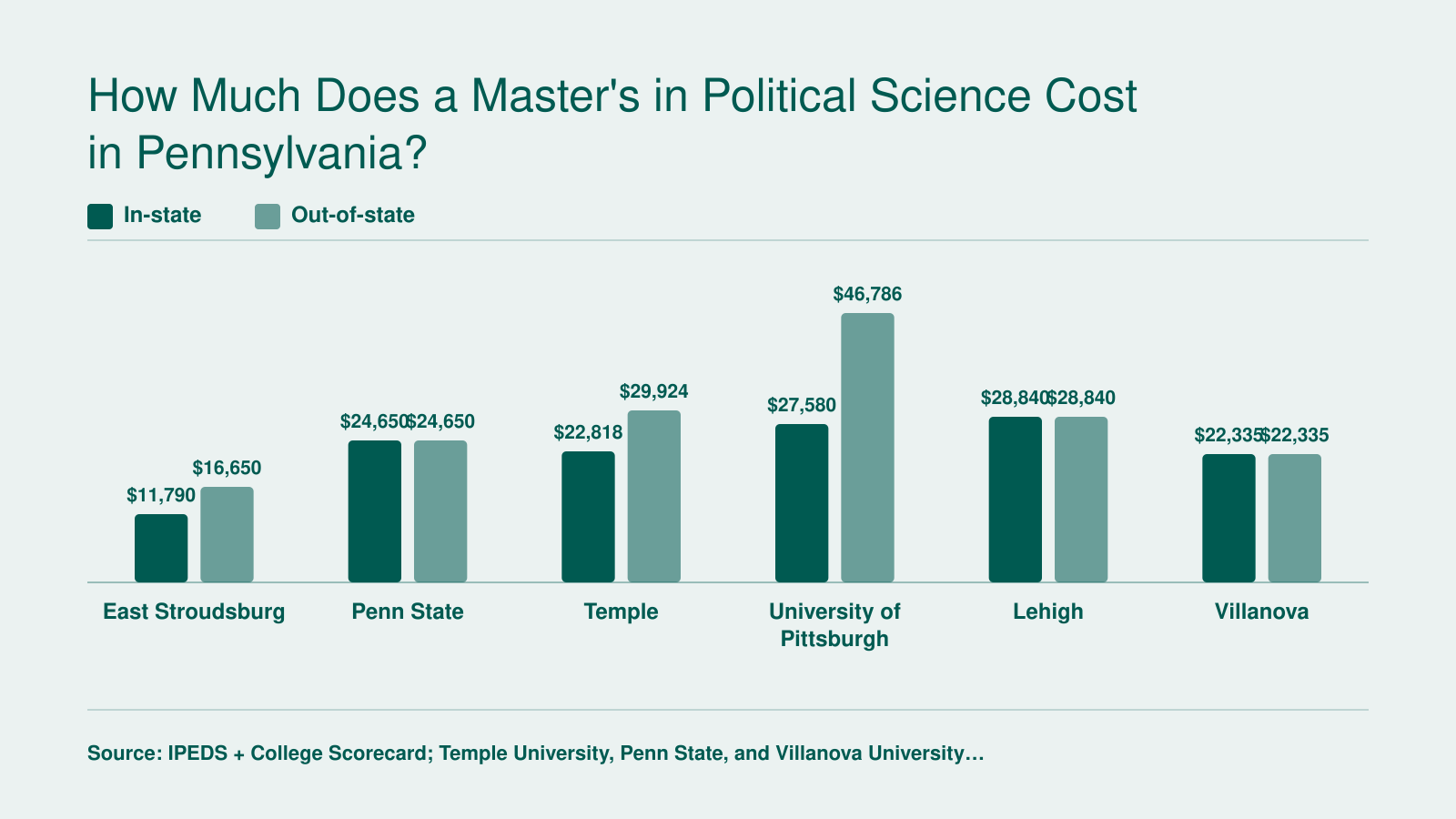
How Much Does a Master's in Political Science Cost in Pennsylvania?
East Stroudsburg is the cheapest option here at $11,790 for in-state students. Public universities show a wider in-state versus out-of-state gap because state funding lowers the price for residents, while private schools such as Lehigh and Villanova charge everyone the same rate. Penn State lists one figure for both groups, so check its current residency rules. Temple lists $1,148 per credit on its program page, and 30 credits at that rate comes to about $34,440 before fees. Penn State and Villanova also require 30 credits. Per-credit rates for the other schools were not confirmed, so check each bursar page before budgeting.
Related Articles
Assistantships, Scholarships, and Pennsylvania Certification Considerations
Funding for a terminal political science master's in Pennsylvania is limited, so ask each department directly what it offers before you count on aid. Assistantships at research universities tend to go to doctoral students. Penn State's own education materials say its assistantships are primarily for Ph.D. students1, and the same pattern is common in other departments.
Villanova is the clearest about funding for its MA. Scholarships and assistantships are considered for fall applicants only, so a spring start rules you out. Teachers at public or private schools receive a 20% tuition discount, and Catholic-school teachers receive 40%, but that is a discount, not an assistantship waiver. Temple's MA lists financial aid and scholarships. No program here publishes a stipend or waiver amount that I can confirm.
Certification
Political science requires no Pennsylvania professional license. Teaching is the one credentialed path nearby, and it runs through separate programs with their own Pennsylvania teacher certification requirements. Temple's +1 pairs a political science bachelor's with a Master's in Secondary Education in Pennsylvania that leads to Social Studies 7-12 certification.3 Pitt's MAT in Social Studies Education (36 credits) leads to the Pennsylvania Instructional I Certificate.2 Penn State's Social Studies M.Ed. does not lead to initial certification.1
The National Conference of State Legislatures classifies Pennsylvania's General Assembly as a full-time legislature with large staffs. With 253 members (50 senators and 203 representatives), it is the nation's largest full-time legislature, which supports a substantial base of policy, research, and staff jobs in Harrisburg.
Frequently Asked Questions About Political Science Master's Programs in Pennsylvania
Is a master's in political science worth it in Pennsylvania?
What can you do with a master's in political science?
Can I earn a political science master's online in Pennsylvania?
How long does a part-time political science master's take while working?
Compare Political Science, Government programs on the data that matters
Explore more Social Work & Social Sciences specializations or browse every graduate field.
All Social Work & Social Sciences programs