Accelerated Master's in Psychology Programs
Compare 200+ accredited fastest General Psychology programs at 190+ schools, with graduate earnings, cost, debt, and completion data from IPEDS and the U.S. College Scorecard.

A combined bachelor's-to-master's pathway can cut about a year from the total time to both degrees, because graduate credits count toward the undergraduate and the graduate requirement at once.
Published in-state graduate tuition across the programs here runs from $10,843 to $44,423, so the price of the same shortcut varies fourfold. Access varies too. Several pathways are open only to the university's own undergraduates, and most of the degrees are 30-credit general psychology programs.
That last point matters. A fast master's in general psychology typically prepares students for doctoral study or research roles, not for counseling psychology licensure.
Key Points
- The 2027 rankings favor shorter timelines and transparent tuition.
- Touro University Worldwide reports the highest median earnings one year after completion.
- The lowest median federal debt at completion is $22,014.
Best Accelerated Master's in Psychology Schools: 2027 Rankings
This list favors master's programs that compress the path from bachelor's degree to psychology master's, with extra attention to accelerated and one-year options. The schools below pair a shorter timeline with transparent graduate tuition and clear concentration choices. Use each card to compare format, cost, and program-level highlights side by side.
University of Virginia
#1Charlottesville, VA · ~$24,000/yr (est.)
Best for: UVA undergraduates adding one-year research MA
The University of Virginia's master's in psychology emphasizes research methods and a final examination, with an accelerated +1 M.A. route for current UVA undergraduates. The general program requires 30 credits, including eight credits of quantitative methods, and students may substitute a novel research project for the exam with faculty approval. The school's overall graduation rate is 95.6%.
- 30 total credit hours
- Eight credits in quantitative methods
- Final master's examination required
- Research project may replace the exam
- Research Methods concentration: 15 credits
- Accelerated +1 MA for UVA undergrads
- Face-to-face instruction on Grounds
California Polytechnic State University-San Luis Obispo
#2San Luis Obispo, CA · ~$14,000/yr (est.)
Best for: California MFT candidates needing licensure-focused training
Cal Poly's master's in psychology is built around California marriage and family therapy licensure, combining coursework in assessment, diagnosis, treatment planning, and supervised traineeship. The 69-unit program reviews applicants with a 2.5 GPA or higher but requires a 3.0 minimum in the last 60 semester units and five prerequisite courses. Students begin in fall and finish with either a comprehensive exam plus essays or a thesis. The school's overall graduation rate is 86.4%.
- 69 total credit hours
- Starts in fall
- 3.0 GPA minimum in last 60 units
- Five prerequisite courses required
- Reviews applications down to 2.5 GPA
- Prepares for California MFT licensure
- Supervised community mental health traineeship
- Thesis or comprehensive exam option
Stony Brook University
#3Stony Brook, NY · ~$14,000/yr (est.)
Best for: Career changers wanting one-year psychology foundation
Stony Brook's MA in general psychology is a one-year, full-time summer-start program for students preparing for careers or further graduate study. The 30-credit curriculum covers statistics, abnormal and social psychology, cognitive science, and integrative neuroscience, and pairs every student with a faculty advisor. The school's overall graduation rate is 75.6%.
- One-year, full-time summer start
- 30 total credit hours
- No entrance exam required
- GRE optional
- 3.3 GPA minimum
- Three letters of recommendation
- Faculty advisor assigned
- Research and internship opportunities
University of Vermont
#4Burlington, VT · $14,000 – $34,000/yr (est.)
The University of Vermont offers an accelerated master's pathway for eligible UVM undergraduates, with the master's typically finished in one additional year and up to nine shared credits counting toward both degrees. Students choose a thesis-based or exam-based route in general/experimental or clinical psychology, and the program is clear that it does not provide supervised hours for licensure. The school's overall graduation rate is 78.6%.
- 2 concentration options
- Thesis and exam-based options
- Thesis mentor required
- Accelerated Master's AMP available
- No practicum or internship hours
- Not for licensed therapist training
Arizona State University
#5Scottsdale, AZ · ~$11,000/yr (est.)
Arizona State University's online master's in psychology uses 7.5-week courses and 36 credit hours across 12 classes, with a recommended background in statistics or research methods. The degree does not indicate online status, and students choose from thesis, applied project, or capstone options. ASU's bachelor's-to-master's route can be completed in as little as five years.
- 36 total credit hours across 12 classes
- 7.5-week course terms
- Starts in fall
- 3.0 GPA minimum
- Prerequisite in statistics or research methods recommended
- Diploma does not indicate online status
- Thesis, applied project, or capstone options
- Bachelor's-to-master's route in as little as five years
University of New Hampshire
#6Durham, NH · ~$17,000/yr (est.)
The University of New Hampshire's psychology M.A. is an accelerated bachelor's-to-master's pathway open only to current UNH undergraduates. Students can apply up to 12 graduate credits as dual credit toward both degrees and finish the master's in one additional year, for a five-year total. The program requires a 3.2 cumulative GPA and does not offer clinical or counseling training.
- One-year master's after bachelor's
- 30 total credit hours
- 3.2 cumulative GPA minimum
- Up to 12 dual-credit credits
- Only open to current UNH undergraduates
- Five years total for B.A./M.A.
- Faculty sponsor required
- No clinical or counseling training
The New School
#7New York, NY · ~$44,000/yr (est.)
The New School's MA in general psychology offers a 30-credit on-campus degree in New York City with full-time or part-time options and two start dates per year. Students can add an optional substance abuse treatment concentration or explore applied psychology and design for user experience research careers, and a bachelor's-master's route accelerates completion. The school's overall graduation rate is 69.4%.
- 30 total credit hours
- Full-time and part-time options
- Fall and spring start dates
- No thesis or capstone required
- Optional concentration in substance abuse treatment
- Applied Psychology and Design subject area
- Bachelor's-Master's accelerated program
- Located in New York City
Roger Williams University
#8Bristol, RI · ~$21,000/yr (est.)
Roger Williams University's one-year master's in general psychology requires 30 credit hours and a thesis, with students matched to a faculty mentor for research activities. The program is designed to strengthen applications to PhD programs through additional research experience. The school's overall graduation rate is 68.7%.
- One-year, full-time program
- 30 total credit hours
- Thesis required
- Faculty mentor on research activities
- Matched to faculty by research interests
- Prepares PhD program applications
Rutgers University-Camden
#9Camden, NJ · $20,000 – $25,000/yr (est.)
Rutgers University-Camden's psychological sciences M.A. is a 30-credit on-campus program that can be completed in three to four semesters, with an accelerated option available. Students complete a capstone in the form of an empirical paper, community-engaged project, or systematic review, and may join faculty-led research labs. The program is not a clinical counseling or therapy license pathway. The school's overall graduation rate is 66.7%.
- Complete in three to four semesters
- 30 total credit hours
- Full-time and part-time options
- 3.0 GPA minimum
- Two letters of recommendation
- Three capstone project options
- Accelerated option available
- No clinical counseling or therapy training
Northern Arizona University
#10Flagstaff, AZ · ~$13,000/yr (est.)
Northern Arizona University's psychological sciences master's requires 36 units and offers a pre-doctoral research emphasis, with thesis and non-thesis options plus optional fieldwork and internship placements. An accelerated 3+2 bachelor's-to-master's plan shares six units, and students can participate in an exchange with the University of Groningen. The school's overall graduation rate is 61.3%.
- 36 total credit hours
- Pre-doctoral general psychology research emphasis
- Thesis or non-thesis option
- 3.0 GPA minimum
- Prerequisite psychology coursework required
- Optional fieldwork and internship placements
- Accelerated 3+2 bachelor's-to-master's plan
- Exchange with University of Groningen
Cost & outcomes by school
Federal data for the highest-earning General Psychology programs, independent of the ranking above. Earnings are this field's master's graduates four years after completing, where the Scorecard reports them.
| School | Earnings | Tuition / yr | Debt | Grads/yr | Format |
|---|---|---|---|---|---|
| Stony Brook University NY | $71,005 | $14,222 | $22,014 | 21 | Campus |
| Touro University Worldwide CA | $65,760 | $9,000 | $27,075 | — | Online |
Sources: U.S. Department of Education. Tuition and graduates: IPEDS. Earnings and debt: College Scorecard, this field's master's graduates; a dash means no figure is reported.
Cost, debt & payoff
Median earnings of this field's master's graduates (4 yrs after completing) vs. their median federal loan debt · U.S. College Scorecard
Across these programs the median graduate earns about $63,039 and finishes with roughly $37,184 in debt — a ratio that clears a common rule of thumb (keep debt below first-year salary). Tuition and debt vary widely school to school, so check the per-school figures in the table above before you shortlist.
How We Rank Accelerated Psychology Master's Programs
What actually decides the order of the Best Master's in Psychology Programs on this page? Federal data, not reputation. Nothing here comes from peer surveys, prestige polls, or how often a school's name appears in a magazine. Every figure we rank on is published by the U.S. Department of Education through the College Scorecard and IPEDS, which means you can check it yourself rather than take our word for it.
What we weigh
- Graduate tuition and average net price: what the degree is listed at, and what students at the institution actually pay after aid.
- Earnings and debt where published: median earnings reported for graduates of the specific psychology program, and the median debt they carried at completion.
- Delivery format: whether the accelerated track runs on campus, through an online master's in psychology program, or in a hybrid structure.
- Time to finish: how quickly the combined bachelor's and master's sequence can realistically be completed, which drives the ranking order on this page.
Where the data has limits
Be skeptical of any single number, including ours. Graduation rates and net price are institution-wide averages, so they describe the whole university rather than the psychology department. Program earnings are medians measured in a fixed window after graduation, which captures early-career pay and not where a career lands a decade out. Small cohorts also get suppressed in federal reporting, so some fields simply have no figure attached.
Verify before you apply
Shared-credit counts, prerequisite coursework, and application deadlines shift from one catalog year to the next. Confirm all three details with the psychology department directly before you build a plan around them.
What Is an Accelerated Master's in Psychology? How Shared Credits Work
The appeal of an accelerated master's is speed, but how much time you actually save depends on how many graduate credits a school lets you count twice. Policies differ more than the labels suggest.
The 4+1 and BA/MA Structure
In a 4+1 or combined BA/MA, undergraduates begin graduate coursework in their junior or senior year. Some of those credits apply to both the bachelor's and the master's, so the master's takes roughly one more year instead of two.
How Many Credits Double-Count
Caps are commonly 6 to 12 credits, though a few schools go higher.
- Rowan University: 12 shared credits. Four senior-year graduate courses replace undergraduate electives and are billed at the undergraduate rate, leaving 21 graduate credits afterward.1
- Miami University: up to 9 shared credits, only with Program Director approval, starting in fall of Year 4.2
- Cleveland State University: up to 9 credits at the 500 level, with minimum grades required. The 36-credit M.A. then needs 27 more graduate credits.3
- Vanderbilt University: no double-counting. Students take 6 graduate credits as seniors and 24 in the fifth year, for 30 total.4
Fairleigh Dickinson allows up to 15 cross-credited credits but requires 120 bachelor's credits before additional graduate courses.5 Check the exact rules for your program.
When to Apply
Most students apply in junior year, though timing varies. Vanderbilt admits at the end of senior year through a form.4 Admission to the accelerated track is usually separate from regular undergraduate admission, so being enrolled at the university does not guarantee a spot. Arizona State's Accelerated Master's in Political Psychology handbook for 2026-27 sets credit-hour thresholds instead: 75 undergraduate hours to apply and 90 to begin graduate courses.6
Standalone Compressed Master's
"Accelerated" can also describe a standalone master's on compressed terms. You apply after finishing a bachelor's, like any graduate applicant, and the speed comes from the schedule, such as shorter terms or year-round courses. Nothing double-counts. A combined degree saves time through overlapping credits and sometimes lower tuition on those credits. A standalone program saves time only by condensing the calendar.
How Much Does an Accelerated Psychology Master's Cost?
The cost of an accelerated psychology master's turns on two variables: how many graduate credits the program lets you share, and what rate you are charged for those credits. In the programs below, published in-state graduate tuition figures start near $8,900 and run up to about $23,400, a range that also appears in the Most Affordable Master's in Psychology programs. Out-of-state and flat-rate figures range from roughly $9,000 to $36,800, with public universities typically charging nonresidents more and private programs often using one rate. The least expensive published options are University of Central Oklahoma at $8,917 for in-state students, and Ferrum College and Touro University Worldwide at $9,000 flat tuition. Indiana Wesleyan University follows at about $10,900. These published rates do not include mandatory fees, books, or living costs. Because accelerated programs often pull graduate coursework into the senior year, the billing rate on those credits matters as much as the sticker price.
What the average net price actually means
Across the schools listed here, institution-wide average net price after grant aid ranges from about $14,100 to about $20,100, with a typical figure near $17,600. That figure is a rough benchmark for the whole institution, not a quote for any individual student. Your net price after scholarships, grants, and work-study can land well above or below that range, depending on your FAFSA results and the aid package a school offers. This is why a school with a higher published tuition can still be the better deal after aid, a dynamic that also plays out among the Most Affordable Master's in Applied Psychology programs.
How shared credits cut the bill
The direct savings come from credits that count toward both degrees. One ranked online program publishes graduate tuition at $500 per credit. If a pathway shares nine credits, that is $4,500 in graduate tuition you do not pay at the master's rate; a 15-credit share would avoid $7,500. Some accelerated programs bill shared credits at the undergraduate rate instead, which can widen the savings further. Some schools cap shared credits at 9 to 15; the higher the share, the larger the potential savings. This is why asking exactly how double-counted credits are billed matters more than comparing sticker prices alone.
The year you get back
There is also a hidden cost advantage. Finishing the master's about a year earlier means entering the workforce a year sooner. That is one fewer year of paying tuition, fees, and living costs, and one more year of earning a salary. A year of lost income is often the largest single cost of a traditional two-year master's. For many students, that recovered income matters more than the shared-credit math, especially in fields where a psychology master's raises starting pay.
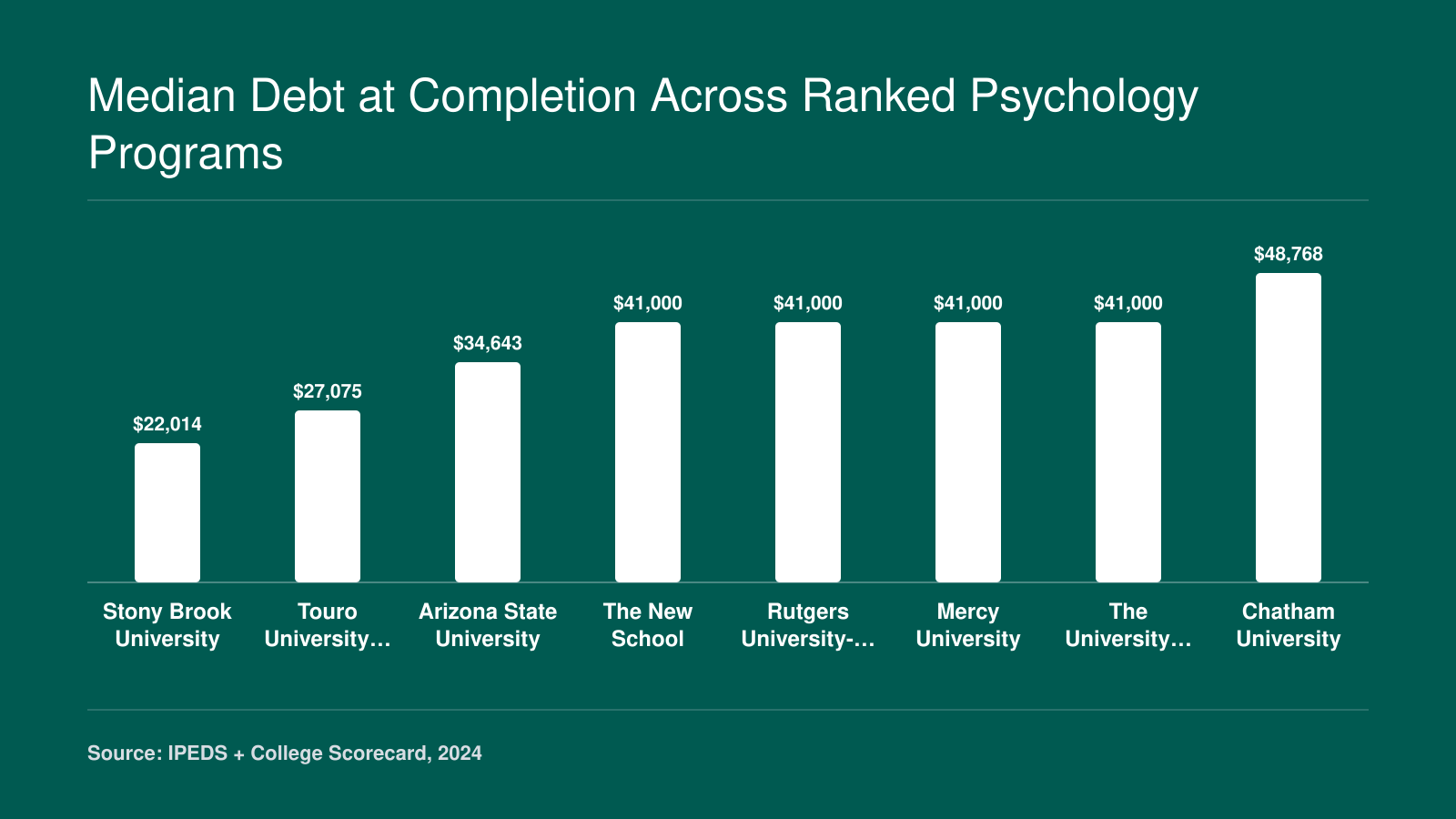
Median Debt at Completion Across Ranked Psychology Programs
The chart below shows the median federal loan debt at program completion for each psychology master's program in the rankings, not the institution-wide debt. The lowest median is $22,014, which works out to about $250 per month on a 10-year repayment plan. The highest median is $48,768, or about $555 per month.
Related Articles
Admission Requirements: GPA, Deadlines, and Transfer Eligibility
Accelerated psychology master's programs favor current undergraduates with strong psychology coursework and a clear timeline to apply. The rules below cover the GPA, credit, deadline, and transfer standards you should check before starting an application.
- Minimum GPAsOverall GPA minimums cluster from about 3.0 to 3.4. Rutgers uses 3.0, UNH 3.2, George Mason 3.25, UT Permian Basin 3.25, Vanderbilt 3.3, and Tulane and Point Park 3.4. Some programs also set psychology-specific bars, George Mason requires 12 psychology credit hours, UT Permian Basin requires 15, and Tulane looks for at least a B in PSYC 3090.
- Credit standing and deadlinesApply once you have reached the school's credit threshold. George Mason considers students after 60 credits, while UNH, UT Permian Basin, and Rutgers set the bar at 90 credits. Deadlines vary: Rutgers lists April 30 and Nov. 30, UT Permian Basin lists Oct. 22, March 15, and July 1, and Tulane's completed application is due June 15.
- Prerequisites and recommendationsConfirm you have taken any required statistics and research methods coursework, because each school names its own prerequisite list. George Mason, for example, requires PSYC 300 plus PSYC 375/376 or PSYC 372. Recommendation requirements range from George Mason's faculty recommendation and UT Permian Basin's letter of intent to Vanderbilt's two faculty letters and Point Park's two recommendations, statement, resume, and interview.
- Transfer eligibilityMost of these pathways are built for current undergraduates at the same school. Vanderbilt's 4+1 admits only current Vanderbilt students, Tulane's terminal 4+1 is limited to Tulane and Xavier University of Louisiana baccalaureate students, and Rutgers accepts current Rutgers psychology majors. If you are transferring in, ask the program how many credits you must complete at that institution before you can apply.
Top Early-Career Earnings Among Ranked Programs
One year after completing the master’s, Touro University Worldwide reports the highest median earnings among the programs ranked here.
General Psychology programs by state
Accelerated Psychology Master's FAQs
Answers to common questions about accelerated psychology master's costs, transfer enrollment, shared credits, and financial aid. Policies vary by university, so confirm details with the programs you are considering.
How much does an accelerated master's in psychology cost?
Can transfer students enroll in an accelerated psychology master's program?
What happens to shared credits if I leave the accelerated track before finishing the master's?
Does financial aid change when undergraduates take graduate-level courses in an accelerated program?
Compare General Psychology programs on the data that matters
Explore more Psychology specializations or browse every graduate field.
All Psychology programs