Best Master's in Psychology Programs in Minnesota
Compare 3 accredited General Psychology programs in Minnesota, with graduate earnings, cost, debt, and completion data from IPEDS and the U.S. College Scorecard.

Minnesota's psychology master's options are thin, and they do different jobs. The general psychology degrees from Capella University and Walden University are not built for licensure; Minnesota's LPCC path alone requires at least 48 semester credits, 24 of them clinical. Price varies just as much, from $10,885 in tuition at Walden to $21,780 for out-of-state students at University of Minnesota-Duluth.
Campus and online programs are ranked together here. With few choices in state, format, cost, and license eligibility decide more than reputation does.
Key Points
- University of Minnesota-Duluth is the only campus option; Capella and Walden are fully online.
- Walden has the lowest tuition here, and Duluth's out-of-state rate runs $21,977 higher.
- Minnesota's LPCC license requires at least 48 semester credits, including 24 clinical.
Best Master's in Psychology Programs in Minnesota, Ranked
Only three Minnesota master's in psychology programs came back in our data, so this list has three entries rather than ten. One is a campus program in Duluth and two are fully online degrees from schools with Minneapolis addresses. Accreditation differs sharply across the three, so check each program's licensure fit before you apply.
University of Minnesota-Duluth
#1Duluth, MN · $22,000 – $33,000/yr (est.)
Best for: Research-minded students who prefer campus study
The University of Minnesota Duluth offers a single Master of Arts in Psychological Science with three integrated tracks: Clinical-Counseling, Industrial-Organizational, and General-Experimental. It is a campus program with a research emphasis, and UMD reports that every student in the program has received some form of funding assistance. The school graduates about 65% of its students, an institution-wide figure rather than a program completion rate. Accreditation: the program is not APA-accredited, since APA accredits at the doctoral level. The university holds regional accreditation, and the program lists eligibility for Minnesota LPC licensure. We found no MPCAC, CACREP, or NASP accreditation for it.
- Three integrated tracks: Clinical-Counseling, Industrial-Organizational, General-Experimental
- Campus-based program in Duluth
- Research-based preparation for clinical, counseling, educational, and organizational settings
- Reports funding assistance for every enrolled student
- Not APA-accredited; lists eligibility for Minnesota LPC
- Separate program application deadlines apply on top of Graduate School requirements
Capella University
#2Minneapolis, MN · $15,000 – $20,000/yr (est.)
Best for: Working professionals needing online flexibility
Capella University's online M.S. in Psychology with a General Psychology specialization is built for working adults heading toward human resources, program management, training, and human-services roles. It is explicitly not designed for licensure, so it will not lead to counseling practice on its own. The school graduates about 20% of its students, an institution-wide figure. Accreditation: Capella is institutionally accredited by the Higher Learning Commission. The program holds no APA, MPCAC, CACREP, or NASP accreditation.
- Fully online, with GuidedPath (structured) or FlexPath (self-paced) delivery
- 48 credit hours and a required capstone
- No GRE or GMAT required; test optional
- Minimum 2.3 GPA, with possible extra documentation below the recommended 2.8
- Not designed for licensure
- One-on-one academic coaching from enrollment to graduation
Walden University
#3Minneapolis, MN · ~$11,000/yr (est.)
Best for: Students with transfer credits to apply
Walden University's online M.S. in Psychology with a General Psychology specialization is a generalist degree covering research methods, psychological theory, and multicultural perspectives. It suits students aiming at roles in research, healthcare, community organizations, or business. Students choose instructor-led courses or self-paced Tempo Learning, with no residency requirement. Accreditation: Walden is institutionally accredited by the Higher Learning Commission. We found no APA, MPCAC, CACREP, or NASP accreditation for this program.
- Fully online, with instructor-led or self-paced Tempo Learning formats
- 48 credit hours; up to 24 transfer credits may count
- Can be finished in as few as 15 months
- GRE not required; typically a minimum 2.5 undergraduate GPA
- Personal Academic Coach in the self-paced format
- Pricing varies by period and scholarship, so confirm the current rate
Cost & outcomes by school
Federal data for the highest-earning General Psychology programs, independent of the ranking above. Earnings are this field's master's graduates four years after completing, where the Scorecard reports them.
| School | Earnings | Tuition / yr | Debt | Grads/yr | Format |
|---|---|---|---|---|---|
| Walden University MN | $60,895 | $10,885 | $41,000 | 218 | Online |
| Capella University MN | $59,640 | $15,092 | $34,698 | 202 | Online |
| University of Minnesota-Duluth MN | — | $21,630 | — | 13 | Campus |
Sources: U.S. Department of Education. Tuition and graduates: IPEDS. Earnings and debt: College Scorecard, this field's master's graduates; a dash means no figure is reported.
Online and Hybrid Master's in Psychology Programs in Minnesota
Online psychology master's programs in Minnesota suit working adults, but only when the degree matches your career goal. Capella University and Walden University both deliver their general psychology master's fully online. The University of Minnesota-Duluth runs its Master of Arts in Psychological Science as a full-time, face-to-face program. None of the three is hybrid.
Capella's online master's in psychology offers GuidedPath and FlexPath formats, and Walden's courses are instructor-led. Neither program page lists required live sessions or campus residencies, so ask an admissions advisor about attendance expectations before you enroll. Duluth expects you on campus.
Online coursework does not remove in-person requirements for licensure. Licensure-track counseling and clinical programs in Minnesota typically require supervised practicum and internship hours at approved local sites, even when classes are virtual. Capella's general psychology master's is explicitly not designed for licensure, so treat it as preparation for roles like program management or HR rather than clinical practice.
One tip: ask how much of the pace is self-directed. FlexPath lets you move at your own speed, which fits an unpredictable work schedule, while a full-time campus model rewards a fixed routine.
Which Minnesota Master's in Psychology Programs Waive or Make the GRE Optional?
We checked GRE policy, 2026-2027 deadlines, and start terms for the schools ranked here, and we do not assume a waiver where an admissions page is silent. For University of Minnesota-Duluth, Capella University, and Walden University, we could not confirm a current GRE policy, deadline, or start term from the admissions information we reviewed, so those cells say so rather than guess. Many online-focused graduate programs do not require test scores, but that is a general pattern, not a confirmed policy for any school below. Typical expectations include a bachelor's degree, a minimum undergraduate GPA, and sometimes prerequisite psychology coursework. Confirm all three, plus the GRE policy, with each admissions office before you apply.
| Program | GRE Policy | Application Deadline | Start Term | Key Requirement |
|---|---|---|---|---|
| University of Minnesota-Duluth | Not confirmed; check the admissions page | Not confirmed for 2026-2027 | Not confirmed | Confirm GPA and prerequisite coursework with admissions |
| Capella University | Not confirmed; check the admissions page | Not confirmed for 2026-2027 | Not confirmed | Confirm GPA and prerequisite coursework with admissions |
| Walden University | Not confirmed; check the admissions page | Not confirmed for 2026-2027 | Not confirmed | Confirm GPA and prerequisite coursework with admissions |
Related Articles
Graduate Tuition at Minnesota Psychology Master's Programs
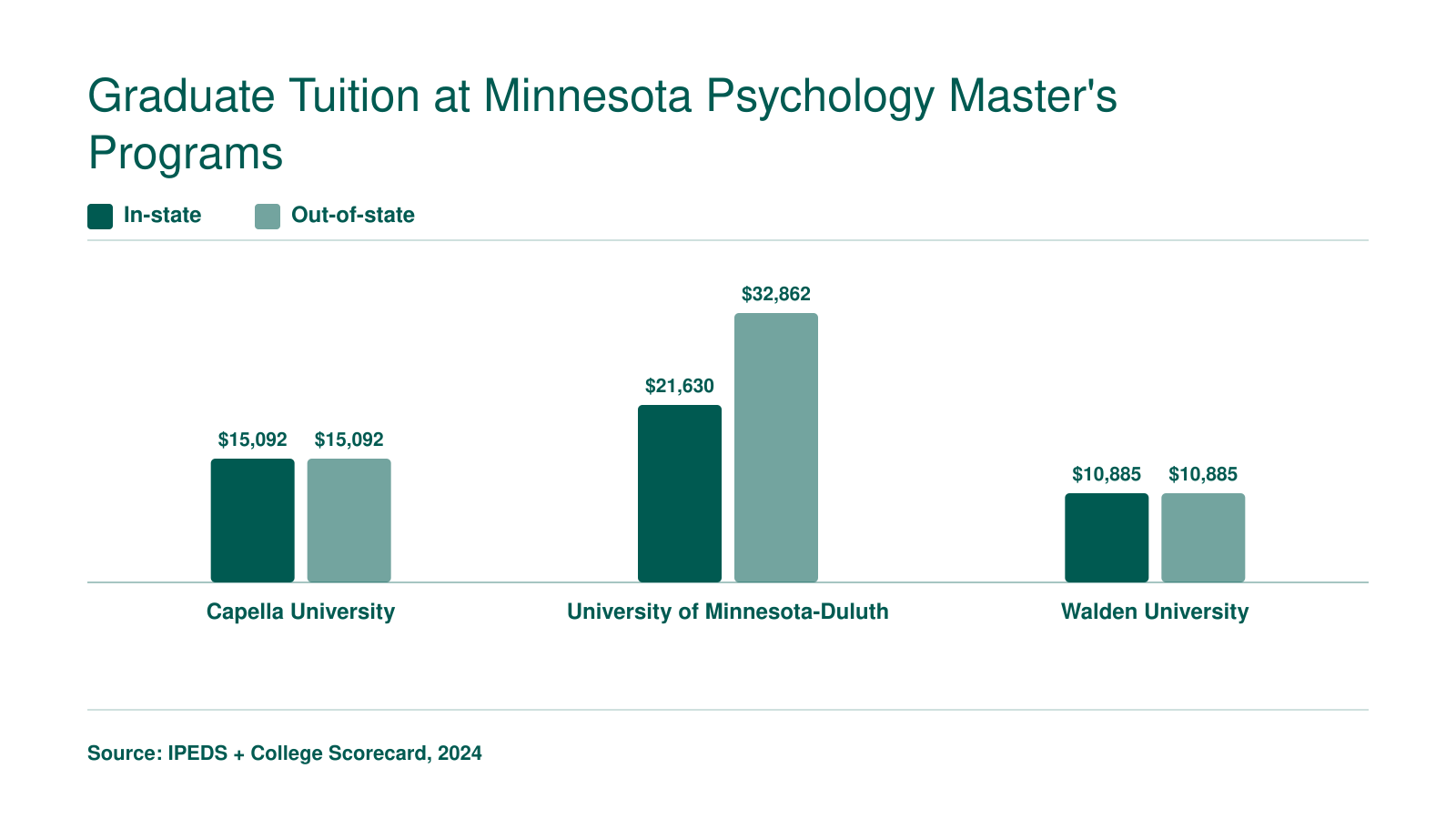
The chart compares in-state and out-of-state graduate tuition for each school here. The biggest public-versus-private gap is at University of Minnesota-Duluth, where out-of-state tuition of $32,862 runs $21,977 above Walden University's $10,885. For Minnesota residents, Walden is the lowest-cost option at $10,885, ahead of Capella University at $15,092 and Duluth at $21,630. Capella and Walden charge the same rate regardless of residency. These are annual tuition and fees, not the total cost of the degree, so program length and credit load will change what you pay overall.
Cost, Earnings, and Licensure for a Master's in Psychology in Minnesota
Minnesota's psychology master's market now separates research and general psychology training from licensure-track counseling more sharply than general program labels suggest. That split shapes what you pay and what the degree can do next.
What these programs cost
- Walden University: $610 per credit for 48 credits, or $24,105 in total program tuition for the MS in Psychology, General Psychology.
- Capella University: $540 per credit for 48 credits, or $25,920 in total program tuition for the MS in Psychology.
- University of Minnesota-Duluth: published graduate tuition and fees are $15,810 in state and $21,780 out of state for the MA in Psychological Science; a separate per-credit program rate is not listed. These figures include required fees.
Earnings and debt after completion
One year after finishing, Walden completers report a median of $46,138 and Capella completers $46,920. At five years, Walden's median is $52,981 and Capella's $50,381. Reported median debt is $41,000 at Walden and $34,698 at Capella. University of Minnesota-Duluth does not publish program-level earnings in the data reviewed.
Minnesota licensure paths
LPC and LPCC require a counseling master's with supervised clinical hours and an exam. LMFT requires a marriage and family therapy sequence, and Minnesota school psychologist credentialing requires a specialist-level degree beyond a general master's, a pathway detailed in school psychology programs in Minnesota.
None of the programs on this page is designed to satisfy those licensure requirements. Walden's MS in Psychology (General Psychology) and Capella's MS in Psychology are general rather than counseling licensure tracks, and University of Minnesota-Duluth's MA in Psychological Science is research-oriented rather than a counseling practicum track. A general psychology or research MA can still support doctoral study or applied roles, but it will not by itself qualify for LPC, LPCC, LMFT, or school psychologist licensure; students seeking LPC or LPCC should compare the Best Master's in Counseling Psychology Programs in Minnesota.
Minnesota Licensing at a Glance
How We Rank Minnesota Master's in Psychology Schools
Our rankings start with outcomes, not reputation. We compare net price, tuition, graduate earnings and debt where published, and graduation rate to identify which Minnesota psychology master's programs offer the strongest value, the same affordability lens used in our Most Affordable Master's in Psychology Programs ranking. Campus and online programs are ranked together on the same criteria, so you can weigh formats side by side without changing the yardstick. This means fewer big-name defaults and more attention to what you actually pay and earn.
We use federal data from College Scorecard and IPEDS. When program-level earnings or debt figures are not published, we leave them out instead of estimating. That keeps each ranking grounded in verifiable numbers, not marketing claims.
Frequently Asked Questions About Master's in Psychology in Minnesota
Which Minnesota psychology master's programs lead to LPCC licensure?
What is the difference between clinical, counseling, and school psychology master's programs?
How long does it take to complete a master's in psychology in Minnesota?
Can you practice as a psychologist in Minnesota with only a master's degree?
Compare General Psychology programs on the data that matters
Explore more Psychology specializations or browse every graduate field.
All Psychology programs