Best Master's in Psychology Programs in Connecticut
Compare 4 accredited General Psychology programs in Connecticut, with graduate earnings, cost, debt, and completion data from IPEDS and the U.S. College Scorecard.

Wesleyan University's MA in psychology is not a standalone graduate degree; it is a six-credit thesis reserved for current Wesleyan students. That limitation sets the tone for a small field. Connecticut has only a handful of ranked general psychology master's programs, so every ranked option is campus-based, and tuition, GRE expectations, and post-master's earnings carry extra weight.
A general master's in psychology also does not qualify you for licensure as a psychologist in Connecticut; that requires a doctorate. Master's-level credentials follow counseling psychology, school psychology, or applied behavior analysis tracks instead.
Key Points
- Southern Connecticut State University M.A. median earnings: $44,900 one year after graduation.
- Central Connecticut State University does not require the GRE for 2027 applicants.
- Connecticut psychologist licensure requires a doctorate, not a master's.
Top-Ranked Master's in Psychology Programs in Connecticut for 2027
These are the Connecticut master's programs in psychology that made this year's list. Each entry notes what the program actually requires, from open application status to thesis, exam, or practicum tracks, so you can compare fit alongside the cost and completion data in the cards.
Wesleyan University
#1Middletown, CT · $65,000 – $70,000/yr (est.)
Best for: Current undergraduates completing a combined degree
Wesleyan University's master's in psychology is not a stand-alone program; it is a combined BA/MA pathway open only to current Wesleyan undergraduates, who complete two post-baccalaureate semesters and a thesis with oral defense. The program requires at least six credits beyond the 32-credit BA, with at least 20 hours of weekly research and a B-minus or better in courses. The school says tuition is waived for those two semesters, including eligible summer and winter courses. Institution-wide, schools offering this program graduate about 93% of students.
- Open only to current Wesleyan undergraduates
- Combined BA/MA pathway, no stand-alone MA
- Requires 6 credits beyond the 32-credit BA
- Thesis with oral defense in mid-April to early May
- At least 20 hours of weekly research expected
- No language or teaching requirement
- GRE scores not required for BA/MA applicants
Central Connecticut State University
#2New Britain, CT · ~$15,000/yr (est.)
Best for: Working adults wanting flexible semester starts
Central Connecticut State University offers a Master of Arts in General Psychology with concentrations in health psychology, community psychology, or general psychology, and lets students choose an empirical thesis or a capstone project. The program admits students for January and August starts and supports full-time or part-time study; applications are due April 1 for fall and November 1 for spring. The university is accredited by the New England Commission of Higher Education (NECHE). Institution-wide, schools offering this program graduate about 48% of students.
- Concentrations in health, community, or general psychology
- Choose an empirical thesis or a capstone project
- Thesis or capstone requires a public defense
- Final paper typically at least 30 pages
- January and August start terms
- Application deadlines: April 1 and November 1
- Accredited by NECHE
- Full-time or part-time study
University of Hartford
#3West Hartford, CT · ~$16,000/yr (est.)
Best for: Doctoral-bound students comfortable with GRE
University of Hartford's Master of Arts in General Psychology provides a research-focused foundation in experimental design, learning, physiological psychology, social psychology, and lifespan development. Students choose between a thesis track for doctoral preparation and an applied practicum track for hands-on experience, and may use electives in biopsychology, industrial-organizational psychology, or health psychology. Admission requires GRE scores, a B average, and three letters of recommendation; an accelerated BA/MA option lets strong undergraduates complete both degrees in five years. Institution-wide, schools offering this program graduate about 54% of students.
- 33-credit on-campus program
- Thesis or applied practicum track
- Elective subspecialties include biopsychology and I/O psychology
- GRE scores required for admission
- Minimum 3.0 GPA and three recommendation letters
- Accelerated BA/MA can be completed in five years
Southern Connecticut State University
#4New Haven, CT · ~$15,000/yr (est.)
Southern Connecticut State University offers a 30-credit Master of Arts in psychology covering research, theory, and methods, with a choice of thesis or exam tracks. Training includes laboratory research, testing and assessment, clinical field practicum experiences, and internships in mental health, educational, and laboratory settings. Students may enroll full-time or part-time, and competitive graduate or research assistantships are available. Institution-wide, schools offering this program graduate about 50% of students.
- 30-credit curriculum
- Thesis or exam track
- Full-time and part-time enrollment
- Laboratory research and thesis projects
- Training in testing and assessment
- Clinical field practicum and internships
- Competitive graduate and research assistantships
- Prepares for Ph.D. or Psy.D. study
Cost & outcomes by school
Federal data for the highest-earning General Psychology programs, independent of the ranking above. Earnings are this field's master's graduates four years after completing, where the Scorecard reports them.
| School | Earnings | Tuition / yr | Debt | Grads/yr | Format |
|---|---|---|---|---|---|
| Southern Connecticut State University CT | $54,350 | $14,930 | $25,262 | 9 | Campus |
| Central Connecticut State University CT | — | $14,562 | — | 10 | Campus |
| University of Hartford CT | — | $16,129 | — | — | Campus |
| Wesleyan University CT | — | $69,702 | — | 3 | Campus |
Sources: U.S. Department of Education. Tuition and graduates: IPEDS. Earnings and debt: College Scorecard, this field's master's graduates; a dash means no figure is reported.
Online and Hybrid Master's in Psychology Options in Connecticut
Can you earn a master's in psychology entirely online from a Connecticut school? Not among the online master's programs in Connecticut ranked here. Wesleyan University, Central Connecticut State University, the University of Hartford, and Southern Connecticut State University are all classified as campus programs, and the research shows no fully online psychology master's among the ranked master's in general psychology M.A. programs. The one hybrid listing is Southern's M.S. in School Psychology, which is a separate program from its M.A. in Psychology.
Timing and part-time study
- Southern M.A.: 30 credits, with a thesis or exam track. Part-time students commonly take one or two courses a semester, full-time students three, and the university caps completion at six years.
- Central M.A.: 36 to 39 credits, full- or part-time. The Community Psychology track holds most of its courses in the evening.
- Hartford M.A.: 33 credits. The research does not confirm a part-time option, so ask admissions.
- Wesleyan M.A.: Two semesters with a required thesis, open only to Wesleyan students, so it rarely suits working adults.
No source gives a single typical completion time for these programs, so plan from credit counts and course loads.
The working-adult tradeoff
Campus programs often come with research labs, faculty-mentored theses, and practicum placements. Wesleyan expects about 20 hours of research weekly, and Southern lists laboratory research and clinical field practicum. Evening or part-time schedules help with work, but they can limit lab time and thesis advising.
If you need fully online study
Look at out-of-state online master's in psychology programs that enroll Connecticut residents. Before you apply, confirm the school is authorized to serve students in Connecticut.
Which Connecticut Master's in Psychology Programs Waive the GRE?
Central Connecticut State University does not require the GRE, while Southern Connecticut State University does not list it as an application requirement. Both programs note preferred preparation in psychology coursework, including statistics and research methods.
| School | GRE Policy | Minimum GPA | Prerequisites | Application Deadline |
|---|---|---|---|---|
| Southern Connecticut State University | No published policy | 3.0 cumulative undergrad GPA, 3.0 psychology GPA, 3.0 graduate GPA (if applicable) | 18 hours of psychology, including statistics and research methods | N/A |
| Central Connecticut State University | No GRE required | 2.70 undergraduate GPA; 3.00 in post-baccalaureate coursework | Preferred: BA/BS in psychology or related field, 18+ psych credits, B or higher in statistics and research methods, 3.0+ psych GPA | April 1 |
Related Articles
What a Master's in Psychology Costs in Connecticut
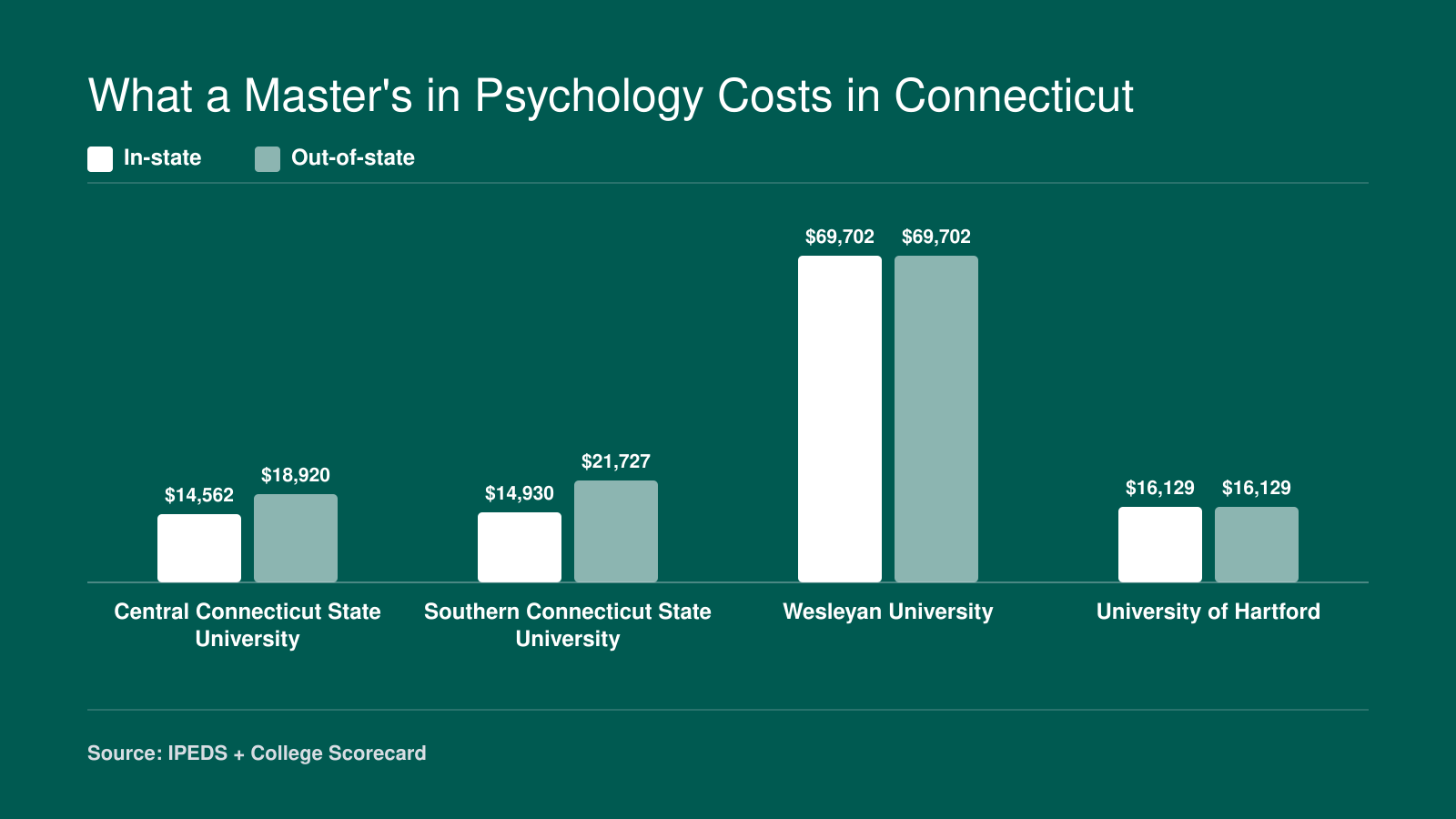
Published in-state and out-of-state graduate tuition and fees differ most at Connecticut's public universities, while the private programs shown here report the same rate for both. These are broad institution figures, not a guaranteed personal price; net price is an approximate institution-wide average that changes with aid, housing, and enrollment choices. At Central Connecticut State and Southern Connecticut State, published graduate assistantship fee waivers generally cover the university fee, university general fee, and student activity fee, though tuition and accident insurance can still apply.
Connecticut Licensure and Certification After a Psychology Master's
Career Outcomes and ROI for Connecticut Psychology Master's Graduates
Is a master's in psychology worth it in Connecticut? The clearest published program-level numbers suggest it makes the most sense as a bridge to further training. For Southern Connecticut State University's M.A., median earnings are about $44,900 one year after finishing and $54,350 four years out. Median debt is $25,262 with an estimated 10-year payment of $287 a month, or roughly 6 to 8 percent of those earnings figures.
That payment-to-earnings ratio is manageable, but the real payoff depends on the next step. SCSU describes the degree as preparation for Ph.D. or Psy.D. applications, and graduates move into clinical psychology, counseling, school psychology programs, social work, research, and human services. Common titles include research coordinator, research analyst, HR specialist, case manager, behavioral health specialist, and social services coordinator. Central Connecticut State University's community, health, and general options point toward research settings, human services, nonprofits, medical environments, and doctoral study.
In Connecticut, a psychology master's alone generally does not license you as a psychologist, so the strongest return comes when it feeds a doctorate or a licensable adjacent field such as counseling or social work. If you plan to stop at the master's, compare the debt against pay in those specific roles and review the most affordable master's in psychology programs before enrolling.
Frequently Asked Questions About Psychology Graduate Programs in Connecticut
Is a master's in psychology worth it in Connecticut?
What can you do with a master's in psychology in Connecticut?
Is a school psychology master's in CT the same as a general psychology master's?
Can I apply credits from a general psychology master's toward a Connecticut doctoral program?
Compare General Psychology programs on the data that matters
Explore more Psychology specializations or browse every graduate field.
All Psychology programs