Best Master's in Counseling Psychology Programs in Connecticut
Compare 7 accredited Counseling Psychology programs in Connecticut at 3 schools, with graduate earnings, cost, debt, and completion data from IPEDS and the U.S. College Scorecard.

How many postgraduate supervised hours does Connecticut require before you can practice as a Licensed Professional Counselor? The answer is 3,000, logged over at least two years, on top of a qualifying master's degree from one of the Best Master's in Psychology Programs in Connecticut and a passing exam score. Choosing the right program is the first link in that chain.
Connecticut's pool of counseling psychology programs is narrow, so format, net price, and CACREP accreditation carry more weight than a familiar name. Graduate earnings here cluster around $60,000, while debt loads and tuition diverge sharply between campus and online tracks, a spread worth weighing against the Most Affordable Master's in Counseling Psychology Programs before you commit two or three years.
Key Points
- Central Connecticut State University reports median earnings of $60,601 five years out.
- Post University offers a fully online M.S. in Clinical Mental Health Counseling.
- Albertus Magnus College lists the GRE as an alternative application path.
Best Master's in Counseling Psychology Programs in Connecticut, Ranked
These are the strongest master's in counseling psychology options in Connecticut, ordered by a mix of graduate outcomes, affordability, and program features. We include campus, hybrid, and fully online formats so you can compare clinical training paths side by side. Each card lists in-state graduate tuition, an approximate institution-wide net price after aid, delivery format, and available concentrations.
Central Connecticut State University
#1New Britain, CT · ~$15,000/yr (est.)
Best for: Connecticut residents pursuing public clinical counseling
Central Connecticut State University's CACREP-accredited MS in Counselor Education prepares clinicians across clinical professional counseling, clinical rehabilitation, and addictions recovery concentrations. The 60- to 63-credit curriculum adds mindfulness-informed coursework, individual, group, and family counseling, and supervised clinical field experiences. Evening classes, full- and part-time enrollment, and no entrance exam support working adults. The school has a graduation rate of 48%.
- CACREP-accredited 60- to 63-credit clinical counseling path
- Individual, group, and family counseling modalities
- Clinical counseling lab plus supervised field experiences
- Evening classes with full-time or part-time enrollment
- No entrance exam required
- Rehabilitation counseling concentration with 60 total credits
- Mindfulness-informed coursework and NBCC content alignment
- Prepares for mental health and addiction agency roles
- State-of-the-art clinical counseling laboratory
- Fall start for new students
- Addictions recovery concentration aligned to CACREP core standards
- Multiculturally competent practitioner training
- Preparation for addiction treatment and recovery settings
- Supervised clinical counseling field experiences
- Financial aid available
Post University
#2Waterbury, CT · ~$8,000/yr (est.)
Best for: Working adults needing fully online flexibility
Post University's online counseling offerings include an MS in Clinical Mental Health Counseling and an MS in Counseling and Human Services with clinical mental health and alcohol and drug counseling concentrations. The clinical mental health path spans 60 credits and roughly 40 months, while the human services option is 39 credits and about 26 months. Both include supervised field practice, group supervision, and full-time or part-time online study. The school has a graduation rate of 25%.
- 60-credit online clinical mental health counseling program
- 48 core credits and 12 elective credits
- Typical completion in about 40 months
- Mock counseling, field practicum, and internship
- Weekly two-hour group supervision
- Military benefits and tuition reductions
- 39-credit online counseling and human services degree
- Clinical mental health and alcohol and drug counseling concentrations
- Typical completion in about 26 months
- Clinical field practicum with clients and capstone
- Work experience required
- Personal academic advisor assigned
Albertus Magnus College
#3New Haven, CT · ~$25,000/yr (est.)
Best for: Employed learners wanting evening classes and internships
Albertus Magnus College's MS in Clinical Counseling offers mental health counseling and addiction counseling tracks, with a 60-credit curriculum completed in about three years. Students log at least 720 supervised clinical hours, complete a thesis tied to the internship site, and can attend evening classes with some hybrid and accelerated summer modules. A dedicated internship coordinator helps secure placements. The school has a graduation rate of 51%.
- 60-credit MS in Clinical Counseling taking about three years
- Mental health counseling and addiction counseling tracks
- At least 720 supervised clinical hours
- Evening classes with hybrid and 8-week summer modules
- Thesis tied to internship site
- Dedicated internship coordinator helps secure placements
- Prepares for LPC licensure; addiction track for LADC
- Test optional with no entrance exam required
Cost & outcomes by school
Federal data for the highest-earning Counseling Psychology programs, independent of the ranking above. Earnings are this field's master's graduates four years after completing, where the Scorecard reports them.
| School | Earnings | Tuition / yr | Debt | Grads/yr | Format |
|---|---|---|---|---|---|
| Central Connecticut State University CT | $61,035 | $14,562 | $53,260 | — | Campus |
| Post University CT | — | $7,955 | — | — | Online |
| Albertus Magnus College CT | — | $24,528 | — | — | Campus |
Sources: U.S. Department of Education. Tuition and graduates: IPEDS. Earnings and debt: College Scorecard, this field's master's graduates; a dash means no figure is reported.
Cost, debt & payoff
Median earnings of this field's master's graduates (4 yrs after completing) vs. their median federal loan debt · U.S. College Scorecard
Across these programs the median graduate earns about $61,035 and finishes with roughly $53,260 in debt — a ratio that clears a common rule of thumb (keep debt below first-year salary). Tuition and debt vary widely school to school, so check the per-school figures in the table above before you shortlist.
Online and Hybrid Master's in Counseling Options in Connecticut
Only one program on this list is built for distance study: Post University's 60-credit M.S. in Clinical Mental Health Counseling, delivered fully online over a roughly 40-month sequence and included among the Clinical Mental Health Counseling Master's Programs in Connecticut. Central Connecticut State University, a school featured among Master's Programs in Connecticut, runs its Counselor Education master's with the Clinical Professional Counseling specialization on campus in New Britain, with evening courses aimed at working adults. Albertus Magnus College also teaches its Clinical Counseling master's on campus in New Haven, with some blended and hybrid coursework and eight-week accelerated summer modules.
What "online" actually requires
Post structures its online program around a weekly two-hour group supervision block, which functions as a scheduled live commitment rather than purely self-paced coursework, a pattern we track in the Best Online Master's in Counseling Psychology Programs ranking. The school does not publish a mandatory on-campus residency or intensive for this program, so treat the absence of one as unconfirmed rather than guaranteed, and ask admissions directly before you plan around it.
Clinical hours still happen in person
No delivery format removes the fieldwork. Online students complete a field practicum and counseling internship at an approved site, in person, with real clients. Albertus Magnus requires 720 clinical hours and assigns an internship coordinator to help students secure placements. None of these schools publishes a clear policy on whether out-of-state online students can arrange sites in their home community, so confirm placement geography, site approval rules, and supervisor credentials before enrolling.
Which Connecticut Master's in Counseling Programs Waive the GRE?
Admissions pages for the counseling programs below publish varying levels of detail about GRE requirements. Central Connecticut State University does not state a GRE policy on its official admissions page, while Albertus Magnus College presents the GRE as an alternative to a substantive writing sample rather than classifying it as required, optional, or not considered.
| School | GRE Policy | Minimum GPA | Application Deadline | Recommendations | Prerequisites |
|---|---|---|---|---|---|
| Central Connecticut State University | No published policy | 2.70 minimum undergraduate GPA; 3.00 minimum graduate GPA | February 1 for fall admission | Three recommendations | N/A |
| Albertus Magnus College | No published policy | 3.0 minimum cumulative GPA | N/A | N/A | At least 15 psychology credits, including a course in statistics for behavioral social sciences |
Related Articles
Cost of a Counseling Master's and Connecticut LPC Licensure
As Connecticut tightens its education rules for new counselors, the gap between sticker tuition and what graduates actually pay matters more than ever when you compare counseling psychology master's programs.
What the Programs Cost
The most affordable option here is Central Connecticut State University, where graduate tuition runs a few thousand dollars a year for residents and somewhat more for out-of-state students. Post University and Albertus Magnus College carry higher published tuition. Watch the net price figure too, but read it with care: it is an institution-wide average across all students and aid packages, not a counseling-specific estimate.
To gauge total cost, pair a school's per-credit rate with the roughly 60-credit load that an LPC-track degree requires. A program charging around $975 per credit, for example, works out to about $58,500 before fees and any annual increases.
The Connecticut LPC Path
Licensure through the Connecticut Department of Public Health follows a clear sequence:1
- Degree: A master's or doctoral degree with 60 graduate semester hours in counseling or a related field.1
- Exam: Pass either the NCE or the NCMHCE.1
- Supervised experience: 3,000 postgraduate hours over no less than two years, including at least 100 hours of direct supervision.1
- Associate credential: If you earn those hours in Connecticut, you must first hold a Professional Counselor Associate license.3
For applicants matriculating on or after July 1, 2017, the state's education requirements specify a CACREP-accredited clinical mental health counseling degree with a 100-hour practicum and a 600-hour internship.2 Confirm your matriculation date and the department's determination early, since the alternative path for non-CACREP graduates is not clearly established.
Connecticut LPC Licensing and Portability to NY, MA, and RI
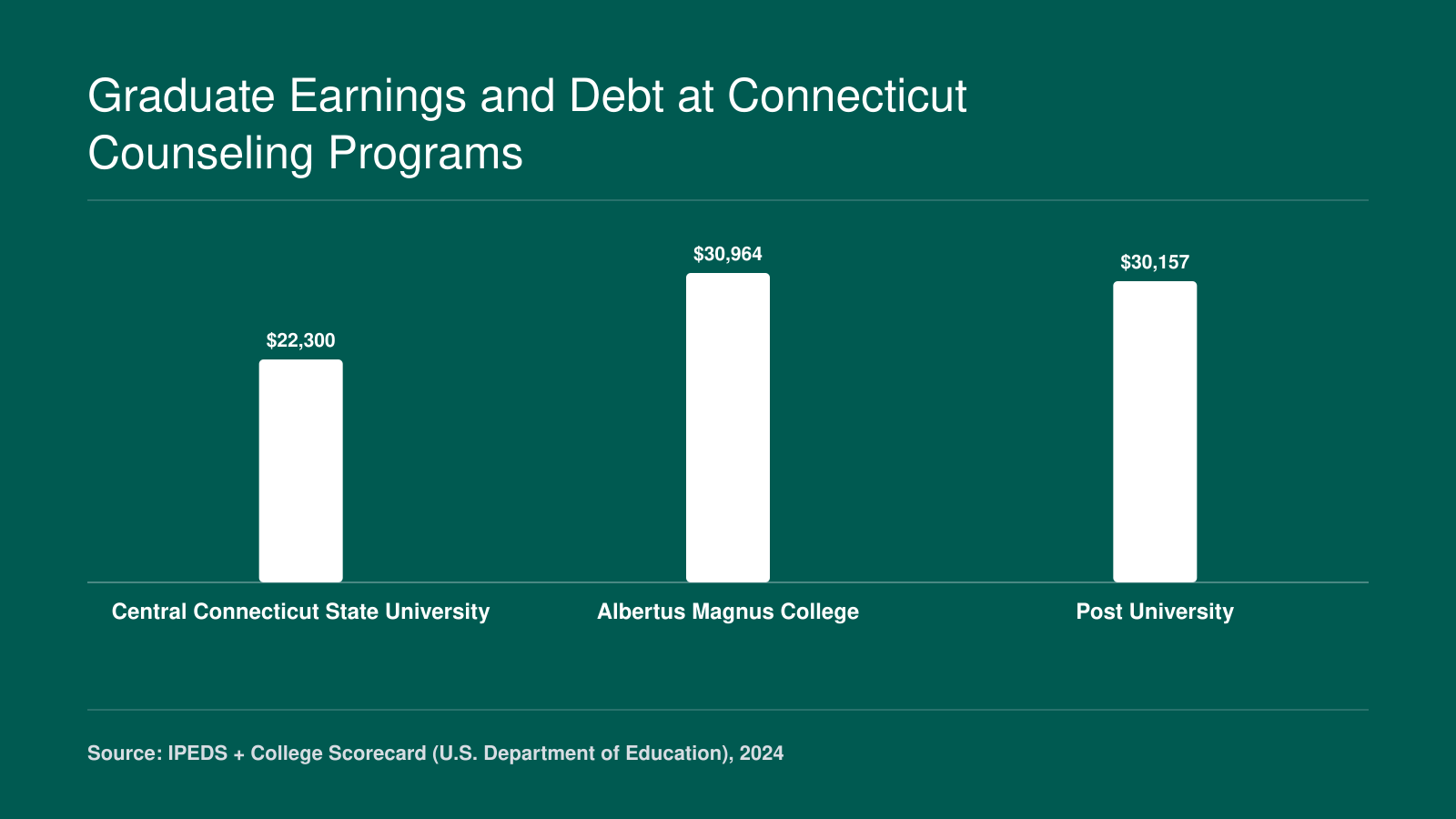
Graduate Earnings and Debt at Connecticut Counseling Programs
Central Connecticut State University reported median earnings of $60,601 five years after completion and a median $606 10-year repayment, a manageable debt-to-earnings profile. Program-level earnings are not separately published for the other ranked counseling programs. Median federal debt across these schools ranges from $22,300 to $30,964.
CACREP Accreditation and Clinical Training Hours
Central Connecticut State University's M.S. in Counselor Education with the Clinical Professional Counseling specialization is CACREP-accredited through March 31, 2028,1 with reaffirmation in process. CACREP accreditation can smooth the Connecticut LPC application, make licensure easier in other states, and open eligibility for some federal and VA counseling positions.
CACREP Status Among Ranked Programs
- Central Connecticut State University: Accredited through March 31, 2028; reaffirmation in process.
- Post University and Albertus Magnus College: Neither appears on the current CACREP Connecticut roster,1 so their counseling master's programs do not carry CACREP accreditation.
Clinical Training Requirements
CACREP's baseline is 100 practicum hours and 600 internship hours.1 Published hour totals were not available for the programs on this list; students should confirm each program's specific practicum and internship sequence directly with the department.
Placement arrangements also vary. The sources reviewed did not establish whether these schools assign clinical sites or expect students to find their own, so ask whether the program coordinates placements before enrolling.
What Non-CACREP Status Means
Students considering Post University or Albertus Magnus College should verify that their intended state licensing board will accept non-CACREP coursework. Connecticut may still license graduates from non-accredited programs after a transcript review, but the application can require extra documentation.
Compare Counseling Psychology programs on the data that matters
Explore more Psychology specializations or browse every graduate field.
All Psychology programs