Accelerated Master's in Advertising Programs
Compare 24 accredited fastest Advertising programs at 21 schools, with graduate earnings, cost, debt, and completion data from IPEDS and the U.S. College Scorecard.

Up to 12 graduate credits can count toward both a bachelor's and a master's in advertising, cutting the graduate degree to roughly one extra year instead of two. Less tuition and faster entry into agency and brand-side roles make that timeline attractive, especially for students who commit early to one school.
The ranked programs below include campus, fully online, and hybrid formats, so staying local or relocating for a specialized track are both realistic. Published median earnings one year after completion at these programs cluster near $63,000 to $67,000.
Key Points
- Accelerated advertising master's pathways share credits to finish faster.
- Loyola University Chicago lists up to $15,240 shared-credit savings.
- Online or hybrid delivery and accelerated pacing are separate decisions.
Best Accelerated Master's in Advertising Schools for 2027
This list highlights accelerated master's options in advertising, including combined bachelor's-to-master's pathways and one-year programs that reduce time to degree.
University of Georgia
#1Athens, GA · ~$11,000/yr (est.)
Best for: Undergrad advertising majors on Double Dawgs path
The University of Georgia's M.A. in Advertising sits in Grady College's Department of Advertising and Public Relations, with thesis and non-thesis tracks. The Double Dawgs accelerated pathway lets advertising majors combine bachelor's and master's work and finish in five years, and the M.A. stage does not require GRE scores. Graduates prepare for leadership roles across advertising, media, and communication.
- Thesis track for research-focused careers; non-thesis track with comprehensive exam.
- Double Dawg accelerated pathway combines bachelor's and master's in five years.
- Offered by Department of Advertising and Public Relations within Grady College.
- Prepares graduates for leadership roles in advertising, media, and communication.
The University of Alabama
#2Tuscaloosa, AL · ~$12,000/yr (est.)
Best for: Working seniors wanting online completion option
The University of Alabama's MA in Advertising and Public Relations offers four concentrations, including a fully online Marketing Communication Management option. Its Accelerated Master's Program lets qualified seniors apply up to 12 shared graduate credits toward both degrees, reducing time to the master's by one year. Assistantships can include a stipend and partial or full tuition waiver.
- 30-36 credit hours across core, electives, professional experience, and capstone.
- Concentrations: Advertising Creative, Digital Communication, Media Strategy, and Marketing Communication Management (online only).
- AMP allows up to 12 shared graduate credit hours and saves one year of study.
- Assistantships are nine-month appointments with stipend and partial or full tuition waiver.
- On-campus fall entry; online fall or spring with rolling review.
- Applicants submit video or written statement of purpose, resume with two references, and three work samples.
Syracuse University
#3Syracuse, NY · $45,000 – $50,000/yr (est.)
Best for: Career changers wanting a one-year master's
Syracuse University's Master of Science in Advertising is a one-year, 36-credit program in the S.I. Newhouse School of Public Communications. Required coursework spans digital branding and strategy, account planning and research, media planning, and integrated campaigns, with six credits of Newhouse electives. Students present advertising ideas, research, and strategies in settings matched to their career paths.
- One-year, 36-credit program in the S.I. Newhouse School of Public Communications.
- Required coursework includes digital branding and strategy, account planning and research, media planning, and integrated campaigns.
- Six credits of Newhouse electives; non-Newhouse electives require a chair petition.
- Students present advertising ideas, plans, research, strategies and executions in career-relevant settings.
- Program director: Carrie Riby; faculty include Beth Egan, Adam Peruta, Edward Russell and Melanie White.
University of Oregon
#4Eugene, OR · ~$19,000/yr (est.)
The University of Oregon's Advertising and Brand Responsibility Master's is a one-year, 46-credit program in the School of Journalism and Communication. Core courses cover brand responsibility, media and society, strategic communication research, and design, technology, and culture. The fall cohort admits 16 to 20 students on the Eugene campus, and no GRE is required for admission.
- 46 graduate credits, including 12 elective credits and at least 6 capstone, internship, or thesis credits.
- Core courses cover brand responsibility, media and society, strategic communication research, and design, technology, and culture.
- No GRE required for admission; international applicants submit TOEFL or IELTS scores.
- 3.00 GPA required to graduate.
- Fall cohort of 16 to 20 students with daytime classes Monday through Friday.
- Estimated total tuition is $21,000+ for Oregon residents and $32,000+ for nonresidents.
- Alumni at Wieden+Kennedy, Axios, The New York Times, and Reformation.
Lipscomb University
#5Nashville, TN · ~$17,000/yr (est.)
Lipscomb University's M.A. in Advertising is a 36-credit program that may be completed in one year, with synchronous and asynchronous options in a hybrid on-campus and online format. The program requires no entrance exam and no thesis or capstone, though an optional thesis track is available, and a 15-hour graduate certificate can be added.
- 36 total credit hours; may be completed in one year.
- Hybrid on-campus and online format with synchronous and asynchronous options.
- No entrance exam required and test optional.
- No thesis or capstone required; optional thesis track available.
- 15-hour graduate certificate available.
- Designed for busy working professionals with a focus on ethical advertising practice.
Cost & outcomes by school
Federal data for the highest-earning Advertising programs, independent of the ranking above. Earnings are this field's master's graduates four years after completing, where the Scorecard reports them.
| School | Earnings | Tuition / yr | Debt | Grads/yr | Format |
|---|---|---|---|---|---|
| Syracuse University NY | $87,500 | $48,132 | $71,289 | 122 | Campus |
| University of Oregon OR | $79,716 | $19,474 | $29,606 | 21 | Campus |
| University of Colorado Boulder CO | — | $16,634 | — | 5 | Campus |
Sources: U.S. Department of Education. Tuition and graduates: IPEDS. Earnings and debt: College Scorecard, this field's master's graduates; a dash means no figure is reported.
Cost, debt & payoff
Median earnings of this field's master's graduates (4 yrs after completing) vs. their median federal loan debt · U.S. College Scorecard
Across these programs the median graduate earns about $87,500 and finishes with roughly $39,224 in debt — a ratio that clears a common rule of thumb (keep debt below first-year salary). Tuition and debt vary widely school to school, so check the per-school figures in the table above before you shortlist.
What Is an Accelerated Master's in Advertising?
An accelerated master's degree trades flexibility for speed: you commit to graduate study early, at one school, in exchange for finishing both degrees sooner and paying for fewer semesters.
How the Pathway Works
In an accelerated bachelor's-to-master's program, undergraduates start graduate-level advertising courses during their senior year. Those shared credits count toward both the bachelor's and the master's, so the graduate portion shrinks. How many credits can double-count varies by school, and that number drives most of the savings.
The Timeline in Plain Numbers
- Standard route: A 4-year bachelor's followed by a 1.5 to 2 year master's, or roughly 5.5 to 6 years total.
- Accelerated route: Typically about 5 years from freshman year to master's diploma.
How It Differs From a Standalone Master's
Students usually apply as juniors rather than after graduation, and they stay at the same university for both degrees. Many programs let current undergraduates who meet a GPA threshold skip separate graduate entrance exams. The tradeoff is less room to shop around: you choose your graduate program before finishing college.
Check the Degree Title
Not every program is advertising alone. Some schools pair advertising with public relations or marketing, so the credential may read as a master's in advertising and public relations or a broader marketing communications degree. Confirm the exact title fits the roles you plan to pursue.
Shared Credits, Tuition per Credit, and Projected Savings
Shared credits are the fastest way to reduce the cost of an accelerated advertising master's. For example, Loyola University Chicago lists up to 12 shared graduate credits at $1,270 per credit, which equals $15,240 in tuition savings before considering any financial aid. Those savings also typically include roughly a semester or more of living costs and the chance to enter the workforce earlier. Where a school does not publish a graduate per-credit rate, the estimated tuition savings are marked as not published instead of projected.
| School | Shared Credits | Grad Tuition per Credit | Estimated Savings | Typical Time to Both Degrees |
|---|---|---|---|---|
| Loyola University Chicago | Up to 12 credits | $1,270 | $15,240 | 18 months full-time master's study |
| Southern Methodist University | Up to 6 credits | Not published | Not published | Not published |
| Quinnipiac University | Up to 6 credits | Not published | Not published | Five-year program |
| American University | Up to 9 credits | Not published | At least $30,000 | Five years |
Related Articles
Online and Hybrid Accelerated Advertising Options
"Online" and "hybrid" describe how graduate courses are delivered, not whether the accelerated pathway itself can be finished remotely. Those are two separate questions, and conflating them is the most common planning mistake students make here.
What the programs list
The University of Alabama's MA in Advertising and Public Relations is hybrid: students in the digital communication concentration can complete the first year on campus and the final year online. The advertising master's at the University of Georgia, Syracuse, and the University of Oregon are each listed as campus-based. Elsewhere, the University of Nebraska-Lincoln runs hybrid and fully online graduate classes in its Integrated Media Communication accelerated program.1 Indiana University notes that accelerated master's coursework can be online or hybrid where a department offers it.2 Loyola University Chicago's Advertising and Emerging Media MS is taught in person.
Part-time and working-student paths
Part-time study is more widely available than fully online study, and an online master's in advertising is not the standard path. Loyola's part-time students take two courses a semester and have up to three years to finish, and Boston University's MS in Advertising runs full- or part-time on campus, typically 12 to 20 months.3 Asynchronous delivery is rarely confirmed at the course level, so verify it rather than assume it.
One thing to confirm
Ask your program advisor directly whether online graduate courses qualify as shared credits. Approval is set program by program, and an online section may not carry the same course level or grade minimum the shared-credit rule requires.
What Advertising Master's Graduates Earn at These Schools
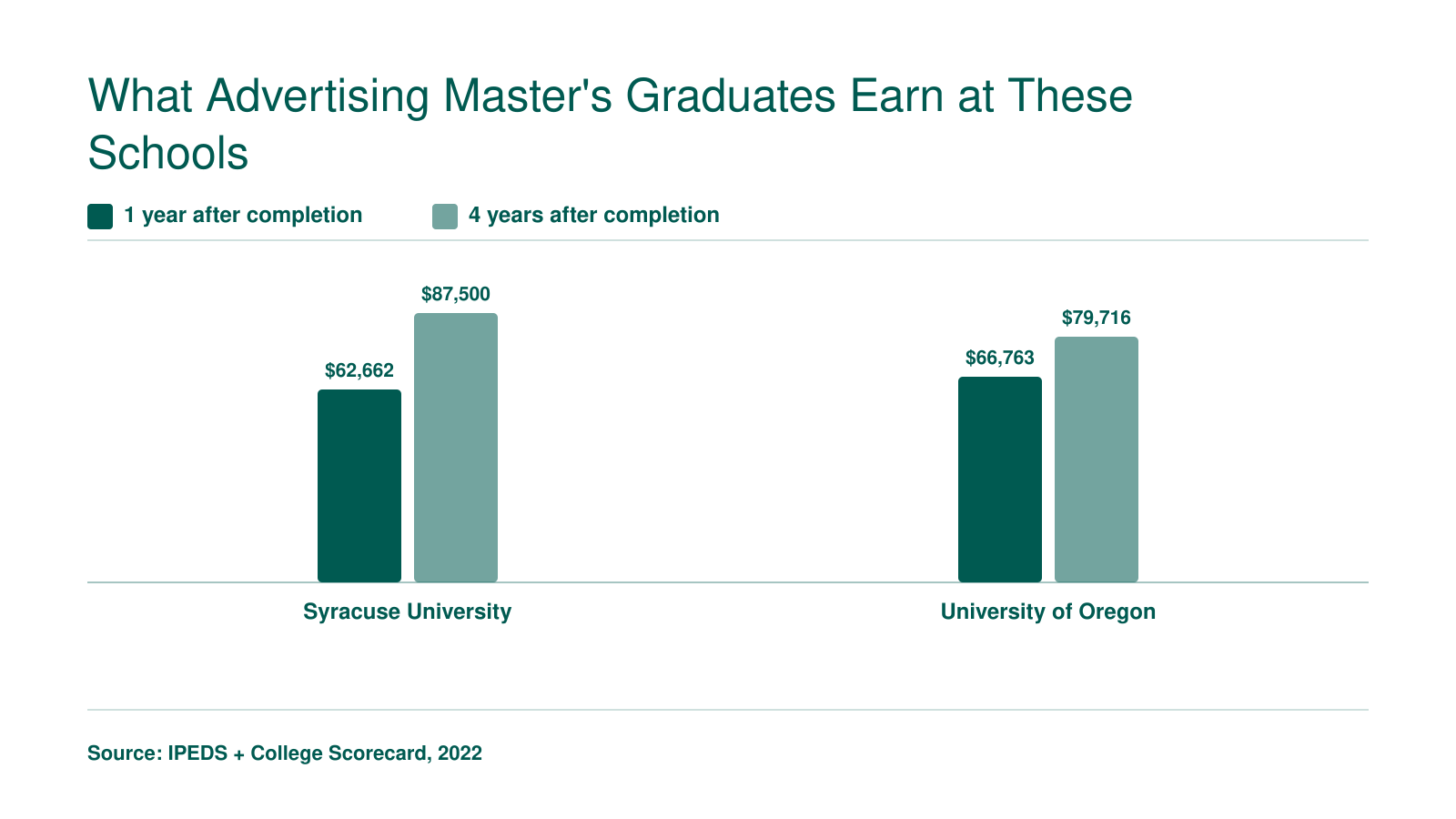
These are College Scorecard median earnings for advertising master's program completers, reported one year and four years after completion. The chart shows Syracuse University and University of Oregon, the schools here with published program-level medians. Schools without a published program-level median are omitted rather than shown with institution-wide earnings.
Admissions Requirements: GPA, Timing, and Who Can Apply
- Minimum GPAPublished minimums range from 3.0 (Roosevelt, Loyola) to 3.5 (SMU). Rowan accepts 3.25 in-major or 3.0 overall; Suffolk uses 3.3 overall/3.5 in-major; BGSU requires 3.0 or 3.2 by earned credits.
- Application timingMost pathways open in the junior year. Rowan's deadline is March 1, Suffolk's priority is March 15, and Roosevelt asks for an application by the end of first-semester junior year; SMU, Loyola, and BGSU use 75-90 earned credits.
- Eligibility and materialsLoyola welcomes any undergraduate major; Rowan, Roosevelt, and Suffolk require advertising, public relations, or related communication/media areas. SMU is limited to enrolled SMU undergraduates. Faculty recommendations are commonly required, and external/transfer eligibility is not published for most programs here.
Advertising programs by state
Accelerated Advertising Master's FAQs
Are accelerated advertising master's programs open to all undergraduate majors?
What happens if I start the accelerated pathway and decide not to finish the master's?
Is a master's in advertising and public relations different from an advertising master's degree?
Does an accelerated master's affect financial aid eligibility?
Compare Advertising programs on the data that matters
Explore more Communications & Media specializations or browse every graduate field.
All Communications & Media programs