Most Affordable Master's in Advertising Programs
Compare 24 accredited most affordable Advertising programs at 21 schools, with graduate earnings, cost, debt, and completion data from IPEDS and the U.S. College Scorecard.

An advertising master's is usually a 31 to 46 credit degree in brand strategy, media analytics, and campaign research, finished in one to two years.
Graduate tuition across the schools ranked here runs from $10,428 a year at the University of South Florida to $41,848 for nonresidents at Michigan State. That spread matters. Agency and brand-side roles do reward the credential, but a nonresident sticker price can outrun entry-level salaries well before a first promotion arrives.
Key Points
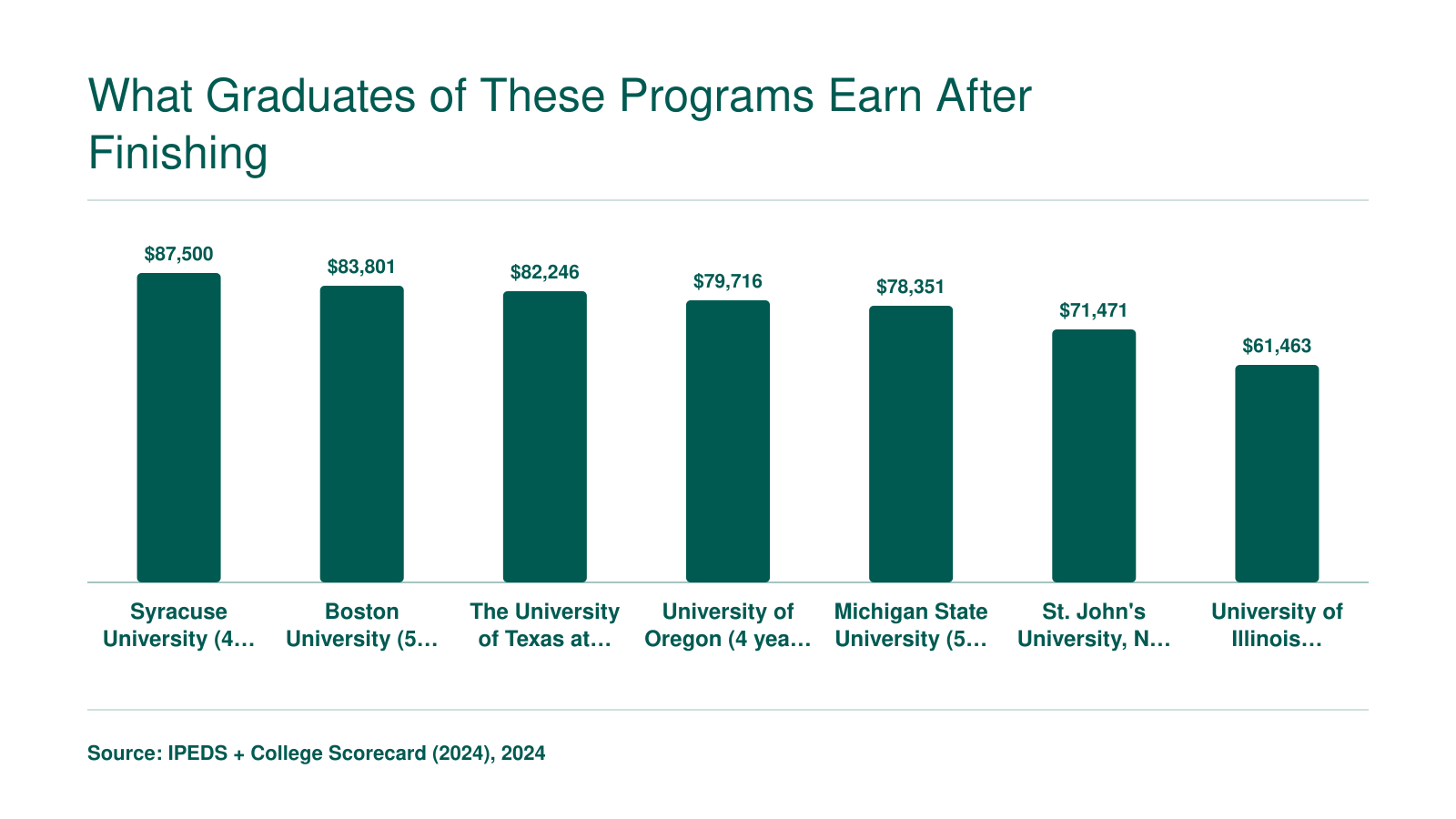
- Median earnings range from $61,463 to $87,500 after finishing.
- Advertising managers earn a median $133,660 annually per BLS.
- Alabama graduate assistants can receive partial or full tuition waivers.
Top 10 Affordable Advertising Master's Schools in 2027
These ten schools pair dedicated advertising master's programs with some of the lower net prices in the category. Tuition shown below is the published graduate rate before aid; net price is the institution-wide average after financial aid, not a guaranteed quote, and graduation rates refer to the university overall.
University of Florida
#1Gainesville, FL · ~$13,000/yr (est.)
Best for: Working professionals needing reduced course load
Florida's customizable research and theory master's lets advertising students pair a thesis with courses across journalism, media management, and mass communication law. Most students finish in two years, and working students can carry a reduced course load. Listed graduate tuition is about $6,381 in-state and $28,659 out-of-state, with an average net price after aid of $6,541. The campus program notes six concentration options, and the university reports a 91.1% overall graduation rate.
- Six concentration options spanning advertising, journalism, and media
- Two-year pace with thesis required
- Reduced course load available for working students
- Combine courses from multiple concentrations
- Articulation courses set by advisers
- Qualified students may be considered for doctoral admission
University of South Florida
#2Tampa, FL · ~$10,000/yr (est.)
Best for: Analytics-focused professionals seeking data-driven advertising training
USF's Zimmerman School offers a 36-credit MS in Advertising built around media analytics, with an applied research project and flexible electives. The campus program prepares students for analytics-driven roles at companies like Facebook and Save the Children. Listed graduate tuition is about $6,410 in-state and $17,324 out-of-state, and the average net price after aid is $9,812.
- 36 total credit hours
- Capstone required
- Analytics-focused curriculum for media strategy and creative content
- Financial aid and scholarships available
- Graduates have worked at Facebook and Save the Children
- Tailor coursework to entry-level or mid-career goals
University of Georgia
#3Athens, GA · ~$11,000/yr (est.)
Best for: Undergraduates seeking accelerated five-year master's pathway
Georgia's Grady College offers an M.A. in Advertising with a thesis track or a non-thesis comprehensive exam, plus an accelerated Double Dawg pathway that can combine bachelor's and master's degrees in five years. Listed graduate tuition is about $11,450 in-state and $31,688 out-of-state, and the average net price after aid is $13,936. The campus program is designed for leadership roles in advertising, media, and communication.
- Thesis or non-thesis capstone option
- Double Dawg accelerated pathway to earn bachelor's and master's in five years
- Comprehensive exam option for non-thesis students
The University of Texas at Austin
#4Austin, TX · ~$12,000/yr (est.)
UT Austin's Stan Richards School offers an M.A. in Advertising with thesis or non-thesis options and three concentrations: Texas Strategy, Texas Creative, and Texas Immersive. Most students finish in 21 months or less in a full-time, in-person weekday format. Listed graduate tuition is about $11,688 in-state and $44,908 out-of-state, and the average net price after aid is $19,857.
- Three concentrations: Texas Strategy, Texas Creative, and Texas Immersive
- 21-month or less completion time
- Full-time, in-person weekday schedule; fall admission only
- Thesis or non-thesis option available
- Financial aid includes fellowships, scholarships, and limited teaching assistantships
- Prerequisite courses in marketing and statistics required
University of Illinois Urbana-Champaign
#5Champaign, IL · ~$19,000/yr (est.)
Illinois offers a 36-credit MS in Advertising that can be completed in three semesters and emphasizes advertising theory, research methods, and strategy. The campus program uses a cohort model and offers a thesis or professional project. Listed graduate tuition is about $16,004 in-state and $35,124 out-of-state, and the average net price after aid is $14,355.
- 36 total credit hours
- Three-semester completion model
- Cohort-based structure
- Thesis or professional project option
- Meets industry professionals twice per semester
- Founded in 1946 by Charles H. Sandage
University of Oregon
#6Eugene, OR · ~$19,000/yr (est.)
Oregon's one-year Advertising and Brand Responsibility master's is a 46-credit campus program with a fall cohort of 16-20 students and no GRE requirement. Core work spans brand responsibility, strategic communication research, and design, technology, and culture. Listed graduate tuition is about $16,137 in-state and $44,598 out-of-state, and the average net price after aid is $22,182.
- 46 total credit hours, including 12 elective credits
- Capstone, internship, or thesis requirement
- One-year, professionally focused program
- Cohort of 16-20 students
- No GRE required for admission
- AI tools integrated into curriculum
- Alumni have worked at Wieden+Kennedy, Axios, and Reformation
The University of Alabama
#7Tuscaloosa, AL · ~$12,000/yr (est.)
Alabama's College of Communication and Information Sciences offers a 30-36 credit MA in Advertising and Public Relations with four concentrations, including an online-only Marketing Communication Management track. The hybrid program supports campus and fully online enrollment, with fall or spring starts online and nine-month assistantships offering tuition waivers. Listed graduate tuition is about $12,180 in-state and $34,172 out-of-state, and the average net price after aid is $22,420.
- Concentrations in creative, digital communication, media strategy, and marketing communication management
- Fully online option available
- Fall or spring start for online students
- Capstone required
- Assistantships are nine-month appointments with partial or full tuition waiver
- Three work samples required for application
Michigan State University
#8East Lansing, MI · $22,000 – $42,000/yr (est.)
Michigan State offers a Master of Arts in Advertising and Public Relations with concentrations in digital strategy and health, science, and the environment. The campus program covers digital analytics, multimedia content, and consumer insights. Listed graduate tuition is about $16,458 in-state and $43,842 out-of-state, and the average net price after aid is $19,680. Note: the program was in moratorium and not accepting applications for spring 2026, so verify current status before applying.
- Digital strategy concentration available
- Faculty-led strategic courses
- Research methods training
- Career-focused curriculum
- Concentration in health, science, and the environment
- Digital analytics and media focus
- Strategic communication training
- Research methods emphasis
- Multimedia content creation skills
Lipscomb University
#9Nashville, TN · ~$17,000/yr (est.)
Lipscomb's Advertising M.A. is a 36-credit, one-year program with synchronous and asynchronous options in a hybrid on-campus and online format. Designed for working professionals, it covers traditional and digital media through an ethical lens and offers an optional thesis track plus a 15-hour graduate certificate. Listed tuition is about $40,572 for both in-state and out-of-state students, and the average net price after aid is $24,739.
- 36 total credit hours
- May be completed in one year
- Synchronous and asynchronous options
- Hybrid on-campus and online format
- Optional thesis track available
- 15-hour graduate certificate available
- No entrance exam required
- Designed for busy working professionals
Temple University
#10Philadelphia, PA · $23,000 – $30,000/yr (est.)
Temple's Lew Klein College offers a 31-credit MS in Advertising and Public Relations that is part-time only and typically takes two years, with online coursework plus two in-person experiences. The hybrid program covers brand strategy, data-driven insights, and AI-enhanced communication through synchronous and asynchronous classes. Listed graduate tuition is about $23,011 in-state and $38,958 out-of-state, and the average net price after aid is $28,198.
- 31 total credit hours
- Part-time only; complete in about two years
- Synchronous and asynchronous online courses
- Two required in-person experiences
- Capstone anchors a professional portfolio
- Scholarships and financial aid available
Cost & outcomes by school
Federal data for the highest-earning Advertising programs, independent of the ranking above. Earnings are this field's master's graduates four years after completing, where the Scorecard reports them.
| School | Earnings | Tuition / yr | Debt | Grads/yr | Format |
|---|---|---|---|---|---|
| Boston University MA | $90,212 | $67,626 | $39,224 | 99 | Campus |
| Syracuse University NY | $87,500 | $48,132 | $71,289 | 122 | Campus |
| The University of Texas at Austin TX | $83,467 | $12,006 | $47,657 | 35 | Campus |
| University of Oregon OR | $79,716 | $19,474 | $29,606 | 21 | Campus |
| St. John's University-New York NY | $71,471 | $36,227 | — | 28 | Hybrid |
| University of Wyoming WY | — | $8,422 | — | — | Campus |
| Liberty University VA | — | $8,730 | — | 17 | Online |
| San Diego State University CA | — | $10,252 | — | — | Campus |
| University of South Florida FL | — | $10,428 | — | 3 | Campus |
| University of Georgia GA | — | $11,002 | — | — | Campus |
| The University of Alabama AL | — | $11,980 | — | 38 | Hybrid |
| University of Florida FL | — | $12,737 | — | — | Campus |
Sources: U.S. Department of Education. Tuition and graduates: IPEDS. Earnings and debt: College Scorecard, this field's master's graduates; a dash means no figure is reported.
Cost, debt & payoff
Median earnings of this field's master's graduates (4 yrs after completing) vs. their median federal loan debt · U.S. College Scorecard
Across these programs the median graduate earns about $87,500 and finishes with roughly $39,224 in debt — a ratio that clears a common rule of thumb (keep debt below first-year salary). Tuition and debt vary widely school to school, so check the per-school figures in the table above before you shortlist.
What Actually Determines an Advertising Master's True Cost?
Annual tuition is the least reliable number for judging what a master's in advertising will cost you. Published tuition covers instruction only. Mandatory fees are added to every bill. The full cost of attendance also includes books, software, a capable laptop, housing, and living expenses, which can rival tuition itself, so compare the total cost of a master's degree.
Read the Sticker Price Carefully
The lowest-cost public options here show how much residency matters. The University of South Florida lists graduate tuition of about $10,428 in-state versus $21,126 out-of-state. The University of Georgia lists $11,002 versus $29,774, and the University of Florida $12,737 versus $30,130. Program length changes the math too. USF's MS requires 36 credits, while the University of Oregon's one-year program runs 46 credits for roughly $38,000 or more in total program cost for Oregon residents.
Fees Students Miss
Bursar schedules carry charges that rarely appear on program pages. UConn's 2025-26 graduate schedule, for example, adds a $102 technology fee, a $293 general university fee, and a $25 per-credit online fee.1 UNC lists a $139.50 per-credit distance education fee.2 Exact charges vary by school and delivery format, so also check for program, studio, or course material fees.
Do the Math Yourself
Multiply the per-credit rate by the required credits, then add every mandatory fee for each term you'll enroll. Compare that total program cost across schools, not one year's tuition.
What Graduates of These Programs Earn After Finishing
Median earnings for these advertising master's programs range from $61,463 one year after finishing at University of Illinois Urbana-Champaign to $87,500 four years after finishing at Syracuse University. The top earning figure pairs with median program debt of $71,289, about $811 per month over 10 years; Boston University's $83,801 figure pairs with $39,224 in debt, about $446 per month.
Advertising Manager Pay Benchmark
As a long-run ceiling, the Bureau of Labor Statistics reports a median annual wage of $133,660 for advertising and promotions managers.
Graduate Assistantships, Scholarships, and Tuition Waivers That Cut Net Price
Where assistantships show up
The University of Alabama appoints graduate assistants in its masters in advertising and public relations program on nine-month terms that carry a partial or full tuition waiver. A full waiver changes the math entirely: the sticker figures in the ranking above assume you pay tuition, and a waived appointment can push your real cost toward living expenses alone. UT Austin considers applicants for fellowships automatically and opens its scholarship application each January, though teaching assistantships there go to doctoral students first. Temple lists teaching assistantships for master's students, and Oregon, South Florida, and Alabama all publish departmental scholarship funds.
Other levers on net price
- In-state rates online: Some public programs charge a single online master's in advertising tuition rate regardless of residency, which closes the gap between resident and nonresident pricing.
- Regional exchanges: The Academic Common Market can provide access to in-state tuition at Southern public universities for an unavailable-at-home program, and the Western Regional Graduate Program does the same across Western states.
- Employer assistance: Oregon explicitly supports employer reimbursement, and most part-time formats are built around it.
Apply by the priority funding deadline, not the final one. Assistantships and fellowships are usually awarded alongside admission, and late files get considered after the money is committed.
Related Articles
Online vs. Campus Advertising Master's: Cost and Flexibility Tradeoffs
Online advertising master's programs tend to use a flat per-credit rate for all U.S. residents, while campus and hybrid options often tie tuition to state residency and pace. The tradeoff usually comes down to flexibility versus hands-on access: online students give up on-campus assistantships and local agency networking, but on-campus students face more fixed scheduling and potential nonresident charges. Choose online if you need pay-as-you-go flexibility and geographic independence; choose campus or hybrid if you want in-person portfolio feedback and agency connections.
| Aspect | Online programs | On-campus or hybrid programs |
|---|---|---|
| Tuition basis | Flat per-credit e-rate, often identical for all U.S. residents (Avila $650, Northwest Missouri State $432, Arkansas State $350 per credit). | Residency-based; University of Oregon tuition is tied to residency classification and pace, and Minnesota charges $1,773.50 resident versus $2,796 nonresident per credit. |
| Technology or distance fees | Some add separate fees: Drexel adds $125 per year, Alabama adds $286 per Culverhouse course. Others include all fees, such as Southern Utah, Northwest Missouri, and Arkansas State. | Campus programs typically fold standard university fees into term charges; no flat online fee applies. |
| Assistantship access | Online students usually cannot hold on-campus assistantships; optional campus events do not replace that funding access. | On-campus and hybrid students may be eligible for assistantships, though terms vary by department. |
| Portfolio and agency networking | Remote projects and internships anchor portfolio work; Drexel's internship can be completed anywhere. | In-person courses, such as Oregon's Portland campus with night and weekend sessions, support local agency contacts and live critiques. |
| Schedule flexibility | Fully online and often asynchronous; Delaware has no residency requirement and Drexel has no expected campus attendance. | Hybrid or in-person formats may require fixed term pacing and scheduled night or weekend courses, as at Oregon. |
| Hybrid definition | Programs labeled online may still be 100 percent remote; Delaware, Drexel, and Minnesota require no on-campus component. | Hybrid typically pairs online coursework with required residencies or synchronous sessions; Oregon blends online and hybrid courses with in-person nights and weekends. |
What You'll Need to Apply
- Bachelor's degree and GPAA bachelor's degree is required. Minimum GPA varies, often around 3.0, though Michigan State prefers 3.25 for regular admission.
- GRE or GMATPolicies differ widely: Michigan State requires the GRE, UT Austin makes it optional, Boston University and Oregon waive it, DePaul requires it only for applicants below a 3.0 GPA, and FIU accepts GMAT or GRE unless you have three-plus years of relevant experience.
- Portfolio or work samplesCreative tracks often ask for portfolios or samples; strategy or account tracks may accept writing samples or none. Alabama requires three samples, Temple builds one through applied projects, while UT Austin and Boston University do not require a portfolio.
- Résumé or work experienceMost programs accept no minimum experience, but FIU requires three-plus years unless submitting test scores, and Michigan State expects an advertising or public relations background.
- Statement of purpose and lettersCommonly required; UT Austin asks for at least three letters, and DePaul recommends one from a faculty member and one from an employer.
Advertising programs by state
Affordable Advertising Master's FAQ
Is an affordable advertising master's degree worth the investment?
Can I get into an advertising master's without an advertising background or portfolio?
Should I choose an advertising master's or an affordable online master's in marketing?
Compare Advertising programs on the data that matters
Explore more Communications & Media specializations or browse every graduate field.
All Communications & Media programs