Accelerated Master's in Health Communication Programs
Compare 40+ accredited fastest Health Communication programs, with graduate earnings, cost, debt, and completion data from IPEDS and the U.S. College Scorecard.

An accelerated health communication master's can be completed in roughly a year to 16 months instead of the usual two, a compressed window shared with many accelerated MPH programs, which changes the return-on-investment math for working adults. The fast options here mix delivery formats: Boston University's MS in Health Communication is fully online, while Chapman, George Mason, and the University of Arizona run campus-based programs. Each is a graduate degree built around translating medical and public health information for patients, providers, and the public, skills that also matter in a Master's in Communication Management. The practical tension is time in the labor market: a condensed timeline can mean less tuition debt and a faster return to full salary.
Key Points
- Boston University graduates report median earnings of $90,212 four years after finishing.
- Washington State's online MA is the lowest-cost option, about $20,150 total.
- Arizona State University's online MA is the fastest verified path.
Best Accelerated Health Communication Master's Programs, Ranked
These accelerated programs pair shorter completion paths with health communication skills that employers in public health, hospital systems, and health care marketing actually look for. Each school below is profiled for its credit load, concentration options, and distinctive career preparation. Use the rankings as a starting point, then compare net price and graduate earnings in the sections that follow.
Boston University
#1Boston, MA · $65,000 – $70,000/yr (est.)
Best for: Online students seeking flexible, part-time pacing
Boston University's Master of Science in Health Communication is a 32-credit, 16-month degree run jointly by Metropolitan College and the College of Communication. It offers two concentrations in Healthcare Promotion, Media & Marketing and Visual & Digital Health Communication, and a certificate-to-degree pathway lets students move from certificates into the master's without a new application. Courses run fully online with asynchronous 7-week sessions and two starts per term, and no thesis or capstone is required. BU is accredited by the New England Commission of Higher Education.
- 32 credit hours; 16-month completion
- Fully online with asynchronous 7-week courses
- Two concentrations: Healthcare Promotion, Media & Marketing; Visual & Digital Health Communication
- Certificate-to-degree pathway without a new master's application
- No thesis or capstone required
- Two online course starts per term
- Jointly offered by Metropolitan College and College of Communication
- $26,140 total program tuition at 2026-2027 rates
Chapman University
#2Orange, CA · ~$40,000/yr (est.)
Best for: Research-focused students needing campus mentorship
Chapman University's MS in Health & Strategic Communication is a 30-credit campus program with a research-driven, evidence-based focus and one- or two-year completion options. Students explore health communication, patient-provider interactions, and crisis communication, with a capstone requirement and faculty mentoring. Graduates have landed at organizations such as the CDC, UCLA Health, Planned Parenthood, and City of Hope. Chapman is accredited by the WASC Senior College and University Commission.
- 30 credit hours; one- or two-year completion paths
- Research-focused, evidence-based curriculum
- Capstone course required
- Employers include CDC, UCLA Health, Planned Parenthood
- Tuition waivers available
- Covers patient-provider interactions and crisis communication
University of St Thomas
#3Saint Paul, MN · ~$21,000/yr (est.)
Best for: Healthcare professionals needing hybrid applied practicum
The University of St. Thomas offers an MS in Health Care Communication that combines online and on-campus coursework with an applied practicum in health care. The 30-credit program is designed with industry input and emphasizes crisis communication and digital-media channels, with part-time and hybrid options for working professionals. St. Thomas is accredited by the Higher Learning Commission.
- 30 credit hours; one-year completion option
- Hybrid format with online and on-campus coursework
- Applied practicum in health care
- Part-time available
- Curriculum developed with industry experts
- Covers crisis communication and digital-media channels
George Mason University
#4Fairfax, VA · $15,000 – $20,000/yr (est.)
George Mason University's MA in Communication has a Health Communication concentration and a 33-credit curriculum that blends communication theory with health campaigns, patient-provider communication, e-health, and intercultural issues. An accelerated bachelor's-to-master's pathway and transfer credit flexibility speed progress for qualified Mason undergraduates. The program is campus-based, and George Mason is accredited by the Southern Association of Colleges and Schools Commission on Colleges.
- 33 credit hours; five concentration options
- Health Communication concentration included
- Accelerated bachelor's to master's pathway
- Up to 15 transfer credits accepted
- Thesis or capstone option
University of Arizona
#5Tucson, AZ · ~$15,000/yr (est.)
The University of Arizona's MA in Communication offers a Health Communication concentration that blends theory and research with practical application in health behavior, patient-provider interaction, and public health messaging. Students can pursue hands-on research projects and teaching opportunities, and an accelerated five-year bachelor's-to-master's track is available. Arizona is accredited by the Higher Learning Commission.
- Health Communication concentration within MA in Communication
- Accelerated five-year bachelor's to master's track
- Hands-on research and teaching opportunities
- Six concentration options available
Cost & outcomes by school
Federal data for the highest-earning Health Communication programs, independent of the ranking above. Earnings are this field's master's graduates four years after completing, where the Scorecard reports them.
| School | Earnings | Tuition / yr | Debt | Grads/yr | Format |
|---|---|---|---|---|---|
| Arizona State University AZ | $76,478 | $10,843 | $44,159 | 24 | Online |
| Arizona State University AZ | $76,478 | $13,587 | $44,159 | 28 | Online |
| Chapman University CA | — | $39,868 | — | 9 | Campus |
Sources: U.S. Department of Education. Tuition and graduates: IPEDS. Earnings and debt: College Scorecard, this field's master's graduates; a dash means no figure is reported.
Cost, debt & payoff
Median earnings of this field's master's graduates (4 yrs after completing) vs. their median federal loan debt · U.S. College Scorecard
Across these programs the median graduate earns about $86,822 and finishes with roughly $41,692 in debt — a ratio that clears a common rule of thumb (keep debt below first-year salary). Tuition and debt vary widely school to school, so check the per-school figures in the table above before you shortlist.
How Fast Can You Finish? Term-by-Term Paths and Live-Session Rules
An accelerated health communication master's program is a 30 to 36 credit online degree that you can finish in about a year to 16 months instead of the usual two. The fastest verified path is Arizona State University's online master's in health communication, 30 credits in six 7.5-week sessions. ASU says it can be done in one year, but that depends on your course load and whether you study full or part time.
Realistic Term Loads
The University of Illinois Urbana-Champaign publishes the clearest plan. Its 32-credit MS runs in one year at four courses per semester, or two years at two courses per semester. Boston University (32 units) and Franklin University (33 credits) each publish 16 months, without stating courses per term. Washington State University Global Campus lists 30 credits and three yearly starts, but no fixed timeline. Check with each school whether a capstone adds a term.
Live Sessions and Residency
Illinois is fully asynchronous, with two to three deadlines a week and no set class times. Boston University lists its delivery as independent, with times arranged. No required live sessions or campus visits are established for ASU. Franklin lists a residency requirement of 1 without defining it, and its online availability varies by state, so ask admissions before applying.
Working Full Time
A one-year pace is hard to combine with a full-time job. Illinois offers the cleanest fallback, since the two-course plan stretches the degree to two years. ASU also allows part-time enrollment, with a longer finish.
Related Articles
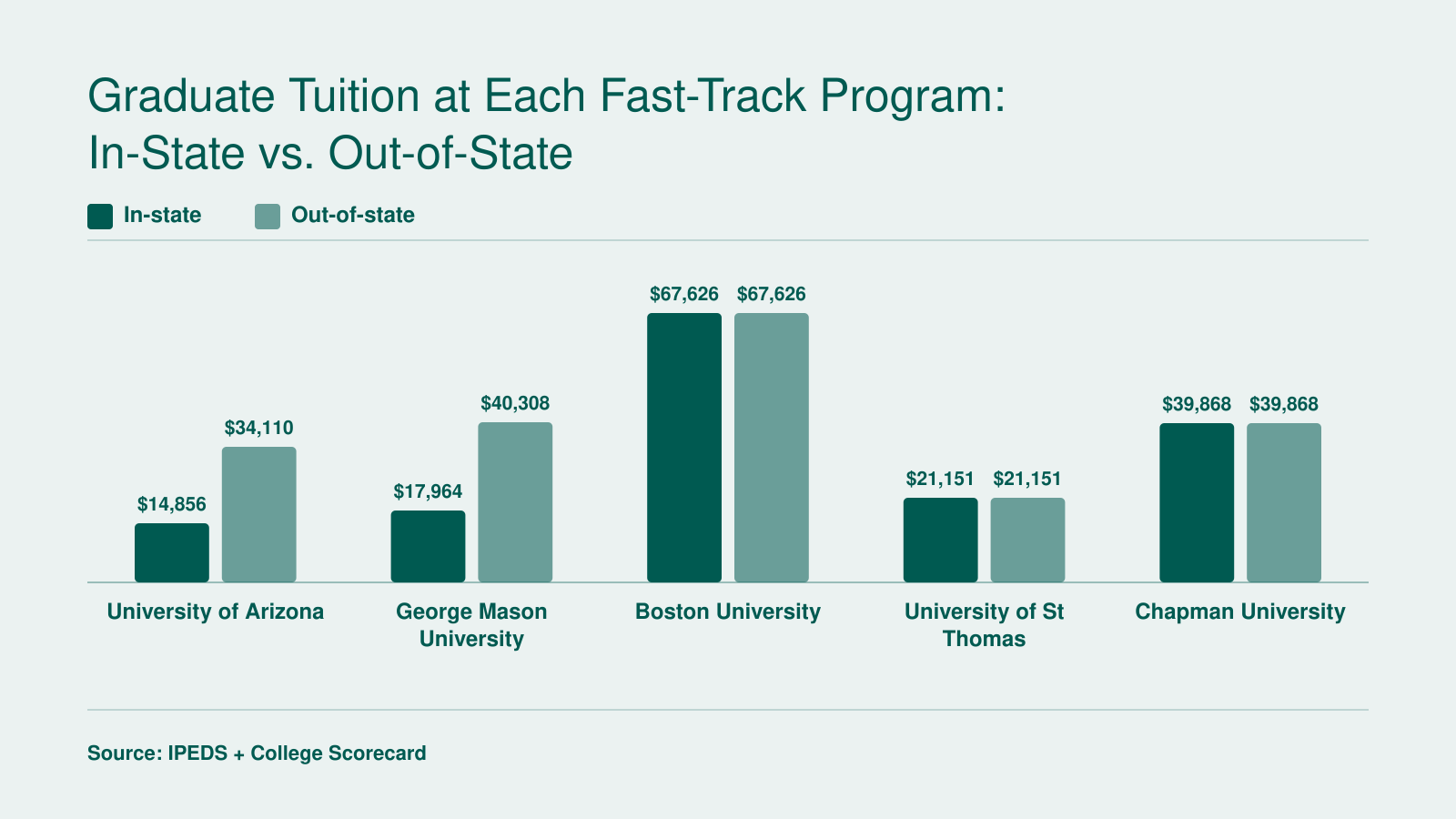
Graduate Tuition at Each Fast-Track Program: In-State vs. Out-of-State
For the online options we reviewed, Washington State's online MA in Health Communication and Promotion is the lowest-cost option at $672 per credit, about $20,150 total. UIUC's online MS in Health Communication charges the same $798 per credit regardless of residency. Net price is an institution-wide average after aid, not a personal quote.
Earnings Snapshot for Health Communication Graduates
Boston University's health communication master's completers report median earnings of $90,212 four years after finishing.
Jobs, Salary, and Payoff After an MS in Health Communication
Health communication graduates typically move into roles that translate medical and public health information for patients, providers, and the public. Common titles include health communication specialist, public health educator, patient education manager, health PR or marketing manager, and digital health content strategist. These positions sit at the intersection of health literacy, marketing, and patient experience, and they usually require both writing fluency and comfort with health data.
Reported Earnings, Debt, and Employment
Among the programs here, Boston University offers the clearest earnings snapshot: median earnings were $73,982 one year after completion and $90,212 four years after completion. Median debt at completion was $39,224, with a standard 10-year monthly payment of $446. Employment one year out was 96.5%. For George Mason, Chapman, St. Thomas, and Arizona, the school-level ROI proxy is the available outcome signal: 3.9, 3.4, 3.2, and 3.1, respectively.
Is a One-Year Timeline Worth It?
Accelerated master's programs reduce the salary you give up while enrolled, but debt still has to be serviced. Boston University's one-year median earnings of $73,982 make the $39,224 median debt manageable in early career, though the $446 monthly 10-year payment should be part of your budget. Because the degree can be completed in a year, lost wages during study are limited compared with a two-year master's, but you should still compare the monthly debt payment against your expected take-home pay. The ROI proxy is not a personal salary promise, but a higher figure signals stronger school-level earnings relative to cost.
The Practical Decision Rule
Choose the program whose cost, live-session demands, and transfer policy fit your schedule first; then confirm programmatic or regional accreditation before applying.
Health Communication programs by state
Admissions and Transfer Credit Questions, Answered
Admissions details vary by program, but the test score, transfer, and deadline rules below shape your fastest path.
Do accelerated health communication master's programs still ask for GRE scores?
How many graduate credits can transfer into a fast-track health communication master's, and does prior learning count?
What GPA, prerequisites, and application deadlines should I plan around for an accelerated start?
Compare Health Communication programs on the data that matters
Explore more Communications & Media specializations or browse every graduate field.
All Communications & Media programs