Best Online Master's in Health Communication Programs
Compare 15 accredited online Health Communication programs, with graduate earnings, cost, debt, and completion data from IPEDS and the U.S. College Scorecard.

Can you earn a health communication master's without leaving your job or your city? Yes. Every program here is 100% online, hybrid formats are excluded, and most require 30 to 36 credit hours.
Hospitals, health departments, nonprofits, and health tech firms all need people who can turn clinical guidance into messages the public can act on, the kind of work an online master's in public relations prepares you to lead. Working professionals in those settings can build that skill in place through an online master's in communication management.
The real tension is price. Published tuition varies roughly ninefold between programs, and a bigger name does not automatically deliver a better return.
Key Points
- Only 12 percent of U.S. adults read at a proficient health literacy level.
- Published tuition runs from $7,658 at East Carolina to $67,626 at Boston University.
- The 2027 ranking highlights fully online, asynchronous programs only.
Top 100% Online Health Communication Master's Programs for 2027
These fully online health communication master's programs range from 30 to 36 credits, with asynchronous formats that let working professionals keep their jobs. The list focuses only on 100% online degrees, so hybrid and campus-based options are excluded.
University of Illinois Urbana-Champaign
#1Champaign, IL · ~$19,000/yr (est.)
Best for: Working professionals needing asynchronous, certificate options
The University of Illinois Urbana-Champaign's online health communication master's emphasizes provider-patient communication, health disparities, and media effects on health behavior. Its fully asynchronous format is designed around working professionals, with rolling admissions and no GRE requirement. Students can also stack four health communication certificates toward the degree.
- Fully online and asynchronous delivery
- 32 total credit hours
- Complete in one to two years
- Rolling admissions with fall and spring starts
- 2.8 GPA minimum and three recommendation letters
- No GRE required, with flat tuition for all students
- Concentrations include interpersonal and organizational communication
- Four stackable health communication certificates available
Boston University
#2Boston, MA · $65,000 – $70,000/yr (est.)
Best for: Mid-career communicators pivoting to health marketing
Boston University's Metropolitan College and College of Communication jointly run a 32-unit, 16-month health communication master's that is fully online and asynchronous. The program includes concentrations in healthcare promotion, media and marketing, and visual and digital health communication, and it requires no capstone. Total program tuition is $26,140 at 2026-2027 rates.
- Fully online with asynchronous classes
- 32 total credit hours and 16-month typical completion
- Two concentration options plus four electives
- $26,140 total program tuition at 2026-2027 rates
- No thesis or capstone required
- Two online course starts per term and 7-week accelerated format
- Joint program with the College of Communication
- Certificate-to-degree pathway available
Washington State University
#3Pullman, WA · ~$15,000/yr (est.)
Best for: Public health educators wanting cohort-based training
Washington State University's online health communication and promotion master's is a cohort-based program taught by the Edward R. Murrow College of Communication. It blends multimedia content creation, crisis communication, and health behavior change across 30 credits. The program is terminal and professional, with weekly online office hours and a required capstone.
- Fully online with cohort-based structure
- 30 total credit hours
- No entrance exam required
- Three start dates per year: spring, summer, fall
- 3.0 GPA minimum
- Capstone project required
- Terminal professional degree, not intended for doctoral preparation
- Weekly online instructor office hours
CUNY Graduate School and University Center
#4New York, NY · $10,000 – $24,000/yr (est.)
CUNY Graduate School of Public Health and Health Policy offers a fully online health communication master's focused on social change and health equity. The 36-credit curriculum covers health literacy, social marketing, and multimedia production, with asynchronous and optional synchronous sessions. The program sits within a CEPH-accredited school of public health and requires a capstone project.
- Fully online with asynchronous and optional synchronous sessions
- 36 total credit hours
- Full-time and part-time enrollment options
- 3.0 GPA minimum and two recommendation letters
- Capstone project required
- Apply through SOPHAS
- CEPH-accredited school of public health
- Scholarships and financial aid available
East Carolina University
#5Greenville, NC · ~$8,000/yr (est.)
East Carolina University's online communication master's includes a health communication concentration built on communication theory and research methods. The 30-credit program covers health campaigns, eHealth, community engagement, and health advocacy, along with interpersonal and intercultural perspectives. Students choose thesis or non-thesis tracks, with a comprehensive exam option for the non-thesis route.
- 30 total credit hours
- Thesis and non-thesis tracks available
- Non-thesis track requires comprehensive exam
- Covers health campaigns, eHealth, and community engagement
- Prepares for careers or doctoral study
Mississippi Christian University
#6Clinton, MS · ~$16,000/yr (est.)
Mississippi College's online healthcare communication master's combines communication theory with healthcare administration. The 30-credit program covers public relations, leadership ethics, healthcare marketing, and legal aspects of healthcare administration, finishing with a capstone and a professional portfolio. Rolling admissions and fall and spring starts keep the degree accessible for working professionals.
- Fully online delivery format
- 30 total credit hours
- Complete in 12 to 24 months
- Rolling admissions with fall and spring starts
- 2.5 GPA minimum and two recommendation letters
- Capstone project required
- Professional portfolio created during program
- Combines communication and healthcare administration
Cost & outcomes by school
Federal data for the highest-earning Health Communication programs, independent of the ranking above. Earnings are this field's master's graduates four years after completing, where the Scorecard reports them.
| School | Earnings | Tuition / yr | Debt | Grads/yr | Format |
|---|---|---|---|---|---|
| George Washington University DC | $101,932 | $36,414 | $51,254 | 68 | Hybrid |
| Boston University MA | $90,212 | $67,626 | $39,224 | 99 | Online |
| Marist University NY | $90,060 | $17,200 | $20,656 | 40 | Online |
| Arizona State University AZ | $76,478 | $10,843 | $44,159 | 24 | Online |
| Arizona State University AZ | $76,478 | $13,587 | $44,159 | 28 | Online |
| East Carolina University NC | — | $7,658 | — | — | Online |
| CUNY Graduate School and University Center NY | — | $10,294 | — | — | Online |
| University of San Francisco CA | — | $29,960 | — | — | Hybrid |
| University of Illinois Urbana-Champaign IL | — | $19,278 | — | 22 | Online |
| Washington State University WA | — | $14,845 | — | 5 | Online |
| Mississippi Christian University MS | — | $15,500 | — | 4 | Online |
| Thomas Jefferson University PA | — | $24,528 | — | 12 | Hybrid |
Sources: U.S. Department of Education. Tuition and graduates: IPEDS. Earnings and debt: College Scorecard, this field's master's graduates; a dash means no figure is reported.
Cost, debt & payoff
Median earnings of this field's master's graduates (4 yrs after completing) vs. their median federal loan debt · U.S. College Scorecard
Across these programs the median graduate earns about $86,822 and finishes with roughly $41,692 in debt — a ratio that clears a common rule of thumb (keep debt below first-year salary). Tuition and debt vary widely school to school, so check the per-school figures in the table above before you shortlist.
Only 12 percent of U.S. adults had proficient health literacy in the 2003 National Assessment of Adult Literacy, a figure the HHS Office of Disease Prevention and Health Promotion still cites. That gap helps explain why skilled health communication specialists are needed to make complex medical information clear enough to act on.
Accreditation, Live Sessions, and Campus Visits: What to Verify
Accreditation Layers
Start with institutional (regional) accreditation. It governs federal financial aid eligibility and how employers read your transcript. CEPH accredits public health schools and programs, so it applies mainly to an MPH, not automatically to every degree with public-health coursework. ACEJMC covers journalism and mass communication units, and the sources reviewed do not establish it for the CUNY, Illinois, or Boston University programs. Many health communication master's programs carry institutional accreditation only, which is normal. For online health communication master's programs, confirm any programmatic claim against CEPH's public list of accredited schools and programs3, since applicant status does not guarantee eventual accreditation4.
Health Communication vs. Public Health
A health communication degree centers on messaging, campaigns, and media. An MPH adds epidemiology, biostatistics, and policy, with a CEPH minimum of 42 semester credits1. A public health communication track blends the two. George Mason's MPH lists such a concentration, though its catalog currently shows it as suspended, so check availability before applying2.
Live Sessions and Campus Visits
Asynchronous courses let you work on your own schedule. Synchronous ones set meeting times. Illinois and Boston University advertise asynchronous online delivery, and CUNY's fully online MS may mix both. The sources reviewed do not mention residencies, immersions, or required orientations, but that is not proof none exist. Ask each admissions office whether any live sessions, capstone presentations, or campus visits are required, and get the answer in writing.
Admission Requirements, Deadlines, and Who Can Enroll
- Bachelor's degree and GPAA bachelor's degree from an accredited institution is the baseline, and a 3.0 minimum is common; Washington State, Arizona State, Illinois, and CUNY each list 3.0.
- GREThe GRE is generally not required; Washington State and Arizona State explicitly list it as not required.
- Application materialsExpect a statement of purpose, résumé, and recommendation letters; lengths vary, from Arizona State's 1-2 page statement to Illinois's 25-page writing sample and CUNY's 500-word statement.
- Deadlines and start termsStart terms vary from rolling to fixed fall, spring, and summer starts. Washington State lists December 1, April 15, and August 1 deadlines; Arizona State lists July 23 and September 16, 2026; Illinois lists December 1; CUNY lists March 1, 2027.
- State authorizationFully online does not guarantee enrollment in every state; check the program's state authorization page before applying, especially for field experiences completed from another state.
- International studentsFully online programs may accept non-U.S. residents, but requirements vary. Arizona State requires TOEFL 80, IELTS 6.5, or Duolingo 105; CUNY requires TOEFL 550 paper, 233 computer, or 60 internet plus a WES or ECE transcript review.
How Much Does an Online Master's in Health Communication Cost?
Flat online pricing is steadily erasing the old in-state versus out-of-state split in graduate education, especially across online master's programs. Published graduate tuition and fees here run from $7,658 in-state at East Carolina University, the lowest, to $67,626 at Boston University, the highest. Boston's online M.S. is priced differently, though: its program page lists $26,140 for 32 units, so confirm which rate applies to you.
Residency and flat rates
Illinois Urbana-Champaign and Missouri charge the same per-credit rate regardless of residency ($798 and $850 respectively, the latter for 2026-2027), a pattern common in health communication master's online programs. Washington State and East Carolina show lower in-state figures, so ask whether online students get them.
Building a full estimate
Multiply the rate by total credits. Franklin's $690 across 33 credits gives $22,770, and Missouri's $850 across 33 gives $28,050. Illinois's $798 across 32 lands near $25,500. Then add what headline totals omit:
- Fees: Boston adds a $75 part-time semester fee, and Franklin a $100 semester resource fee.
- Books and materials: Missouri excludes textbooks and varying course fees. Illinois estimates $200 to $300 for the program.
- Credit waivers: Lasell requires 36 credits, but up to 6 may be waived for prior academic work.
Net price figures are approximate institution-wide averages after aid, not a quote for your situation.
Ask each program for a total-cost-of-attendance sheet listing every mandatory fee, including graduation fees.
Related Articles
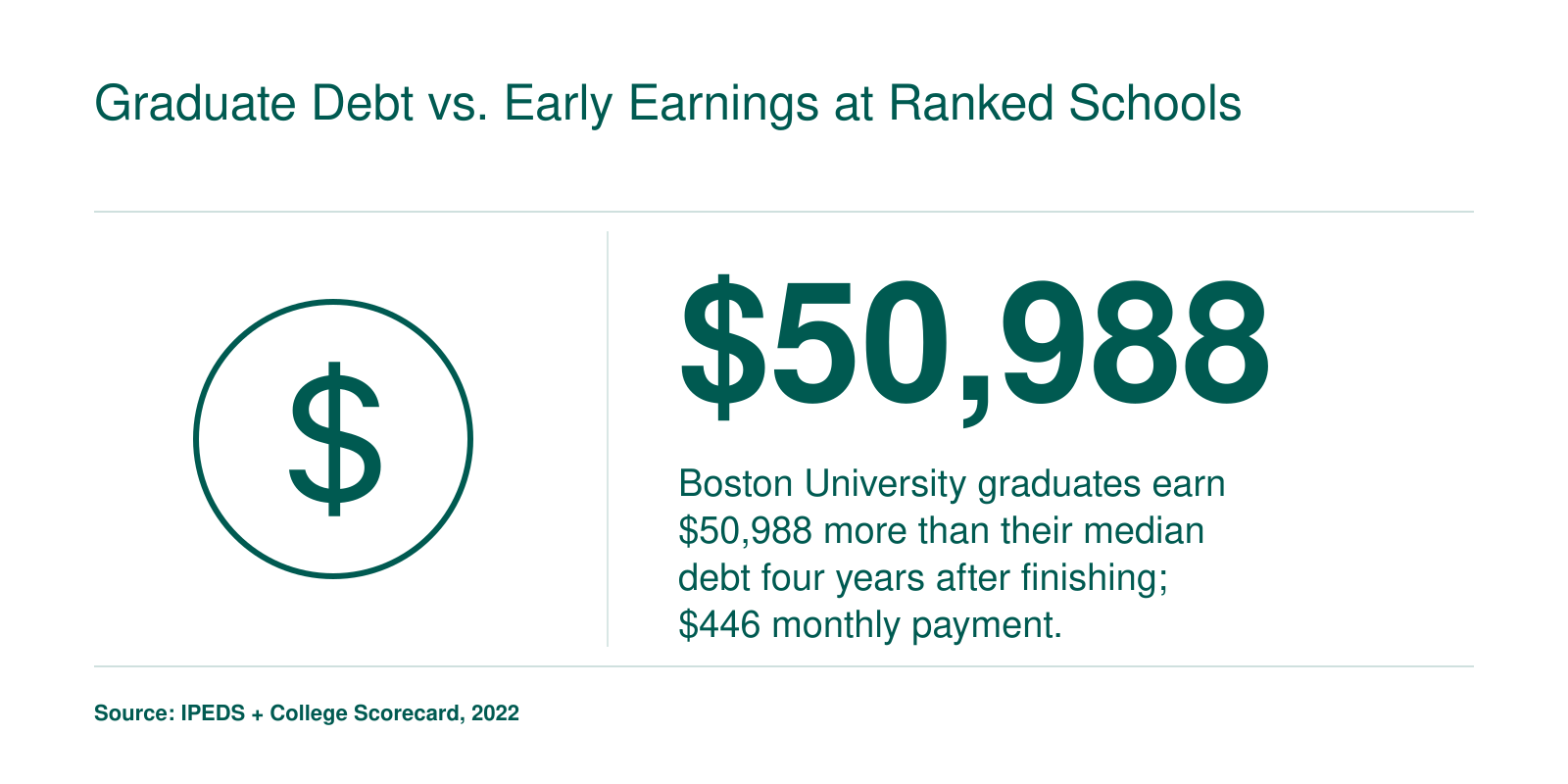
Graduate Debt vs. Early Earnings at Ranked Schools
Health Communication Degree Jobs, Pay, and Whether It's Worth It
A health communication master's pays off most when it solves a specific career problem, not when it is treated as a generic credential.
Jobs you can target
- Health communication specialist: Plans campaigns that turn clinical guidance into clear patient and community messages.
- Public relations specialist in healthcare: Handles media, crisis response, and public health announcements for hospitals or agencies.
- Health education specialist: Designs programs that help communities adopt healthier behaviors.
- Patient education manager: Oversees materials that help patients understand diagnoses, treatments, and follow-up care.
- Digital health content strategist: Shapes websites, apps, and social content for patients and caregivers.
What the pay data shows
BLS occupation-wide medians are $35.94 per hour for public relations specialists (May 2025), $64,070 for health education specialists (latest available), and $123,860 for medical and health services managers (May 2025). Those figures cover all industries, not any particular program's graduates.
Scorecard outcomes are more specific. One cohort reports median earnings of $73,982 one year after completion and $90,212 four years after completion. Another reports $61,463 one year after completion. Where reported, about 96% of graduates show earnings one year out.
Is it worth it?
Published tuition for the programs above runs from under $8,000 to about $68,000 before aid. At $15,000 to $30,000, the degree clears the bar quickly in PR or health education roles. Above $50,000, the payoff depends on reaching a management or senior communications role, which a Master's in Communication Management can support. Clinical and public health backgrounds gain the most because the degree formalizes communication work they already do; marketers benefit most when they pivot to health-specific strategy rather than relying only on an online master's in strategic communication.
Health Communication programs by state
Compare Health Communication programs on the data that matters
Explore more Communications & Media specializations or browse every graduate field.
All Communications & Media programs