Accelerated Master's in Higher Education Programs
Compare 200+ accredited fastest Higher Education programs at 170+ schools, with graduate earnings, cost, debt, and completion data from IPEDS and the U.S. College Scorecard.

A two-year master's in higher education leaves room for a full assistantship. A one-year program trades that pace for an earlier start in student affairs, advising, admissions, or academic administration. Published in-state graduate tuition across these schools ranges from $9,720 at Ohio University to $67,626 at Boston University.
Only a few offer online or hybrid delivery, and most accelerated tracks still expect campus presence, often year-round. The compressed calendar leaves little room for outside work, so the practicum or internship matters as much as the speed.
Key Points
- Most accelerated higher education master's tracks finish in 10 to 18 months.
- Programs often swap a thesis for a capstone, portfolio, or exam.
- Saint Peter's graduates earn median $91,891 four years after finishing.
Best Accelerated Master's in Higher Education Programs for 2027
These are the accelerated and one-year master's programs in higher education and student affairs that combine a fast timeline with meaningful practicum or internship experience. Use the cards to compare concentrations, delivery formats, and program structure before checking tuition and net price. The list is ordered for this article's focus on accelerated completion.
University of Virginia
#1Charlottesville, VA · ~$24,000/yr (est.)
Best for: Aspiring student affairs leaders wanting hands-on internships
University of Virginia's School of Education and Human Development is ranked #6 nationally and delivers a ten-month, cohort-based M.Ed. for student affairs practice. The program combines theory with required administrative internships at more than 50 sites and lets students choose among three concentrations. Financial aid and paid internships help offset costs.
- 34 credit hours, full-time completion in ten months
- Three concentrations: Higher Education Administration, Student Affairs Practice, or Intercollegiate Athletics Administration
- Cohort model of 40 students with a faculty advisor assigned
- Over 50 internship sites with paid internships directly
- No GRE required; 3.0 GPA minimum and two recommendation letters
- Early notification deadline February 1
University of Pennsylvania
#2Philadelphia, PA · ~$48,000/yr (est.)
Best for: Policy-minded higher ed administrators pursuing leadership
Penn's Graduate School of Education offers a one-year M.S.Ed. in Higher Education with six focus areas including Diversity, Equity, and Inclusion and public policy. Discussion-based seminars, interdisciplinary electives, and paid graduate assistantships give students direct administrative experience. The program reports alumni at institutions such as Stanford, RAND, and Harvard.
- Six concentration options, including DEI, university administration, and public policy
- 10 course units with full-time and part-time enrollment options
- Paid graduate assistantships available for hands-on administrative experience
- Comprehensive exam required for graduation
- Interdisciplinary electives can be drawn from across Penn
- Fall start with discussion-based seminars and faculty mentorship
Boston University
#3Boston, MA · $65,000 – $70,000/yr (est.)
Best for: Working professionals needing online or campus flexibility
Boston University's Wheelock College offers an EdM in Higher Education Administration that can be finished in one year in person or about 18 months online. Full-time and part-time enrollment options, three start dates, and a graduate assistantship or internship make it adaptable. The program reports that over 65% of new students receive merit-based scholarships.
- 36 credit hours, available full-time or part-time
- Complete in one year in person or about 18 months online
- Three start dates per year: fall, spring, and summer
- Graduate assistantship or internship option for hands-on experience
- Merit-based scholarships awarded to over 65% of new students
- Curriculum covers student affairs, admissions, financial aid, and counseling
Vanderbilt University
#4Nashville, TN · ~$58,000/yr (est.)
Vanderbilt Peabody offers a 36-credit M.Ed. in Higher Education Administration, normally two years but with a one-year accelerated option using online and summer courses. The campus-based program includes a built-in practicum and faculty-led research. Peabody reports a 93% job placement rate and holds top U.S. News rankings in educational administration and higher education administration.
- 36 credit hours, full-time campus-based cohort
- Can be completed in one year by enrolling in online and summer courses
- Built-in practicum experience plus faculty-led research opportunities
- Rolling admissions with fall start
- 93% job placement rate reported by the program
- Ranked #1 in Educational Administration and #9 in Higher Education Administration by U.S. News
University of Rochester
#5Rochester, NY · ~$39,000/yr (est.)
The Warner School at Rochester offers a Master of Science in Higher Education with three tracks and flexible pacing, including a one-year full-time option. A supervised internship and hybrid-online courses support working learners, and fellowships may cover up to 60% of tuition. Students culminate with a thesis or comprehensive exam.
- Three tracks: Higher Education Administration, Student Affairs, and a dual Student Affairs/Academic & Career Advising focus
- 36 credit hours, complete in as little as one calendar year full-time or two years part-time
- Supervised internship included with hybrid-online course options
- Thesis or comprehensive exam culminating option
- Fellowships may offer up to 60% tuition scholarships
- Rolling admissions with priority deadline; start fall, spring, or summer
University of Miami
#6Coral Gables, FL · ~$47,000/yr (est.)
Miami's M.S.Ed. in Higher Education Administration emphasizes a yearlong practicum with reflective analysis and offers an Institutional Research and Policy Analysis track. Students can earn a certificate without adding time and choose one- or two-year completion. The program reports a 90% job placement rate and paid graduate assistantships.
- Three concentration options including Institutional Research and Policy Analysis
- Complete in one or two years with fall or spring start
- Yearlong practicum with journaling and reflective analysis
- Earn a graduate certificate with no extra time
- 90% job placement rate reported by the program
- Paid graduate assistantships available
University of Massachusetts-Amherst
#7Amherst, MA · $15,000 – $20,000/yr (est.)
UMass Amherst's M.Ed. in Higher Education features a formal 4+1 accelerated pathway for undergraduates plus a dual degree option with a Master's in Public Policy Administration. The program culminates in a capstone integrative seminar and draws on interdisciplinary coursework to prepare graduates for admissions, advising, and institutional research careers.
- 4+1 accelerated option for current UMass undergraduates
- Dual degree option with a Master's in Public Policy Administration
- Capstone integrative seminar with a case study project
- Interdisciplinary coursework in sociology, psychology, history, and economics
- Prepares for admissions, advising, institutional research, and doctoral study
Loyola University Chicago
#8Chicago, IL · ~$22,000/yr (est.)
Loyola Chicago's M.Ed. in International Higher Education is an asynchronous online cohort that includes one in-person study abroad course at the Rome center. Part-time students complete 30 credits over two years including summers, and all admits receive a 30% tuition discount. An electronic portfolio serves as the capstone.
- 30 credit hours, asynchronous online plus one in-person study abroad course in Rome
- Complete in two years including summers, part-time
- $1,115 per credit hour with a 30% tuition discount for all admits
- Electronic portfolio capstone
- Rolling admissions, fall start, no application fee
- Accelerated Master's Pathway for Loyola undergraduates
Ohio University
#9Athens, OH · ~$10,000/yr (est.)
Ohio University's M.Ed. in Higher Education is a part-time, 30-credit program offered fully online or in hybrid Athens campus format. Students can finish in one year and eight months by taking two courses per semester. The curriculum covers finance, law, policy, diversity, and assessment, and a capstone project is required.
- 30 credit hours, part-time completion in one year and eight months at two courses per semester
- Fully online or hybrid Athens campus options with fall, spring, summer starts
- No GRE required; portfolio, transcripts, and three recommendation letters
- Capstone project assembled from curriculum materials
- Covers finance and budgeting, law, policy, diversity, and assessment
- Built for working professionals; no I-20 issued for this program
Mississippi State University
#10Mississippi State, MS · ~$10,000/yr (est.)
Mississippi State's M.S. in Educational Leadership with a Student Affairs and Higher Education concentration is a one-year campus program starting in August. Coursework spans counseling theory, legal issues, diversity, and assessment strategy. It prepares graduates for leadership roles in P-12 and higher education settings.
- One-year campus program with an August start
- Concentration in Student Affairs and Higher Education
- Covers counseling theory, legal issues, diversity, and assessment strategy
- Prepares for P-12 and higher education leadership roles
- $26,580 total program tuition
Cost & outcomes by school
Federal data for the highest-earning Higher Education programs, independent of the ranking above. Earnings are this field's master's graduates four years after completing, where the Scorecard reports them.
| School | Earnings | Tuition / yr | Debt | Grads/yr | Format |
|---|---|---|---|---|---|
| University of Virginia VA | $85,232 | $23,526 | $28,778 | 60 | Campus |
| The University of Texas Rio Grande Valley TX | $66,977 | $8,589 | $17,819 | 153 | Online |
| Franklin University OH | — | $12,090 | — | — | Online |
| Southern Oregon University OR | — | $17,874 | — | — | Online |
| Texas A&M University-Central Texas TX | — | $6,242 | — | 27 | Online |
Sources: U.S. Department of Education. Tuition and graduates: IPEDS. Earnings and debt: College Scorecard, this field's master's graduates; a dash means no figure is reported.
Cost, debt & payoff
Median earnings of this field's master's graduates (4 yrs after completing) vs. their median federal loan debt · U.S. College Scorecard
Across these programs the median graduate earns about $66,970 and finishes with roughly $29,220 in debt — a ratio that clears a common rule of thumb (keep debt below first-year salary). Tuition and debt vary widely school to school, so check the per-school figures in the table above before you shortlist.
How Long Does an Accelerated Master's in Higher Education Take?
Most accelerated master's in higher education tracks are 30 to 36 credits and finish in 10 to 18 months, but the shortest advertised timelines assume a full-time, year-round pace. Plans that claim 8 to 12 months typically count two courses per five- to eight-week term with no summer break.
At Lindenwood University, for example, ten five-week terms run each year. Taking the standard two courses per term can finish the 33-credit M.A. in about eight months, though the program advertises 12 months as the typical window and transfer credit can shorten it further.1 Arkansas State's 33-credit online master's in higher education is advertised as a 12-month program with seven-week courses and shorter five-week summer terms, matching the same year-round structure.
Accelerated estimates usually assume you stay enrolled every consecutive term and remain in good standing. Skipping a term can move you to a part-time track, and maximum time-to-degree policies vary, so check the program's rules before stopping out. Some schools expect two courses per term each semester until completion.
Your own timeline can stretch with a part-time load, practicum placement scheduling, or capstone sequencing. If a required 120-hour practicum or final project must follow earlier coursework, build that buffer into your plan.
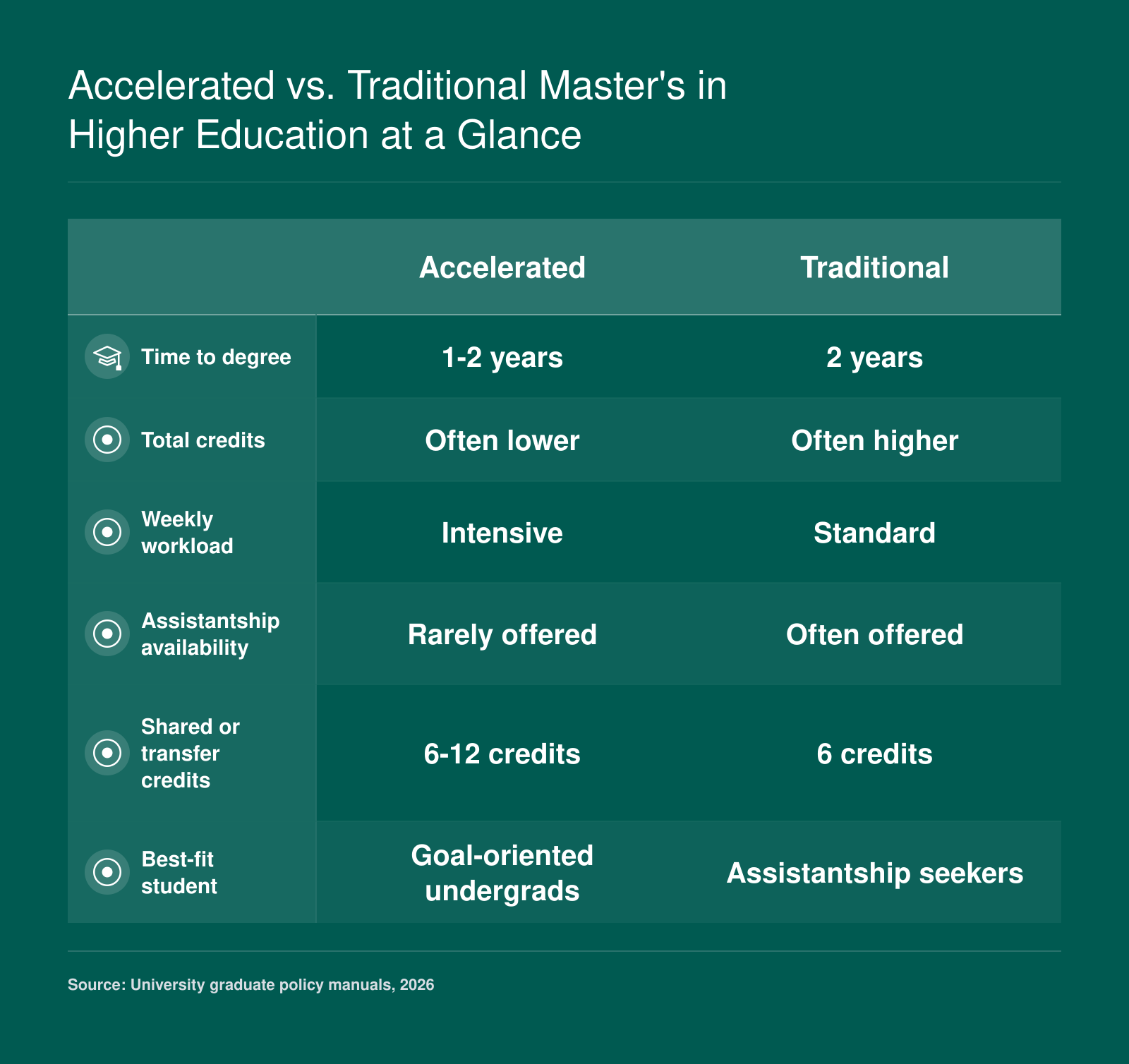
Accelerated vs. Traditional Master's in Higher Education at a Glance
Accelerated formats, including 4+1 pathways that share undergraduate and graduate credit, compress the timeline but demand a heavier weekly load. Shared-credit ceilings typically run from 6 to 12 graduate credits, though a few universities allow up to 15 or 16. Traditional two-year programs more often bundle paid graduate assistantships, which accelerated formats rarely offer.
Practicum, Capstone, and Thesis Requirements That Affect Your Timeline
Most programs here end with a capstone, portfolio, or comprehensive exam rather than a thesis, and a thesis track usually adds time. Northern Illinois uses an e-portfolio,1 Colorado State a culminating paper,2 and Michigan State a certifying exam.3
Practicum hours vary widely and count different things. Grand Canyon lists 60 hours,4 Michigan State 135,3 and Texas Tech, American Public, and Morgan State 150.567 UW-La Crosse requires at least 670 across two experiences.8 Some schools, including SIUE and Northern Illinois, publish credits rather than hours.91
Working at a campus does not guarantee credit. UW-La Crosse lets a professional position count toward its 600-hour field experience, but its 70-hour practicum must be in a different area.8 Morgan State allows approved sites near where you live and work.7
Confirm placement rules, site approval, and supervision before enrolling. Practicum timing is the most common reason an accelerated plan slips.
Related Articles
Lowest-Cost Accelerated Higher Education Master's Programs
The table below shows lower-cost accelerated higher education master's programs using published institution net price and program-level graduate tuition. For online programs, some schools publish one flat per-credit rate regardless of residency: Arkansas State's online M.S. in Higher Education is $350 per credit for 33 credits (about $11,550 total), and Kansas's online M.S. in Education in Higher Education Administration is $595 per credit for 33 credits (about $19,635 total). ASU's online M.Ed. in Higher Education lists $650 per credit for 30 credits (about $19,500 total), Houston's online M.Ed. in Higher Education lists $489 to $999 per credit (about $17,600 total for the 36-credit program), and Penn State World Campus lists $1,027 per credit for 30 credits (about $30,810 total).
| School | Program | In-State Tuition | Out-of-State Tuition | Institution Net Price |
|---|---|---|---|---|
| Saint Peter's University | M.A. in Education, Higher Education Concentration | $16,035 | $16,035 | $12,199 |
| William Carey University | Leadership and Learning in Higher Education, M.Ed. | $11,880 | $11,880 | $14,258 |
| University of Missouri-St Louis | Higher Education MEd Accelerated Master's Degree | $15,480 | $36,792 | $15,071 |
Top Program-Level Earnings for Higher Education Graduates
Completers of the higher education master's program at Saint Peter's University show median earnings of $91,891 four years after finishing.
Higher Education programs by state
Frequently Asked Questions About Accelerated Higher Education Master's Programs
Can you complete a higher education master's online in one year?
What jobs can you get with an accelerated higher education master's?
Do accelerated higher education programs accept transfer credits?
Is an accelerated degree viewed differently by colleges hiring student affairs staff?
Compare Higher Education programs on the data that matters
Explore more Education & Teaching specializations or browse every graduate field.
All Education & Teaching programs