Best Master's in Higher Education Programs in Arizona
Compare 7 accredited Higher Education programs in Arizona, with graduate earnings, cost, debt, and completion data from IPEDS and the U.S. College Scorecard.

Arizona has no crowded field of higher education master's degrees: only a small number of universities offer a dedicated program, so every option here gets a close look. The tension is format and cost. Northern Arizona University delivers its program fully online, while Arizona State University offers evening classes in Tempe.
Campus and online formats are both represented, which matters for working advisors and student affairs staff who can't leave a job. With so few choices, small differences in tuition, residency rules, and admissions requirements, including whether a program is among the Master's in Higher Education Programs With No GRE Required, carry real weight.
Key Points
- Northern Arizona University is the most affordable option here, with master's tuition of $13,023.
- Arizona State University makes the GRE optional for its Master of Arts in Higher Education.
- Assistantships and tuition remission can cut real costs far below the published sticker price.
Ranked: Arizona's Top Master's in Higher Education Programs for 2027
Our data returned two Arizona programs, one at a public university in Flagstaff and one at a public university with a Scottsdale and Tempe presence. Both are Master of Education degrees with a higher education focus and an online option. Neither program page we reviewed publishes alignment with CAS standards, so ask each admissions office whether the curriculum is mapped to them. Graduation rates below describe each institution as a whole, not the program.
Northern Arizona University
#1Flagstaff, AZ · ~$13,000/yr (est.)
Best for: Future community college faculty and administrators
Northern Arizona University offers a Master of Education in Educational Leadership with a Community College/Higher Education concentration. The degree is built for people heading toward faculty or leadership roles in community colleges and other higher education settings. Schools offering this program graduate about 61% of students institution-wide, which is a campus-level figure and not this program's own rate. Confirm the university's current Higher Learning Commission status with HLC directly. NAU's educational partnership program advertises a 10% tuition reduction, but it is not confirmed that it applies to this degree, so verify eligibility with the school.
- 30 credit hours, including 21 in the higher education core
- 3-unit introduction to research course plus 6 units of electives
- All-online, asynchronous courses with multiple enrollment points
- Admission requires a bachelor's degree with a 3.0 GPA
- No course prerequisites, and fieldwork is optional
- Out-of-state students get in-state tuition through the Western Regional Graduate Program
- Individualized research option available
Arizona State University
#2Scottsdale, AZ · ~$11,000/yr (est.)
Best for: Aspiring student affairs professionals
Arizona State University's Higher and Postsecondary Education MEd sits in the Mary Lou Fulton College for Teaching and Learning Innovation and is offered in hybrid format at Tempe and fully online. Students choose a focal area, either leadership and organizational dynamics or student recruitment, retention and success. That makes it a natural fit for people aiming at student affairs or program director roles. ASU's Higher Learning Commission accreditation was reaffirmed in 2023, with the next review set for 2032-33. No CAS alignment is published for the program.
- 30 credits across 10 courses, with a 3-credit practicum and a 3-credit capstone
- 9-credit core: intro to higher education, assessment and evaluation, equity and inclusion
- Two focal areas: leadership and organizational dynamics, or recruitment, retention and success
- Tempe sections are hybrid with weekday evening classes; online sections are asynchronous
- 7.5-week terms in fall and spring, six weeks in summer
- Admission needs a 3.00 GPA, one recommendation, a personal statement and a resume
- Bachelor's degree in any field accepted
- Reduced tuition for western states residents
Cost & outcomes by school
Federal data for the highest-earning Higher Education programs, independent of the ranking above. Earnings are this field's master's graduates four years after completing, where the Scorecard reports them.
| School | Earnings | Tuition / yr | Debt | Grads/yr | Format |
|---|---|---|---|---|---|
| Grand Canyon University AZ | $73,501 | $10,015 | $26,235 | 1,105 | Online or campus |
| Arizona State University AZ | $69,836 | $10,843 | $35,800 | 64 | Hybrid |
| Arizona State University AZ | $69,836 | $13,587 | $35,800 | 59 | Hybrid |
| University of Phoenix-Arizona AZ | $68,550 | $15,208 | $30,295 | 207 | Online |
| Northern Arizona University AZ | $67,995 | $13,023 | $30,953 | 130 | Online |
| The University of Arizona Global Campus AZ | $48,181 | $12,930 | $37,528 | 94 | Online |
| American InterContinental University System AZ | — | $11,633 | — | — | Online |
Sources: U.S. Department of Education. Tuition and graduates: IPEDS. Earnings and debt: College Scorecard, this field's master's graduates; a dash means no figure is reported.
Cost, debt & payoff
Median earnings of this field's master's graduates (4 yrs after completing) vs. their median federal loan debt · U.S. College Scorecard
Across these programs the median graduate earns about $69,193 and finishes with roughly $33,377 in debt — a ratio that clears a common rule of thumb (keep debt below first-year salary). Tuition and debt vary widely school to school, so check the per-school figures in the table above before you shortlist.
How We Rank Arizona's Master's in Higher Education Programs
Prestige doesn't pay tuition, so this list of master's in higher education programs leans on what a degree actually costs and returns. Each program is judged on graduate tuition, average net price, program-level College Scorecard earnings and debt where they are published, and the institution's overall graduation rate.
One caution on net price: it is an institution-wide average after grant aid, not a quote for any single student. Your own figure depends on your aid package, your residency status, and how many credits you take, so treat it as a starting estimate.
Campus and online Master's Programs in Arizona sit on one scale. A degree from Northern Arizona University or Arizona State University is compared on the same measures whether you attend in person or from home, so format never earns a program extra credit.
Online and Hybrid Master's in Higher Education Options in Arizona
Fully online study or evening classes in Tempe: that is the core format choice between these two programs. Northern Arizona University delivers its MEd in Educational Leadership (Community College/Higher Education) online, with asynchronous classes, multiple enrollment points and 30 credit hours, a delivery model common among Best Online Master's in Higher Education Programs. Fieldwork is optional, which suits staff who already work on a campus.
Arizona State University's MEd in Higher and Postsecondary Education is campus-based, a choice among the Best M.Ed. Programs in Arizona. Students attend face-to-face weekday evening courses in Tempe. Courses run in 7.5-week blocks, with fall, spring and summer starts and full- or part-time pacing across 30 credits. A capstone is required, and program descriptions also list a practicum.
Ask advisors how long part-time study typically takes, since timelines depend on how many courses you carry each term. If you hope to complete a practicum where you already work, confirm in writing that your current college role qualifies.
One practical step: if you work at an Arizona public college or university, check whether your employer offers a tuition benefit for NAU or ASU courses before you apply.
Which Arizona Master's in Higher Education Programs Waive or Make the GRE Optional?
Among the Arizona programs where we could confirm admissions details, the GRE is not a barrier. Arizona State University makes it optional for its Master of Arts in Higher Education, and it has dropped the requirement for master's degrees in its School of Sustainable Engineering and the Built Environment (an engineering unit, shown here only as a comparison point). Policies, deadlines, and materials change by cycle, so verify each detail on the official admissions page, including Northern Arizona University's, before you apply.
| Program | GRE Policy | Application Deadline | Minimum GPA | Other Requirements |
|---|---|---|---|---|
| Arizona State University, Master of Arts in Higher Education | Optional (scores may be submitted if they strengthen the application) | January 15 | 3.0 | Statement of purpose and recommendations are cited as supporting factors, especially for applicants below the standard GPA; the full materials list is not confirmed |
| Arizona State University, master's degrees in the School of Sustainable Engineering and the Built Environment | Waived (no longer required for any MS or MSE program) | March 1 for fall; October 1 for spring | 3.0 cumulative and 3.0 in the junior and senior years | Statement, resume, and letter requirements not specified in the available information; confirm on the program page |
Related Articles
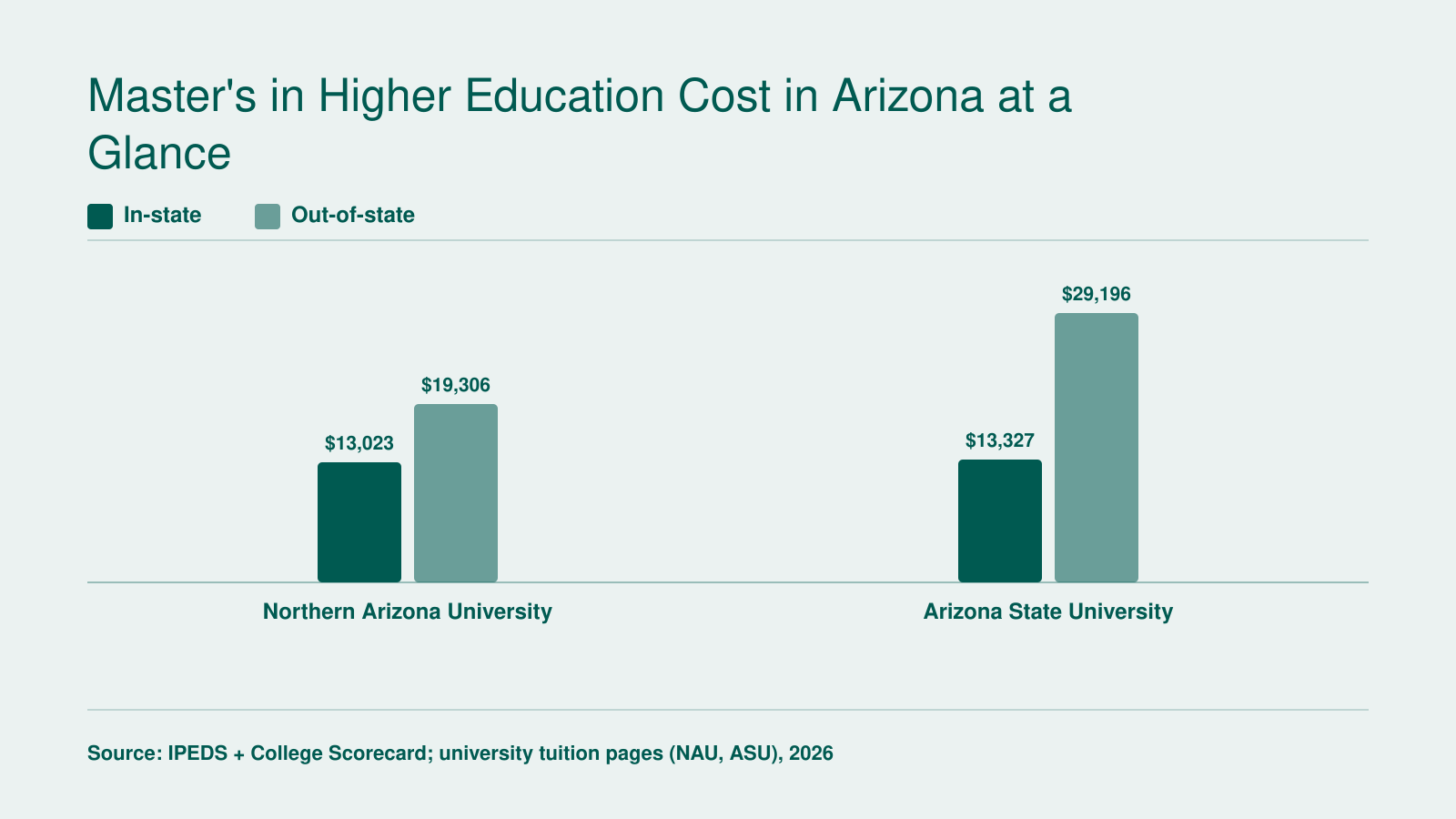
Master's in Higher Education Cost in Arizona at a Glance
Graduate tuition at Northern Arizona University and Arizona State University looks very different once residency is factored in. The bars compare published annual in-state and out-of-state tuition. Treat them as estimates, because program credit hours and fee structures vary.
Cost, Financial Aid, and Arizona Licensure or Certification
Graduate funding in higher education administration has shifted toward assistantships and tuition remission, making real costs more flexible than sticker prices suggest. The most affordable option in the data here is Northern Arizona University, one of the Most Affordable Master's in Higher Education Programs; master's tuition is $15,207 and the institution-wide average net price after aid is about $14,158. That net price is an average across all students, not a guaranteed out-of-pocket amount.
Assistantships and Financial Aid
Some Arizona higher education programs advertise graduate assistantships in residence life, student affairs, or advising offices. Appointments often run one year at 0.50 FTE and may include a stipend, tuition remission, and health coverage, but terms vary by department and appointment. Federal graduate students generally qualify for Direct Unsubsidized and Grad PLUS loans, and university scholarship databases can surface internal awards, though named department-specific awards may be communicated directly by email. Qualified tuition reduction may apply for eligible university employees, spouses, and dependents.
Licensing and Certification
Arizona does not require a state license or certificate for general college or university administration and student affairs roles. That is distinct from K-12 school administration, where the Arizona Department of Education issues administrator certification. Job-specific institutional or regulated-function requirements can still apply, so verify individual postings.
A graduate assistantship that covers tuition and pays a stipend changes the math on a higher education master's far more than a school's name ever will.
What You Can Do With a Master's in Higher Education in Arizona and What It Pays
A master's in higher education leads to roles across the administrative side of a college or university. Common roles include academic advisor, residence life coordinator, admissions or financial aid officer, student affairs director, and registrar or institutional research staff, all grouped as postsecondary education administrators. Some graduates move into community college teaching or program coordination, a path NAU's community college track points toward directly.
What Graduates Earn
NAU's higher education master's reports median earnings of about $59,826 one year after finishing, rising to roughly $68,669 five years out, with nearly all graduates working within a year. ASU's higher and postsecondary education program shows a similar early figure, close to $59,901 one year after completion. These are program-specific numbers for recent graduates, not lifetime ceilings.
Broader Salary Benchmarks
For the senior roles many graduates grow into, the Bureau of Labor Statistics reports a May 2025 median of $103,280 a year for postsecondary education administrators in Arizona, close to the $104,590 national figure. Advisor and entry-level student affairs pay typically sits well below that.
A Quick ROI Check
Median debt runs near $19,000 at NAU and $19,500 at ASU, with estimated monthly payments around $352 and $407. Against early earnings near $60,000, both programs look manageable on a payment-to-paycheck basis.
Quick Answers for Arizona Higher Ed Master's Applicants
Which Arizona universities offer a master's in higher education?
How long does it take to finish a higher education administration master's while working full time in Arizona?
Is a master's in higher education and student affairs different from a higher education administration degree?
Compare Higher Education programs on the data that matters
Explore more Education & Teaching specializations or browse every graduate field.
All Education & Teaching programs