Best Online Master's in Higher Education Programs
Compare 120+ accredited online Higher Education programs, with graduate earnings, cost, debt, and completion data from IPEDS and the U.S. College Scorecard.

Can you move into student affairs, academic advising, enrollment management, or higher education administration without leaving your current job? Yes, if the program is built for working adults. Every program ranked here is a 100% online master's in higher education, and hybrid or in-person formats are excluded.
Cost is the sharpest dividing line. In-state tuition runs from $6,242 at Texas A&M University-Central Texas to $67,626 at Boston University, though most programs here fall between roughly $10,000 and $17,500.
That tenfold gap is hard to defend on pay alone. Where federal data reports first-year earnings, several graduates land near $60,000 regardless of what the degree cost.
Key Points
- Texas A&M University-Central Texas charges $6,242 in-state tuition here.
- Most programs need 30-36 credits and take 18-24 months part-time.
- Keep total borrowing below expected first-year higher education earnings.
Best Fully Online Master's in Higher Education Programs for 2027
This list highlights fully online master's programs in higher education, with no hybrid or on-campus residency formats included. The order blends graduate outcomes, affordability, and program features rather than ranking on cost or outcomes alone. Each entry is built for working professionals who want to advance into student affairs, enrollment management, academic advising, or campus leadership.
Texas A&M University-Central Texas
#1Killeen, TX · $5,000 – $10,000/yr (est.)
Best for: Working professionals needing accelerated online format
Texas A&M University-Central Texas offers an accelerated, fully online Master of Education in Higher Education Leadership built for working professionals. The 30-credit program uses 8-week course terms and can be finished in as little as 12 months. The curriculum emphasizes planning, resource management, student development, higher education law and ethics, and leading change, preparing graduates for academic advising, student affairs, enrollment management, and other campus leadership roles.
- 30 total credit hours
- 100% online delivery
- 8-week course terms
- 12-month accelerated path
- Covers higher education law, ethics, and student development
- Careers in academic advising and student affairs
University of South Florida
#2Tampa, FL · ~$10,000/yr (est.)
Best for: Student affairs professionals wanting graduate certificates
The University of South Florida offers a Master of Education in Higher Education Administration that can be completed fully online with synchronous and asynchronous options. The 36-credit curriculum covers student affairs practice, assessment, and data-informed decision-making, and 12 elective credits can be applied toward graduate certificates in Academic Advising, Big Data & Learning Analytics, or College Student Well-Being. The school reports a 77% graduation rate overall.
- 36 total credit hours
- Fully online option available
- Synchronous and asynchronous options
- 12 elective credits for customization
- Graduate certificates in Academic Advising, Big Data, and College Student Well-Being
- Built for working professionals
University of Georgia
#3Athens, GA · ~$11,000/yr (est.)
Best for: Practicing administrators wanting part-time asynchronous study
The University of Georgia's online Master of Education in Higher Education Administration, offered through the Louise McBee Institute, prepares students for roles in colleges and universities. The fully asynchronous, 36-credit program uses 8-week courses and includes a three-semester practicum, with full-time or part-time pacing. The school reports an 89.7% graduation rate overall.
- 36 total credit hours
- Fully asynchronous online classes
- Courses in 8-week blocks
- Full-time and part-time options
- Three-semester practicum included
- No thesis or capstone required
- Offered by Louise McBee Institute
- Prepares for entry- and mid-level administrative roles
Texas A&M University-College Station
#4College Station, TX · ~$12,000/yr (est.)
Texas A&M University offers an online M.Ed. in Educational Administration with a Higher Education Administration concentration. The 36-credit, cohort-based program can be completed in two years and covers higher education law, diversity and social justice, administration, and research methods. No GRE or minimum GPA is required, and a culminating case study provides practical application.
- 36 total credit hours
- Concentration in Higher Education Administration
- No entrance exam required
- No minimum GPA requirement
- Cohort-based structure
- Full-time and part-time options
- Capstone case study or project required
- Focus on diversity and social justice
Boston University
#5Boston, MA · $65,000 – $70,000/yr (est.)
Boston University's EdM in Educational Leadership & Policy Studies with a Higher Education Administration concentration prepares leaders for college and university settings. The 36-credit degree can be completed fully online in about 18 months, with full-time or part-time options and start dates in fall, spring, and summer. The program includes a graduate assistantship or internship option, and over 65% of new students receive merit-based scholarships. The school reports an 88.7% graduation rate overall.
- 36 total credit hours
- Complete in about 18 months
- Full-time and part-time options
- Three start dates per year
- Graduate assistantship or internship available
- Merit-based scholarships for over 65% of students
- Covers student affairs, admissions, and financial aid
Iowa State University
#6Ames, IA · ~$13,000/yr (est.)
Iowa State University offers an online Master of Education in Higher Education with a Community College Leadership concentration. The 30-credit, coursework-only program can be completed in as few as 20 months, with half-term courses and fully asynchronous completion possible. The curriculum focuses on student success, leadership, resource management, campus culture, and the unique challenges of two-year colleges.
- 30 total credit hours
- Community College Leadership concentration
- 20-month accelerated path
- Fully asynchronous completion possible
- Half-term courses avoid scheduling overlap
- No thesis or capstone required
- Synchronous and asynchronous options
- Pathway to Ed.D. or Ph.D.
Oregon State University
#7Corvallis, OR · $15,000 – $20,000/yr (est.)
Oregon State University offers an online Master of Education in Adult and Higher Education designed for those interested in instructional design, program evaluation, and student success across higher education and nonprofit settings. The two-year, part-time program requires 45 credits and is delivered in a small cohort of about 25 students. The curriculum covers adult learning theory, instructional technology, and needs assessment, with an optional internship that can be completed in a current workplace.
- 45 total credit hours
- Two-year, part-time format
- Cohort size averages 25 students
- Covers adult learning theory and instructional design
- Flexible internship in current workplace
- Optional internship available
- Prepares for instructional design and program management careers
University of Massachusetts-Amherst
#8Amherst, MA · $15,000 – $20,000/yr (est.)
UMass Amherst offers an online Master of Education in Higher Education that prepares students for leadership roles in college and university administration. The curriculum draws on sociology, psychology, history, and economics, and includes assessment, evaluation, and research projects. A capstone integrative seminar requires developing and defending a case study project, and a dual degree option with a Master's in Public Policy Administration allows students to combine policy and higher education interests.
- Capstone integrative seminar required
- Interdisciplinary coursework in sociology, psychology, history, and economics
- Dual degree with MPPA available
- 4+1 accelerated option for undergraduates
- Prepares for university administration careers
- Engages in assessment and research projects
Louisiana State University and Agricultural & Mechanical College
#9Baton Rouge, LA · $10,000 – $15,000/yr (est.)
LSU offers an online Master of Arts in Education with a Higher Education Administration concentration for aspiring administrators. The 36-credit curriculum covers student development theory, higher education law and finance, strategic planning, and issues of access and equity, with asynchronous classes and small cohorts. The program charges a flat-rate tuition with no out-of-state fees and does not require the GRE.
- 36 total credit hours
- Concentration in Higher Education Administration
- $16,704 total program tuition
- $464 per credit, locked tuition rate
- No entrance exam required
- Asynchronous online classes
- Flat-rate tuition, no out-of-state fees
- Class sizes of 20 to 25 students
Citadel Military College of South Carolina
#10Charleston, SC · $13,000 – $19,000/yr (est.)
The Citadel's online Master of Education in Higher Education Leadership is a 36-credit program for professionals pursuing leadership in post-secondary settings. The curriculum integrates higher education administration, student affairs, counseling, finance, and strategic planning, with nine core courses, two electives, and a field-based practicum or internship. Accelerated 8-week courses allow students to move efficiently through the program, and electives cover strategic enrollment management, college admissions counseling, and higher education finance.
- 36 total credit hours
- 8-week courses for faster completion
- Field-based practicum or internship required
- Covers student affairs, counseling, finance, and planning
- Electives in strategic enrollment management and college admissions counseling
- 3.0 GPA minimum
- Online format allows remote learning
Cost & outcomes by school
Federal data for the highest-earning Higher Education programs, independent of the ranking above. Earnings are this field's master's graduates four years after completing, where the Scorecard reports them.
| School | Earnings | Tuition / yr | Debt | Grads/yr | Format |
|---|---|---|---|---|---|
| Western Washington University WA | $129,722 | $13,878 | — | 12 | Hybrid |
| National University CA | $110,083 | $16,416 | $23,388 | 103 | Online |
| University of West Georgia GA | $95,143 | $6,046 | $24,976 | 38 | Online |
| Saint Peter's University NJ | $91,891 | $16,035 | $41,000 | 24 | Hybrid |
| Saint Cloud State University MN | $79,831 | $10,924 | $20,891 | 34 | Hybrid |
| Columbus State University GA | $74,854 | $8,268 | $27,333 | 25 | Online |
| University of West Alabama AL | $73,704 | $6,868 | $27,333 | 120 | Online |
| Grand Canyon University AZ | $73,501 | $10,015 | $26,235 | 1,105 | Online or campus |
| University of Houston TX | $70,000 | $10,051 | $20,500 | 52 | Online |
| University of Sioux Falls SD | $69,008 | $7,470 | $16,185 | 22 | Online |
| East Texas A&M University TX | $67,656 | $7,338 | $22,372 | 97 | Hybrid |
| The University of Texas Rio Grande Valley TX | $66,977 | $8,589 | $17,819 | 153 | Online |
Sources: U.S. Department of Education. Tuition and graduates: IPEDS. Earnings and debt: College Scorecard, this field's master's graduates; a dash means no figure is reported.
Cost, debt & payoff
Median earnings of this field's master's graduates (4 yrs after completing) vs. their median federal loan debt · U.S. College Scorecard
Across these programs the median graduate earns about $66,970 and finishes with roughly $29,220 in debt — a ratio that clears a common rule of thumb (keep debt below first-year salary). Tuition and debt vary widely school to school, so check the per-school figures in the table above before you shortlist.
How We Rank Fully Online Higher Education Master's Programs
Every program on this list is delivered fully online. If a master's in higher education or higher education administration requires on-campus residencies, in-person intensives, or any blended coursework, it does not appear here. The goal is a clean comparison for students who need to finish their degree without relocating or commuting.
What the Ranking Order Reflects
The order comes from a composite quality score built from verifiable federal data, not reputation or marketing. That score draws on several inputs:
- Cost: Published tuition and the average net price students actually pay after grants and scholarships.
- Completion: Institution graduation and retention rates, which signal how reliably students finish what they start.
- Outcomes: Program-level graduate earnings and debt, where those figures are published for higher education degrees.
Affordable master's in higher education programs that graduate students into solid earnings rise toward the top. A big name does not earn a spot here on its own.
Where the Data Has Limits
We want you to read these numbers with the right caveats. The net price figure is an institution-wide average after aid, so your own cost may differ depending on your aid package. Graduation rates cover the whole institution, not the higher education program specifically. And some programs have no published earnings figures at all, because their graduating cohorts are too small to report without compromising privacy.
These figures reflect the latest available federal snapshot. Tuition in particular changes year to year, so confirm current rates directly with each school before you apply or budget.
Most Affordable Fully Online Higher Education Master's Programs
The three lowest-cost fully online higher education master's programs here are all public universities, and none of them charges a single flat online tuition rate for both residency categories. In-state tuition runs from $6,242 at Texas A&M University-Central Texas to $10,788 at Northern Kentucky University, while out-of-state tuition reaches $16,350. The average net price column is an institution-wide figure after federal, state, and institutional aid, not a personal price; multiply each program's published per-credit rate by its total credit load for a more exact program cost.
| School | In-State Tuition | Out-of-State Tuition | Average Net Price |
|---|---|---|---|
| Texas A&M University-Central Texas | $6,242 | $13,586 | $1,300 |
| The University of Texas Rio Grande Valley | $8,589 | $15,971 | $4,831 |
| Northern Kentucky University | $10,788 | $16,350 | $8,191 |
Related Articles
Graduate Earnings and Debt: What the Federal Data Shows
Federal reporting now tracks earnings by field of study rather than by institution alone, which matters enormously in higher education administration, where a university's overall salary profile tells you nothing about what its student affairs graduates actually make.
Where earnings run highest
Pepperdine University's M.S. in Education with a Leadership in Higher Education concentration posts the strongest published figure in this group: a median of $95,306 four years after finishing. University of Massachusetts-Lowell graduates of the M.Ed. in Education Administration reach a median of $91,947 five years out, having started at $54,342 one year after completion, one of the steepest climbs here. University of Georgia's M.Ed. in Higher Education Administration reports $82,709 four years after finishing, and Boston University's EdM in Educational Leadership and Policy Studies shows $82,099 five years out.
Those numbers reward patience. Early-career medians across these programs cluster in the high $50,000s to high $60,000s, which reflects the reality that entry-level advising, admissions, and residence life roles pay modestly before the move into directorships and deanships.
What graduates actually borrow
Typical borrowing varies far more than earnings do. Pepperdine graduates carry a median of $41,000 in program debt, which works out to roughly $466 a month on a standard 10-year schedule. Boston University sits at $29,762, or about $339 monthly. The University of Texas Rio Grande Valley's M.A. in Higher Education Administration is the standout on this measure: a median of $17,819 borrowed, about $203 a month, against $61,569 one year after finishing.
A workable borrowing rule
Keep total borrowing at or below what you expect to earn in your first year after graduation. At a $60,000 starting salary, that means capping debt near $60,000 total, and ideally well below it, since payments compete with rent in expensive college towns.
One more lever: most colleges and universities offer tuition remission or reimbursement to their own staff. If you already work on a campus, that benefit can cut your out-of-pocket cost dramatically, and it is worth checking before you borrow a dollar.
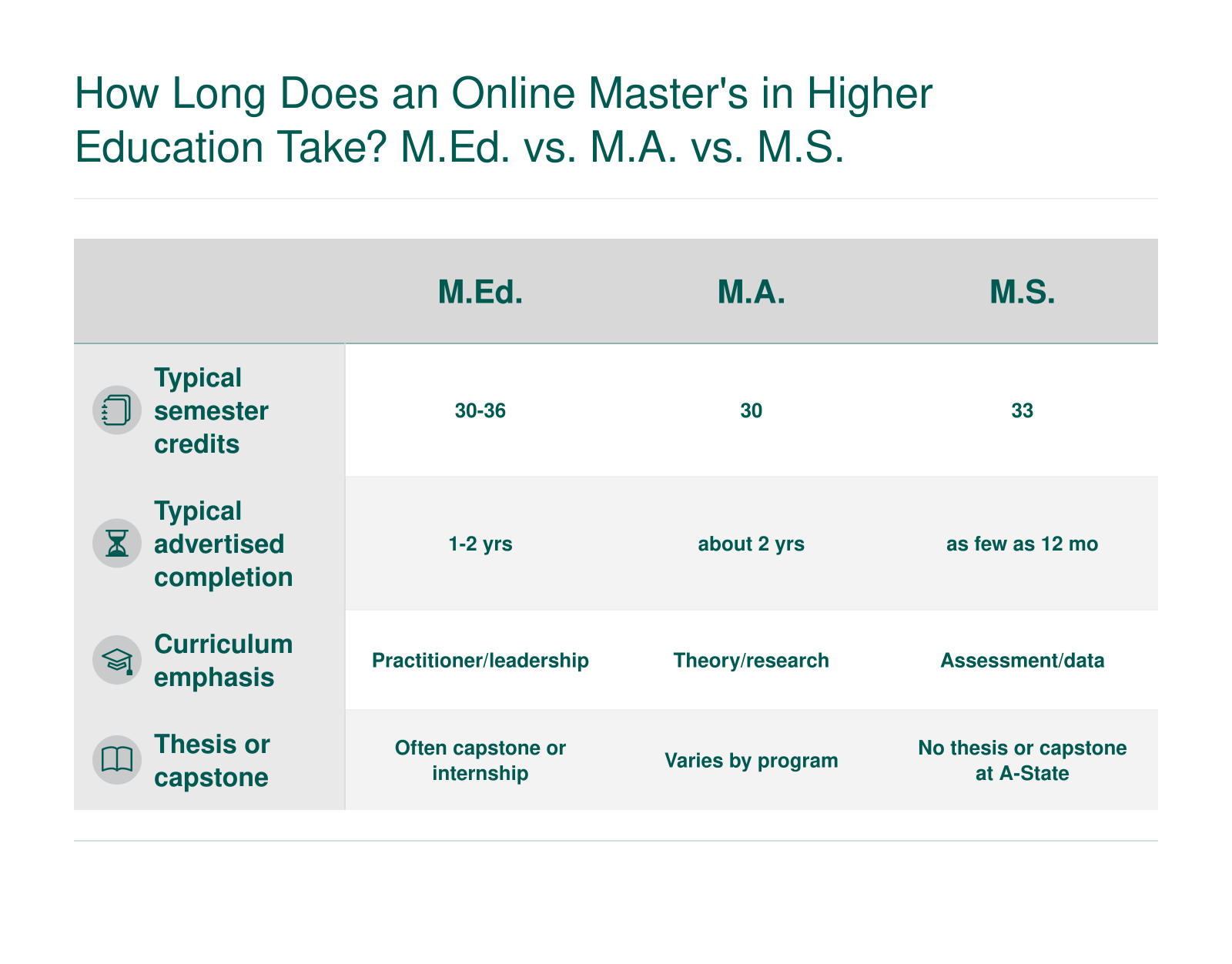
How Long Does an Online Master's in Higher Education Take? M.Ed. vs. M.A. vs. M.S.
Most fully online higher education master's programs run 30-36 semester credits and take about 18-24 months part-time, with accelerated options near 12 months. The degree title matters less to employers than concentration and practicum experience.
Staffing and turnover vary by institution and year, so treat any figure as a snapshot. Start with BLS.gov and the NCES IPEDS Human Resources component, check a school's institutional research or HR pages, and benchmark with CUPA-HR. In 2025, 25% of higher ed employees were likely to look for other work, down from 33% in 2023.
Admissions Requirements: Do You Need Higher Ed Work Experience?
Admission requirements vary by program, but prior higher education work experience is generally not a requirement.
- Bachelor's degree and GPAYou need a bachelor's degree from a regionally accredited institution. Minimum GPAs vary: SIUE asks 2.5, Saint Martin's 2.75, UW–La Crosse 2.85, and Colorado State and Indiana require 3.0.
- GRE policyMichigan State, SIUE, and Colorado State do not require the GRE; other programs may waive it or leave it optional.
- Work experiencePrior higher education employment is not generally required. Some student affairs tracks expect a campus job or graduate assistantship for the practicum once enrolled.
- Application materialsExpect transcripts from every college attended, a statement of purpose, a resume or CV, and two to three recommendation letters, Saint Martin's requests three, while Indiana and Morgan State ask two.
- Deadlines and start termsDeadlines are fixed and program-specific: Michigan State and NYU close December 1 and December 15, SIUE's is December 30, and UW–La Crosse starts in May after a February 1 deadline. Confirm current-cycle dates on the program page.
A master's degree in higher education is only a good value if your total borrowing stays below what you can reasonably expect to earn in your first year after graduating.
Higher Education programs by state
Frequently Asked Questions About Online Higher Education Master's Degrees
These answers summarize the detailed sections above. Use them as a starting point, then confirm current tuition, fees, aid, and admission requirements directly with each program.
Which online higher education master's programs provide the best value after fees and financial aid?
Which online higher education master's programs lead to jobs in student affairs, enrollment management, or academic administration?
Do online higher education master's programs require prior higher education work experience?
Which online higher education master's degrees qualify graduates to teach college courses?
Compare Higher Education programs on the data that matters
Explore more Education & Teaching specializations or browse every graduate field.
All Education & Teaching programs