Best Master's in Higher Education Programs in Alabama
Compare 4 accredited Higher Education programs in Alabama, with graduate earnings, cost, debt, and completion data from IPEDS and the U.S. College Scorecard.
Most Alabama master's programs in higher education run 30 to 33 credit hours, the standard load for moving into or up within college administration, student affairs, or academic advising. Published graduate tuition across the programs here spans roughly $6,900 to $26,900 in-state, a wide spread for degrees that train for the same kinds of jobs.
Both campus and online options sit on one list. The practical tension is cost against format: the most affordable master's in higher education program is fully online, while the priciest is a private campus program. Alabama sets no state license for these administrator roles, so employers, not a licensing board, define what qualifies you.
Key Points
- The University of South Alabama and University of West Alabama deliver their programs fully online.
- Alabama sets no state license for college administrators or student affairs staff.
- Graduate GRE requirements are generally relaxed, but check each school's admissions page for 2027 policies.
Ranked: Top Master's in Higher Education Administration Programs in Alabama
Alabama has four master's programs in higher education that fit this list, spanning one campus program, two online programs and one on-campus private option. Graduation rates and net prices are institution-wide figures, not quotes for this degree, so use them as context and confirm costs with each admissions office.
Auburn University
#1Auburn, AL · $13,000 – $34,000/yr (est.)
Best for: Working professionals preferring in-person classes
Auburn University graduates about 82% of its students, the strongest institution-wide rate among Alabama schools on this list, and its average net price after aid is roughly $24,300. The higher education master's is offered on campus only, which suits students who want in-person study. Program graduates who reported earnings had a median of about $55,600 one year after finishing.
- 33 total credit hours, designed for working professionals and researchers
- Five domains: leadership, ethics, diversity, research and policy
- Internship included in the core curriculum
- Electives in student services, legal issues and financial management
- Optional certificate in College and University Teaching
- Optional certificate in Instructional Technology for Distance Education
- Campus delivery; application deadline listed as January 31
University of South Alabama
#2Mobile, AL · ~$9,000/yr (est.)
Best for: Future administrators focused on law and policy
The University of South Alabama in Mobile graduates about 53% of its students, and its average net price after aid is roughly $17,600. Its Educational Administration M.Ed. with a Higher Education concentration is aimed at postsecondary administrators, separate from the school's K-12 leadership tracks. Program graduates with reported earnings had a median of about $58,500 four years after finishing.
- 30 total credit hours with a focus on postsecondary education
- Internship in higher education
- Courses in law, policy and student development
- Organizational planning coursework
- Comprehensive exam required
- Fall, spring and summer starts; deadlines Nov 1, Apr 1 and Jul 1
- Delivered online
University of Mobile
#3Mobile, AL · ~$14,000/yr (est.)
Best for: Research-minded students wanting small cohorts
The University of Mobile is a private institution that graduates about 57% of its students, with an average net price after aid near $22,400. Its Higher Education Leadership and Policy M.Ed. is a campus program built around a thesis and a practicum. Graduate education cohorts there tend to be small, which supports close faculty mentoring.
- 33 total credit hours
- Thesis required
- Practicum requirement applies theory in real settings
- 2.8 minimum GPA and graduate admission essay required
- Does not lead to Alabama P-12 administrator certification
- Rolling admission with a $40 domestic application fee
University of West Alabama
#4Livingston, AL · $7,000 – $14,000/yr (est.)
The University of West Alabama in Livingston has the lowest average net price after aid on this list, at roughly $12,700, though it graduates about 35% of its students institution-wide. Its fully online M.Ed. in Student Affairs in Higher Education has the largest graduate completion count of the four programs. Program graduates with reported earnings had a median of about $65,400 one year after finishing.
- 33 total credit hours at $429 per credit
- Complete in 1 to 2 years through 8-week course terms
- Fully online with a practicum that can be virtual or in person
- Comprehensive examination required
- Up to 9 transfer credits accepted
- No teaching certification required
- Personal success coach provided
Cost & outcomes by school
Federal data for the highest-earning Higher Education programs, independent of the ranking above. Earnings are this field's master's graduates four years after completing, where the Scorecard reports them.
| School | Earnings | Tuition / yr | Debt | Grads/yr | Format |
|---|---|---|---|---|---|
| University of West Alabama AL | $73,704 | $6,868 | $27,333 | 120 | Online |
| Auburn University AL | $73,265 | $12,890 | $35,474 | 22 | Campus |
| University of South Alabama AL | $58,540 | $9,360 | — | 7 | Online |
| University of Mobile AL | — | $14,410 | — | 3 | Campus |
Sources: U.S. Department of Education. Tuition and graduates: IPEDS. Earnings and debt: College Scorecard, this field's master's graduates; a dash means no figure is reported.
How We Scored Alabama's Higher Education Master's Programs
A low sticker price and a schedule built for working professionals rarely come in the same package across Master's Programs in Alabama, so the scoring had to weigh both. The Best Master's in Higher Education Programs in Alabama had to earn their place on public numbers, not brochure claims.
Graduate tuition and fees come from federal IPEDS data. Net price, program-level earnings, and median debt come from the College Scorecard; cost, graduate debt, and post-completion earnings carried the most weight, because they decide whether the degree pays for itself. Delivery format counted too, since administrators who work full time often need evening, hybrid, or online options.
The numbers have limits. Graduation rates and net price describe the whole institution, not the higher education program alone, and some small programs have no published earnings figures. Where a figure is missing, we judged the program on the data that does exist rather than guess.
Online and Hybrid Master's in Higher Education Options in Alabama
Which Alabama higher education master's programs can you finish without relocating? Sorted by delivery format, the University of South Alabama and the University of West Alabama are fully online, two of the best online master's in higher education programs in Alabama. Auburn University and the University of Mobile are campus programs. None of the schools here is listed as a hybrid.
Format and Practicum
West Alabama's M.Ed. in Student Affairs in Higher Education runs in 8-week course terms, which suits working professionals. Its practicum can be completed virtually or in person, and a comprehensive exam is required. South Alabama's online M.Ed. includes an internship in higher education and a comprehensive exam. Its published page does not say whether you can complete the internship at your own workplace, so ask the department before applying.
Auburn's Administration of Higher Education M.Ed. and Mobile's Higher Education Leadership and Policy M.Ed. both involve in-person study. Auburn requires an internship, and Mobile includes a practicum and a thesis.
Live Sessions and Support
"Online" alone doesn't tell you whether classes meet live or run on your own schedule, and neither online program here spells that out. Confirm it with admissions. West Alabama assigns a personal success coach. Support services at South Alabama's online program aren't detailed, and neither school's page confirms an in-state rate for out-of-state online students, so ask about that too.
Related Articles
Which Alabama Master's Programs Waive or Make the GRE Optional?
Where Alabama programs publish admissions details, the GRE is generally not a standard requirement for a master's in higher education. It more often serves as a fallback for applicants whose GPA falls short. Policies change and some schools publish little, so confirm current terms with each admissions office before you apply.
| School | GRE Policy | Minimum GPA | Application Deadline / Start Terms |
|---|---|---|---|
| Auburn University | Not required with a 2.75 undergraduate GPA from an ABET-accredited program (general graduate admissions guidance, not specific to higher education administration) | 2.75 on a 4.0 scale (same general guidance) | No fixed deadline; domestic applicants should apply about 30 days before classes start, international applicants about 90 days before |
| University of South Alabama | Not stated as a general requirement; applicants without a qualifying GPA may submit GRE or MAT scores, with the GRE standard at the 50th percentile on each section | 2.5 overall, or 2.5 on the last 60 undergraduate semester hours (4.0 scale) | N/A |
| University of Mobile | No published policy | N/A | N/A |
| University of West Alabama | No published policy | N/A | N/A |
What a Master's in Higher Education Administration Costs in Alabama
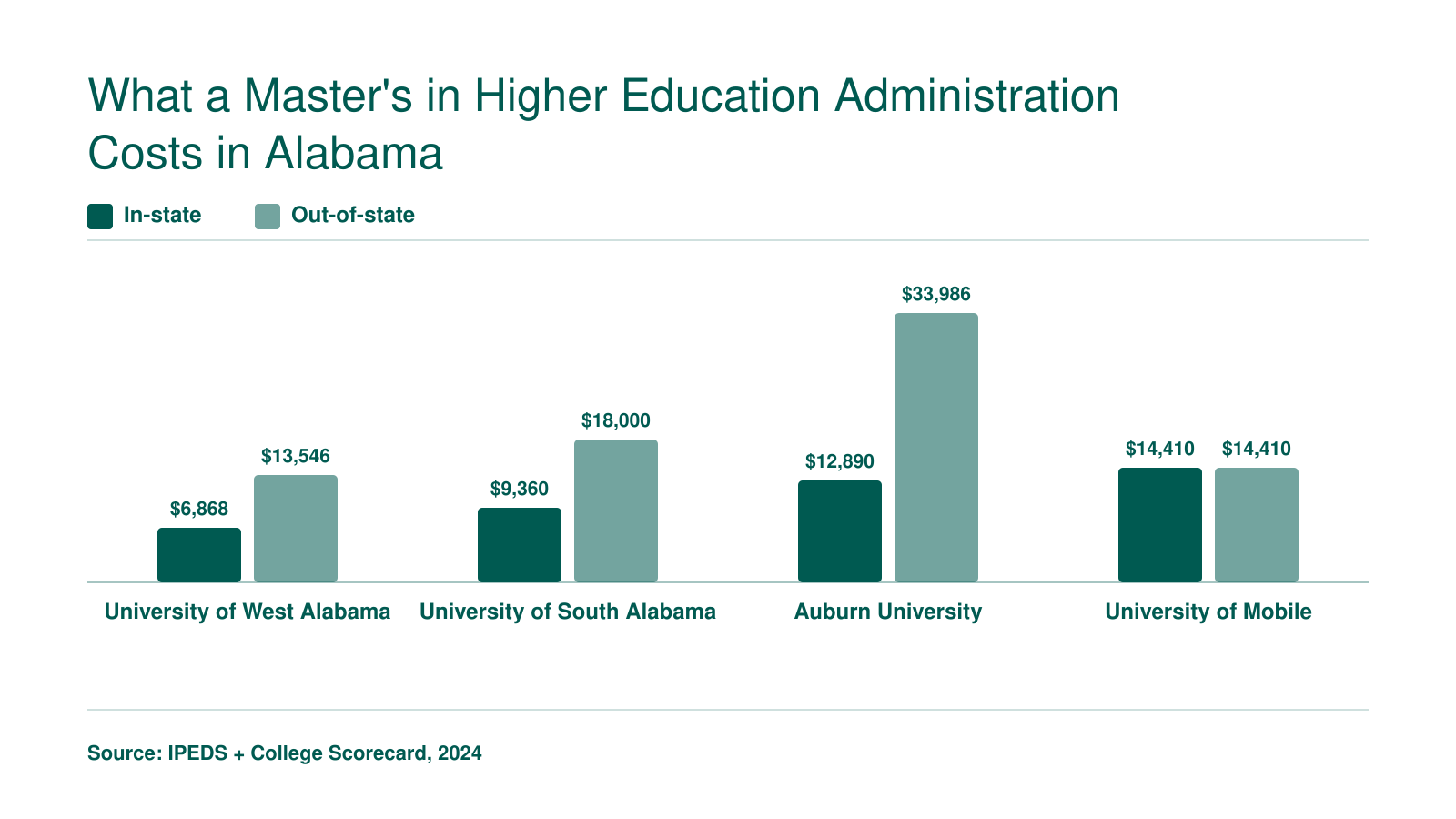
The chart compares reported in-state and out-of-state graduate tuition and fees for each school here. These are published rates, not the full price of the degree, so scale them to the credit load. The University of West Alabama lists $429 per credit across 33 credit hours, or about $14,157 in tuition before fees. The University of South Alabama requires 30 credit hours, while the University of Mobile and Auburn University each require 33. Other per-credit rates were not available to compare. Median federal debt at completion for the program is $27,333 at the University of West Alabama and $35,474 at Auburn University. The other two schools do not report a program-level figure. Net price is an institution-wide average after grant aid, so it will not match what a graduate student pays.
Does Alabama License Higher Education Administrators?
What Can You Do With a Master's in Higher Education in Alabama?
Student-facing work and back-office administration lead to very different paychecks after a master's in higher education. Advising and student affairs jobs are common first stops. Registrar, financial aid, and institutional research posts lean toward data, compliance, and budgets.
Common roles for graduates include:
- Admissions director
- Registrar
- Student affairs coordinator
- Academic advisor
- Financial aid administrator
- Institutional research analyst
Wages and Program Outcomes
As of May 2025, BLS data show a median annual wage of $100,030 for postsecondary education administrators in Alabama, across roughly 3,760 jobs.1 The national median is $104,590. Projected growth is 2% from 2025 to 2035, which is slower than average.
Program-level earnings run lower. Many graduates start in advising or coordinator roles rather than director posts. Five years after completing the degree, University of West Alabama graduates earned a median of $76,111, University of South Alabama graduates earned $63,854, and Auburn University graduates earned $58,172. Auburn's cohort reached $73,265 at four years, so a single cohort's figure can swing from one year to the next.
Where the Jobs Are
Alabama's employers include large public research universities, regional public campuses, two-year community colleges in the state system, private colleges, and the state's HBCUs. Each of these hires for admissions, advising, and student services.
How Long Does a Master's in Higher Education Administration Take in Alabama?
How long you spend in a master's in higher education administration depends on pacing, credit load, and whether the program includes fieldwork or a culminating exam. Most programs in this field run 30 to 36 credits, but published timelines vary by institution.
Auburn University's M.Ed. requires 33 credits and an internship or practicum plus a comprehensive exam. The minimum coursework can be finished in about nine months across two semesters, a pace typical of accelerated master's in higher education programs, though many students take three semesters or longer. The University of South Alabama's fully online M.Ed. requires 30 credits and reports a 12-month full-time pace, with part-time students typically finishing within 24 months.
Internships, practicums, and a comprehensive exam or capstone can add a semester or more for working professionals. Because start terms and deadlines differ, and several schools now offer master's in higher education programs with no GRE required, comparing the admissions table above is the most practical next step before you apply.
Compare Higher Education programs on the data that matters
Explore more Education & Teaching specializations or browse every graduate field.
All Education & Teaching programs