Best Master's in Higher Education Programs in Ohio
Compare 8 accredited Higher Education programs in Ohio, with graduate earnings, cost, debt, and completion data from IPEDS and the U.S. College Scorecard.

A master's in higher education prepares students for academic advising, admissions, enrollment management, and student affairs administration on Ohio campuses.
Published graduate tuition for Ohio residents in the ranked programs spans $9,720 at Ohio University to $19,580 at the University of Dayton. That cost gap is larger than many applicants expect, and it does not track neatly with format: online, hybrid, and campus-based options all appear across the price range.
Key Points
- Franklin University publishes $670 per credit across 32 credits.
- Ohio residents save about $11,800 at the University of Toledo.
- Ohio generally requires no state license for college administration or advising jobs.
Ohio's Top Master's in Higher Education Programs, Ranked
This list weighs what each degree costs against what graduates tend to get out of it, looking at cost after aid, completion, and earnings where they are published. Seven Ohio programs made the page, covering online, hybrid, and campus formats. Earnings figures below reflect program graduates one year after finishing, and graduation rates describe each university as a whole.
University of Dayton
#1Dayton, OH · ~$20,000/yr (est.)
Best for: Aspiring student affairs professionals studying online
The University of Dayton delivers its higher education master's online through a Master of Science in Education in Educational Leadership with a Higher Education and Student Affairs concentration. Graduate in-state tuition is listed at $19,530 a year, and the university graduates 80% of its students. Program graduates reported median earnings of $54,726 one year after finishing, with median debt of $18,786, the lowest among the programs here that report debt.
- Online delivery with live weekly classes plus asynchronous options
- Full-time or part-time pacing, three start dates per year
- Field experience in the local community
- No teaching license required for the student affairs track
- Two letters of recommendation, $50 application fee
- Prepares for advising, career services, and student services roles
Ohio University
#2Athens, OH · ~$10,000/yr (est.)
Best for: Part-time working adults in Southeast Ohio
Ohio University offers its Master of Education in Higher Education in a fully online format and in a hybrid format based on the Athens campus. Graduate in-state tuition is listed at $9,444 a year, the lowest of the public universities here, and the university graduates 65% of its students. Program graduates reported median earnings of $51,665 one year after finishing, though median debt of $39,756 is on the higher side.
- 30 credit hours, finishable in 1 year and 8 months at two courses per term
- Online option, or hybrid with 20 to 40% of coursework online
- Part-time only, with three start dates per year
- No entrance exam required
- Three letters of recommendation and a goal-statement portfolio
- Capstone project required
- Covers finance, legal issues, governance, diversity, and policy
Baldwin Wallace University
#3Berea, OH · ~$17,000/yr (est.)
Best for: Career changers wanting hands-on internship experience
Baldwin Wallace University in Berea pairs coursework with a substantial internship in its Leadership in Higher Education program. Graduate in-state tuition is listed at $16,738 a year, and the university graduates 67% of its students. Program graduates reported median earnings of $54,167 one year after finishing, with median debt of $38,997.
- Campus-based, full-time or part-time
- 46 credits: 30 coursework and 16 internship
- Non-thesis, with a capstone seminar and portfolio
- Practicum in student affairs or academic affairs
- Part-time students intern at their own higher education employer
- Internship approval required before admission
- Coursework in funding, finance, and ethical leadership
Kent State University
#4Kent, OH · ~$12,000/yr (est.)
Kent State University runs an in-person M.Ed. in Higher Education Administration and Student Affairs on its Kent campus. Graduate in-state tuition is listed at $12,483 a year, and the university graduates 64% of its students. Program graduates reported median earnings of $44,433 one year after finishing, with median debt of $27,000, so the draw is assistantships and a dual-degree path more than early pay.
- 39 credit hours, in person on the Kent campus
- 6-credit internship in areas like advising and career services
- Graduate assistantships available at northeast Ohio colleges
- Dual degree option with an MBA
- Rolling admissions, 3.0 GPA minimum
- Two letters of recommendation
University of Toledo
#5Toledo, OH · $18,000 – $29,000/yr (est.)
The University of Toledo offers an online M.Ed. in Higher Education built for working professionals. Graduate in-state tuition is listed at $15,661 a year, and the university graduates 57% of its students. Program graduates reported median earnings of $49,088 one year after finishing.
- 30 credit hours, finishable in six semesters
- Asynchronous online courses in seven-week terms
- Rolling admissions
- Practicum experiences for those new to the field
- Aimed at entry- and mid-level roles like advisor or registrar
Tiffin University
#6Tiffin, OH · ~$17,000/yr (est.)
Tiffin University offers an asynchronous online M.Ed. in Higher Education Administration with six start dates a year. Graduate in-state tuition is listed at $15,000 a year, or $635 per credit, and the university graduates 40% of its students. Program graduates reported median earnings of $49,452 one year after finishing, with median debt of $28,000.
- 30 credit hours, finishable in 12 months full-time
- Fully online, asynchronous, seven-week courses
- Starts in January, March, May, July, August, and October
- $635 per credit hour
- Capstone course required
- Each student is assigned a graduate advisor
- Concentrations in Higher Education Administration and Instructional Design
Franklin University
#7Columbus, OH · ~$12,000/yr (est.)
Franklin University in Columbus offers a fully online M.Ed. in Educational Leadership with a Higher Education Leadership focus, aimed at working adults. Graduate tuition is listed at $12,060 a year, the lowest sticker figure here. The university graduates 11% of its students, the lowest rate on this list, and no program-level earnings are published, so weigh it mainly on cost and flexibility.
- 32 credit hours, finishable in as little as 12 months, one class at a time
- $670 per credit, about $21,440 total, with a locked tuition rate
- Automatic $2,000 scholarship for new students
- No entrance exam required, 2.5 GPA minimum
- Capstone action research project
- Three start dates per year, asynchronous online
- Military benefits and employer reimbursement supported
Cost & outcomes by school
Federal data for the highest-earning Higher Education programs, independent of the ranking above. Earnings are this field's master's graduates four years after completing, where the Scorecard reports them.
| School | Earnings | Tuition / yr | Debt | Grads/yr | Format |
|---|---|---|---|---|---|
| Ohio University OH | $69,204 | $9,720 | $39,756 | 38 | Hybrid |
| Ashland University OH | $65,364 | $8,400 | $22,323 | 63 | Online |
| University of Dayton OH | $63,216 | $19,580 | $18,786 | 33 | Online |
| University of Toledo OH | $59,531 | $17,605 | — | 9 | Online |
| Tiffin University OH | $57,728 | $17,000 | $28,000 | 17 | Online |
| Baldwin Wallace University OH | $55,820 | $16,738 | $38,997 | 15 | Campus |
| Kent State University OH | $55,723 | $12,483 | $27,000 | 29 | Campus |
| Franklin University OH | — | $12,090 | — | — | Online |
Sources: U.S. Department of Education. Tuition and graduates: IPEDS. Earnings and debt: College Scorecard, this field's master's graduates; a dash means no figure is reported.
Cost, debt & payoff
Median earnings of this field's master's graduates (4 yrs after completing) vs. their median federal loan debt · U.S. College Scorecard
Across these programs the median graduate earns about $59,531 and finishes with roughly $27,500 in debt — a ratio that clears a common rule of thumb (keep debt below first-year salary). Tuition and debt vary widely school to school, so check the per-school figures in the table above before you shortlist.
Online and Hybrid Master's in Higher Education Options in Ohio
As student affairs work has shifted toward remote advising and virtual student services, several of the programs ranked here now deliver coursework entirely online for people already on the job.
Fully online and asynchronous
Ohio University's Master of Education in Higher Education runs online with asynchronous coursework across 30 credits and 5 semesters, built for working professionals. University of Toledo, Tiffin University, and Franklin University also deliver asynchronous online classes, typically in 7-week terms with two courses per semester. These formats let you keep working while you study.
Hybrid and flex formats
Ohio University also offers a hybrid version, mostly in person on the Athens campus with 20 to 40 percent of coursework online, two courses per semester. University of Dayton uses a flex format for its higher education and student affairs graduate programs: attend in person or by video, with no requirement to travel to campus every week.
Start terms and who each format fits
Start dates matter if you want to begin soon. University of Dayton's MSEd in Educational Leadership and Ohio University both offer three starts a year; Tiffin opens six. Campus programs at Baldwin Wallace and Kent State pair coursework with internships and assistantships, which suit career changers seeking hands-on experience. Online formats fit people already employed at a college.
Related Articles
Which Ohio Master's in Higher Education Programs Skip the GRE?
Test requirements for master's in higher education programs vary by school and sometimes by specialization. Kent State University is the one school here where we could confirm a policy from its published admissions information. For the others, we found no published policy, so we do not guess.
| School | GRE Policy | Other Key Admission Requirements |
|---|---|---|
| Kent State University | Not required (graduate education programs are described as test-optional; some specializations may differ) | Bachelor's degree from an accredited institution; typically a 2.75 minimum undergraduate GPA; statement of purpose; letters of recommendation. Fall graduate assistantship applicants should apply by December 1. |
| University of Dayton | No published policy | Confirm GPA, résumé, and interview expectations with the program |
| Ohio University | No published policy | Confirm GPA, résumé, and interview expectations with the program |
| Baldwin Wallace University | No published policy | Confirm GPA, résumé, and interview expectations with the program |
| University of Toledo | No published policy | Confirm GPA, résumé, and interview expectations with the program |
| Tiffin University | No published policy | Confirm GPA, résumé, and interview expectations with the program |
| Franklin University | No published policy | Confirm GPA, résumé, and interview expectations with the program |
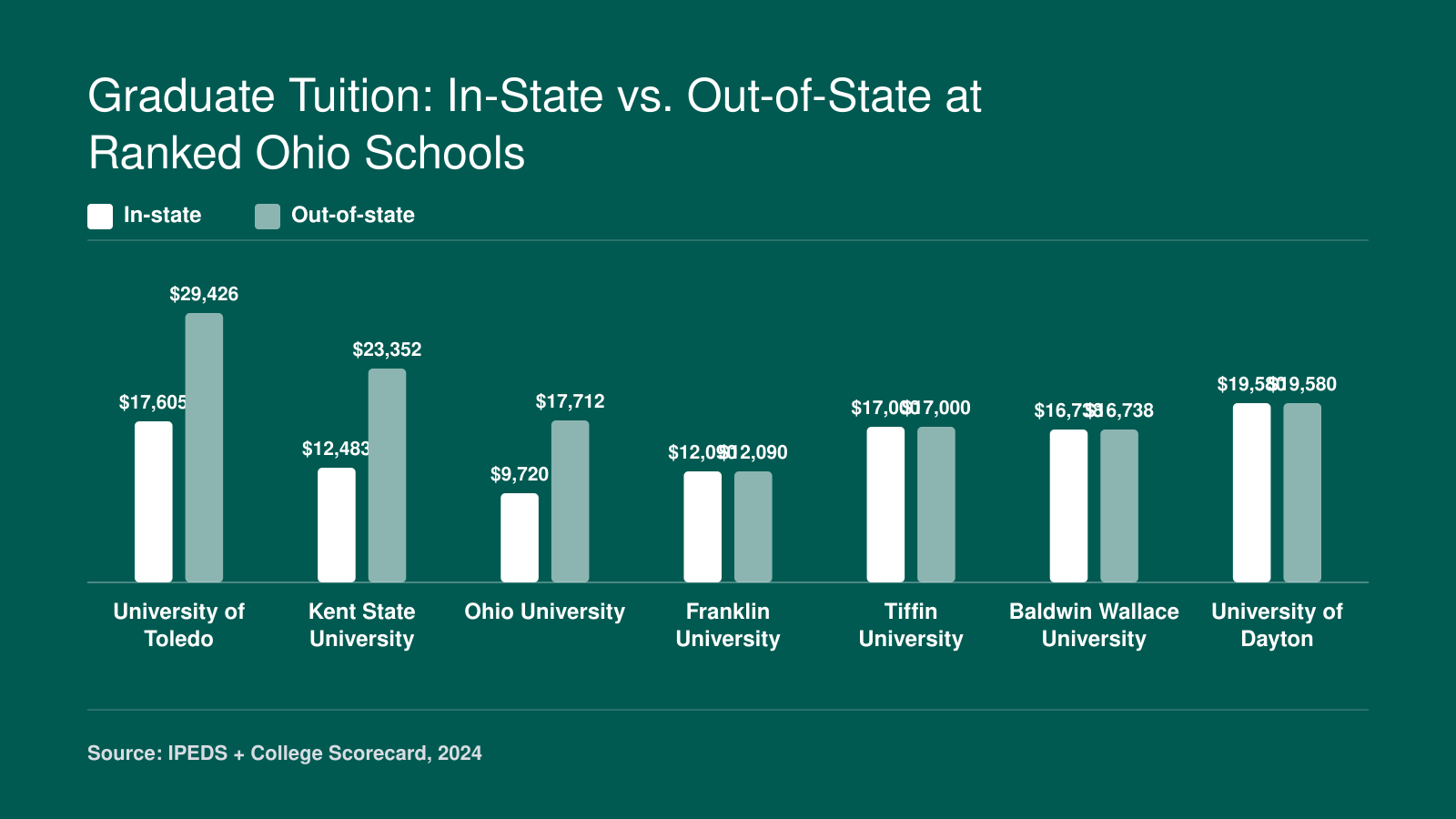
Graduate Tuition: In-State vs. Out-of-State at Ranked Ohio Schools
The public universities here charge Ohio residents far less than nonresidents. The gap is about $11,800 at the University of Toledo, about $10,900 at Kent State University and about $8,000 at Ohio University. Franklin University, Tiffin University, Baldwin Wallace University and the University of Dayton charge one rate to everyone, so residency does not change your price there.
How Much a Master's in Higher Education Costs in Ohio
Cost is the clearest differentiator among Ohio's higher education master's programs, and the gap between the lowest and highest published tuition is larger than many applicants expect.
Published Tuition Basics
Franklin University lists $670 per credit and 32 credits, putting its total near $21,440. Tiffin University lists $635 per credit and 30 credits, roughly $19,050. Ohio University's 30-credit M.Ed. carries the lowest listed in-state tuition on this page at about $9,700, while the University of Dayton's program is the highest listed private tuition at $19,580 and the University of Toledo's out-of-state listed tuition reaches about $29,400.
Net Price After Aid
Institution-wide net price after aid, an average for the whole school and not a program quote, shows a public-private split. The public schools here fall roughly between $17,200 and $21,600, while private schools land from about $25,200 to $29,500.
Debt and Return
Published median program debt is more telling than sticker price. Kent State reports $27,000 with a monthly payment near $307; Ohio University reports $39,756 with $452; the University of Dayton reports $18,786 with $214. One year after completing, median earnings ranged from roughly $44,400 at Kent State to about $54,700 at the University of Dayton.
Cost Cutters
Ohio University graduate appointments can cover the instructional fee and, for out-of-state students, the nonresident surcharge, though general and college-specific fees remain. College and university employees should ask about tuition remission, and online learners may avoid some campus fees even when distance-learning charges apply.
Ohio Certification Rules for Higher Education Professionals
Behind the List: How Ohio Programs Earned Their Spots
Price and payoff drive the order here: published graduate tuition, net price after aid, institution-wide graduation rates, and, where federal data reports them, median earnings and borrowing for graduates of these higher education programs.
Institutional accreditation is the floor. Ohio University has held Higher Learning Commission accreditation since 1913, covering its programs and units, and Kent State is likewise listed as accredited.1 That status is what makes federal aid available and keeps credits transferable.
No specialized accreditor governs master's degrees in higher education or student affairs. Instead, programs align to CAS standards and ACPA/NASPA competencies, as Ohio University's College Student Personnel curriculum does. CAS is a self-assessment framework, not an accrediting agency.
One caveat: graduation rates and net price are institution-wide figures, not your program's numbers.
Quick Answers for Ohio Higher Ed Master's Applicants
These short answers cover the questions applicants ask most about Ohio master's programs in higher education. Figures come from published program pages and federal data, so confirm current details with each school before you apply.
Which Ohio school offers the lowest-cost master's in higher education?
Can you earn a higher education master's fully online from an Ohio university?
How many semesters does a master's in higher education take in Ohio?
Is the GRE still required for Ohio higher education graduate programs?
What careers does a higher education administration master's lead to in Ohio?
Do graduate assistantships cover tuition in Ohio student affairs programs?
How is a higher education master's different from a college student personnel or student affairs degree?
Compare Higher Education programs on the data that matters
Explore more Education & Teaching specializations or browse every graduate field.
All Education & Teaching programs