Best Master's in Higher Education Programs in Washington
Compare 4 accredited Higher Education programs in Washington, with graduate earnings, cost, debt, and completion data from IPEDS and the U.S. College Scorecard.

A master's in higher education is the standard credential for student affairs, academic advising, admissions, and administrative roles across Washington's colleges and universities. Only a handful of institutions in the state award it, so the practical shortlist is short.
That scarcity makes comparison matter. In-state graduate tuition at the public campuses is roughly $9,400 to $13,000 a year, while delivery splits between Seattle's portfolio-based program and the fully online and hybrid options built for working professionals. The gap between those paths, not prestige, is what shapes most enrollment decisions.
Key Points
- Central Washington University offers a fully online Higher Education MEd.
- Median federal debt ranges from $14,615 at UW to $19,500 at Central.
- UW's higher education MEd emphasizes leadership and student affairs.
Top-Ranked Higher Education Administration Master's Programs in Washington
Washington's higher education master's programs reward close comparison of graduate tuition, net price, and how well each institution graduates its students overall. The four schools below stand out for a mix of campus, hybrid, and fully online delivery, with in-state public options typically priced below private programs. Use each card's program details to match your schedule and career focus before finalizing a shortlist.
University of Washington-Seattle Campus
#1Seattle, WA · ~$19,000/yr (est.)
Best for: Research-minded campus students
UW-Seattle's higher education M.Ed. sits inside a Research 1 university with strong graduation outcomes, making it a fit for students who want policy and leadership theory alongside a thesis. The 48-credit curriculum combines research methods, advanced leadership, and higher education electives, with a second-year research project guided by a faculty advisor. It is designed for those considering doctoral study or leadership roles in colleges and nonprofits.
- 48 total credit hours
- Thesis required
- 6 credits of introductory research methods
- 9 credits of advanced leadership sequence
- 9 credits of foundational higher education coursework
- Two courses required outside higher education
- Prepares students for doctoral study
- Elective topics include law and higher education
Western Washington University
#2Bellingham, WA · $14,000 – $27,000/yr (est.)
Best for: Working adults needing hybrid Saturdays
Western Washington's adult and higher education master's is a part-time hybrid built for working professionals, blending online coursework with two Saturday sessions per quarter in Bellingham. The 52-credit program covers e-learning, research methods, curriculum development, and policy analysis, with a non-thesis option that keeps the path practical. Graduates target roles in community colleges, universities, government agencies, and corporate training.
- 52 total credit hours
- Complete in three to four years part-time
- Starts fall and spring
- Two Saturdays per quarter on campus
- Non-thesis option available
- Requires statement of purpose
- 2 letters of recommendation (minimum)
- $100 application fee
Central Washington University
#3Ellensburg, WA · ~$13,000/yr (est.)
Best for: Online learners valuing no GRE
Central Washington's online higher education M.Ed. is a flexible 45-credit program aimed at administrative and student affairs roles. It mixes synchronous discussion with self-paced work and requires no GRE, with quarterly priority deadlines. The curriculum includes organizational leadership, research methods, data analysis, and a capstone or internship, supported by a dedicated program advisor.
- 45 total credit hours
- No entrance exam required
- Test optional
- Starts fall, winter, spring, summer
- Synchronous and asynchronous options
- 3.0 GPA minimum
- Thesis or capstone option
- Five-credit internship or capstone
Saint Martin's University
#4Lacey, WA · ~$17,000/yr (est.)
Saint Martin's offers a synchronous online MED-HESA that emphasizes social justice, counseling, diversity, and ethical practice rooted in Benedictine values. The 36-credit program includes a practicum and internship, preparing graduates for student affairs and administrative positions. Its flexible start dates and Education College of Distinction recognition make it a supportive option for working professionals.
- 3 start dates per year
- Synchronous class sessions
- 2.8 GPA minimum
- 3 letters of recommendation (minimum)
- Capstone required
- Practicum in higher education
- Internship in student affairs
- Education College of Distinction
Cost & outcomes by school
Federal data for the highest-earning Higher Education programs, independent of the ranking above. Earnings are this field's master's graduates four years after completing, where the Scorecard reports them.
| School | Earnings | Tuition / yr | Debt | Grads/yr | Format |
|---|---|---|---|---|---|
| Western Washington University WA | $129,722 | $13,878 | — | 12 | Hybrid |
| University of Washington-Seattle Campus WA | $87,362 | $18,792 | $35,140 | 70 | Campus |
| Central Washington University WA | $81,827 | $13,220 | $32,338 | 7 | Online |
| Saint Martin's University WA | — | $17,332 | — | 5 | Online |
Sources: U.S. Department of Education. Tuition and graduates: IPEDS. Earnings and debt: College Scorecard, this field's master's graduates; a dash means no figure is reported.
Student Affairs, Leadership, or Policy? What Washington Higher Education Master's Programs Emphasize
In higher education graduate study, the concentration you choose often says more about your career direction than the degree title does. The clearest answer among Master's Programs in Washington to the "master's in higher education and student affairs" question is the University of Washington-Seattle Campus, which offers a Student Affairs emphasis within its Organizations & Policy master's. It is a two-year, 48-credit terminal degree aimed at leadership careers in student personnel and student affairs. Readers searching "master's in education UW" will find this emphasis is the confirmed route.
How leadership, policy, and assessment fit in
At the University of Washington-Seattle Campus, these areas show up as coursework threads rather than separate tracks: organizational theory, law and higher education, public policy, assessment and evaluation, student-development theory, and higher-ed data. Students finish with a professional portfolio instead of a thesis. Current concentration details for Western Washington University, Central Washington University, and Saint Martin's University are not confirmed here, so check each department's page before you apply.
The internship requirement
The hands-on component is substantial. Students complete 9 credits of supervised student-affairs work, chosen with a faculty advisor. Each 3-credit internship runs about 9 hours a week, and the credits can be spread across up to three sites, with at least 3 credits at any one. The work is meant to go beyond regular job duties and is arranged among the student, advisor, and site supervisor.
A practical tip
Match the concentration to the campus role you want in five years. If that role is advising, student conduct, or institutional research, pick the emphasis and internship sites that build those exact skills.
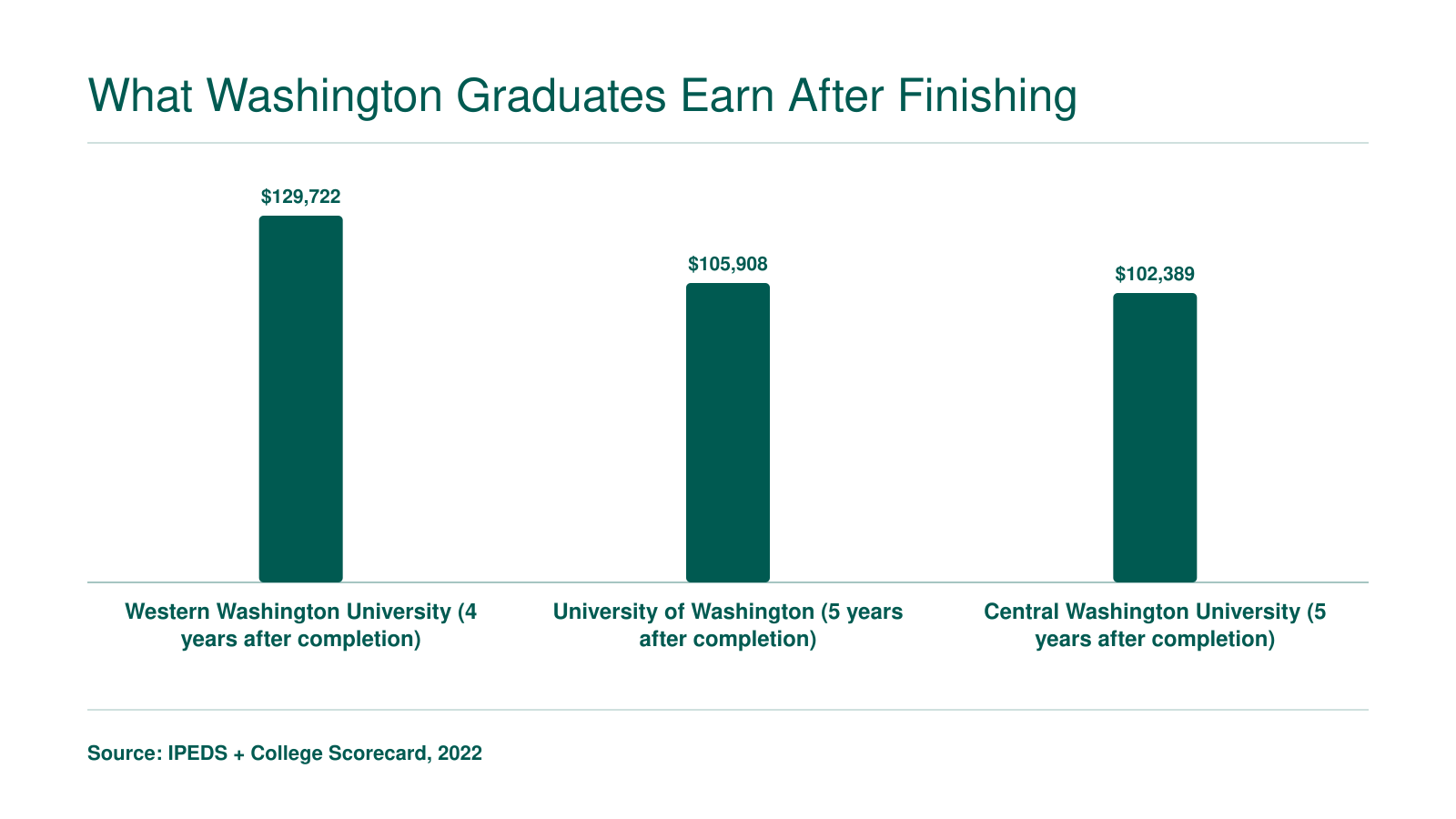
What Washington Graduates Earn After Finishing
The chart shows median earnings for master's in higher education completers at the ranked Washington schools that publish a program-level figure. Median federal debt at completion was $18,500 at Western Washington, $14,615 at University of Washington, and $19,500 at Central Washington; 10-year monthly payments were $400 at UW-Seattle and $368 at Central Washington. These are College Scorecard medians for completers, not guaranteed salaries.
Online and Hybrid Master's in Higher Education Options in Washington
Can you complete a master's in higher education in Washington without relocating to campus? Yes, but the format varies by school.
Fully online options
Central Washington University's Higher Education MEd is an online master's in higher education that mixes synchronous and asynchronous options. Saint Martin's University's Master of Education in Higher Education and Student Affairs follows synchronous online classes. Live synchronous class times vary, so working professionals should check schedules before enrolling. Both are built for working professionals, though published part-time timelines are limited.
Hybrid and campus formats
Western Washington University's M.Ed. in Adult and Higher Education is hybrid, not fully distance. Each 10-week course requires two mandatory face-to-face Saturdays on the Bellingham campus, with the rest online through synchronous and asynchronous work. WWU markets a three-to-four-year part-time pace.
The University of Washington's student affairs emphasis is listed as a campus program, running about 24 months with nine credits of supervised internship and a professional portfolio.
Cost and assistantships
Out-of-state online students may pay more, so an affordable master's in higher education is worth weighing. CWU lists in-state tuition near $13,220 and out-of-state near $28,031; Saint Martin's lists a flat $17,332. Campus and hybrid placements like UW's internship and WWU's residencies can create graduate assistantship and on-campus employment advantages that fully online formats do not automatically include.
In higher education, the program that fits your schedule, your career target, and your budget will usually deliver more value than the one with the bigger name.
Which Washington Higher Education Master's Programs Make the GRE Optional?
Required versus optional: the GRE question now splits graduate admissions, and in Washington the trend leans away from the exam. Still, policy lives at the program level, not the campus level, so the safest move is to read the specific department page before you assume anything.
Where the Ranked Schools Stand
- University of Washington-Seattle Campus: The UW Graduate School sets no institution-wide GRE requirement and leaves the call to individual programs, so confirm the policy for the specific master's in higher education no gre you are targeting.1 The Graduate School's minimum GPA is 3.0 on a 4.0 scale, or 3.0 across the last 90 graded quarter credits.
- Western Washington University: WWU reports that most of its graduate programs don't require GRE or GMAT, though the available materials do not spell out the policy for a specific higher-education track. WWU deadlines run anywhere from January to June depending on the program.2
- Central Washington University and Saint Martin's University: The sources reviewed here do not publish a clear GRE policy for a dedicated higher-education master's, so treat the requirement as unconfirmed rather than waived.
What Admissions Committees Expect
Beyond test scores, plan for the usual package: a statement of purpose, two or three letters of recommendation, a current résumé, and transcripts showing a competitive GPA. Experience in student affairs or campus work strengthens an application even where it is not formally required. Because policies and deadlines shift each cycle, verify every detail on the program's own admissions page before applying.
Related Articles
Master's in Higher Education Costs and Credentialing in Washington
Published graduate tuition in this group splits sharply by residency and sector. Central Washington University lists $9,417 in-state and $27,526 out-of-state, Western Washington University lists $9,582 and $28,707, and the University of Washington-Seattle lists $12,973 in-state and $43,209 out-of-state. Saint Martin's University, the private option here, publishes $45,510 regardless of residency.
Net Price as a Comparative Yardstick
Net price tells a different story because aid and institutional support shift the real cost. The published net price is $14,091 at UW-Seattle, $18,476 at Central Washington, and $21,193 at Western Washington, while Saint Martin's comes in at $28,119. Those are institution-wide averages, not quotes for a specific master's degree, so treat them as a way to compare affordability rather than a promise of your final bill.
Assistantships and Fees
At UW, a graduate service appointment of at least 20 hours per week can qualify Washington residents for a nonresident tuition differential waiver, and resident operating or technology fees may be waived in whole or part. Those terms are specific to UW and must be confirmed with the program. Program pages publish per-credit rates and fee schedules, so estimate total cost from the school rather than assuming an institution-wide rate.
Credentialing and the Bottom Line
Washington does not license student affairs, academic advising, or higher education administration roles the way it certifies K-12 school administrators.1 The K-12 administrator certificate is a separate school-system requirement, distinct from educational leadership master's programs in Washington. For higher education roles, institutional accreditation through NWCCU is the key quality marker, and the public universities here hold that accreditation.2 Because there is no state-level mandate, employers set their own degree and experience expectations; voluntary professional development may help but is not required.
The bottom line: weigh total program cost, any assistantship offset, and the format you need, including accelerated higher education master's programs, against published earnings and debt figures. A lower-cost public route can leave you in a comparable career position to a higher-priced private program.
Compare Higher Education programs on the data that matters
Explore more Education & Teaching specializations or browse every graduate field.
All Education & Teaching programs