Best Master's in Higher Education Programs in Arkansas
Compare 4 accredited Higher Education programs in Arkansas at 3 schools, with graduate earnings, cost, debt, and completion data from IPEDS and the U.S. College Scorecard.

Student affairs hiring increasingly runs through M.Ed. programs in Arkansas, even for entry-level advising and admissions work. Only a few universities in the state teach it: a 30-credit campus program at the University of Arkansas, a fully online 30-credit degree at Southern Arkansas University, and a hybrid track at Arkansas Tech.
Published in-state tuition sits between roughly $8,674 and $10,104 a year, and median earnings a year out range from about $54,000 to $64,000. The real tradeoff is format against funding: assistantship money still clusters on campus.
Key Points
- Southern Arkansas University's M.Ed. in higher education is fully online.
- Arkansas Tech offers a hybrid higher education and student affairs program.
- Rankings weigh cost after aid, graduation rates, and early-career earnings.
Ranked: Best Master's in Higher Education Programs in Arkansas
This list favors programs with clear evidence of graduate completion, reasonable cost, and stronger early-career earnings, not marketing claims. The three Arkansas master's programs below take different paths: one campus-based, one fully online, and one hybrid. Each entry includes the essentials that matter for a hiring decision after graduation.
University of Arkansas
#1Fayetteville, AR · ~$12,000/yr (est.)
Best for: Campus-based learners prioritizing assistantship funding
University of Arkansas in Fayetteville offers a 36-credit Master of Education in Higher Education that is fully in-person and built around internships, student affairs, academic advising, and admissions. Admission does not require the GRE, and graduate assistantships with tuition waivers and stipends are a realistic funding path. Alumni have landed roles in 17 states. The university is HLC-accredited, and its College of Education holds CAEP accreditation for teacher-education programs through 2027.
- 36 credit hours with internships and hands-on projects
- Covers student affairs, academic advising, and admissions
- No GRE required for admission
- Graduate assistantships with tuition waivers and stipends available
- Fall, spring, and summer start dates
- Full-time and part-time enrollment options
- In-person on the Fayetteville campus
Southern Arkansas University
#2Magnolia, AR · $5,000 – $10,000/yr (est.)
Best for: Adult learners wanting fully online convenience
Southern Arkansas University in Magnolia delivers a 30-credit Master of Education in Higher, Adult, and Lifelong Education that is fully online, with concentrations in Higher Education and Adult Education. Core courses cover educational research and a HALE seminar, while electives span budgeting, finance, distance learning design, and student affairs theory. A capstone project applies learning to real-world challenges. The available materials do not specify specialized accreditation for the HALE program.
- 30 credit hours, fully online
- Core courses include educational research and HALE seminar
- Electives cover budgeting, finance, and curriculum evaluation
- Emphasis on higher education leadership roles
- Capstone project required
- Focus on adult learning theory and program design
- Electives include distance learning and postsecondary teaching
- Emphasis on student affairs theory
- Tailored for working adult educators
- Capstone addresses adult education challenges
Arkansas Tech University
#3Russellville, AR · $5,000 – $10,000/yr (est.)
Best for: Career changers needing HyFlex attendance options
Arkansas Tech University in Russellville offers a 30-credit Master of Science in Higher Education and Student Affairs with face-to-face, HyFlex, and online options. The practitioner-based curriculum covers student development theory, legal issues, research design, assessment, and administration, plus a capstone seminar and electives. Admission requires a 2.70 undergraduate GPA or 3.0 in the last 30 hours, with conditional admission available on appeal. Available program materials do not specify current institutional accreditation status.
- 30 credit hours, including capstone seminar and 6 elective hours
- Required courses cover student development theory and legal issues
- Unconditional admission: 2.70 GPA or 3.0 in last 30 hours
- Conditional admission available by program director appeal
- Face-to-face, HyFlex, and online class options
- All students pay in-state tuition
- Graduate assistantships available
- Spring, summer, and fall entry points
Cost & outcomes by school
Federal data for the highest-earning Higher Education programs, independent of the ranking above. Earnings are this field's master's graduates four years after completing, where the Scorecard reports them.
| School | Earnings | Tuition / yr | Debt | Grads/yr | Format |
|---|---|---|---|---|---|
| Arkansas Tech University AR | $66,101 | $7,670 | $26,480 | 7 | Hybrid |
| University of Arkansas AR | $64,018 | $12,470 | $25,948 | 57 | Campus |
| Southern Arkansas University AR | $58,663 | $7,380 | $31,062 | 23 | Online |
Sources: U.S. Department of Education. Tuition and graduates: IPEDS. Earnings and debt: College Scorecard, this field's master's graduates; a dash means no figure is reported.
Cost, debt & payoff
Median earnings of this field's master's graduates (4 yrs after completing) vs. their median federal loan debt · U.S. College Scorecard
Across these programs the median graduate earns about $61,341 and finishes with roughly $28,771 in debt — a ratio that clears a common rule of thumb (keep debt below first-year salary). Tuition and debt vary widely school to school, so check the per-school figures in the table above before you shortlist.
Online and Hybrid Master's in Higher Education Options in Arkansas
An online or hybrid master's in higher education lets you earn the degree without leaving a campus job or relocating. Among the schools ranked here, Southern Arkansas University's M.Ed. in Higher, Adult, and Lifelong Education is fully online. Arkansas Tech University's M.S. in Higher Education & Student Affairs offers online, face-to-face, and hybrid-flexible ("hyflex") formats, including a fully online option. University of Arkansas's M.Ed. in Higher Education is campus-based for most concentrations, but its Community College Leadership concentration1 is offered online.
Who benefits from each format
Working professionals already employed in campus roles often choose the online master's in higher education programs at SAU and ATU because they can keep their current jobs and apply coursework immediately. Career changers who want in-person mentoring, assistantships, and a stronger campus network may prefer the on-campus University of Arkansas experience.
Time and residency notes
The programs listed here typically advertise a two-year completion timeline, but that is a minimum. Part-time students balancing work frequently take longer, while full-time enrollment or accelerated terms may shorten the path. If you live outside Arkansas, confirm whether the program applies in-state or out-of-state tuition to online enrollment. Arkansas Tech lists the same tuition for in-state and out-of-state students, but other programs may differ.
GRE Waivers and Test-Optional Admissions for Arkansas Higher Ed Master's
The entrance exam question for Master's Programs in Arkansas is less about getting admitted than about getting paid: a program can drop the GRE for admission and still want a score when assistantship money is on the table.
University of Arkansas
Among Master's in Higher Education Programs With No GRE Required, the M.Ed. in Higher Education, including the student affairs concentration, does not require the GRE to apply. A score report may still be requested when you are competing for funding through the Graduate School and International Education, so plan accordingly if an assistantship is part of your budget. The Graduate School looks for a 3.0 cumulative GPA or a 3.0 over the last 60 hours; applicants below that may be eligible for special consideration after speaking with the program coordinator. Students can start in fall, spring, or summer. Fellowship and assistantship consideration runs on earlier dates (September 15 for spring, January 15 for summer and fall) than standard applications (November 15 for spring, April 15 for summer and fall).
Arkansas Tech University
The M.S. in Higher Education and Student Affairs does not list an entrance exam among its admission requirements, but the university publishes no explicit test-optional or waiver statement either. Email the program coordinator rather than assume. Unconditional admission requires a 2.70 cumulative GPA or a 3.0 in the last 30 hours, and materials should arrive at least two weeks before the semester starts; later applications may be considered if seats remain.
The non-test file
Expect the same core packet everywhere: transcripts meeting the GPA floor, a statement of purpose, and recommendation letters.
Related Articles
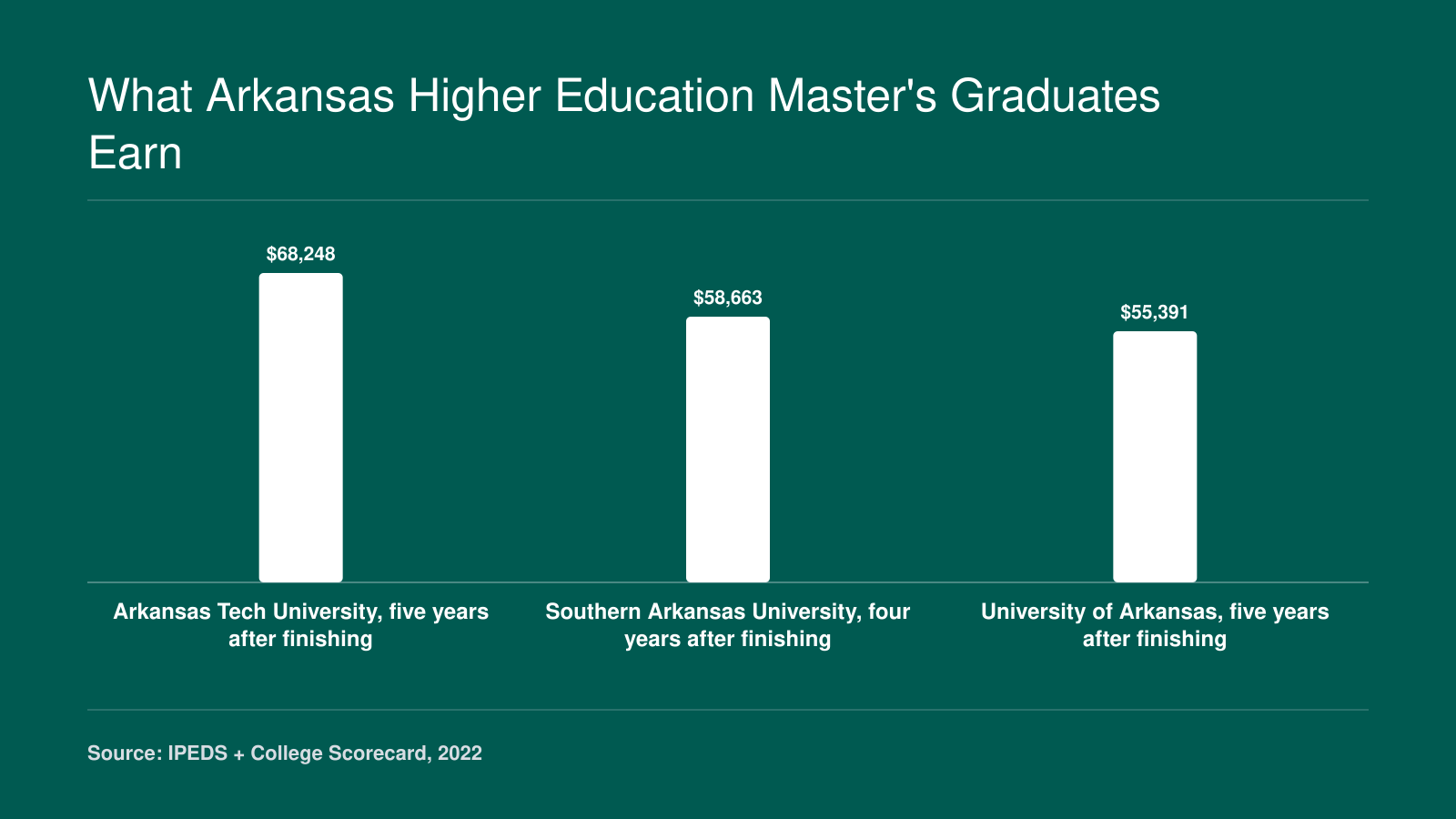
What Arkansas Higher Education Master's Graduates Earn
Median program-level earnings are reported at different points after finishing. Graduates of these programs often move into roles such as academic advisor, admissions counselor, residence life coordinator, and registrar staff.
Master's in Higher Education Cost and Arkansas Certification Requirements
The main credential in student affairs is in transition: NASPA has reported that the current Student Affairs Educator Certification model sunsets in July 2026 while alternatives are considered, with existing credentials honored and extended two years past their original expiration and no recertification required at the end.
What the degrees cost
Published graduate tuition for these programs runs from lowest to highest as follows: Southern Arkansas University at $7,380 in-state, Arkansas Tech at $7,670, and the University of Arkansas at $12,470. Southern Arkansas is the most affordable in-state option, though Arkansas Tech charges the same $7,670 to residents and nonresidents, making it the cheaper choice from out of state. Out-of-state rates elsewhere are $10,656 at Southern Arkansas and $30,892 in Fayetteville.
Average net price after aid is $12,970 at Arkansas Tech, $14,027 at Southern Arkansas, and $18,209 at the University of Arkansas. Treat those as institution-wide averages across all students, not a quote for this particular master's.
Licensure and optional credentials
Arkansas does not require a state license to work as a postsecondary administrator, academic adviser, or student affairs professional.1 That differs sharply from K-12 leadership, where the state's Building-Level Administrator license covers P-12 principal and assistant principal roles and requires a master's degree, a state-approved Educational Leadership Program in Arkansas, and a formal application.12
What hiring managers notice instead is involvement in NASPA, ACPA, or NACADA, work aligned to the ACPA/NASPA professional competencies maintained by the NASPA Professional Standards Division, and the advising or athletic advising certificates Arkansas Tech offers alongside the degree.
Shortlist two programs, email each about graduate assistantships, and confirm the current per-credit rate before you apply.
Quick Answers About Arkansas Higher Education Master's Programs
Short, practical answers to the questions prospective Arkansas higher education students ask most, from return on investment to funding and transfer credit.
Is a master's in higher education worth it in Arkansas?
Can a graduate assistantship cover a higher education master's in Arkansas?
Do Arkansas higher education master's programs accept transfer credit?
Compare Higher Education programs on the data that matters
Explore more Education & Teaching specializations or browse every graduate field.
All Education & Teaching programs