Best Master's in Higher Education Programs in Missouri
Compare 4 accredited Higher Education programs in Missouri at 3 schools, with graduate earnings, cost, debt, and completion data from IPEDS and the U.S. College Scorecard.

Which Missouri master's in higher education actually leads to a job in admissions, advising, or student affairs? The field is narrow. Only a few universities in the state offer a dedicated degree, and they differ sharply in format: an online M.Ed. at the flagship, an accelerated master's in higher education pathway in St. Louis, and a fully online option at Missouri Baptist University.
Most graduates head into student affairs, enrollment, advising, or academic administration, roles that rarely require a license but often expect a graduate credential for advancement. With so few choices, the real tradeoff is cost and schedule, not brand.
Key Points
- Missouri Baptist University's online 30-credit program lists tuition at $648 per credit, about $19,440 before fees.
- Missouri sets no state license for college administrators; the DESE routes cover K-12 school leaders only.
- Check each admissions page for GRE rules in 2027, since several programs lean on transcripts and essays instead.
Missouri's Top Master's in Higher Education Programs for 2027
Each program here earns its place by pairing what students pay with how the school's graduates fare. Missouri offers a short list of verified options: one flagship campus program, one accelerated pathway, and one fully online degree. All three sit at institutions regionally accredited by the Higher Learning Commission, and we note below where program-level recognition goes beyond that.
University of Missouri
#1Columbia, MO · ~$14,000/yr (est.)
Best for: Aspiring student affairs professionals studying on campus
The University of Missouri in Columbia is Missouri's flagship campus, and its Master of Education in Higher Education is a campus-based program built around ACPA and NASPA professional competencies. The university graduates about 75% of its students, and it holds Higher Learning Commission accreditation. Mizzou also publishes alignment with CAS Professional Standards, though no separate programmatic accreditation for this degree is verified. It fits students aiming at student affairs, advising, or enrollment management who want assistantship options and faculty mentoring.
- 33 total credit hours with a required capstone
- Capstone includes an oral group defense
- 3.0 GPA minimum and three recommendation letters
- No entrance exam required
- Up to 12 transfer credit hours accepted
- Research assistantships available
- Curriculum guided by ACPA and NASPA competencies
- Focus on organizational analysis and student development theory
- Rolling admissions with fall and spring starts
- Assistantships available on campus
- Competitive scholarships offered
- GRE scores not required
University of Missouri-St Louis
#2Saint Louis, MO · $15,000 – $20,000/yr (est.)
Best for: Education undergraduates continuing straight into graduate study
The University of Missouri-St. Louis offers an accelerated Master of Education in Higher Education that runs as a five-year bachelor's-to-master's pathway for Bachelor of Educational Studies students. The university graduates about 57% of its students and is accredited by the Higher Learning Commission, which covers its bachelor's, master's, and doctoral levels. No program-level accreditation or CAS alignment is published for this degree. It suits current UMSL education undergraduates who want to move straight into graduate study at a reduced total credit load.
- Five-year pathway cuts combined credits from 150 to 138
- 30 graduate credit hours
- Two internship courses count toward the graduate degree
- Internship courses billed at undergraduate tuition rates
- 3.0 GPA minimum for provisional admission
- Apply before starting the internship courses
Missouri Baptist University
#3Saint Louis, MO · $10,000 – $15,000/yr (est.)
Best for: Working professionals needing online flexibility
Missouri Baptist University in St. Louis delivers its M.S. in Higher Education Leadership fully online, with cohort-based classes taught by practitioners in the field. The university graduates about 48% of its students, the lowest rate of the three schools here, so it is worth weighing against the program's flexibility. It fits working professionals, including those without a related undergraduate major, who want a defined 18-month path into admissions, financial aid, or student life roles.
- Fully online option available
- 30 credit hours completed in about 18 months
- $648 per credit hour
- New classes start every eight weeks
- Cohort-based, discussion-driven coursework with case studies
- No specific undergraduate major required
- Covers enrollment management, finance, and campus crisis management
Cost & outcomes by school
Federal data for the highest-earning Higher Education programs, independent of the ranking above. Earnings are this field's master's graduates four years after completing, where the Scorecard reports them.
| School | Earnings | Tuition / yr | Debt | Grads/yr | Format |
|---|---|---|---|---|---|
| University of Missouri-St Louis MO | $71,651 | $15,480 | $41,000 | 16 | Campus |
| University of Missouri MO | $62,405 | $13,681 | $27,367 | 30 | Campus |
| Missouri Baptist University MO | $58,508 | $11,538 | $34,762 | 27 | Online |
Sources: U.S. Department of Education. Tuition and graduates: IPEDS. Earnings and debt: College Scorecard, this field's master's graduates; a dash means no figure is reported.
Cost, debt & payoff
Median earnings of this field's master's graduates (4 yrs after completing) vs. their median federal loan debt · U.S. College Scorecard
Across these programs the median graduate earns about $62,405 and finishes with roughly $31,065 in debt — a ratio that clears a common rule of thumb (keep debt below first-year salary). Tuition and debt vary widely school to school, so check the per-school figures in the table above before you shortlist.
Online and Hybrid Master's in Higher Education Options in Missouri
Missouri Baptist University's M.S. in Higher Education Leadership is delivered online. It is a 30-credit, cohort-based program with new classes every 8 weeks, listed at $648 per credit (roughly $19,440 before fees). The University of Missouri's Higher Education M.Ed. is offered online, and the University of Missouri-St. Louis accelerated M.Ed. is a campus program.
Residency, Live Sessions, and Tuition
Mizzou does run fully online graduate degrees through Missouri Online1, and online graduate students pay online tuition regardless of residency. Rates vary by program, though. Its online Learning Technologies M.Ed. is estimated at $607.60 per credit for 2026-27, while another online master's costs far more. Don't assume a single Mizzou online rate; compare Most Affordable Master's in Higher Education Programs for broader cost context. UMSL's Higher Education M.Ed. is on-campus, so online formats and tuition do not apply.
Published pages generally don't say whether a given program requires live class meetings, a campus visit, or in-person internship hours. "Online" describes delivery, not schedule. Ask each admissions office before you apply, and ask about extra fees if you take any on-campus courses.
Who Online Fits Best
The online route, one of the Best Online Master's in Higher Education Programs, suits working professionals already employed at a college, such as in admissions, advising, or student affairs, who can complete practicum hours in their current role.
Working at a college while you study online can double as your practicum, giving you hands-on experience and a professional network before you ever graduate.
Which Missouri Higher Education Master's Programs Waive the GRE?
Standardized testing has quietly disappeared from most higher education graduate admissions, as Master's in Higher Education Programs With No GRE Required lean on transcripts, essays, and professional experience instead of exam scores. Here is where the ranked Missouri programs stand, drawn from their official admissions pages.
University of Missouri (MEd, Higher Education emphasis)
- GRE policy: Scores are not required.
- Minimum GPA: 3.0 over the last 60 hours of undergraduate coursework on a 4.0 scale.
- Fall deadlines: Priority January 15, second priority May 15, final August 1.
- Spring deadlines: Priority September 15, final December 1.
The January 15 priority date matters most if you want assistantship consideration. Graduate assistantships, which often carry tuition remission and a stipend, are awarded early, so applying by the first priority window gives you the strongest odds before funding is committed.
University of Missouri (MA, Higher Education emphasis)
The University of Missouri's separate MA emphasis in educational leadership and policy analysis is no longer admitting students, and its archived page does not state a current GRE requirement, GPA minimum, or application deadlines. If you are weighing St. Louis options, confirm availability directly with the Graduate School before planning around it.
When a school among No-GRE master's programs publishes no GRE policy at all, treat that silence as a prompt to email admissions rather than an assumption either way.
Related Articles
Missouri Higher Education Master's Tuition Comparison
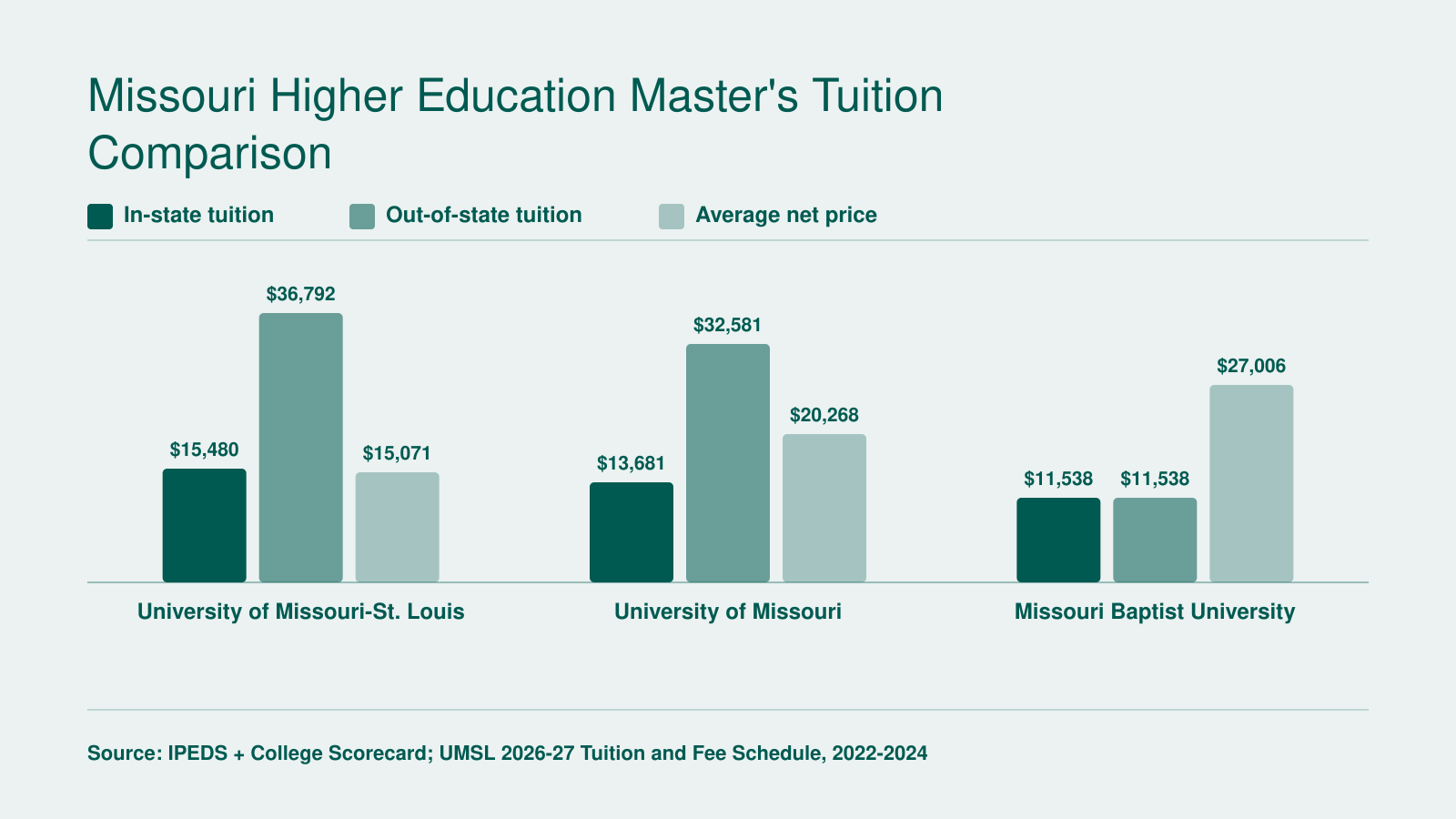
Missouri Baptist University charges the lowest sticker tuition in the federal figures, and it charges the same rate to residents and nonresidents. Among the public options, the University of Missouri is cheapest for residents and out-of-state students alike, while the University of Missouri-St. Louis has the lowest average net price. For a full-program estimate, UMSL's 2026-27 rate is $751 per credit for residents and $1,712 for nonresidents over 30 credits (about $22,530 and $51,360 before fees of roughly $650-$900 per semester). Missouri Baptist lists $648 per credit over 30 credits. Mizzou's program is 33 credits, but a current per-credit rate was not confirmed. Net price is an institution-wide average after aid, not a program quote.
Is There a Missouri License for Higher Education Administrators?
Jobs, Earnings, and ROI After a Higher Education Master's in Missouri
A higher education master's in Missouri pays for itself fastest when the degree's earnings comfortably clear its debt load, and all three programs here clear that bar.
What Graduates Earn Against What They Borrow
Five years out, graduates of Missouri Baptist University's online M.S. in Higher Education Leadership report median earnings near $70,300, the highest of the group, against median graduate debt of roughly $34,800. The University of Missouri-St. Louis Higher Education MEd shows median earnings around $63,400 with about $20,000 in median debt, a particularly clean ratio. The University of Missouri's Higher Education MEd lands close behind at roughly $63,000 earned against $20,500 borrowed. In every case, annual earnings exceed total borrowing, which is a healthier ROI read than most graduate fields deliver.
Career Support and Placement
UMSL ties its MEd to real campus roles: academic and career advising, student services administration, and K-12 college and career coaching, with professional counselors helping on résumés, internships, and job connections. Alumni keep full Career Services access for two years, plus Handshake. Mizzou's support is university-wide (coaching, employer recruiting, experiential placements), though its 95.4% six-month outcomes rate covers all 2025 graduates, not this program specifically.1
The Practical Takeaway
For career-switchers, UMSL offers the strongest value, pairing low debt with embedded internships. Current campus employees may prefer Mizzou's assistantships and flexible rolling admissions.
Quick Answers on Missouri Higher Education Master's Programs
These short answers cover the questions prospective students ask most about funding, fit, and careers in Missouri. They draw on the program pages and graduate school policies at the University of Missouri and the University of Missouri-St. Louis.
Which Missouri master's program is the strongest fit for higher education administration?
Can a graduate assistantship cover tuition in a Missouri higher education master's?
What jobs can a master's in higher education lead to in Missouri?
Compare Higher Education programs on the data that matters
Explore more Education & Teaching specializations or browse every graduate field.
All Education & Teaching programs