Accelerated Master's in Healthcare Management Programs
Compare 670+ accredited fastest Healthcare Management programs at 590+ schools, with graduate earnings, cost, debt, and completion data from IPEDS and the U.S. College Scorecard.

An accelerated master's in healthcare management compresses the usual two-year MHA into about 12 to 18 months, either as a standalone one-year degree, often online, or as a 4+1 or 3+1 pathway where undergraduates count graduate credits toward both degrees. Fordham's CAHME-accredited program, for example, runs one year and 31 credits.
The tradeoff is intensity against cost: less tuition and an earlier return to paid work, but a near full-time course load.
Accreditation also varies, so speed alone says little about quality.
Key Points
- Boston College, Clarkson, Salve Regina, and Endicott offer fully online accelerated MHAs.
- Reported median debt ranges from $25,500 at SIUE to $98,447 at Cornell.
- Shared-credit 4+1 and 3+1 tracks shorten the MHA across campuses.
Best Accelerated Healthcare Management Schools in 2027
The programs below emphasize the fastest routes to a healthcare management master's, from true one-year formats to accelerated bachelor's-to-master's pathways. We looked for credit-efficient structures, flexible delivery, and clear signals that a program can move working students into healthcare leadership roles without a traditional two-year wait.
Fordham University
#1Bronx, NY · ~$27,000/yr (est.)
Best for: Working healthcare professionals in New York
Fordham's MS in Health Administration is built around a one-year accelerated format: 31 credits across 14 courses, with weekend classes at the Lincoln Center campus so students can keep working full time. The cohort model and yearlong case study give the degree a practice-heavy, mentorship-driven feel. Graduates have been hired by Memorial Sloan Kettering, Northwell Health, and NYU Langone Health.
- One-year accelerated style program
- 31 total credits and 14 courses
- Weekend classes at Lincoln Center campus
- Cohort-based with yearlong case study and capstone
- Complimentary ACHE membership
Dartmouth College
#2Hanover, NH · $65,000 – $70,000/yr (est.)
Best for: Future physicians seeking leadership exposure
Dartmouth's MHA blends the Tuck School of Business and Geisel School of Medicine through a hybrid program that offers 12-month and 24-month tracks. The accelerated one-year option is especially useful for future physicians who want healthcare leadership exposure before medical school or residency, while full CAHME accreditation and dual-school faculty strengthen the credential. Students can choose a standard two-year pace if they need more room for clinical or professional obligations.
- 12-month or 24-month completion options
- Hybrid delivery with online and on-campus sessions
- Faculty from Tuck School of Business and Geisel School of Medicine
- Designed for early- to mid-career professionals
- Full CAHME accreditation as of 2026
- Accelerated track supports future physicians
Dominican University of California
#3San Rafael, CA · ~$21,000/yr (est.)
Best for: Experienced professionals preferring hybrid weekend format
Dominican University of California's Healthcare Executive MBA compresses a healthcare management credential into one year and 36 units. The hybrid format meets on campus every other weekend with bi-weekly Zoom sessions, and no GMAT or GRE is required. Rolling admissions and merit-based scholarships make it a practical route for working professionals in the San Francisco Bay Area.
- One-year, 36 unit program
- Hybrid: on-campus every other weekend and bi-weekly Zoom
- No GMAT or GRE required
- Rolling admissions, fall and spring deadlines
- Merit-based scholarships and financial aid available
Clarkson University
#4Potsdam, NY · ~$37,000/yr (est.)
Clarkson's MS in Clinical Leadership in Healthcare Management is a fully online, asynchronous program that can be finished in one year full time or two to three years part time. The 12-course curriculum covers healthcare finance, health law, data analytics, and organizational strategy, with a capstone on strategic issues for health organizations. Small class sizes and automatic admission at a 3.25 GPA can speed up the application process.
- One year full time, two to three years part time
- 12 courses, fully online asynchronous
- No entrance exam required, test optional
- Capstone in strategic issues for health organizations
- Automatic admission available at 3.25 GPA
- Small class sizes with personalized instruction
Boston College
#5Chestnut Hill, MA · ~$38,000/yr (est.)
Boston College's MHA is an asynchronous online degree with accelerated seven-week courses and options for full- or part-time study. Eligible students in the university's public health program can apply up to 12 to 14 graduate credits toward the MHA, reducing completion time to about one year for that pathway. The curriculum covers health systems, policy, leadership, finance, and analytics.
- 12 courses, 43 to 45 total credits
- Asynchronous 7-week online courses
- No GRE or GMAT required
- Accelerated pathway can reduce completion to one year
- Minimum 3.0 GPA required
- Rolling admissions, fall spring summer starts
University of North Florida
#6Jacksonville, FL · $10,000 – $15,000/yr (est.)
UNF's CAHME-accredited MHA is a 45-credit program with evening classes and both full-time and part-time tracks. Its BHA-MHA accelerated pathway allows qualified undergraduates to move quickly into graduate study, and students earn Lean certification and train in Human Centered Design. Jacksonville ties to Mayo Clinic and Baptist Health support internships and job placement.
- 45 total credit hours
- CAHME accredited
- Full-time and part-time options
- Evening classes
- BHA-MHA accelerated pathway
- Lean Competency System certification
- Human Centered Design training
University of Missouri
#7Columbia, MO · ~$14,000/yr (est.)
Missouri's residential MHA is a 54-credit, CAHME-accredited program that usually takes two years, so it is not a one-year master's. The clearest acceleration is the BHS to MHA five-year pathway for undergraduate health sciences students. A paid 12-week administrative internship and dual-degree options with MBA, JD, MPA, or MS add depth for students who can commit to a longer timeline.
- 54 total credit hours over two years
- CAHME accredited since 1968
- 12-week administrative internship with stipend
- Accelerated BHS to MHA five-year pathway
- Dual degrees: MBA, JD, MPA, MS
Cornell University
#8Ithaca, NY · ~$30,000/yr (est.)
Cornell's Sloan MHA is a CAHME-accredited, 64-credit residential program that runs two years for the standalone degree. The accelerated route is a five-year BS/MHA option for Cornell undergraduates. With a required 10-week summer internship, yearlong capstone, and trips to Washington, D.C., it is a strong traditional program rather than a fast one-year path.
- CAHME accredited
- 64 total credit hours
- Two-year full-time program
- Accelerated five-year BS/MHA option
- Required 10-week summer internship
- Yearlong capstone with real-world clients
- Off-campus trips to Washington, D.C.
Salve Regina University
#9Newport, RI · ~$13,000/yr (est.)
Salve Regina's online MS in Healthcare Administration is a flexible 36-credit program usually completed in 18 to 24 months. Qualified undergraduates can begin graduate coursework in their senior year, creating an accelerated pathway into the master's. The program is IACBE accredited and offers live virtual sessions plus asynchronous work for working professionals.
- 36 credits, 12 fully online courses
- 18 to 24 month completion
- Rolling admissions, fall spring summer starts
- Accelerated option for undergraduates
- IACBE accredited
- Live virtual and asynchronous learning
- Cybersecurity concentration option
- Four-course stackable certificates
- Focus on healthcare leadership
- Same 36-credit online format
Endicott College
#10Beverly, MA · $15,000 – $20,000/yr (est.)
Endicott's MS in Healthcare Management is a 36-credit fully online program built around accelerated six-week courses and part-time enrollment, with completion in as little as 18 months. Students choose from four concentrations: Health Informatics, Operations Management, Public Administration, and Information Technology Management. The program emphasizes data-driven decision-making and quality improvement across healthcare settings.
- 36 total credits, 100% online
- Accelerated six-week courses
- Complete in as little as 18 months
- Concentrations: Health Informatics, Operations Management, Public Administration, IT Management
- 24 core credits, 12 concentration credits
Cost & outcomes by school
Federal data for the highest-earning Healthcare Management programs, independent of the ranking above. Earnings are this field's master's graduates four years after completing, where the Scorecard reports them.
| School | Earnings | Tuition / yr | Debt | Grads/yr | Format |
|---|---|---|---|---|---|
| University of California-San Francisco CA | $192,159 | $14,738 | $53,300 | 26 | Hybrid |
| Albright College PA | — | $1,540 | — | — | Online |
| Albany State University GA | — | $5,008 | — | — | Online or campus |
| Hartwick College NY | — | $5,400 | — | — | Hybrid |
| Northwestern Oklahoma State University OK | — | $5,320 | — | — | Online |
| Northwestern College IA | — | $6,790 | — | — | Online |
| University of West Alabama AL | — | $6,868 | — | — | Online |
| Longwood University VA | — | $7,758 | — | — | Online |
| New Mexico Highlands University NM | — | $8,016 | — | — | Online |
| Delta State University MS | — | $8,605 | — | — | Hybrid |
| The University of Texas Rio Grande Valley TX | — | $8,589 | — | — | Online |
| Westminster College PA | — | $9,000 | — | — | Campus |
Sources: U.S. Department of Education. Tuition and graduates: IPEDS. Earnings and debt: College Scorecard, this field's master's graduates; a dash means no figure is reported.
Cost, debt & payoff
Median earnings of this field's master's graduates (4 yrs after completing) vs. their median federal loan debt · U.S. College Scorecard
Across these programs the median graduate earns about $89,928 and finishes with roughly $41,000 in debt — a ratio that clears a common rule of thumb (keep debt below first-year salary). Tuition and debt vary widely school to school, so check the per-school figures in the table above before you shortlist.
Lowest-Cost Accelerated MHA Options: Tuition vs. Net Price
This table compares published in-state and out-of-state tuition, average net price after aid, and where available per-credit tuition and required credits for the most affordable accelerated healthcare management options in the current data. Average net price is an institution-wide figure after aid, not a quote for every admitted student. In a 4+1 pathway, graduate credits taken as an undergraduate may be billed at the undergraduate rate, and finishing a year sooner can reduce living costs and time out of the workforce.
| School | In-State Tuition | Out-of-State Tuition | Average Net Price After Aid | Per-Credit Tuition | Total Credits |
|---|---|---|---|---|---|
| California State University-Los Angeles | $8,688 | $18,768 | $3,967 | N/A | 36 |
| University of North Florida | $10,364 | $21,930 | $10,154 | N/A | 45 |
| Indiana University-Indianapolis | $11,180 | $28,964 | $11,668 | $593.50 (in-state), $1,440 (out-of-state in-person), $639.54 (out-of-state online) | 42 |
How Accelerated Pathways Work: 4+1, 3+1, and Dual-Credit Options
Shared-credit pathways have become one of the main ways colleges shorten accelerated healthcare management master's programs, but each campus sets its own rules. There is no national standard.
Combined Tracks for Current Undergrads
In a 4+1 or similar combined track, you take graduate courses while still an undergraduate and count them toward both degrees. How many credits count varies widely by school:
- University of Wisconsin-Milwaukee: 6 graduate credits earned as an undergraduate can count toward the MHA, within a 24-credit overall sharing limit.1
- Samford University: Up to 18 credits can be shared between the BS and the MHA.
- Loyola University Chicago: Sharing is capped at half of the required graduate credits.2
- Rasmussen University: Up to four courses can be substituted, saving as much as $4,760, for students with a 3.0 program GPA.3
The catch is eligibility. These tracks are built for each school's own students. Loyola, for example, expects applicants to apply during their junior year.4 If you finished your bachelor's somewhere else, don't count on getting into one.
Standalone Accelerated MHAs
Outside applicants should look instead at standalone programs designed for working professionals. Bellevue University's accelerated Online Master's in Healthcare Management runs 36 credits. It requires a bachelor's degree and at least 20 hours a week of healthcare employment. Expect transfer credit to help only a little: Texas State University's 40-credit Executive MHA caps transfer and prior-learning credit combined at 6 credits.5
Related Articles
Online, Hybrid, and Campus Accelerated MHA Formats
The MHA programs ranked here split across all three formats. Boston College, Clarkson, Salve Regina, and Endicott are fully online. Cornell, Fordham, UNF, and Missouri are campus-based. Dartmouth and Dominican are hybrid.
Start Dates and Course Length
Start frequency varies widely. Western Governors University enrolls monthly6, while George Washington admits cohorts only in January and September.1 MUSC offers three starts a year,2 and UCLA offers four.3 Accelerated online MHA programs often run 7 to 8 weeks: MUSC uses 7-week courses2 and IU Indianapolis uses 8-week sessions.4 Endicott runs six-week courses, and Dartmouth uses 3 to 6 weeks.5
Live Sessions and Residencies
Check the fine print if you work full time. Dartmouth requires on-campus residencies and two live sessions a week.5 UCLA asks for a weekly one-hour live session plus two 3-day Los Angeles immersions.3 George Washington includes two on-campus immersions in D.C.1 Loyola Chicago requires an on-site immersion.7 MUSC and IU Indianapolis are asynchronous with no required residency.24
Match format to your schedule. Asynchronous online suits full-time workers. Campus and hybrid cohorts offer stronger networking and easier access to residency placements.
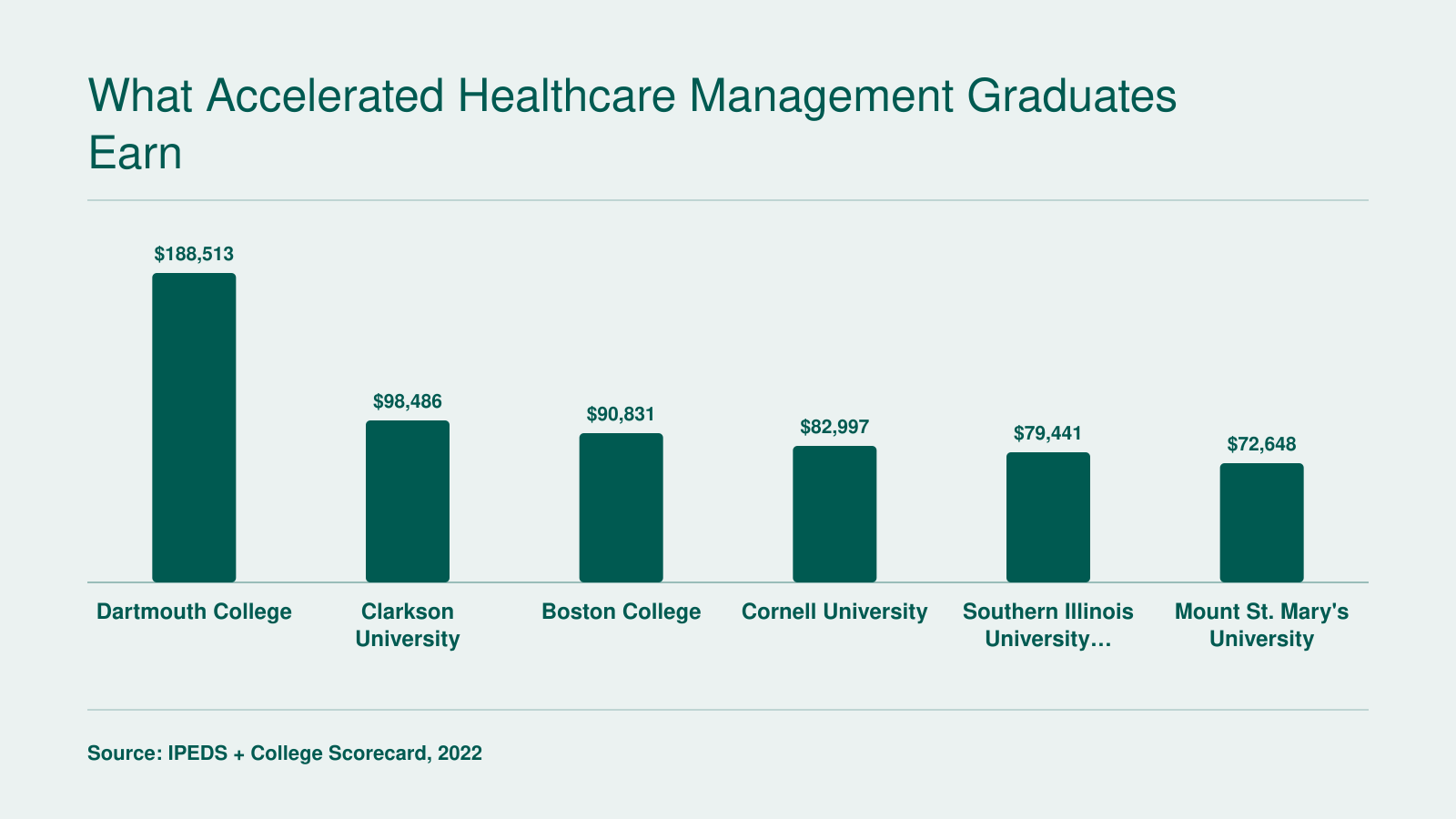
What Accelerated Healthcare Management Graduates Earn
Median earnings one year after completion vary widely across the programs shown below. Among schools with published debt figures, Cornell reports median program debt near $98,447 with an estimated $1,120 monthly payment, while SIUE reports about $25,500 with a $290 monthly payment. This frames each program's short-term earnings against what graduates owe.
Admission Requirements and Application Deadlines
Accelerated MHAs expect a bachelor's degree, a solid GPA, and either test scores or work experience, but specific requirements vary by program.
- Bachelor's degreeYou'll need a bachelor's degree from a regionally accredited school. For 4+1 tracks, current undergraduates may apply if their school has an approved pathway, such as Boston College's 12-credit accelerated option.
- Minimum GPASeveral schools here set a 3.0 minimum, including Boston College, Loma Linda, and UW. Others accept lower thresholds, such as Eastern Mennonite (2.50) and Wayne State or Texas State (2.75), while UNT Health Fort Worth uses 3.0 for automatic admission.
- GRE/GMAT policyMany accelerated MHAs are test-optional. Boston College, Indiana O'Neill, UW, Wayne State, Texas State, and UNT Health Fort Worth require no exam. Loma Linda lists GMAT, GRE, or MCAT but offers waivers for qualifying applicants; Idaho State uses GMAT or GRE.
- Prerequisites and experiencePublished prerequisite courses are limited, but healthcare work experience varies. Eastern Mennonite asks for one year, and Aga Khan prefers one year; Indiana O'Neill requires none.
- Application windowsFor fall entry, deadlines range from February to August. Texas State's priority date is February 1 with a standard August 1 date extended to August 15, 2026. Loma Linda's deadline is August 1 for domestic students and July 1 for international students, while Boston College's is August 15. Eastern Mennonite reviews applications anytime with a June 30 cutoff.
Healthcare Management programs by state
Accelerated MHA FAQs
What is the fastest accelerated MHA program?
Can I work full time while completing an accelerated MHA online?
Does CAHME accreditation matter for an accelerated MHA?
Is an accelerated MHA respected as much as a traditional two-year MHA?
Compare Healthcare Management programs on the data that matters
Explore more Business & Management specializations or browse every graduate field.
All Business & Management programs