Best Master's in Healthcare Management Programs in South Carolina
Compare 10 accredited Healthcare Management programs in South Carolina, with graduate earnings, cost, debt, and completion data from IPEDS and the U.S. College Scorecard.
A master's in healthcare management, usually an MHA, trains graduates to run hospitals, clinics, and health systems. The real decision in South Carolina is which affordable healthcare management master's school fits your budget, schedule, and career goals. Only a small number of programs made our ranked list, so each gets a close look. Listed in-state graduate tuition runs from $14,134 to $17,574.
Format matters nearly as much as price, since delivery ranges from weekend campus courses to hybrid and fully online. CAHME accreditation is the credential many hospital employers and administrative fellowships look for first.
Key Points
- CAHME-accredited options are MUSC and USC; Columbia College adds an online path.
- For 2027, MUSC's online MHA requires no GRE or GMAT.
- USC's in-state graduate tuition is $14,134; out-of-state tuition is $30,160.
Best Master's in Healthcare Management Programs in South Carolina, Ranked
South Carolina's healthcare management master's landscape is anchored by two CAHME-accredited programs, at the University of South Carolina and the Medical University of South Carolina, plus a flexible online alternative at Columbia College. The rankings below emphasize accreditation, delivery format, and career-relevant structure over name recognition. Each card highlights what makes the program a distinct choice for prospective healthcare leaders.
University of South Carolina
#1Columbia, SC · ~$14,000/yr (est.)
Best for: Columbia-based professionals needing weekend executive classes
The University of South Carolina's Master of Health Administration is CAHME-accredited, with initial accreditation dating to 1991, and also carries CEPH accreditation. The full-time Columbia campus program offers a traditional track with graduate assistantships and a weekend executive track for professionals with at least three years of healthcare experience. That dual accreditation and executive flexibility make USC a strong resident option for advancing within South Carolina's larger health systems.
- Full-time campus program in Columbia
- Traditional track with graduate assistantships
- Executive track for working professionals, weekend classes
- CAHME-accredited since 1991 and CEPH-accredited
- Executive track requires three years healthcare experience
- Courses cover policy, management, accounting, law, and ethics
Medical University of South Carolina
#2Charleston, SC · ~$18,000/yr (est.)
Best for: Charleston clinicians balancing work with Monday hybrid
The Medical University of South Carolina's Master in Health Administration is CAHME-accredited and tied for No. 19 in U.S. News's 2026 health care management rankings. The hybrid structure combines Monday in-person classes with online coursework in 7-week terms, and an accelerated plan can be completed in five semesters. MUSC also publishes a $34,545 total tuition with no GRE or GMAT requirement, which keeps costs predictable for both in-state and out-of-state students.
- Hybrid format with Monday classes and online coursework
- 49 credits over eight semesters; accelerated five-semester path
- 6-credit practicum and capstone; practicum waiver lowers to 43 credits
- No GRE or GMAT required
- $705 per credit; $34,545 total program tuition
- Three start dates per year with rolling admissions
- Fully online option available
Columbia College
#3Columbia, SC · ~$16,000/yr (est.)
Best for: Online learners wanting asynchronous statewide option
Columbia College's Master of Arts in Healthcare Administration is a fully online, 36-credit program designed for working adults with at least two years of relevant experience. It can be finished in about 12 months across six start dates and 7-week courses, but it is not currently CAHME-accredited. The program aligns with CAHME standards and offers strong asynchronous flexibility, making it a fit for schedule-constrained students who do not require that specific accreditation.
- Fully online asynchronous program, no campus visits
- 36 credit hours, completable in about 12 months
- Six start dates per year with 7-week courses
- Requires at least two years relevant professional experience
- Transfer up to 9 credit hours
- Curriculum aligns with CAHME standards
Cost & outcomes by school
Federal data for the highest-earning Healthcare Management programs, independent of the ranking above. Earnings are this field's master's graduates four years after completing, where the Scorecard reports them.
| School | Earnings | Tuition / yr | Debt | Grads/yr | Format |
|---|---|---|---|---|---|
| University of South Carolina SC | $105,165 | $14,134 | $44,964 | 14 | Campus |
| Medical University of South Carolina SC | $88,321 | $17,574 | $70,167 | 43 | Hybrid |
| South University-Columbia SC | $65,167 | $16,611 | $41,000 | 5 | Hybrid |
| Strayer University-South Carolina SC | $58,850 | $15,135 | $81,207 | 11 | Online |
| South Carolina State University SC | — | $11,460 | — | — | Online |
| University of South Carolina Aiken SC | — | $14,096 | — | — | Online |
| Benedict College SC | — | $14,402 | — | — | Hybrid |
| Winthrop University SC | — | $16,306 | — | — | Campus |
| Anderson University SC | — | $13,759 | — | — | Online or campus |
| Columbia College SC | — | $15,630 | — | 4 | Online |
Sources: U.S. Department of Education. Tuition and graduates: IPEDS. Earnings and debt: College Scorecard, this field's master's graduates; a dash means no figure is reported.
Cost, debt & payoff
Median earnings of this field's master's graduates (4 yrs after completing) vs. their median federal loan debt · U.S. College Scorecard
Across these programs the median graduate earns about $76,744 and finishes with roughly $57,566 in debt — a ratio that clears a common rule of thumb (keep debt below first-year salary). Tuition and debt vary widely school to school, so check the per-school figures in the table above before you shortlist.
How We Ranked These Healthcare Management Master's Programs
Federal data tells you more about a master's in healthcare management than a prestige ranking does. The programs below are ordered using figures from IPEDS and the College Scorecard: graduate tuition, net price, graduation rate, program-level earnings, and debt. We did not use reputation surveys, because a survey score can't tell you what you will pay or what you will earn afterward.
These sources have limits, and you should know them before relying on the order.
- Graduation rate and net price: Both are institution-wide averages. They describe the whole university, not the healthcare management cohort specifically, so treat them as a rough guide to the school's overall affordability and completion record.
- Earnings and debt: Program-level figures exist only where a program has enough graduates for the federal government to report them. Where a program has no published earnings, we say so and rely on the other measures instead of guessing.
Why it matters for your decision
A master's degree is a financial decision as much as an academic one. Federal figures get you closer to the real cost and payoff than a brand name does, and they let a lesser-known program stand on its results. Use them as a starting point, then confirm current tuition and outcomes directly with each master's program in South Carolina.
Online and Hybrid Healthcare Management Master's Options in South Carolina
Among MHA programs South Carolina, formats are shifting, with the Medical University of South Carolina (MUSC) consolidating its residential and executive tracks into a single 49-credit MHA offered online or hybrid. Check current details with the school, since older listings still describe separate tracks.
Online and hybrid
- Columbia College: Fully online and asynchronous, 36 credits, with no campus visits. Part-time study is available, a 12-month pace is advertised, accelerated master's in healthcare management, and terms start six times a year. Work experience is required, so it suits working clinicians and managers.
- MUSC: Hybrid, with synchronous online classes plus in-person Mondays in Charleston. It includes a 6-credit practicum, which can be waived for experienced students, reducing the total to 43 credits. Three start dates a year suit career changers who need a structured placement.
Campus-based
- USC Traditional: Full-time, in-person, 58 credits over three semesters, including a residency of at least 32 hours a week. This fits recent graduates seeking hands-on experience.
- USC Executive: 45 credits, with classes one weekend a month in Columbia over about 32 months. It is for working healthcare professionals, and it is not online.
Before enrolling in any online option, confirm whether on-campus intensives, residencies, or weekend visits are required, and which start terms are open.
CAHME lists 175 accredited healthcare management programs across the United States, Canada, and other countries, but only two are in South Carolina: Medical University of South Carolina and University of South Carolina. Accreditation matters because many residencies and employers look for it as a signal of program quality.
Which South Carolina Master's Programs Waive or Make the GRE Optional?
GRE and GMAT Policies
Admission to these programs begins with a bachelor's degree, but test rules vary. Medical University of South Carolina's online MHA is among the mha programs with no gre requirement and states no GRE or GMAT is required; it lists a 3.0 GPA in relevant coursework and notes that applicants below that level may still apply and are encouraged to add an optional essay and resume. University of South Carolina's Arnold School MHA does not require the GRE and allows optional GRE or GMAT submission, with a published 3.00 GPA threshold. USC's Executive MHA lists the GRE/GMAT as optional. Columbia College's online MA in Healthcare Administration does not publish a GRE/GMAT policy in available admissions materials, so students comparing master's in healthcare administration no GMAT or GRE programs will need to contact the program directly.
Other Application Details
MUSC lists deadlines of December 2, 2026 for Spring 2027 and July 28, 2027 for Fall 2027. USC's traditional MHA uses SOPHAS or HAMPCAS with an April 15 fall deadline, while the Executive track applies through the USC Graduate School by July 15. USC generally accepts transfer credit graded B or better and earned within six years, pending program and graduate school approval; Columbia College states it accepts up to 9 transfer credits. Columbia College requires work experience, but published materials do not specify a minimum number of years. Confirm current policies with admissions, since test-optional and waiver terms change often.
Related Articles
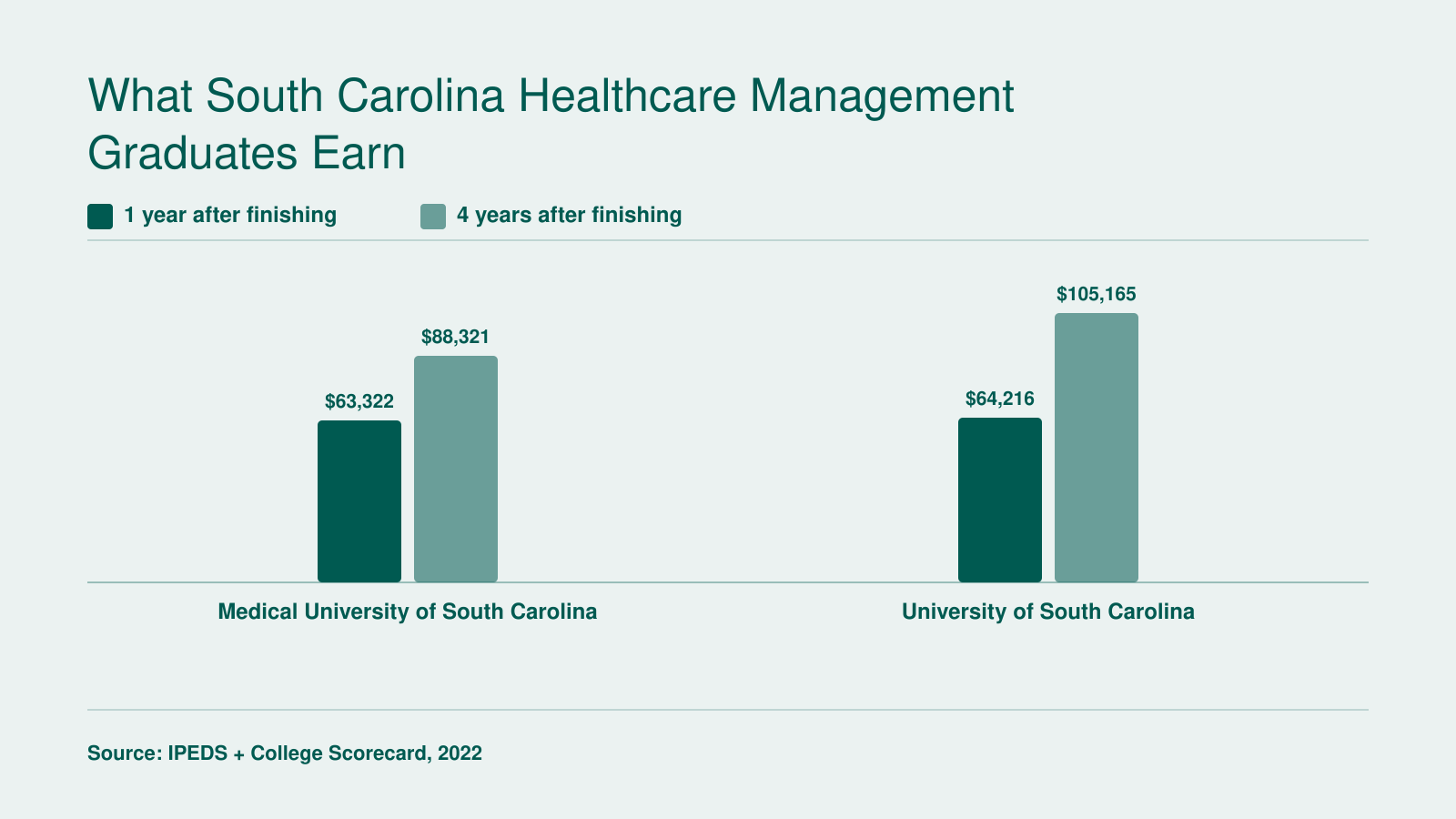
What South Carolina Healthcare Management Graduates Earn
Program-level earnings show the long-run payoff of a South Carolina healthcare management master's. Median pay one and four years after finishing is shown below, with median program debt of $15,000 at the Medical University of South Carolina and $21,500 at the University of South Carolina. Common roles include practice manager, health services manager, and department director.
What a Master's in Healthcare Management Costs in South Carolina, Plus Licensure and Certification
The cost of a South Carolina master's in healthcare management varies by program, and only some administrator roles require a license.
Tuition and Total Price
At the University of South Carolina, listed graduate tuition is $14,134 for in-state students and $30,160 for out-of-state students. Columbia College lists $15,630 regardless of residency for its 36-credit online Master of Arts in Healthcare Administration, one of the online healthcare management master's programs. Total cost depends on credits. Among MHA programs in South Carolina, USC's Traditional MHA requires 58 credits and its Executive MHA 45; published 2026, 27 professional-format MHA rates are $572.25 per credit for state residents and $597.25 for nonresidents, plus an $8,088 matriculation fee, so ask the program for a current total cost sheet.
Institution-wide net price after aid averages roughly $18,408 at Columbia College and $22,811 at USC. Treat those as rough guides, not graduate-specific bills.
Licensure for Administrators
Hospital and health system administrators need no state license. Nursing home administrators do, through the South Carolina Board of Long Term Health Care Administrators.1 The path:
- Education: A baccalaureate or higher, or enrollment in a course that awards one. NAB's state summary cites an associate degree, but the state regulation is more specific.21
- Training: A six-month administrator-in-training period for applicants with a healthcare administration or related degree.1
- Exams: NAB CORE plus the NHA Line of Service, and a Board-approved state exam with a raw 75% passing score. Register within 30 days of approval.3
- Fees: $200 application, $190 exam, $175 license and $175 renewal, plus $25 for the AIT application and $50 for the preceptor application.2
Voluntary Credentials
FACHE through ACHE is optional. It requires one year of ACHE membership, and recertification requires 36 healthcare-management continuing-education credits within three years.4 Confirm other eligibility conditions with ACHE. The program details reviewed list no dedicated long-term care administration track, so ask admissions how coursework and practicum fit the AIT.
Compare Healthcare Management programs on the data that matters
Explore more Business & Management specializations or browse every graduate field.
All Business & Management programs