Best Online Master's in Healthcare Management Programs
Compare 540+ accredited online Healthcare Management programs, with graduate earnings, cost, debt, and completion data from IPEDS and the U.S. College Scorecard.

An online master's in healthcare management trains you to run the business side of care delivery: budgets, compliance, staffing, and operations in hospitals, clinics, insurers, and public health agencies. Degrees carry different labels, from the Master of Health Administration to the MS in healthcare management, but selected programs run 30 to 54 credits over 12 to 24 months.
The problem is that dozens of fully online programs look nearly identical in their marketing, while few disclose what graduates actually earn or what the degree really costs after aid. The ranked programs here are 100% online, hybrid and in-person formats excluded, ordered by a mixed composite of cost, outcomes, and quality.
Institution-wide average net price across the top programs runs from roughly $9,300 to over $41,000, a spread wide enough to change the math on any given degree. CAHME accreditation, which signals a vetted curriculum, remains the exception rather than the rule among accredited online master's programs.
Key Points
- George Mason's 39-credit online MHA totals $36,270 before other costs.
- CAHME plus regional accreditation marks the strongest online MHA programs.
- Program-level earnings data show clear salary variation across ranked schools.
Best Fully Online Healthcare Management Master's Programs for 2027
These are the top fully online healthcare management master's programs for 2026. The list excludes hybrid and in-person requirements and is ordered by a composite of affordability, earnings, and program quality, not prestige. Each profile below highlights what makes the program distinct.
Purdue University
#1West Lafayette, IN · ~$10,000/yr (est.)
Best for: Early-career healthcare professionals seeking stackable credentials
Purdue's fully online Master of Health Administration is a 40-credit program that can be completed in about 24 months and does not require the GRE. Students can also earn stackable graduate certificates in healthcare leadership, operations, and quality improvement. Graduate tuition and fees run $9,992 for Indiana residents and $28,794 for non-residents, with an institution-wide average net price after aid of $14,600.
- 100% online delivery
- 40 credits required
- 24 months to completion
- No GRE required
- Capstone project included
- Focus on healthcare access
- Stackable graduate certificates available
University of Utah
#2Salt Lake City, UT · $9,000 – $28,000/yr (est.)
Best for: Mid-career managers balancing work and online study
The University of Utah's online Master of Healthcare Administration is designed for mid-career professionals and includes healthcare finance, operations, policy, and strategic management. The 42-credit program lists graduate tuition and fees at $9,620 in-state and $30,860 out-of-state, with an average net price of $16,200 after aid. Program-level earnings reports show a median of $73,715 one year after completion and $114,128 four years after completion.
- 42 credit hours required
- Fall semester start
- Full-time healthcare experience required
- Management experience required
- Healthcare finance and policy courses
- Capstone project required
- Online discussion and group work
Florida International University
#3Miami, FL · ~$11,000/yr (est.)
Best for: Learners wanting Lean Six Sigma certification
Florida International University's Master of Health Services Administration offers fully online and hybrid formats, with a Lean Six Sigma Green Belt certification built in. The program can be completed in 18 to 24 months. Graduate tuition and fees are $6,565 for Florida residents and $18,964 for non-residents, and the institution-wide average net price after aid is $9,288. Median earnings are $53,360 one year after completion and $67,431 four years out.
- 18-24 month program duration
- Online option available
- CAHME accredited
- Includes Lean Six Sigma certification
- Administrative residency placement
- Focus on health equity
- Focus on organizational transformation
- Bachelor's degree required
University of Rochester
#4Rochester, NY · ~$39,000/yr (est.)
The University of Rochester's Simon Business School offers an online MS in Medical Management through synchronous evening and Saturday classes. The 10-course program includes a health care practicum and does not require the GMAT or GRE. Graduate tuition and fees are $67,080, and the institution-wide average net price after aid is $29,278.
- 18-month program
- 10 total courses
- Synchronous online classes
- One night per week plus two Saturdays monthly
- Health Care Practicum included
- AACSB accredited
- No GMAT or GRE required
- 50% tuition scholarship for mission-driven roles
Texas Tech University Health Sciences Center
#5Lubbock, TX · ~$7,000/yr (est.)
Texas Tech University Health Sciences Center's online MS in Healthcare Administration is a 36-credit, accelerated program designed for working healthcare professionals. Program-level earnings report a median of $66,286 one year after completion, $86,358 four years after completion, and $89,550 five years after completion.
- 36 total credit hours
- 3 start dates per year
- Entirely online and distance-based
- Designed for working healthcare professionals
- Health informatics and data analytics courses
- Strategic planning and marketing focus
- No requirement to relocate
Western Governors University
#6Salt Lake City, UT · ~$9,000/yr (est.)
Western Governors University offers a fully online Master of Healthcare Administration with flat-rate term pricing and a self-paced format that can be completed in as little as 12 months. Graduate tuition and fees are $8,658, and the institution-wide average net price after aid is $12,548. Program-level earnings show a median of $98,667 one year after completion and $111,643 four years after completion.
- Online program delivery
- Finish in 12 months possible
- Bachelor's degree required
- Minimum 2.5 GPA needed
- 10 courses in program
- Flat-rate term tuition
- No set class times
- Self-paced learning
Ana G. Mendez University
#7Orlando, FL · ~$10,000/yr (est.)
Ana G. Mendez University's online Master of Health Administration includes a concentration in Health Services Management and Evaluation, with coursework in quality management, health economics, and biostatistics. The 42-credit program uses an evidence-based approach and ends with a capstone evaluation model. Graduate tuition and fees are $13,575, and the institution-wide average net price after aid is $19,775.
- 42 total credit hours
- 3.0 GPA minimum
- Prerequisite courses required
- Capstone required
- Final project develops evaluation model
- Prepares for healthcare middle management
- Evidence-based management focus
- Quality management in health services
Boston College
#8Chestnut Hill, MA · ~$38,000/yr (est.)
Boston College's online Master of Healthcare Administration is a 43-to-45-credit program delivered through asynchronous seven-week courses. The curriculum includes health systems, policy, finance, analytics, and a capstone with real-world clients. Graduate tuition and fees are $70,702, and the institution-wide average net price after aid is $41,704. Program-level earnings show a median of $90,831 one year after completion.
- Online program delivery
- Asynchronous course format
- 12 courses required
- 43-45 total credits
- 7-week course format
- Minimum 3.0 GPA requirement
- No GRE or GMAT required
- Real-world capstone project
St. Joseph's University-New York
#9Brooklyn, NY · ~$23,000/yr (est.)
St. Joseph's University-New York offers an online MS in Management with a Health Care Management concentration for working adults. The asynchronous program develops strategic thinking, quality improvement, and cost management skills. Graduate tuition and fees are $36,550, and the institution-wide average net price after aid is $19,035.
- Online Master of Science
- Health Care Management concentration
- Asynchronous class format
- Designed for working adults
- Focus on complex healthcare issues
- Strategic thinking skills
- Reduced tuition for prerequisites
- Prepares for management positions
Charter Oak State College
#10New Britain, CT · $10,000 – $15,000/yr (est.)
Charter Oak State College's online MS in Health Care Administration is a 30-credit program focused on strategic management, finance, quality improvement, and health law. Admission requires a bachelor's degree with a 3.0 GPA. Graduate tuition and fees are $8,506, and the institution-wide average net price after aid is $15,815.
- 30 credit program
- No elective credits
- Online delivery format
- Bachelor's degree required
- 3.0 GPA admissions requirement
- Professional resume required
- 500-700 word essay required
- B- minimum grade required
Cost & outcomes by school
Federal data for the highest-earning Healthcare Management programs, independent of the ranking above. Earnings are this field's master's graduates four years after completing, where the Scorecard reports them.
| School | Earnings | Tuition / yr | Debt | Grads/yr | Format |
|---|---|---|---|---|---|
| University of California-San Francisco CA | $192,159 | $14,738 | $53,300 | 26 | Hybrid |
| Western Governors University UT | $111,643 | $9,320 | $13,527 | 1,945 | Online |
| Albright College PA | — | $1,540 | — | — | Online |
| University of the Cumberlands KY | — | $3,195 | — | — | Online |
| Columbia Southern University AL | — | $3,936 | — | — | Online |
| Middle Georgia State University GA | — | $4,534 | — | — | Online or campus |
| Albany State University GA | — | $5,008 | — | — | Online or campus |
| Fort Hays State University KS | — | $4,949 | — | — | Online or campus |
| Hartwick College NY | — | $5,400 | — | — | Hybrid |
| Northwestern Oklahoma State University OK | — | $5,320 | — | — | Online |
| Northeastern State University OK | — | $5,771 | — | — | Online or campus |
| Adams State University CO | — | $5,898 | — | — | Online |
Sources: U.S. Department of Education. Tuition and graduates: IPEDS. Earnings and debt: College Scorecard, this field's master's graduates; a dash means no figure is reported.
Cost, debt & payoff
Median earnings of this field's master's graduates (4 yrs after completing) vs. their median federal loan debt · U.S. College Scorecard
Across these programs the median graduate earns about $89,928 and finishes with roughly $41,000 in debt — a ratio that clears a common rule of thumb (keep debt below first-year salary). Tuition and debt vary widely school to school, so check the per-school figures in the table above before you shortlist.
CAHME vs. Regional Accreditation: What Each Seal Means for an Online MHA
Regional accreditation decides whether you can use federal aid. CAHME accreditation tells you whether the healthcare management curriculum itself has been vetted. The best online MHA programs carry both.
Two Seals, Two Different Jobs
Institutional accreditation, still commonly called regional accreditation, evaluates the university as a whole: governance, finances, faculty, student services, and overall academic quality. It makes a school eligible for federal financial aid and is what other schools and employers check when accepting transfer credit or verifying a degree. Skip any school without it.
CAHME (the Commission on Accreditation of Healthcare Management Education) works at the program level. It reviews a specific MHA or executive MHA for curriculum, leadership competencies, faculty, and experiential learning. A university can be fully accredited while its healthcare management master's programs have never gone through CAHME review.
Online CAHME Programs Are a Minority
A September 2026 compilation based on CAHME's list counted 143 covered U.S. programs at 105 schools: 56 online, 36 hybrid, and 67 campus-based. Some schools offer more than one version, and CAHME notes its directory may not capture every accredited or candidate program. Online programs identified as CAHME-accredited include George Mason University's online executive MHA in Health Systems Management (accredited since 2019, completed over 30 months), George Washington University's MHA@GW, and Seton Hall University's online/hybrid MHA. Status matters too: A.T. Still University's online MHA is listed as a Candidate, and AdventHealth University appears as On Probation.
When CAHME Carries Weight
CAHME tends to matter most if you're targeting competitive administrative fellowships, leadership tracks at larger health systems, or an employer whose tuition reimbursement policy specifies CAHME accredited MHA programs. For a clinician moving into a department manager role, institutional accreditation plus a solid curriculum may be enough.
The 30-Second Check
- CAHME directory: Search the program by name and confirm its status reads Accredited, not Candidate or Probation.
- Institutional accreditor: Find the accreditor named on the school's site, then confirm the listing on that accreditor's own website.
- Red flag: Be wary of any program that advertises "accreditation" without naming the accrediting body.
What You'll Actually Pay: Tuition, Fees, and Net Price at the Most Affordable Programs
Sticker tuition rarely tells the full story for an online healthcare management degree. George Mason University lists $895 per credit plus a $35 per-credit distance-learning fee, so its 39-credit program totals $36,270 before other costs; the University of Illinois Chicago charges $575 per credit plus a $4 online fee, or $27,792 for 48 credits including fees. Auburn University at Montgomery adds a $30 per-credit technology fee and a $40 per-credit online fee, pushing its 36-credit resident total to $19,908 before a $35 semester administrative fee. Public programs often quote one online rate for all students, as UMass Amherst does at $950 per credit, even when the university's general graduate tuition still separates in-state and out-of-state rates. Net price is an institution-wide average, not a quote for this specific degree.
| School | In-State Graduate Tuition | Out-of-State Graduate Tuition | Institution Net Price |
|---|---|---|---|
| Florida International University | $6,565 | $18,964 | $9,288 |
| University of West Florida | $6,360 | $19,241 | $9,364 |
| Saint Mary's University of Minnesota | $45,080 | $45,080 | $11,704 |
Related Articles
Salary and ROI: What Healthcare Management Master's Graduates Earn and Owe
Program-level figures are the most useful ones here, because they describe graduates of the specific degree rather than the whole university. Where a school has no program-level number, it is left out of the comparison below.
Earnings and Debt Side by Side
Earnings below are medians one year after finishing. Debt is the median federal loan balance for graduates of that program.
- Western Governors University: $98,667 in earnings, $13,527 in debt, about $154 a month over 10 years.
- Texas Tech University Health Sciences Center: $66,286 in earnings, $29,116 in debt, about $331 a month.
- University of Utah: $73,715 in earnings, $47,209 in debt, about $537 a month.
- Florida International University: $53,360 in earnings, $51,820 in debt, about $589 a month.
WGU shows the most comfortable ratio, which fits its flat-rate tuition and its standing among the most affordable master's in healthcare management programs. At FIU, debt nearly matches first-year earnings, so the monthly payment would take a noticeably larger bite. Boston College reports $90,831 in earnings one year out but no program-level debt figure, and George Mason reports $82,124.
How Quickly Graduates Land Work
Share of graduates employed one year after finishing runs high where reported: about 98% at WGU, Utah, and Texas Tech, roughly 95% at Boston College and FIU, and about 89% at George Mason. These are strong signals, though they say nothing about job level or whether the role is in management.
Reading the ROI Ratio Carefully
The return-on-investment ratio compares institution-wide earnings ten years after enrollment with graduate debt. It describes the school as a whole, not this master's program. Texas Tech's ratio of about 7.5 leads the group, with Northwestern near 6.0 and Boston College and WGU near 5.5. Treat those as context for the institution, since they blend in every degree level and field.
For a decision, put the program-level earnings next to the program-level monthly payment. Ask whether you could cover that payment comfortably on a first-year salary, then check whether your current employer offers tuition support that would shrink the balance.
Top Program-Level Earnings Among Ranked Online Programs
MHA vs. MBA vs. MS in Healthcare Management vs. MPH
The degree you choose should follow the job you want, not the other way around. MHA, MBA with healthcare concentration, MS in healthcare management, and MPH all lead into healthcare, but they are built for different floors.
The four degrees, side by side
- MHA: Core curriculum focuses on healthcare delivery, operations, finance, and leadership inside hospitals, health systems, and clinics. Most direct route to provider-organization leadership, with titles like COO and health services manager. Practicums or capstones are typical but vary.
- Healthcare MBA: Broad business core, from finance and strategy to marketing, with healthcare electives. Fits consulting, finance, corporate development, and cross-industry executive roles, and is more portable outside healthcare.
- MS in healthcare management: The most variable option, emphasizing analytics, informatics, quality, or project management. Credit totals, internships, and capstones depend on program design.
- MPH: Focuses on population health, epidemiology, policy, and prevention, not internal operations. Online MPH programs fit government, nonprofit, community, or public-health roles.
Credit loads vary more than advertised
There is no universal credit standard. Selected online programs include 47 credits at Scranton, 54 at Georgia, 48 at Hofstra and UNC Wilmington, and 49 at the Medical University of South Carolina. Wichita State lists 37 core, 3 elective, and 3 practicum credits. These totals often include internships, capstones, or electives, so treat them as program-specific examples, not a rule.
How to choose
Choose the job first. To run a hospital department or health system, pick the MHA. To pursue consulting, finance, or the option to leave healthcare later, pick the MBA. To seek deeper analytics or a specialized management role, pick the MS. To focus on population health or policy, pick the MPH.
A caveat on earnings
Program-level earnings shown here draw on federal College Scorecard data; curriculum differences come from university program pages and professional guidance. Neither source supports a blanket claim that one degree always pays more. The MHA is the most direct path into healthcare operations, but an MBA can be more portable, and MPH programs can lead to roles that trade salary for mission.
Admissions Requirements for Online Healthcare Management Master's Programs
Typical online MHA admissions share a bachelor's baseline, but GPA, test, and experience expectations vary by program.
- Bachelor's degree and majorA bachelor's from a regionally accredited institution is the standard baseline, and a specific undergraduate major is usually not required. Official transcripts are expected.
- Minimum GPA and flexibilityA 3.0 cumulative GPA is common, but published minimums range from 2.5 to 3.0. American Health, Sacred Heart, Ohio, and UCLA list 3.0; Touro accepts 2.5; Texas State and UMass Global accept 2.75. Texas State also considers a 2.75 in the last 60 undergraduate hours plus completed graduate courses, and UNT Health offers automatic admission at 3.0 with no stated minimum to apply. Conditional admission is not uniform, but alternative review can replace a fixed cutoff.
- GRE/GMATTest scores are generally not required. American Health, Sacred Heart, Texas State, UMass Global, Ohio, UCLA, UNT Health, and Howard do not require GRE or GMAT; Touro states the GRE is not required. Because scores are omitted rather than waived, few programs publish GPA- or work-based waiver rules.
- Work experienceHealthcare work experience is not typically required for standard online MHA tracks. UNT Health, Sacred Heart, and Touro require none; Ohio prefers U.S. healthcare experience and recommends two years. UCLA requires three years in any industry plus a supervisor recommendation. Executive tracks, such as Texas State's Executive MHA, may prefer healthcare or supervisory experience but do not always require it. American Health's associate-degree entrants must be employed in healthcare and hold a license or certificate.
- Application materials and feesExpect a resume or CV, statement of purpose, and recommendations; counts vary. American Health and Sacred Heart require two letters, UNT Health requires three, and Sacred Heart charges a $75 application fee.
- Transfer creditPublished transfer maximums vary widely: up to 12 semester credits at UNT Health and UMass Global, with military prior schooling capped at 6 at UMass Global; 9 at Touro; 6 at Sacred Heart; and no transfer credit at Ohio. American Health has no numerical cap but requires regionally accredited courses completed within five years with a B or better, syllabus, and chair approval.
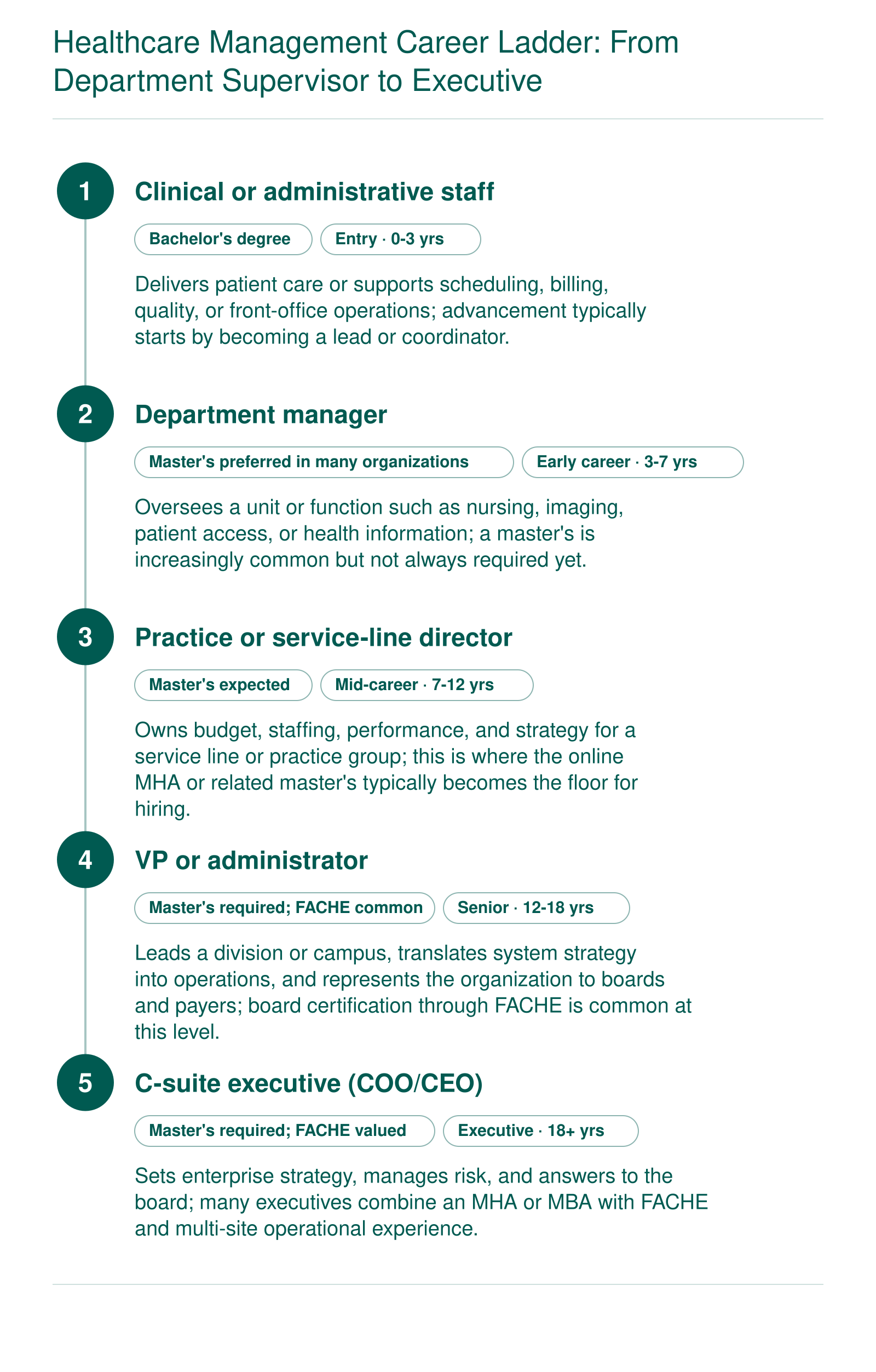
Healthcare Management Career Ladder: From Department Supervisor to Executive
The path from front-line role to executive usually follows five distinct stages, and degree requirements sharpen as you move up. A master's in healthcare management becomes the expected credential around the director level, while the FACHE credential signals readiness for senior and system-level leadership roles. These roles appear across hospitals and health systems, physician groups, long-term care, insurers, and consulting.
Healthcare Management programs by state
Online MHA FAQs: Financial Aid, Employer Support, and More
Prospective online MHA students often ask how to pay for the degree and whether the online experience matches on-campus support. Here are direct answers on employer tuition assistance, financial aid, program speed, and career services.
Can I use employer tuition assistance for an online MHA?
What financial aid is available for online graduate healthcare management students?
Which online healthcare management master's programs can be finished fastest?
Do online MHA programs offer career services or fellowship support comparable to on-campus programs?
Compare Healthcare Management programs on the data that matters
Explore more Business & Management specializations or browse every graduate field.
All Business & Management programs