Best Master's in Healthcare Management Programs in Maryland
Compare 9 accredited Healthcare Management programs in Maryland at 7 schools, with graduate earnings, cost, debt, and completion data from IPEDS and the U.S. College Scorecard.

Maryland's healthcare economy extends well beyond hospitals: federal health agencies, insurers, and major delivery systems, employers that often recruit from MPH programs in Maryland, all compete for managers who can handle value-based payment and regulatory pressure. The state's ranked healthcare management master's programs are few enough to compare directly: reported tuition runs from $8,460 at Stevenson University to $64,730 at Johns Hopkins University. What separates the programs is less prestige than format and cost: a nine-month residential option versus online and accelerated cohort designs. The real filter is which debt-to-earnings path you can sustain over a decade.
Key Points
- Reported tuition runs from $8,460 at Stevenson University to $64,730 at Johns Hopkins University.
- Johns Hopkins offers a 9-month, on-campus master's, while Stevenson and Mount St. Mary's add flexible formats.
- Maryland requires no license for most managers, but nursing home administrators need a separate board credential.
Ranked: Best Healthcare Management Schools in Maryland
Johns Hopkins leads because it pairs a 9-month, on-campus master's with a school-wide 94% graduation rate and access to Hopkins' medical, nursing and public health schools. Stevenson and Mount St. Mary's cost less and offer more flexible formats. The two Maryland programs that hold CAHME accreditation are Hopkins' Bloomberg MHA and the Uniformed Services University program, and neither is among the three ranked here.
Johns Hopkins University
#1Baltimore, MD · ~$65,000/yr (est.)
Best for: Recent graduates seeking Baltimore campus immersion
The Master of Science in Health Care Management at Johns Hopkins is a full-time, on-campus program through the Carey Business School. Tuition is $65,230 for in-state and out-of-state students alike, and the school's overall graduation rate is 94%. Carey is AACSB accredited. CAHME accreditation belongs to the separate Bloomberg School MHA, not to this degree. Students work on a health care consulting practicum and use Baltimore as an urban health case study.
- 9-month, 30-credit full-time program
- Ten core courses plus five electives, including AI in health and finance
- Signature Health Care Consulting Practicum
- Test optional, with no entrance exam required
- Cohort-based, with a capstone
- Carey Business School holds AACSB accreditation
Stevenson University
#2Owings Mills, MD · ~$8,000/yr (est.)
Best for: Working professionals needing fully online study
Stevenson offers a fully online Master of Science in Healthcare Management, with in-state and out-of-state tuition both at $40,560. The school's overall graduation rate is 68%. The program is IACBE accredited and is not CAHME accredited. Its Maryland partner network includes Johns Hopkins, Kennedy Krieger Institute and the Maryland Department of Health, and some employers qualify for tuition discounts.
- 36 credits, 100% online
- Finish in two years or less
- IACBE accredited
- 3.0 GPA, resume and personal statement required
- Healthcare internship available
- 36 credits, 100% online
- Finish in two years or less
- IACBE accredited
- Coursework in healthcare policy, ethics and finance
- Graduate certificate option available
Mount St. Mary's University
#3Emmitsburg, MD · $10,000 – $15,000/yr (est.)
Best for: Healthcare staff choosing accelerated cohort pacing
Mount St. Mary's in Emmitsburg offers an on-campus Master of Science in Health Administration with an ethical focus on serving vulnerable populations. In-state and out-of-state tuition are both $48,630, and the school's overall graduation rate is 65%. The program holds IACBE accreditation and has no CAHME accreditation. Cohorts start in January, May and August.
- 36 credits in a cohort model
- Accelerated 1-year or part-time 2-year option
- Entry through a 2.75 GPA, three years of healthcare experience, or GRE/GMAT scores
- Rolling admissions, with starts in January, May and August
- Accounting, statistics and microeconomics prerequisites
- Not available to F-1 visa students
Cost & outcomes by school
Federal data for the highest-earning Healthcare Management programs, independent of the ranking above. Earnings are this field's master's graduates four years after completing, where the Scorecard reports them.
| School | Earnings | Tuition / yr | Debt | Grads/yr | Format |
|---|---|---|---|---|---|
| Johns Hopkins University MD | $118,011 | $64,730 | $55,801 | 219 | Campus |
| Mount St. Mary's University MD | $82,869 | $14,351 | — | 14 | Campus |
| Strayer University-Maryland MD | $58,850 | $15,135 | $81,207 | 3 | Online |
| Frostburg State University MD | — | $11,498 | — | — | Online |
| University of Maryland-College Park MD | — | $18,276 | — | — | Campus |
| Stevenson University MD | — | $8,460 | — | 12 | Online |
| Washington Adventist University MD | — | $11,525 | — | 5 | Hybrid |
Sources: U.S. Department of Education. Tuition and graduates: IPEDS. Earnings and debt: College Scorecard, this field's master's graduates; a dash means no figure is reported.
Cost, debt & payoff
Median earnings of this field's master's graduates (4 yrs after completing) vs. their median federal loan debt · U.S. College Scorecard
Across these programs the median graduate earns about $70,860 and finishes with roughly $81,207 in debt — a ratio that clears a common rule of thumb (keep debt below first-year salary). Tuition and debt vary widely school to school, so check the per-school figures in the table above before you shortlist.
How We Rank These Programs
Institution-wide figures describe a university, while program-level figures describe the degree you would actually earn, and we use both where they exist. The rankings draw on IPEDS and College Scorecard data: graduate tuition, net price, graduation rate, and program-level earnings and debt where they are published.
We include only programs that are currently enrolling. A Maryland public university's healthcare management master's program, for example, is in a formal teach-out and no longer admits students, so it is left out.
Graduation rate and net price cover the whole institution, not one master's program. Treat them as context for comparing Master's Programs in Maryland, not as a guarantee of what you will pay or how quickly you will finish.
Online and Hybrid Master's in Healthcare Management Options in Maryland
An online master's in healthcare management, whether fully online or hybrid, is any format that lets students do most coursework remotely, with occasional synchronous class times or brief campus visits instead of weekly commuting. Among the programs ranked here, the delivery options split clearly.
Program formats
- Stevenson University: The M.S. in Healthcare Management is fully online, so there is no standing on-campus component. The program's published details list an internship opportunity rather than a required placement.
- Johns Hopkins University: Carey Business School runs the M.S. in Health Care Management as an in-person Baltimore degree or a part-time online option. Online coursework combines asynchronous and synchronous work, and a select online course carries a two-day residency at the Baltimore campus.
- Mount St. Mary's University: The M.S. in Health Administration is campus-based, so it is not an online or hybrid option among healthcare administration programs in Maryland.
For a full-time healthcare employee, Stevenson's fully online delivery is the most straightforward fit, while Johns Hopkins's online format works for professionals who can arrange the short Baltimore residency.
Admissions: GRE Waivers and Test-Optional Policies at Maryland Programs
Policies change by cycle, so confirm each item on the school's admissions page before you apply.
- Johns Hopkins UniversityThe Carey Business School program is listed as test-optional, with no entrance exam required, so no waiver is needed. This page does not have a minimum GPA for it. The deadline it lists is dated 2025, so check the current date.
- Stevenson UniversityThe online program lists no GRE or GMAT policy, so we can't say whether tests are required, optional or waived. It does publish a bachelor's degree and a 3.0 cumulative GPA. It also asks for transcripts, a recommendation, a personal statement and a resume. No deadline format is published.
- Mount St. Mary's UniversityGRE or GMAT scores are accepted. The listing doesn't say they are mandatory and states no waiver criteria. Admission is rolling, with cohorts starting in January, May and August. The GPA figures published are 2.75 and 3.00, so confirm which applies. Three years of healthcare experience is also listed.
Related Articles
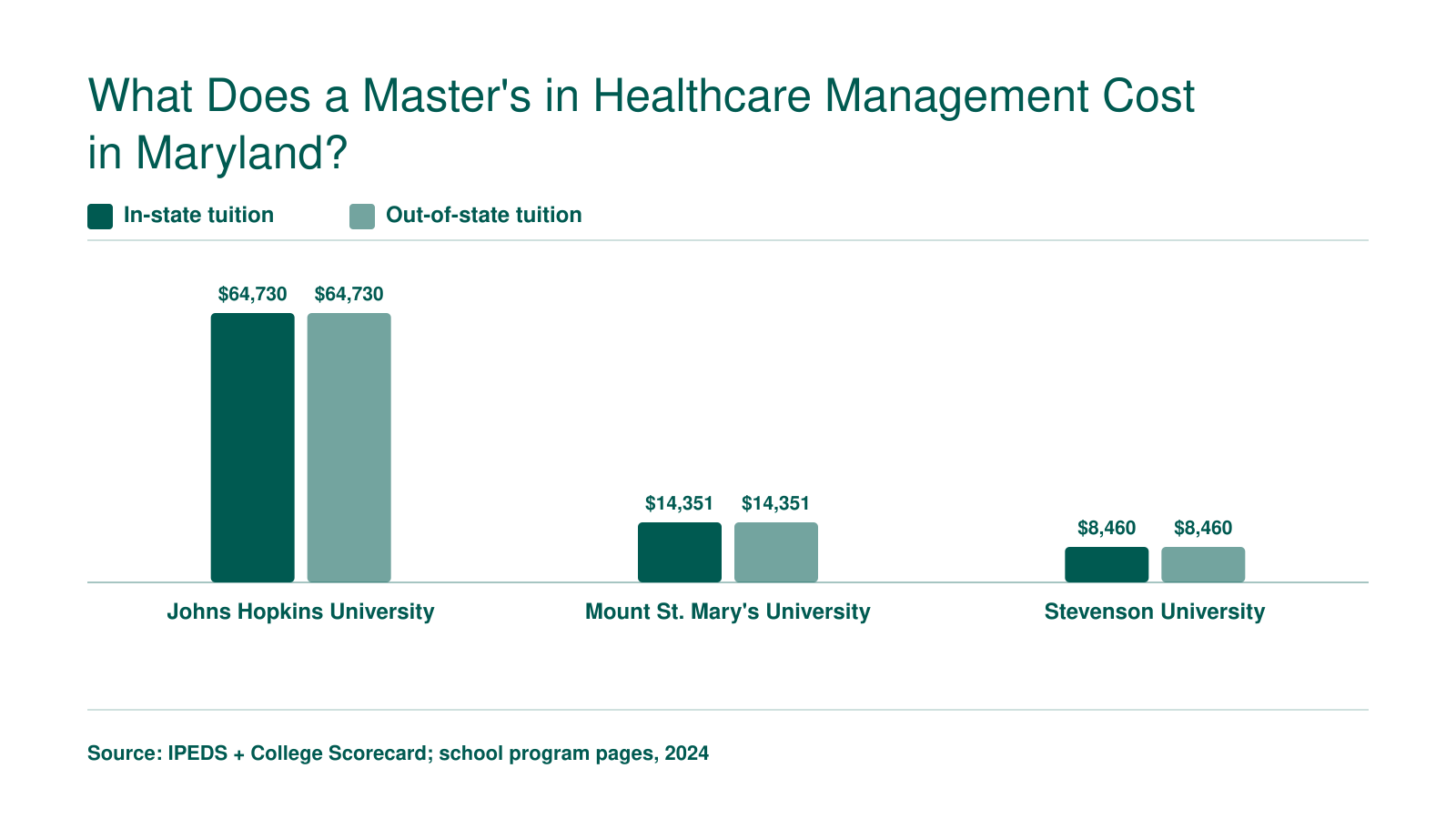
What Does a Master's in Healthcare Management Cost in Maryland?
Reported tuition for these master's programs ranges from $8,460 at Stevenson University to $64,730 at Johns Hopkins University, so the cheapest option here costs a fraction of the most expensive. In-state and out-of-state figures are identical for every school shown, so residency does not change the price. Johns Hopkins lists $78,500 in total program tuition for its 30-credit, 9-month program, which is higher than the chart figure, so confirm the current total with the school. Mount St. Mary's and Stevenson each require 36 credits. Stevenson delivers its program 100% online, and no separate online rate is published for any school here. Per-credit rates were not available for these programs. Net price is an institution-wide average after aid and should be treated as approximate: about $18,809 at Johns Hopkins, $22,655 at Mount St. Mary's, and $26,505 at Stevenson.
Maryland Licensure and Certification for Healthcare Managers
MHA vs MPH vs MS: Which Healthcare Management Degree Is Right for You?
The lines between healthcare management degrees have blurred as health systems lean harder on data and value-based payment. Each degree still points toward a different first job.
- MHA: MHA programs in Maryland are built around operations, finance, staffing and leadership inside hospitals, clinics and health systems. Graduates often start as practice managers, department coordinators or administrative fellows.
- MPH: MPH programs are centered on population health, epidemiology and policy rather than running a facility. Common first roles include epidemiology analyst, program analyst or policy associate at health departments and nonprofits.
- MS: Titles vary by school, but many add an analytics or informatics emphasis. Typical entry points include health data analyst or quality improvement analyst.
If you plan to run a department or, eventually, a facility, the MHA is the most direct route. If you want a post-graduate administrative fellowship at a hospital system, check whether the program holds CAHME accreditation, because many fellowship programs look for it. Confirm current status on CAHME's site or the school's program page before you apply.
Career and Salary Outcomes for Maryland Graduates
The clearest way to judge a Maryland master's in healthcare management is earnings against debt, the same cost lens used to rank the Most Affordable Master's in Healthcare Management Programs, and the numbers differ sharply by school.
Johns Hopkins graduates of the Master of Science in Health Care Management report median earnings of $95,780 one year after finishing, $118,011 four years out, and $123,655 five years out. Median program debt is $55,801, which works out to about $635 a month on a 10-year plan. That is a strong earnings-to-debt balance.
Mount St. Mary's graduates of the Master of Science in Health Administration report $72,648 one year after finishing and $82,869 four years out. Stevenson University's Master of Science in Healthcare Management shows $68,806 one year after finishing. Neither school reports program-level debt, so no payment estimate is shown. Both figures come from small graduating groups, so treat them as directional.
Graduates commonly move into these roles:
- Practice manager
- Health services manager
- Quality or patient safety director
- Operations director
Stevenson's Quality Management and Patient Safety concentration points toward the quality track.
Frequently Asked Questions About Maryland Healthcare Management Master's Programs
These answers draw on what the programs publish on their own admissions and FAQ pages. Policies change, so confirm details with each admissions office before you apply.
Can I get into a Maryland healthcare management master's program without healthcare or business experience?
Are there 1-year or accelerated healthcare administration master's options online in Maryland?
Do Maryland healthcare management master's programs require prerequisite courses like statistics or accounting?
Compare Healthcare Management programs on the data that matters
Explore more Business & Management specializations or browse every graduate field.
All Business & Management programs