Best Master's in Healthcare Administration Programs in Maryland
Compare 8 accredited Healthcare Administration programs in Maryland, with graduate earnings, cost, debt, and completion data from IPEDS and the U.S. College Scorecard.

Maryland's hospital systems cluster tightly around Baltimore and the Washington suburbs, and that density keeps demand for trained health administrators steady. Applicants face a split, though: a Johns Hopkins degree and a Strayer or UMGC credential sit at very different price points.
The programs here mix campus, hybrid, and fully online formats. At least one Maryland program has stopped accepting applicants, so a school's current enrollment status matters as much as its reputation.
Key Points
- Stevenson University is the lowest-priced option here, with tuition of $8,460.
- Hopkins graduates earn a median $95,780 one year out, versus $46,948 at Strayer University-Maryland.
- Confirm a program is still enrolling for 2027, since the University of Baltimore's M.S. is in teach-out.
MHA at a glance
- Common degrees
- MHA · MSHA · MS in Health Administration · MBA (Healthcare)
- Typical length
- 2 years full-time (1–3 depending on format)
- Formats
- On-campus, online, and hybrid
- Programmatic accreditation
- CAHME (the gold standard for MHA programs)
- Common concentrations
- Hospital administration, health informatics, policy, long-term care
- Typical entry
- Bachelor's degree; GRE increasingly optional
The Best MHA Schools in Maryland, Ranked
This order reflects cost, graduate outcomes, and delivery format rather than name recognition. Graduation rates below are institution-wide figures, not completion rates for the health administration program itself. The University of Baltimore's M.S. in Health Administration is in teach-out and no longer accepts new applicants, so it is not ranked. CAHME status is noted only where research confirmed it.
Johns Hopkins University
#1Baltimore, MD · ~$65,000/yr (est.)
Best for: Early-career leaders seeking hospital residency
Johns Hopkins is the only Maryland school in this list whose MHA is described as CAHME-accredited, and it pairs a year of coursework with an 11-month paid administrative residency in the Johns Hopkins Health System and affiliated institutions. The university graduates about 94% of its students. It is the priciest option here and admits a small cohort, so it suits candidates who want hospital or consulting leadership roles and can take on the full-time, two-year commitment. A second-year tuition scholarship is listed in the program materials.
- On-campus, full-time, two-year format with fall start
- CAHME and AUPHA accredited per program materials
- 11-month full-time paid administrative residency
- No entrance exam required; 3.0 GPA minimum listed
- Prerequisite courses required
- Application deadline listed as January 15
- 75% tuition scholarship in the second year
Stevenson University
#2Owings Mills, MD · ~$8,000/yr (est.)
Best for: Working professionals needing flexible online study
Stevenson, in Owings Mills near Baltimore, offers an online master's in healthcare management built for working professionals, with 8-week courses and up to 15 transfer credits. The university graduates about 68% of its students. The program holds IACBE business accreditation, and no CAHME status was confirmed. Its 2026 enrollment status could not be verified from research, so confirm it before applying.
- 100% online with 8-week courses
- 36 credit hours; completion in two years or less
- Concentrations: Quality Management and Patient Safety, or Project Management in Healthcare
- IACBE accredited; CAHME status not confirmed
- 3.0 GPA minimum and one recommendation letter listed
- Up to 15 transfer credits accepted
- Optional healthcare internship (3 to 6 credits)
- Low-residency option listed for F-1 visa students
Mount St. Mary's University
#3Emmitsburg, MD · $10,000 – $15,000/yr (est.)
Best for: Mid-career managers wanting cohort-based learning
Mount St. Mary's, in Emmitsburg, offers a master's in health administration with a healthcare practicum and a dual-degree option with a B.S. in Health Sciences. The university graduates about 65% of its students. Research shows rolling admission with cohorts starting in August and January, though published sources differ on full-time versus part-time pacing and on start terms, so confirm both with the program. Admission can rest on a 2.75 GPA, 2 to 5 years of professional experience, or a GMAT score of 500.
- 36 credit hours with a required capstone practicum
- Cohort-based; online with synchronous and asynchronous options listed
- Rolling admission; August and January starts confirmed by research
- Admission: 2.75 GPA, 2 to 5 years of experience, or GMAT 500
- Dual degree option with B.S. in Health Sciences
- Not confirmed as CAHME accredited
University of Maryland, Baltimore
#4Baltimore, MD · ~$18,000/yr (est.)
The University of Maryland, Baltimore offers an MD/MHA only for medical students, not as a standalone degree. Students complete a 46-credit MHA during a full-time step-out year, and the degree is conferred by the School of Public Health at College Park. Current UMSOM students submit a letter of intent by December 15 of their first year, so it is relevant only if you are already in or applying to the medical school.
- Five-year MD and MHA dual degree
- 46-credit MHA with a required capstone project
- Full-time step-out year for MHA study
- Letter of intent due December 15 of first medical year
- MHA conferred by the School of Public Health at College Park
- Open only through the medical school pathway
University of Maryland Global Campus
#5Adelphi, MD · ~$10,000/yr (est.)
University of Maryland Global Campus offers a fully online master's in healthcare administration with no-cost digital textbooks, an interest-free payment plan, and up to 12 transfer credits. It publishes separate Maryland-resident and nonresident per-credit rates and a reduced military rate, which makes it a strong affordability pick. The university graduates about 33% of its students, a low institution-wide rate typical of a large adult-learner school. CAHME status was not confirmed, and 2026 enrollment status should be verified.
- 42 credit hours with a required capstone
- Fully online courses
- Aligned with preparation for FACHE and CPH exams
- Transfer up to 12 credits
- Military benefits accepted with reduced military tuition
- Scholarships and financial aid available
Strayer University-Maryland
#6Baltimore, MD · ~$15,000/yr (est.)
Strayer University-Maryland lists a Master of Health Services Administration with two concentration options in its Maryland disclosures, and the program is listed as online. The university graduates about 38% of its students. Little program detail was available beyond the listing, and no CAHME status or Maryland-specific features were confirmed, so request curriculum, cost, and outcome details directly before comparing it with the programs above.
- Two concentration options listed
- Listed as an online program
- Appears in Strayer's Maryland disclosures
- CAHME status not confirmed
University of Maryland-College Park
#7College Park, MD · ~$18,000/yr (est.)
The University of Maryland-College Park runs its master's in health administration through the School of Public Health. It is marketed as online, but research notes several required in-person fall weekend sessions on campus. The university graduates about 89% of its students. Applicants file through SOPHAS plus a UMD supplemental application, and the program is non-thesis. It also feeds the MD/MHA pathway, and CAHME status was not confirmed.
- 46-credit non-thesis curriculum with internship and capstone
- Full-time (two years) or part-time (three years) options
- Online delivery with required in-person fall weekend sessions
- Apply through SOPHAS and a UMD supplemental application
- 3.0 GPA minimum and three recommendation letters listed
- Final fall deadline listed as May 14, 2027
Cost & outcomes by school
Federal data for the highest-earning Healthcare Administration programs, independent of the ranking above. Earnings are this field's master's graduates four years after completing, where the Scorecard reports them.
| School | Earnings | Tuition / yr | Debt | Grads/yr | Format |
|---|---|---|---|---|---|
| Johns Hopkins University MD | $118,011 | $64,730 | $55,801 | 219 | Campus |
| University of Maryland Global Campus MD | $90,343 | $9,882 | $41,000 | 115 | Online |
| Mount St. Mary's University MD | $82,869 | $14,351 | — | 14 | Online |
| Strayer University-Maryland MD | $58,850 | $15,135 | $81,207 | 3 | Online |
| University of Maryland, Baltimore MD | — | $17,827 | — | — | Campus |
| University of Maryland-College Park MD | — | $18,276 | — | — | Online |
| Stevenson University MD | — | $8,460 | — | 12 | Online |
| Washington Adventist University MD | — | $11,525 | — | 5 | Hybrid |
Sources: U.S. Department of Education. Tuition and graduates: IPEDS. Earnings and debt: College Scorecard, this field's master's graduates; a dash means no figure is reported.
Cost, debt & payoff
Median earnings of this field's master's graduates (4 yrs after completing) vs. their median federal loan debt · U.S. College Scorecard
Across these programs the median graduate earns about $86,606 and finishes with roughly $55,801 in debt — a ratio that clears a common rule of thumb (keep debt below first-year salary). Tuition and debt vary widely school to school, so check the per-school figures in the table above before you shortlist.
What Drives the Order of These Maryland Rankings
Why would a lesser-known school rank above a famous one among Master's Programs in Maryland? Because the order here follows cost and outcomes, not reputation. For the best master's in healthcare administration programs, each program is placed using federal figures from IPEDS and College Scorecard: graduate tuition, average net price, the school's graduation rate, and, where the government publishes them, graduates' earnings and debt for the healthcare administration program itself.
Prestige lists and peer surveys work differently. They ask administrators what they think of other schools. Every number behind this order can be checked on College Scorecard.
Two limits are worth knowing. Net price is an average across the whole institution, so it reflects undergraduates too and won't match a specific MHA bill. Some programs also show no earnings at all, because their graduating cohorts are too small for federal privacy rules to allow publication. A blank is not a bad grade.
CAHME Accredited MHA Programs in Maryland: Who Has the Seal
CAHME is the only programmatic accreditor specific to healthcare management master's degrees, and hospital administrative fellowships often value it. The table shows what we could verify. Ranked schools whose program details we could not confirm are left out rather than guessed at, so check the CAHME directory before you apply. Programs without CAHME can still be regionally accredited and respected, but students targeting hospital fellowships should prioritize a CAHME-accredited program.
| School | Program | CAHME Status | Other Programmatic Accreditation |
|---|---|---|---|
| Johns Hopkins University | Master of Health Administration | Accredited | N/A |
| University of Maryland-College Park | Master of Health Administration | Not confirmed; check the CAHME directory | CEPH (School of Public Health) |
| Mount St. Mary's University | Master of Science in Health Administration | Not confirmed; check the CAHME directory | N/A |
| University of Maryland Global Campus | Graduate Health Care Administration program | Not confirmed; check the CAHME directory | N/A |
Online and Hybrid Master's in Healthcare Administration Options in Maryland
Online MHA programs let you complete most coursework remotely, though some MHA programs in Maryland still add campus time. Here is how the formats split.
- UMGC: The M.S. in Healthcare Administration (42 credits) is the main working-professional option. It is listed as online, with one source also noting hybrid. No required live sessions or residency are identified. Courses start year-round, including Aug. 12 and Sept. 16 in fall 2026.
- University of Maryland-College Park: The M.H.A. in Health Administration (46 credits) is listed as online. Confirm with the program whether any sessions run live and how the 4-credit practical experience is completed.
- Johns Hopkins: The MHA is on-campus, with a required 11-month paid administrative residency. The part-time online M.S. in Health Care Management (30 credits) requires a two-day, real-time residency in Baltimore.
How long does it take?
Johns Hopkins' MHA runs 24 months full-time. At UMGC's recommended 6 credits per term, expect a little more than two years. A true 1-year online MHA is not confirmed for any school here.
Related Articles
Which Maryland MHA Programs Waive or Make the GRE Optional
Testing requirements are the admissions detail applicants most often assume rather than verify, and the assumption can cost a cycle.
- University of Maryland, College Park: the GRE is not required for its online master's in health administration, one of the Master's in Healthcare Administration Programs With No GMAT or GRE Required, so there is no waiver to request. Expect a 3.0 undergraduate GPA and at least one undergraduate math course, applying through SOPHAS with a university supplement. Work experience is not required. Fall 2027 deadlines fall on January 15 and May 14; spring 2027 closes October 9 and November 20, 2026.
- Mount St. Mary's University: a GRE/GMAT waiver tied to healthcare management experience has been reported, but we could not confirm it on the university's own admissions page. Treat it as unverified and ask directly.
- The other MHA programs in Maryland: no current testing policy that we could verify appears on their published admissions pages. Silence is not a waiver. Email the program coordinator before you pay an application fee.
Cost, Licensure, and Certification for Maryland MHA Students
What does a master's in healthcare administration in Maryland actually cost once fees are added to tuition?
Comparing the price tags
Stevenson University is the most affordable option here, placing it among the Most Affordable Master's in Healthcare Administration Programs, with tuition of $8,460, an advertised rate of $699 per credit, and no mandatory fees. University of Maryland Global Campus charges $555 per credit for Maryland residents and $659 for out-of-state students across its online MHA programs; over a 42-credit program, that totals $23,310 in-state and $27,678 out-of-state. Mount St. Mary's uses a single private rate: about $740 per credit, or roughly $26,640 for a 36-credit program. At University of Maryland-College Park, residency matters: $18,276 in-state against $38,207 out-of-state, with a published 2026-2027 graduate rate of $1,120 per credit and campus fees of $738 per semester full-time or $382.50 part-time, varying by term and credit load. Johns Hopkins is the outlier at $64,730.
Net price figures you see elsewhere are approximate institution-wide averages across all students, not a quote for a specific graduate program. Always confirm current per-credit rates and fees with the bursar's office.
Licensure and credentials
Most hospital and health system administration roles in Maryland carry no state licensing requirement. Nursing home administrators are the exception and must be licensed by the state. The FACHE designation is a voluntary professional credential, not a legal requirement to practice.
Maryland's Licensing Path for Nursing Home Administrators
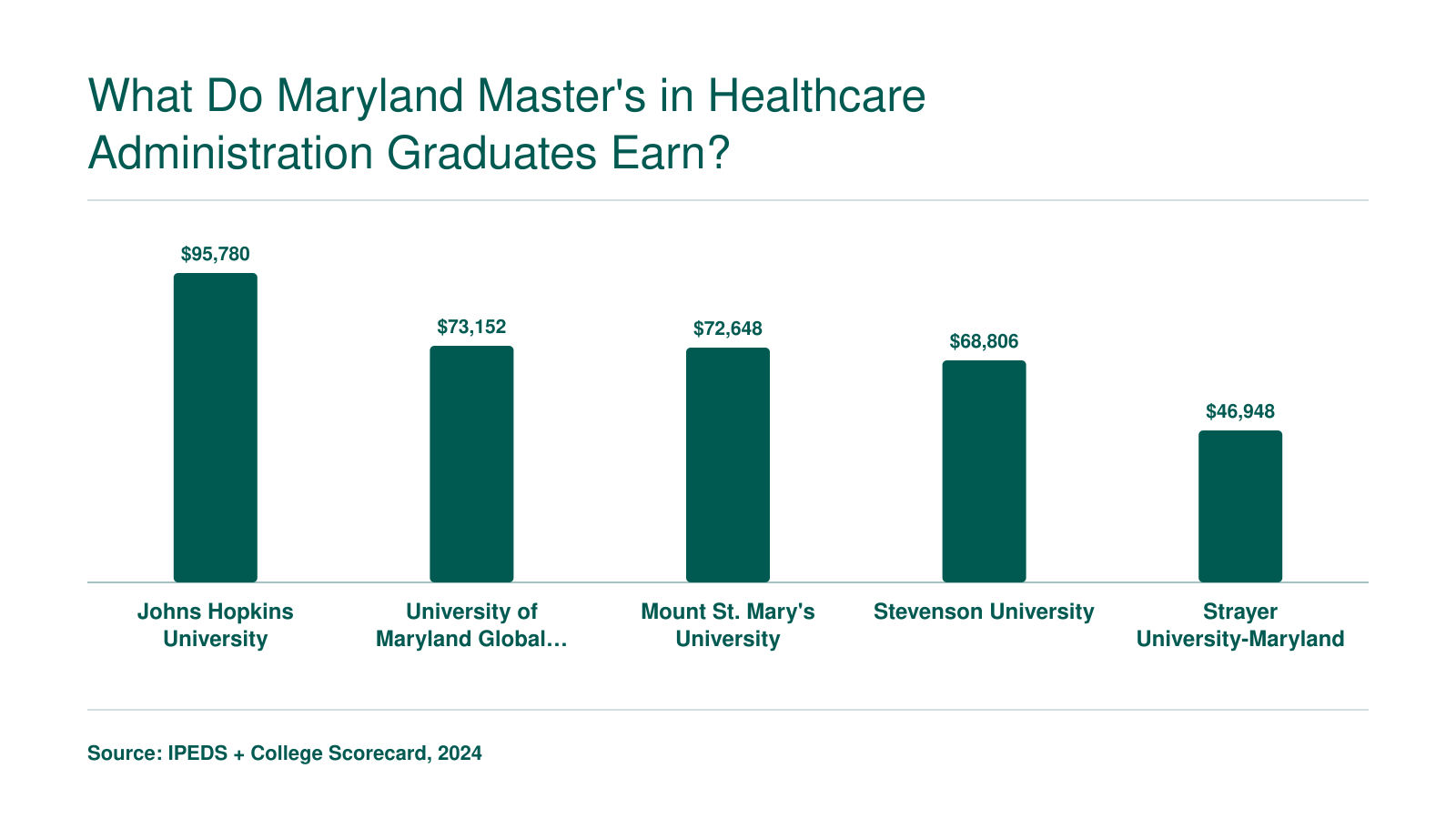
What Do Maryland Master's in Healthcare Administration Graduates Earn?
Program-level median earnings one year after finishing run from $46,948 at Strayer University-Maryland to $95,780 at Johns Hopkins University. Hopkins graduates carry $55,801 in median program debt and reach $123,655 five years out. University of Maryland Global Campus graduates report $41,000 in debt and $89,262 five years out. Strayer graduates report $81,207 in debt and $55,397 five years out.
How to Choose the Right Maryland MHA Program
The best fit usually comes down to prestige and networking versus flexibility and price, and your career goal decides which one wins.
- Hospital-executive or fellowship track: Look for CAHME accredited MHA programs first, then favor campus or hybrid formats where cohort and alumni networks feed fellowship placement.
- Working full-time: Look for fully online formats with few or no synchronous sessions, so coursework bends around your shifts.
- Budget-driven: Add up total cost including fees, then weigh in-state public pricing against each program's debt and earnings figures.
- Long-term care track: Confirm the curriculum supports Maryland's nursing home administrator licensure requirements before you enroll.
Whichever path you take, verify current enrollment status and admissions terms directly with the school.
Frequently asked questions
Is a master's in healthcare administration worth it?
For people aiming at management and leadership in healthcare, it usually is — most director- and executive-level roles expect a graduate degree, and healthcare management is among the fastest-growing management fields. Whether a specific program is worth it depends on its cost, completion rate, and what its graduates actually earn, which is exactly what the ranking on this page compares.
MHA vs. MBA — which is better for healthcare?
An MHA goes deep on healthcare — operations, policy, financing, and the regulatory environment specific to the industry. An MBA (or MBA with a healthcare concentration) is broader business training that travels across industries. Choose the MHA if you're committed to healthcare and want role-specific depth; choose the MBA if you want general management flexibility or may work outside healthcare. Many schools offer both, and some offer a dual degree.
Can you get an MHA online?
Yes — online and hybrid MHA programs are widely available and common, since much of the coursework suits remote study. Look for the same CAHME/regional accreditation you'd want in an on-campus program. Use the "Online" filter on the ranking to see programs with an online option.
Do you need the GRE for an MHA?
Increasingly, no. A large and growing share of MHA programs have made the GRE optional or dropped it, weighting your undergraduate record and work experience instead. Requirements vary by school, so check each program.
How long does an MHA take?
Most full-time MHA programs run about two years; accelerated options can finish in roughly 12–18 months, and part-time or online formats built for working professionals may take longer. Program length and total credits are listed per school where available.
Compare Healthcare Administration programs on the data that matters
Explore more Business & Management specializations or browse every graduate field.
All Business & Management programs