
Boston College Master's Programs
Boston College's 1,516 master's degrees are awarded by eight separate schools, each setting its own tuition rate, deadlines, and placement record. That fragmentation is where prospective students get stuck: IPEDS reports a $37,520 average graduate tuition for 2024, yet individual programs charge their own prices, and outcomes diverge far more sharply than prices do.
College Scorecard puts median earnings four years after completion at $152,252 for a business master's and $64,786 in theology. Median federal debt runs from $20,500 to $63,861. Choosing BC means choosing a school inside BC, and the figures that decide whether it pays off are set at that level.
Key Points
- Boston College awarded 1,516 master's degrees in 2025 across eight schools.
- Business master's graduates earn a median $152,252 four years out, per federal data.
- Only 13% of BC's 6,013 graduate students studied exclusively online in 2024.
Master's programs at Boston College
Business & Management All programs in this field →
Computers & IT All programs in this field →
Counseling All programs in this field →
Criminal Justice & Law All programs in this field →
Education & Teaching All programs in this field →
Healthcare All programs in this field →
Nursing All programs in this field →
Psychology All programs in this field →
Religion & Theology All programs in this field →
Science & Engineering All programs in this field →
Social Work & Social Sciences All programs in this field →
In the 2025 IPEDS completions data, Boston College awarded 1,516 master's degrees across 49 fields of study in 19 subject areas. Business & Management accounts for the most, 358 (24%), led by Business Administration and Management, General with 176. 59% of graduates were women and 34% were international students. That is down 9% from 1,660 in 2023.
Business & Management 358 degrees · 24%
- Business Administration and Management, General 17630% women
- Management Science 6442% women
- Organizational Leadership 6063% women
- Finance, General 5516% women
- Organizational Behavior Studies 3100% women
- Also reported, no graduates in 2025: Accounting
Public Administration & Social Work 245 degrees · 16%
- Social Work 24587% women
Education 229 degrees · 15%
- Curriculum and Instruction 5881% women
- Educational Leadership and Administration, General 4764% women
- Higher Education/Higher Education Administration 3077% women
- Elementary Education and Teaching 2282% women
- Special Education and Teaching, General 1979% women
- Educational Statistics and Research Methods 944% women
- Educational/Instructional Technology 875% women
- History Teacher Education 838% women
- Educational Evaluation and Research 786% women
- English/Language Arts Teacher Education 757% women
- Early Childhood Education and Teaching 6100% women
- Biology Teacher Education 367% women
- International and Comparative Education 250% women
- Mathematics Teacher Education 250% women
- Chemistry Teacher Education 1100% women
- Also reported, no graduates in 2025: Counselor Education/School Counseling and Guidance Services; Educational Assessment, Testing, and Measurement; Physics Teacher Education; Spanish Language Teacher Education
Psychology 124 degrees · 8%
- Developmental and Child Psychology 11785% women
- Psychology, General 540% women
- Psychometrics and Quantitative Psychology 1100% women
- Social Psychology 1100% women
- Also reported, no graduates in 2025: Counseling Psychology
Theology & Ministry 95 degrees · 6%
- Theology/Theological Studies 8244% women
- Divinity/Ministry 1338% women
- Also reported, no graduates in 2025: Pastoral Studies/Counseling
Parks, Recreation & Fitness 83 degrees · 5%
- Sport and Fitness Administration/Management 8342% women
Health Professions 77 degrees · 5%
- Registered Nursing/Registered Nurse 4794% women
- Health/Health Care Administration/Management 3087% women
- Also reported, no graduates in 2025: Mental Health Counseling/Counselor
Social Sciences 74 degrees · 5%
- Econometrics and Quantitative Economics 6239% women
- Sociology, General 757% women
- Political Science and Government, General 560% women
Mathematics & Statistics 65 degrees · 4%
- Financial Mathematics 6543% women
- Also reported, no graduates in 2025: Mathematics, General
Interdisciplinary Studies 42 degrees · 3%
- Data Analytics, General 4245% women
Computer & Information Sciences 32 degrees · 2%
- Computer and Information Systems Security/Auditing/Information Assurance 3247% women
Philosophy & Religious Studies 25 degrees · 2%
- Philosophy 2313% women
- Applied and Professional Ethics 20% women
English 18 degrees · 1%
- English Language and Literature, General 1867% women
History 13 degrees · 1%
- History, General 1354% women
Law & Legal Studies 12 degrees · 1%
- Legal Professions and Studies, Other 1275% women
Physical Sciences 12 degrees · 1%
- Physics, General 80% women
- Chemistry, General 2100% women
- Geology/Earth Science, General 2100% women
- Also reported, no graduates in 2025: Geophysics and Seismology
Languages & Linguistics 9 degrees · 1%
- French Language and Literature 560% women
- Italian Language and Literature 250% women
- Spanish Language and Literature 2100% women
- Also reported, no graduates in 2025: Classics and Classical Languages, Literatures, and Linguistics, General; Latin Language and Literature; Linguistics
Area, Ethnic & Gender Studies 2 degrees · 0%
- Near and Middle Eastern Studies 250% women
Biological & Biomedical Sciences 1 degree · 0%
- Biology/Biological Sciences, General 10% women
- Also reported, no graduates in 2025: Neuroscience
Source: U.S. Department of Education, IPEDS completions 2025, master's degrees, first majors, by the field the school reports (CIP code). Programs we have verified and profiled are under Popular programs.
Graduate cost and enrollment at Boston College
| Average graduate tuition and fees, full-time, per year | $37,520 |
|---|---|
| Graduate students (12-month enrollment) | 6,013 |
| Studying fully online | 13% |
| Taking some online courses | 23% |
| Master's degrees awarded (2025) | 1,516 |
| Share of all degrees and certificates the school awards | 34% |
Source: U.S. Department of Education, IPEDS 2024. Tuition is the school-wide average a full-time graduate student is charged; each program sets its own rate, so check the program page.
Graduate outcomes by field
Master's degrees Boston College awards each year by field, with the median earnings of its graduates four years after completing and their median federal debt, where the Scorecard reports them.
| Field | Degrees / yr | Median earnings | Median debt |
|---|---|---|---|
|
Social Work, Social Work Advanced Standing Figures for the whole field: Social Work |
245 | $71,957 | $51,250 |
|
Organizational Leadership, Project Management, General Business, Management Figures for the whole field: Business Administration, Management and Operations |
236 | $152,252 | $55,000 |
|
Developmental Psychology, Social Psychology Figures for the whole field: Research and Experimental Psychology |
119 | — | — |
|
Christian Ministry, Divinity, Theology Figures for the whole field: Theological and Ministerial Studies |
95 | $64,786 | $30,860 |
| Educational Leadership | 77 | $71,676 | $29,642 |
| Curriculum & Instruction | 58 | $71,427 | $20,500 |
| Finance | 55 | $151,547 | $41,000 |
|
Adult Gerontology Primary Care Nurse Practitioner, Direct Entry MSN (MENP), Psychiatric Mental Health Nurse Practitioner Figures for the whole field: Registered Nursing, Nursing Administration, Nursing Research and Clinical Nursing |
47 | $117,616 | $63,861 |
|
Analytics, Data Analytics Figures for the whole field: Data Analytics |
42 | — | — |
|
Healthcare Administration, Healthcare Management, Health Administration Figures for the whole field: Health and Medical Administrative Services |
30 | — | — |
|
Early Childhood Education, Elementary Education, STEM Education, Secondary Education, Teaching Figures for the whole field: Teacher Education and Professional Development, Specific Levels and Methods |
28 | $68,576 | — |
| Special Education | 19 | $71,459 | — |
| English Education | 18 | $64,159 | $40,346 |
| Sociology | 7 | — | — |
| General Psychology | 5 | — | — |
Source: U.S. Department of Education — IPEDS completions (master's level) and College Scorecard field-of-study data.
Accreditation
Boston College is institutionally accredited by the New England Commission on Higher Education.
- Institutional Accreditation — Accreditation Commission for Midwifery Education (Preaccredited)
- Nurse Midwifery (MIDWF) - Basic certificate and graduate nurse-midwifery education programs for registered nurses — Accreditation Commission for Midwifery Education (Preaccredited)
- Law (LAW) - Professional schools — American Bar Association, Council of the Section of Legal Education and Admissions to the Bar
- Counseling Psychology (COPSY) - PhD Doctoral programs — American Psychological Association, Commission on Accreditation
- Theology (THEOL) - Freestanding schools, as well as programs affiliated with larger institutions, offering graduate professional education for ministry and graduate study of theology — Commission on Accrediting of the Association of Theological Schools
- Nursing (CNDNP) - Nursing education programs at the doctorate degree levels — Commission on Collegiate Nursing Education
- Nursing (CNURED) - Nursing education programs at the baccalaureate degree levels — Commission on Collegiate Nursing Education
- Nursing (CNURED) - Nursing education programs at the graduate degree levels — Commission on Collegiate Nursing Education
- Nurse Anesthesia (ANEST) - Institutions and programs at the master's degree, post master's certificate or doctoral degree levels — Council on Accreditation of Nurse Anesthesia Educational Programs
- Teacher Education (TED) - Baccalaureate and graduate programs for the preparation of teachers and other professional personnel for elementary and secondary schools — National Council for Accreditation of Teacher Education
- Institutional Accreditation — New England Commission of Higher Education
- Baccalaureate Teacher Education Accreditation Council (BTEAC) - Baccalaureate programs — Teacher Education Accreditation Council, Accreditation Committee
- Graduate Teacher Education Accreditation Council (GTEAC) - Graduate programs — Teacher Education Accreditation Council, Accreditation Committee
Eight Schools, One University: How BC's Master's Programs Are Organized
One graduate school, one application, one tuition rate, one academic calendar: that is how many universities run their master's degrees. Boston College runs it differently.
Eight schools, eight sets of rules
Master's degrees at BC are awarded across eight schools and colleges: the Carroll School of Management, the Morrissey College of Arts and Sciences, the Lynch School of Education and Human Development, the Connell School of Nursing, the School of Social Work, the School of Theology and Ministry, the Woods College of Advancing Studies, and the Clough School of Law. Each sets its own admissions standards, deadlines, credit requirements, and per-credit price, so an applicant who reads one school's page and assumes the rest of the university works the same way will misjudge both timing and budget. Some programs cross schools entirely: the dual JD/MBA and the MSW/MBA each combine two sets of admissions files and two tuition structures in a single degree.
The scale behind the name
That decentralization is not a side operation. BC awarded 1,516 master's degrees in 2025, according to IPEDS completions data, equal to 34% of the 4,500 degrees and certificates of every level the university conferred that year. Graduate enrollment stands at 6,013 students (IPEDS 2024, 12-month unduplicated count) against 10,085 undergraduates, a graduate body roughly three-fifths the size of the undergraduate one. The degrees cluster in social work, business, psychology, theology, and education, and that mix shapes both who enrolls and what the outcomes data show.
Formats, and the tuition trap
Our directory tracks programs across all eight schools in three formats: on-campus degrees in the majority, a substantial hybrid group, and a smaller set that runs fully online. The format mix differs by school, and so does what flexibility means in practice.
One figure deserves care. BC's average graduate tuition and fees of $37,520 per year (IPEDS 2024, full-time) is a school-wide average, not the price of any individual program. A campus MS in Accounting and an online healthcare administration master's are not billed alike, and neither is billed at the average. Convert each program's published per-credit rate into a full-program total; that is the honest comparison. Budget from the program page, not the fact book.
Master's Degrees Awarded by Field at Boston College
Boston College awarded 1,516 master's degrees in 2025, and the distribution is anything but even. Social Work and Business Administration, Management and Operations each account for roughly one in six of those degrees, while a long tail of psychology, theology, education, applied math, economics, finance, and nursing fields each award between 47 and 119 degrees a year. The table below shows the largest fields, sourced to IPEDS completions for 2025 (first majors).
| Field | Master's Degrees Awarded (2025) | Share of BC Master's Degrees |
|---|---|---|
| Social Work | 245 | 16.2% |
| Business Administration, Management and Operations | 236 | 15.6% |
| Research and Experimental Psychology | 119 | 7.8% |
| Theological and Ministerial Studies | 95 | 6.3% |
| Health and Physical Education/Fitness | 83 | 5.5% |
| Educational Administration and Supervision | 77 | 5.1% |
| Applied Mathematics | 65 | 4.3% |
| Management Sciences and Quantitative Methods | 64 | 4.2% |
| Economics | 62 | 4.1% |
| Curriculum and Instruction | 58 | 3.8% |
| Finance and Financial Management Services | 55 | 3.6% |
| Registered Nursing, Nursing Administration, Nursing Research and Clinical Nursing | 47 | 3.1% |
Where the Portfolio Runs Deep: Social Work, Business, Education, and Nursing
At Boston College, the question is rarely whether a master's degree carries weight. It is whether your field is one where BC has built enough scale to matter. Four professional areas account for the bulk of the 1,516 master's degrees the university awarded in 2025, per IPEDS / U.S. Department of Education College Scorecard data, and each rewards students differently.
Social Work: The Largest Field
Social work is BC's deepest master's field at 245 degrees a year. The School of Social Work offers the Master of Social Work with clinical and macro concentrations, an Advanced Standing MSW for students who already hold a BSW, and an MSW/MBA dual degree for those aiming at nonprofit or health-system leadership. Scale here means a broad field-education network across Boston's hospitals and agencies. Graduates posted median earnings of $71,957 four years out, with median federal debt of $51,250.
Business and Finance: The Carroll School
Business administration (236 degrees) and finance (55) together award roughly 290 master's degrees annually, making the Carroll School the university's other engine. The M.B.A., Master's in Finance, and M.S. in Accounting all sit on the Chestnut Hill campus. The payoff gap is the story: business administration graduates report median earnings of $152,252 four years after completion, finance $151,547, and accounting $118,957.
Education, Counseling, and Nursing
The Lynch School's portfolio spans the Ed.M. in Curriculum and Instruction, Educational Leadership & Policy, and Special Education, alongside the M.A. in School Counseling and the M.A. in Mental Health Counseling. Educational Administration and Supervision (77 degrees) and Curriculum and Instruction (58) alone account for 135. At the Connell School, the M.S.N. Nurse Practitioner tracks in adult-gerontology primary care and psychiatric-mental health sit beside the Direct Entry MSN for non-nurses, while the online Master of Healthcare Administration runs through Woods College. Registered nursing awards 47 master's degrees a year.
Smaller Programs With Sharp Focus
Beyond the four anchors, BC runs options that trade scale for specialization: the M.A. in Theology and Ministry, the M.S. in Applied Analytics, the M.S. in Cybersecurity Policy and Governance, the M.S. in Leadership, and the Master of Legal Studies. Smaller cohorts mean thinner alumni networks but often closer faculty contact, a tradeoff worth weighing against the field-wide earnings figures.
6,013 Graduate Students, Three Modes of Study
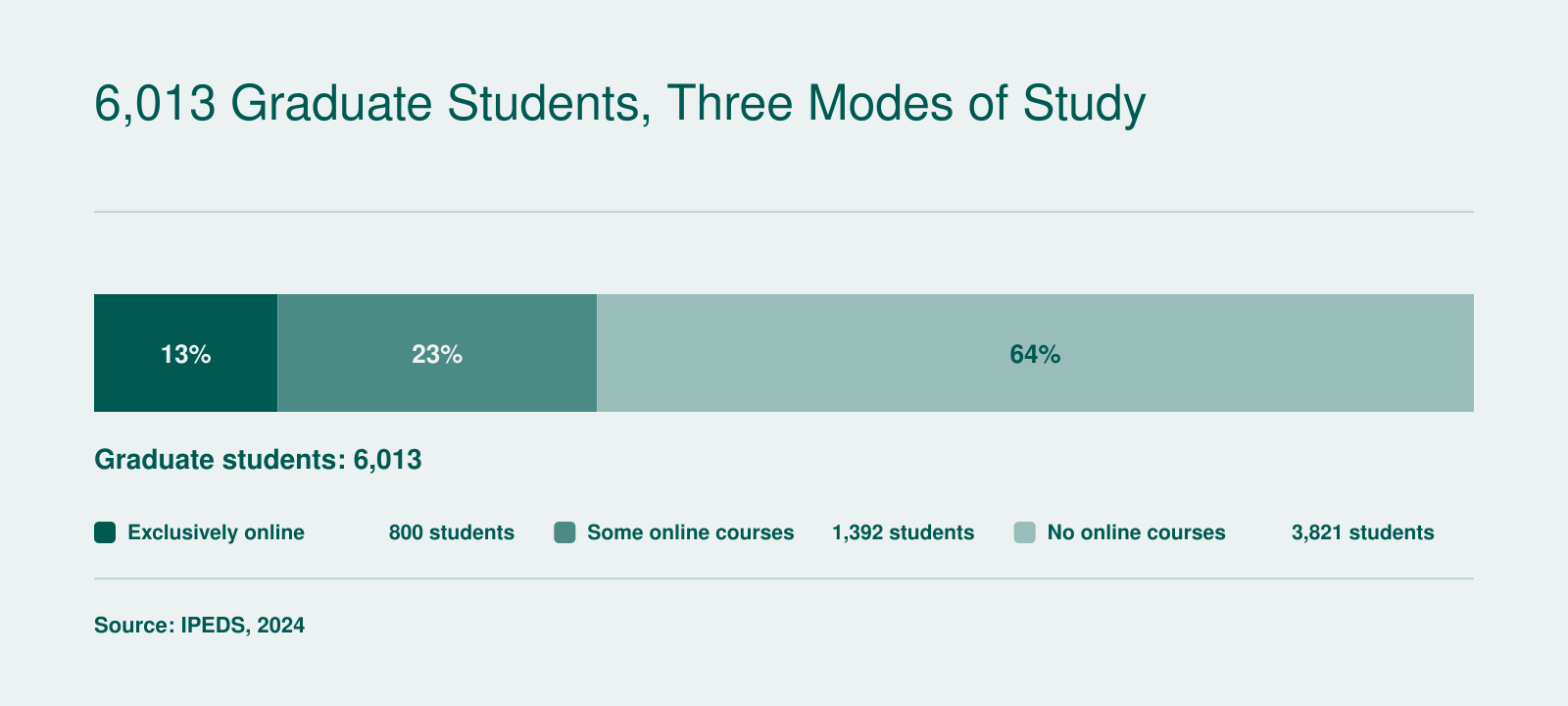
Boston College enrolled 6,013 graduate students in 2024, and most of them were on campus. Only 800, or 13%, studied exclusively online, while 1,392 (23%) took some online courses and 3,821 (64%) took none at all. Online study at BC works as an add-on to a largely campus-based graduate experience rather than a separate track running alongside it.
On-Campus, Hybrid, or Online: What Flexibility Really Looks Like at BC
Delivery format at Boston College is a program-level decision, not a university-wide one: each school sets its own mix of seated, hybrid, and online coursework. The catalog leans heavily toward classrooms in Chestnut Hill, and the federal numbers back that up. IPEDS counted 6,013 graduate students at BC in 2024, with 13 percent enrolled exclusively in online master's programs and 64 percent taking no online courses at all. Most master's programs are built for in-person study, a meaningful middle tier runs hybrid, and a small handful can be completed entirely at a distance.
Where the fully online degrees sit
The fully online options are the Master of Healthcare Administration and the Master of Legal Studies in Cybersecurity, Risk, and Governance, both offered through Woods College. That is the ceiling at BC: a student who needs a fully asynchronous degree is choosing from a short list rather than from the whole graduate catalog, and should build the search around those two instead of assuming another program can be delivered remotely.
Hybrid means scheduled sessions plus work in between
The hybrid programs cluster in Woods College and the Lynch School. The M.S. in Applied Analytics, the M.S. in Leadership, the M.Ed. in Educational Leadership & Policy, and the M.A. in School Counseling all pair scheduled class sessions with online coursework between them, so expect evening or weekend meeting blocks and steady midweek assignments. Woods College's M.S. in Applied Economics goes further, offered online, in the evening on campus, or as a combination of the two.
How long each format actually takes
The Woods M.S. in Leadership can finish in about 18 months at two courses per semester. The Lynch School M.S. in Data Science carries 36 credits across 12 courses, typically four semesters or roughly 24 months, with an early-admit route that can wrap in about 15 months using 12 credits of advanced standing. The School of Theology and Ministry's hybrid M.A. in Theology and Ministry combines three summer residencies with online work during the academic year, taking around two years at 36 credits and about three years at 48. Full-time MSW and M.Ed. students often finish within two years, while part-time study stretches the same degrees past three. Cohort start terms and formal part-time availability differ by school, so confirm both with the program office before you apply.
Paying for It: Scholarships, Assistantships, and Aid for Master's Students
Two funding paths run through Boston College's master's programs: money a school awards you, and money you borrow. The first is smaller, quieter, and easy to miss. The second is the default for most master's students, which is exactly why the first is worth a few hours of your time.
Where the Aid Actually Lives
BC administers master's aid school by school rather than through a single university-wide policy. Merit scholarships, assistantships, tuition remission, and named awards are decided inside the individual graduate schools, so the same award name does not carry the same terms, amounts, or deadlines from one to the next. Start with the program, not the financial aid homepage: university pages that read generously are often describing undergraduate aid. A named dean's award may exist in a given school, but confirm it there rather than assuming a university-wide program. Woods College of Advancing Studies is one place with published terms: it awards a limited number of scholarships each semester in select programs, including the M.S. in Leadership, Sports Administration, and Cybersecurity Policy and Governance, decided at admission with no separate application. Amounts and renewal conditions still need confirming.
The Other Ways to Pay
Graduate assistantships, where a program offers them, typically pair a stipend with partial or full tuition remission, but availability, hours, and terms are school-specific, and no standard quota or remission percentage applies across BC. Employer tuition benefits, federal work-study, and federal loans (FAFSA, including grad PLUS) round out the picture. Loans are the route nearly every master's student can count on.
What Borrowing Looks Like
The federal College Scorecard figures are the reality check. Median federal debt for BC master's graduates runs from $20,500 in Curriculum and Instruction to $63,861 in Nursing; Business Administration sits at $55,000 and Social Work at $51,250. Weighed against median earnings four years after completion, those numbers are what separate a manageable degree from a decade of payments.
Three Moves to Make Now
- File the FAFSA early: BC lists preferred 2026 dates of Feb 27 for incoming graduate students, Apr 15 for continuing students, and Mar 16 for summer.
- Email the graduate program director, not just the central aid office, about assistantships, remission, and named awards.
- Look outside BC for profession-specific scholarships in nursing, social work, and education, where external funders are more common.
Admissions: Deadlines, Test Policy, and Prerequisites Across BC's Schools
Boston College runs graduate admissions school by school, not through one central portal. Each of BC's eight graduate and professional schools sets its own deadlines, test requirements, and prerequisite coursework, so there is no single application you can file for every master's program. The pattern across the schools is consistent enough to plan around, but verify each specific before you build a calendar.
Deadlines and Round Structure
Most programs enroll for a fall start, with review running from roughly January into April. Priority rounds matter: MBA and nursing cohorts typically close earlier than the rest, and competitive funding usually goes to applicants in the first round.
The Carroll School of Management runs an unusually early cycle. Its August 2027 start has an application deadline of October 13, 2026, with decisions by December 2, 2026, and the January 2027 Quantitative Track follows the same calendar. Woods College programs (Applied Economics, Health Analytics) use a rolling three-term structure: fall dates of May 1 and August 15, spring dates of October 15 and January 5, and summer dates of March 1 and April 1, with international applicants facing earlier cutoffs. Spring entry is available in several programs, so a missed fall deadline is not a lost year.
Tests, Waivers, and Prerequisites
Test policy has loosened considerably. The Woods College master's programs do not require the GRE or GMAT at all, and many other BC programs either waive scores on request or for applicants with relevant professional experience. The MBA remains the program most likely to expect a score, along with certain quantitative tracks.
Prerequisites are where schools diverge most sharply:
- Nursing: the M.S.N. expects a BSN; non-nurses apply to a separate Direct Entry track.
- Social Work: Advanced Standing MSW candidates need a BSW; the standard MSW does not.
- Business and health administration: MBA and MHA admissions weigh work experience heavily.
- Woods College: Applied Economics lists four prerequisites (microeconomics, macroeconomics, statistics, calculus); Health Analytics requires statistics and calculus plus a 3.0 GPA.
Shared Components and Acceptance Rates
Nearly every application asks for transcripts, a statement of purpose, letters of recommendation, a résumé, and a fee, with interviews at some schools. BC does not publish a university-wide graduate acceptance rate, and program-level rates are rarely released; treat any figure you see quoted as the undergraduate rate with suspicion, because it tells you nothing about master's selectivity.
IPEDS and College Scorecard data for 2024 and 2025 confirm the scale of BC's graduate operation but not its admit rates. Verify every deadline directly with the school before you apply.
$152,252: What a BC Business Master's Pays Four Years Out
Business is where Boston College's master's outcomes climb highest.
Outcomes by Field: Median Earnings and Federal Debt for BC Master's Graduates
Median earnings four years after graduation separate Boston College's master's fields into three clear tiers: business and finance above $150,000, accounting and nursing near $118,000, and most education, social work, and theology programs between roughly $64,000 and $72,000. The debt beside each figure changes the comparison. Curriculum and Instruction graduates report $71,427 in median earnings against $20,500 in median federal debt, a far lighter burden than Social Work graduates, who report $71,957 in earnings against $51,250 in debt. These debt figures are median federal loan balances for program completers, not total cost of attendance, and they exclude private and parent borrowing; the earnings and debt data come from IPEDS and the U.S. Department of Education College Scorecard.
| Field | Median Earnings (4 Years After Graduation) | Median Federal Debt |
|---|---|---|
| Business Administration, Management and Operations | $152,252 | $55,000 |
| Finance and Financial Management Services | $151,547 | $41,000 |
| Accounting and Related Services | $118,957 | N/A |
| Registered Nursing, Nursing Administration, Nursing Research and Clinical Nursing | $117,616 | $63,861 |
| Social Work | $71,957 | $51,250 |
| Educational Administration and Supervision | $71,676 | $29,642 |
| Special Education and Teaching | $71,459 | N/A |
| Curriculum and Instruction | $71,427 | $20,500 |
| Mental and Social Health Services and Allied Professions | $68,060 | $58,845 |
| Theological and Ministerial Studies | $64,786 | $30,860 |
Debt, not sticker price, is where BC's master's fields diverge most. Federal College Scorecard data shows median federal debt of $20,500 for Curriculum and Instruction, $29,642 for Educational Administration and Supervision, and $30,860 for Theological and Ministerial Studies, while business graduates borrow $55,000 and nursing $63,861.
Is a Boston College Master's Worth It? Payback, Fit, and the Boston Context
A Boston College business master's graduate earns a median $152,252 four years after completion, against $55,000 in median federal debt, according to IPEDS and the U.S. Department of Education's College Scorecard. Finance lands close behind at $151,547 in earnings and $41,000 in debt. That is the fast-payback end of BC's portfolio. At the other end, theology graduates show $64,786 against $30,860 in debt, and social work graduates show $71,957 against $51,250. The gap is not about effort. It is about how much margin the target field's salary leaves after tuition and loan payments.
What Else the Same Money Buys in Boston
BC's average graduate tuition and fees run $37,520 a year (IPEDS 2024), but programs set their own rates, so use the program page, not the average. For context, Boston University's Arts & Sciences master's lists $73,024 in annual tuition for 2026-27, its Social Work master's lists $37,838, and UMass Boston's online MBA lists $673 per credit. Those figures are not a ranking of other schools. They are benchmarks for what the same Boston money buys elsewhere. On the wage side, the Boston-Cambridge-Newton area's all-occupation mean is $43.09 an hour (BLS, May 2025), against $33.54 nationally. That is a broad market signal, not a social work or nursing salary. The national social worker median is $61,780, and it is a national figure.
Who Fits, and Who Does Not
BC's master's portfolio is built for practitioners. It fits:
- Working professionals who need a hybrid schedule or a program they can pace around a job.
- Licensure-seekers in nursing, social work, and education, where the credential is tied to practice.
- Career-switchers aiming at Boston's finance, healthcare, and nonprofit employers.
It fits less well if you need a fully asynchronous program. BC's catalog shows just four master's programs delivered fully online; the rest are campus or hybrid. It also fits less well if you want a research-intensive thesis track; BC's master's portfolio leans toward professional practice, so verify thesis requirements program by program.
Run the Three-Part Test
Put three numbers side by side: total program cost, the field's median earnings four years out, and median federal debt. Then check them against your own timeline. If you can pay the debt down on the field's typical salary while staying in Boston, the degree clears the bar. If the numbers only work with an aggressive income assumption, or if the program forces you out of the workforce for two years, the case is weaker. The right question is not whether BC is worth it in general. It is whether this program, at this price, against this field's earnings and this debt load, fits your next five years.
Accreditation, Licensure, and What to Verify Before You Enroll
Boston College's institutional accreditation is not in question. Federal IPEDS data lists the New England Commission on Higher Education (NECHE) as its accreditor, the status that underpins federal financial aid, accepted transfer credits, and the recognizability of a BC degree outside Massachusetts. That is the baseline every applicant should confirm first, and it applies university-wide.
Institutional First, Then Programmatic
Programmatic accreditation is a narrower question. Social work looks to the Council on Social Work Education (CSWE); nursing to the Commission on Collegiate Nursing Education (CCNE); educator preparation to CAEP and Massachusetts state approval. Those bodies matter because licensure boards and employers use them as a filter. But not every BC master's carries a specialized accreditor: analytics, leadership, legal studies, and several other degrees rely on institutional accreditation alone. Before enrolling, ask the program directly which specialized body, if any, reviews it and when that review was last affirmed.
Licensure Is a Separate Track
A master's degree does not confer a license. Massachusetts licenses social workers in four categories (LICSW, LCSW, LSW, LSWA). The LCSW requires an MSW, DSW, or PhD from a CSWE-accredited program; the LICSW adds a current LCSW, 3,500 hours of post-LCSW clinical experience over at least two years, and 100 face-to-face supervision hours. Initial RN licensure in Massachusetts runs through the NCLEX-RN, and APRN authorization requires current RN licensure, a final transcript in the specific clinical category, and graduate coursework in pathophysiology, advanced physical assessment, and pharmacotherapeutics (CNP, CNM, CRNA, PCNS, CNS). Educators follow DESE requirements under 603 CMR 7.00.
Four Items to Confirm Directly
- Accreditation: the institutional status and any specialized programmatic review, with dates.
- Pass rates: first-time licensure exam results for the program you are considering.
- Clinical or field hours: the required total, supervision format, and who places you.
- State authorization: if you study online from outside Massachusetts, confirm BC is authorized to enroll you in your state.
Requirements change, and the state board, not the university, has the final word. Confirm current rules before you commit.
Common Questions About Boston College Master's Programs
These are the questions applicants ask most often about Boston College master's programs, from admission requirements and online formats to cost and timing. Where a figure is a university-wide average rather than a specific program price, we say so.
What are the requirements for Boston College master's programs?
Does Boston College offer online master's programs?
How much do Boston College graduate programs cost?
What is the acceptance rate for Boston College master's programs?
Can you complete a Boston College master's part time or start in the spring?
Compare Boston College against every school in its field
Every ranking scores programs on graduate earnings, graduate tuition, debt and completion data from IPEDS and the College Scorecard.
Master's programs in Massachusetts Browse all fields