Best Master's in Curriculum and Instruction Programs in Massachusetts
Compare 13 accredited Curriculum & Instruction programs in Massachusetts at 7 schools, with graduate earnings, cost, debt, and completion data from IPEDS and the U.S. College Scorecard.

A Massachusetts Initial teaching license is valid for five years, and the push toward Professional status sends many classroom teachers into a curriculum and instruction master's. Others want an instructional coaching seat or a district curriculum role.
The complication is that several of these programs are explicitly non-licensure. Tuition swings hard too, from Fitchburg State's $13,860 total to Boston College's figure. The cheapest degree and the one that advances your license are often not the same degree.
Key Points
- Four years out, graduate median earnings run from $66,277 at UMass Lowell to $78,782 at Boston College.
- UMass Lowell's online M.Ed. accepts GRE scores but does not require them.
- Check licensure fit before price: the cheapest degree may not lead to a license.
Ranked: Top Master's in Curriculum and Instruction Programs in Massachusetts
These six Massachusetts schools offer twelve distinct master's tracks in curriculum and instruction, from licensure pathways to non-licensure degrees for working teachers. Graduation rates are institution-wide, so read them as the share of students the school as a whole graduates, not a figure for this one program. Deadlines and requirements change, so confirm them on each program page before you apply.
Boston College
#1Chestnut Hill, MA · ~$38,000/yr (est.)
Best for: Experienced educators preparing for doctoral study
Boston College in Chestnut Hill offers a non-licensure M.Ed. built for experienced educators and future doctoral students, with six concentrations including Catholic Education, TESOL and Inclusive Practices. Coursework is hybrid, and full-time students typically finish in 1 to 1.5 years. Schools offering this program graduate about 91% of students, and graduate tuition in federal data is $37,404 per year. Starts are fall, spring and summer, and a comprehensive exam is required. District partnerships across Boston, Newton, Brookline and other communities support field work.
- Non-licensure degree for experienced educators
- 30 credit hours, 10 courses
- Six concentration options
- Hybrid coursework, online plus on-campus
- Full-time students typically finish in 1 to 1.5 years
- Comprehensive exam required
- J.D./M.Ed. dual degree offered
- Starts fall, spring or summer
- Nine-credit concentration within the 30-credit degree
- Focus on philosophical and spiritual foundations
- Pedagogical approaches for Catholic schooling
- Catholic educational history course option
- Hybrid delivery, starts fall, spring or summer
Boston University
#2Boston, MA · $65,000 – $70,000/yr (est.)
Best for: Part-time students wanting flexible pacing
Boston University's Wheelock program is titled Curriculum & Teaching and is offered online and in person, full or part time. It spans subject areas such as math, social studies and special education, and some paths lead to initial licensure. Schools offering this program graduate about 89% of students, and graduate tuition in federal data is $66,670 per year. Online students can start in spring, summer or fall.
- Online and in-person formats
- Full-time and part-time options
- Option for initial teaching licensure
- Covers math, social studies and special education
- Research-focused curriculum with classroom management skills
- CAGS also available
- 36 credit hours over about two years
- Asynchronous online classes with flexible live sessions
- Seven concentration options in the online program
- Option to pursue teaching licensure
- Starts spring, summer or fall
- 36 credit hours, two-year online program
- Asynchronous classes with live sessions
- Three start dates per year
- Pathway to teaching licensure available
- 653 student field placements reported for 2022 to 2023
University of Massachusetts-Lowell
#3Lowell, MA · ~$16,000/yr (est.)
Best for: Career changers pursuing secondary teacher licensure
UMass Lowell offers the most licensure-focused options on this list, with three tracks: non-licensure, Applied Behavior Analysis and Education, and an initial licensure program. The licensure track lists $470 per credit and uses partner districts such as Lowell, Haverhill and Lawrence. Schools offering this program graduate about 65% of students. Admission is rolling, with a 3.0 GPA minimum, two recommendation letters and a $50 application fee, and the university says online tuition is the same for all students.
- 30 credit hours, online
- 3.0 GPA minimum, prerequisite courses required
- At least one year of work experience preferred
- Combines in-service and pre-service teachers in class
- Accelerated bachelor's to master's option
- Culturally sustaining practices emphasis
- Fully online, 30 credit hours
- Requires an ABA certificate completed with a 3.0 GPA
- Transfer up to five certificate courses
- Does not lead to a teaching license
- $470 per credit, 30 credits, 12-month program
- About 300 clinical hours with local district partners
- Rolling admissions, no entrance exam required
- 3.0 GPA, two recommendation letters, $50 application fee
- Bachelor's in English, History, Math or Science expected
- Includes SEI endorsement, prepares for middle and secondary teaching
- MTEL tests are required for licensure
Merrimack College
#4North Andover, MA · ~$37,000/yr (est.)
Merrimack College in North Andover runs a non-licensure M.Ed. that stands out for its six start dates per year and a path to finish in as few as 13 months. Students can take each course online or on campus and choose from six concentrations or design their own. Schools offering this program graduate about 70% of students. Tuition is $620 per credit, $22,320 in total, with no application fee and no GRE or GMAT required. Listed 2026 entry points include Fall II (October 9) and Spring I (December 8); verify the Spring I date with admissions.
- 36 credit hours, nine courses, 13 months at the fastest pace
- Six concentrations or a self-designed option
- $620 per credit, $22,320 total program tuition
- Eight-week terms, six start dates per year
- Self-designed capstone required
- $0 application fee, no entrance exam
- Non-licensure, aimed at roles outside the classroom
Fitchburg State University
#5Fitchburg, MA · ~$6,000/yr (est.)
Fitchburg State University's online program is titled Curriculum and Teaching and is non-licensure, with the lowest listed program tuition here at $385 per credit, $13,860 total. It is fully online with accelerated seven-week courses and four start dates per year. Schools offering this program graduate about 55% of students. Applicants need a 2.8 GPA minimum in prior coursework, and a $50 application fee applies. Recommendation letters are required only for applicants below 2.8.
- 36 credit hours, 12-month program
- $385 per credit, $13,860 total tuition
- 100% online with seven-week courses
- Four start dates per year, summer and fall starts
- 2.8 GPA minimum, $50 application fee
- Capstone required
- No teaching license required
- Same tuition for all students
Western New England University
#6Springfield, MA · ~$18,000/yr (est.)
Western New England University in Springfield offers a 30-credit online M.Ed. with Elementary and Secondary concentrations and rolling admission. No prior teaching experience is required, which makes it accessible to career changers who do not need a license. Schools offering this program graduate about 64% of students, and graduate tuition in federal data is $18,000 per year. Admission asks for a 2.8 GPA, two recommendation letters and a $30 fee.
- 30 credit hours, ten courses, 100% online
- Elementary and Secondary concentrations
- Rolling admissions, four start terms per year
- 2.8 GPA minimum, two recommendation letters
- $30 application fee
- No teaching experience required
- Transfer up to six credits
- Adult Learner Scholarship and TEACH Grant eligibility
Cost & outcomes by school
Federal data for the highest-earning Curriculum & Instruction programs, independent of the ranking above. Earnings are this field's master's graduates four years after completing, where the Scorecard reports them.
| School | Earnings | Tuition / yr | Debt | Grads/yr | Format |
|---|---|---|---|---|---|
| Boston University MA | $78,782 | $67,626 | $20,500 | 76 | Online |
| Fitchburg State University MA | $72,362 | $6,246 | $17,119 | 201 | Online |
| Boston College MA | $71,427 | $37,520 | $20,500 | 65 | Hybrid |
| University of Massachusetts-Lowell MA | $66,277 | $16,434 | $20,500 | 45 | Online |
| Endicott College MA | — | $15,534 | — | — | Campus |
| Western New England University MA | — | $18,210 | — | 5 | Online |
| Merrimack College MA | — | $36,800 | — | 46 | Online |
Sources: U.S. Department of Education. Tuition and graduates: IPEDS. Earnings and debt: College Scorecard, this field's master's graduates; a dash means no figure is reported.
Cost, debt & payoff
Median earnings of this field's master's graduates (4 yrs after completing) vs. their median federal loan debt · U.S. College Scorecard
Across these programs the median graduate earns about $71,427 and finishes with roughly $20,500 in debt — a ratio that clears a common rule of thumb (keep debt below first-year salary). Tuition and debt vary widely school to school, so check the per-school figures in the table above before you shortlist.
What Shaped Our Massachusetts Curriculum and Instruction Rankings
A master's in curriculum and instruction should leave a working teacher better paid and not buried in debt. That standard drives what we look at first: net price after grant aid, how reliably students finish, and the program-level earnings and debt figures the federal College Scorecard publishes where they exist.
Two caveats matter. Completion rates are reported for the institution as a whole, not for the C&I program specifically, and net price is an averaged estimate from past aid awards, not a quote for your file.
Accreditation is a floor, not a tiebreaker. Every school in our master's programs in Massachusetts ranking holds regional accreditation from the New England Commission of Higher Education, which covers the institution rather than any single degree.1 For licensure, state approval is what counts: Massachusetts has stepped away from NCATE/CAEP and is building a new approval process. Boston University's educator preparation programs are DESE-approved for Initial licensure, and Fitchburg State is state approved for licensure endorsement and an AAQEP member in good standing.
Master's in Curriculum and Instruction Cost and Massachusetts Licensure
The cheapest master's in curriculum and instruction in Massachusetts may not be the one that gets you the license you need, so price and pathway have to be weighed together.
What the programs cost
Fitchburg State University has the lowest listed graduate tuition here at $6,246, and it charges the same rate to all students. Its online program runs $385 per credit over 36 credits, or $13,860 in total tuition. UMass Lowell is the other public option, listing $16,434 in-state and $29,118 out-of-state. Its online M.Ed. is $470 per credit for 30 credits, or $14,100 before fees.
The private schools cost more. Western New England University lists $18,210, Merrimack College $36,800, and Boston College $37,520. Merrimack's online program is $620 per credit over 36 credits, or $22,320 in total. Boston University is the highest at $67,626. Per-credit rates and totals for the other schools aren't published in the material I reviewed, so confirm them before budgeting.
Three paths, and where programs fit
- Initial licensure: For career changers without a license. Boston University offers an option for initial teaching licensure.
- Professional license support: Massachusetts requires more than a master's: an Initial license, three years of employment under it, a one-year induction, 50 hours of mentored experience, and either an approved program or 12 graduate credits, six of them in your subject. I found no published confirmation that any program here satisfies this on its own.
- Non-licensure: UMass Lowell's online M.Ed. and Boston College's degree are non-licensure. Boston College is designed for experienced educators. Fitchburg State requires no teaching license to enroll.
None of the published details I reviewed require a current Initial license to enroll, but check each admissions page before you apply.
Massachusetts Teacher Licensure at a Glance
Online and Hybrid Curriculum and Instruction Master's Options in Massachusetts
Fully online and hybrid formats solve different problems. Online suits teachers who need to study around a school schedule, while hybrid suits those who want some in-person contact. Most programs here are online. Boston College is the hybrid listing, and Merrimack lets you choose online or on-campus for each course.
Delivery and Field Work
Boston University's EdM in Curriculum & Teaching runs asynchronously with flexible live sessions. Confirm whether those sessions are required. UMass Lowell's general option is online with no residency identified and no separate practicum, though applicants should have a year in an educational setting. Its secondary licensure option adds a 6-credit in-school practicum, and a hybrid initial licensure pathway involves 300 supervised hours across two practicums.
Working Teachers
Short terms help. Merrimack uses eight-week courses with six start dates a year, and Fitchburg State runs seven-week courses, is 100% online, and charges the same tuition to all students. Western New England is also 100% online, with four starts a year. UMass Lowell charges the same online tuition to in-state, out-of-state, and international students.
Related Articles
Which Massachusetts Curriculum and Instruction Master's Programs Skip the GRE or MTEL?
Do you need the GRE to apply for a curriculum and instruction master's in Massachusetts? For the programs here, mostly no. UMass Lowell's online M.Ed. in Curriculum and Instruction accepts scores but does not require the GRE, and its C&I track also does not require the MTEL for admission. Merrimack College's M.Ed. in Curriculum and Instruction requires no GRE or GMAT. Fitchburg State's online M.Ed. in Curriculum and Teaching asks for no GRE, no MTEL, and no teaching license to enroll, joining other master's programs with no GRE required. Several other ranked schools do not publish a clear GRE policy for this specific program, so treat those as unconfirmed rather than assuming a waiver.
MTEL: Admission Versus Licensure
Keep two uses of the MTEL separate. As an admission hurdle, these C&I programs generally do not require it. As a licensure requirement, it is different: initial-licensure tracks often require passing the relevant MTEL before student teaching, while non-licensure C&I tracks, like Merrimack's, typically do not.
Test policies shift between application cycles, so confirm the current GRE and MTEL expectations directly with admissions before you apply.
What Curriculum and Instruction Graduates Earn After Finishing
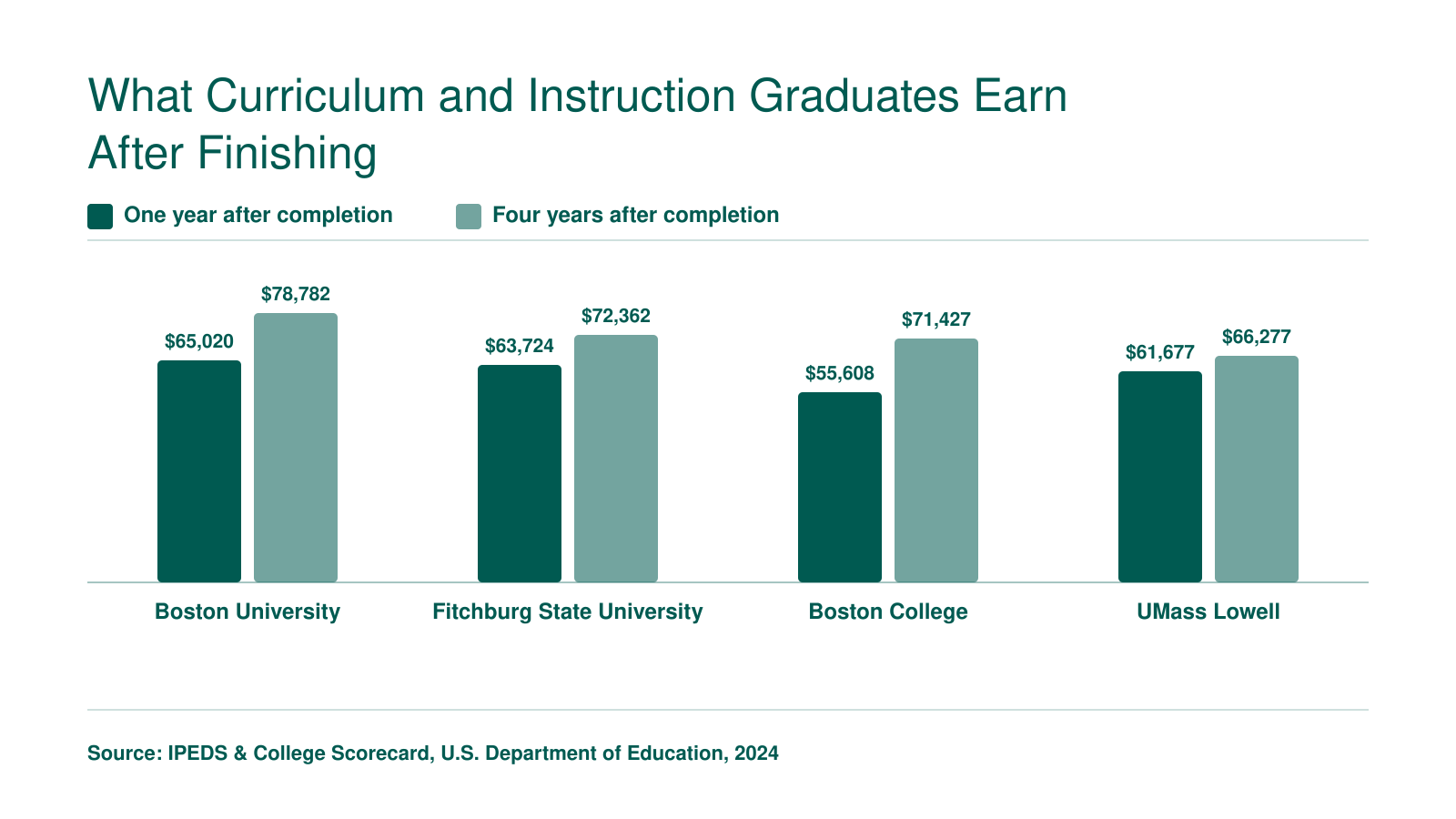
The chart shows median earnings for graduates of each school's own master's program, one and four years after completion. Only schools with published program-level figures appear. Four years out, medians run from $66,277 at UMass Lowell to $78,782 at Boston University. Median debt at completion is $20,500 at those two schools, $20,500 at Boston College, and $17,119 at Fitchburg State. So four-year earnings are roughly three to four times the debt load, a solid return for educators seeking advancement.
Curriculum and Instruction Master's in Massachusetts: Your Questions Answered
These answers cover the questions applicants ask most about licensure, transfer credit, speed and the move to a Professional license. Policies change by catalog year, so confirm details with each program before you apply.
Do I need a Massachusetts teaching license to enroll in a curriculum and instruction master's program?
How do licensure and non-licensure curriculum and instruction master's tracks differ?
Can I transfer graduate credits into a Massachusetts curriculum and instruction master's?
Is there an accelerated way to finish a curriculum and instruction master's in Massachusetts?
Will this master's help me move from an Initial to a Professional license in Massachusetts?
Compare Curriculum & Instruction programs on the data that matters
Explore more Education & Teaching specializations or browse every graduate field.
All Education & Teaching programs