Chestnut Hill, MA · Private nonprofit · Master of Education · Hybrid
3Program tracks
47Master's degrees awarded (2025)
3%Of Boston College master's degrees
$71,676Median earnings in the field, 4 yrs after
$29,642Median debt in the field
$37,520Avg. graduate tuition and fees / yr
Boston College's M.Ed. in Educational Leadership: Cost, Tracks, and Value
Boston College's Lynch School charges $1,908 per credit for graduate study, which puts the 30-credit M.Ed. in Educational Leadership at $57,240 in tuition before fees. The Catholic Leadership Cohort, which awards the same degree, is priced on a separate and lower per-credit rate.
The two questions that decide most applicants' choice are what the credential actually costs and whether it earns a Massachusetts principal license. On the second, the answer comes with a large caveat: the program is DESE-approved and monitored, but the principal licensure pathway is paused indefinitely, and the license itself still requires the teaching experience and field-based hours the state demands.
The price is knowable in advance. The return is not, because it arrives through a district salary schedule rather than at graduation.
Key Points
Standard M.Ed. tuition runs $57,240 at $1,908 per credit for 30 credits.
Graduates earn a median $71,676 four years out, against $29,642 federal debt.
Three decision rounds are published for Spring 2027 entry in 2027.
Program tracks
Master of Education in Educational Leadership & Policy Master of EducationHybrid
Boston College's Master of Education in Educational Leadership & Policy prepares you to become a transformational leader in schools, districts, or community organizations. The curriculum blends leadership theory with policy analysis, covering organizational change, data-driven improvement, family engagement, and ethical decision-making. You can tailor your degree through concentrations in Social Justice Leadership, Educational Policy Development, or the Catholic Leadership Cohort—a 20-month online program with retreats. Core courses include Instructional Leadership, Educational Law, and a final Reflection Seminar where you synthesize your learning. Graduates pursue roles as principals, instructional coaches, policy developers, or directors of community programs. The program is offered online or hybrid, with fall, spring, and summer start dates. You'll learn from faculty who are both scholars and practitioners, and benefit from a supportive community focused on equity and social justice. With 30 credits and a typical two-year completion timeline, this flexible M.Ed. empowers you to drive meaningful change in education.
Master of Education in Educational Leadership & Policy Master of EducationHybrid
Concentration: Social Justice Leadership
The M.Ed. in Educational Leadership & Policy with a concentration in Social Justice Leadership at Boston College prepares educators to lead for equity. The curriculum blends core courses in organizational theory, instructional leadership, and data-driven improvement with specialized courses on leadership for social justice, ethics, and supporting emergent bilinguals. Students graduate equipped to drive systemic change in schools, community organizations, or policy arenas. The program is offered in hybrid and online formats, allowing working professionals to complete 30 credits in two years, with start terms in fall, spring, or summer. Boston College's Lynch School provides over $13.8 million in financial aid annually.
Master of Education in Educational Leadership & Policy Master of EducationHybrid
Concentration: Educational Policy Development
Boston College's Master of Education in Educational Leadership & Policy with a concentration in Educational Policy Development prepares you to drive meaningful change in education. This 30-credit, 2-year program offers online and hybrid formats with fall, spring, or summer start dates. The curriculum combines core leadership courses with specialized policy training, including Educational Policy Analysis and Applied Education Policy in the Community Context. You'll learn to use policy levers to advance equity and organizational goals. Ideal for aspiring policy developers, directors of community organizations, and school leaders, the program emphasizes critical reflection, data-informed decision-making, and social justice. Graduates are equipped to shape policy at local, state, and organizational levels. The Lynch School is ranked #21 nationally for Education Policy by U.S. News, and you'll learn from experienced faculty committed to transformational leadership.
How Boston College compares in Educational Leadership
454 schools in our directory offer a master's in Educational Leadership, 356 of them with an online or hybrid option.
Boston College
National median (458 schools)
Median earnings, 4 years after the degree
$71,676
$69,836
Median federal debt
$29,642
$28,097
Source: U.S. Department of Education, College Scorecard field-of-study data for master's graduates. Figures cover the whole field family at each school, not one program alone.
Boston College M.Ed. Educational Leadership: Key Facts at a Glance
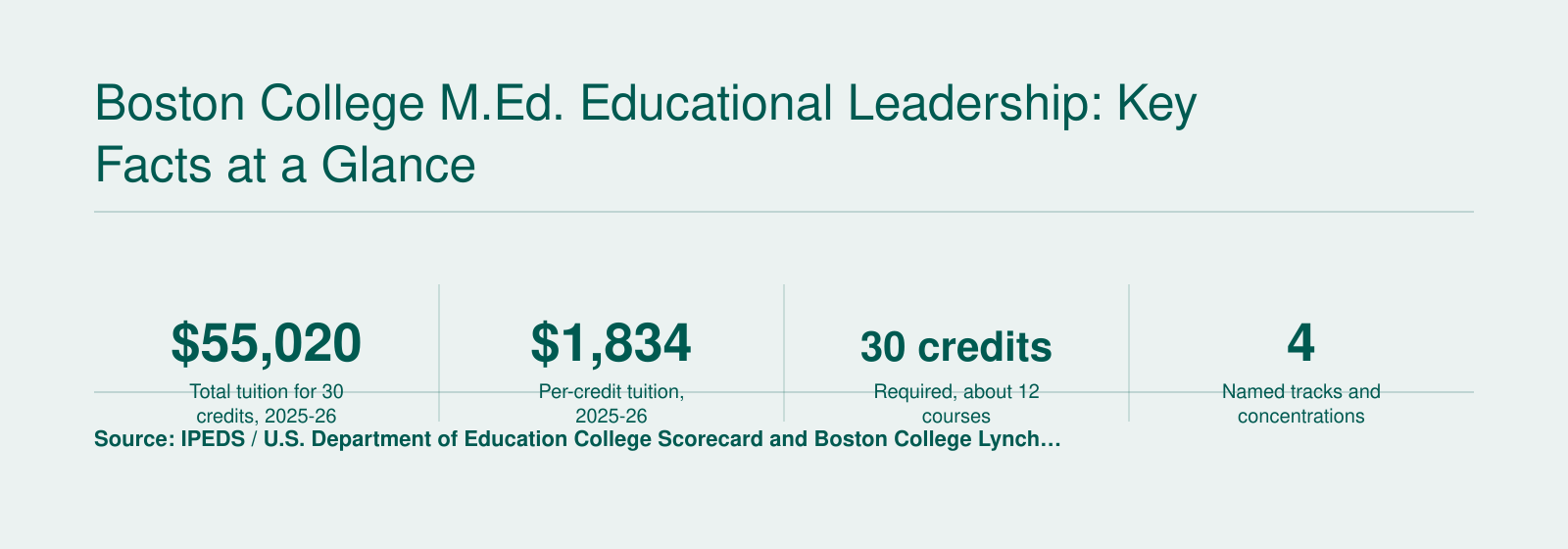
Boston College's M.Ed. in Educational Leadership & Policy is housed in the Lynch School of Education and Human Development in Chestnut Hill, Massachusetts, and is offered in online and hybrid formats. The degree runs 30 credits, roughly 12 courses over about two years, with four named pathways. The university is accredited by the New England Commission on Higher Education; two questions shape the rest of this page, what the program costs and what it licenses you to do in Massachusetts.
Tracks and Specializations: Standard M.Ed. vs. the Catholic Leadership Cohort
The choice between Boston College's standard master's in educational leadership and its Catholic Leadership Cohort comes down to pace, peers, and purpose rather than price: both award the same 30-credit degree, but one finishes in about 20 months with a fixed group of Catholic school educators, while the other runs a typical two years and leaves room to build a policy or social justice focus.
Policy development and social justice are formal concentrations
The distinction is formal and easy to miss. Educational Policy Development and Social Justice Leadership are formal concentrations within the Lynch School's Educational Leadership and Policy M.Ed., not informal elective clusters a student assembles alone. Policy Development consists of three courses on how policy shapes cultural norms and day-to-day practice, from a single school building up through district, city, and state levels. Both concentrations sit inside the same 30-credit degree; published program information does not attach a separate or larger credit total to either one.
Who the Catholic Leadership Cohort is for
The cohort is an Accelerated Master's in Educational Leadership pathway, not a second degree. Participants cover the same 30 credits in 20 months, and 12 of those credits are cohort-only courses on leadership in Catholic education, organized around Mission and Catholic Identity, Governance and Leadership, Academic Excellence, and Operational Vitality. The rest of the coursework is taken alongside public and charter school leaders, so the peer network stays wider than one sector. Four retreat opportunities are built into the calendar, and the 2024-2025 program of study listed ten 3-credit courses plus a comprehensive exam. It is designed for Catholic school and mission-driven educators: typically teachers and administrators in parish, diocesan, or religious-order schools who intend to keep leading in Catholic education. The schedule is where it diverges most from the standard track: a fixed sequence with one entering group, rather than the standard track's individual course-by-course pacing across two years. Published materials do not set out separate admissions criteria for the cohort, so confirm current application requirements with the Lynch School.
What to weigh before choosing
Credit load: 30 credits on every path, the standard track, both concentrations, and the cohort.
Completion pace: roughly 24 months on the standard track, 20 months in the cohort.
Cohort structure: a fixed group, four retreats, and 12 credits of Catholic-education leadership coursework.
Fieldwork: published program information describes practicum opportunities across Lynch School master's programs but does not specify a required hour total for any of these paths.
Licensure alignment: the two concentrations keep you in the general M.Ed. stream that public-district candidates typically follow, while the cohort's curriculum is oriented toward Catholic school governance and mission.
Tuition, Fees, and the Total Cost of the 30-Credit M.Ed.
Boston College publishes two tuition paths for this 30-credit M.Ed., and neither one is the full cost of attendance. At the standard Lynch School graduate rate of $1,908 per credit, tuition comes to $57,240; the Catholic Leadership Cohort rate of $1,424 per credit brings tuition to $42,720, and both are 2026-27 estimates that exclude university fees, the $4,403 student health insurance charge for 2025-26, books, and living costs, so relocating students should budget separately for housing and personal expenses. The university-wide graduate average of $37,520 per year is context only, third-party listings of $1,834 per credit or $27,510 per year may reflect a different reporting year, program category, or annual rather than total-program pricing, and the bursar's current per-credit schedule is the billing baseline; ask the program directly whether course or technology fees apply and whether merit scholarships, need-based aid, or graduate assistantships are available and reduce the per-credit rate.
Cost Component
Amount
Basis / Source
Standard M.Ed. per-credit tuition
$1,908 per credit
Lynch School graduate rate for 2026-27; the bursar's program-specific schedule is the billing baseline
Catholic Leadership Cohort per-credit tuition
$1,424 per credit
Lynch School Catholic Leadership Cohort rate for 2026-27
Total credits required
30 credits
M.Ed. in Educational Leadership & Policy requires 30 credits, normally over two years
Standard M.Ed. tuition at 30 credits
$57,240
30 credits at $1,908 per credit; 2026-27 estimate; excludes fees and other expenses
Catholic Leadership Cohort tuition at 30 credits
$42,720
30 credits at $1,424 per credit; 2026-27 estimate; excludes fees and other expenses
Graduate student fee
$116 per semester
Boston College graduate mandatory fees, 2026; charged per semester
Student health insurance
$4,403
2025-26 annual rate; confirm waiver eligibility with the bursar
Indirect cost allowance
$1,300
2025-26 graduate cost-of-attendance estimate; not a billed tuition or mandatory fee
Third-party directory per-credit figure
$1,834 per credit
Mastersportal listing, 2026; does not match the current official Boston College schedule
Third-party directory annual figure
$27,510 per year
Mastersportal listing, 2026; annual figure, not a 30-credit total; methodology may differ
Institution-wide average graduate tuition and fees
$37,520 per year
IPEDS 2024, full-time; school-wide average for Boston College, not this program's price
Online, Hybrid, or On-Campus: How the Lynch School Delivers the Degree
Fully online and hybrid are not competing formats at Boston College so much as two versions of the same part-time Lynch School degree. The M.Ed. in Educational Leadership & Policy is an online master's in educational leadership that can be completed fully online, and the school also lists a hybrid option. Neither route requires you to relocate or pause your career.
What the Online Format Actually Looks Like
Boston College describes the online classroom as interactive virtual instruction: small classes, direct access to instructors, and virtual breakout rooms rather than recorded lectures alone. The program does not publish a course-by-course breakdown of live versus self-paced work, so expect some scheduled sessions and confirm the weekly rhythm with admissions before you commit. The 2026 program page presents the degree as fully online; the online-program listing says "Fully online or hybrid." No required campus residencies or on-campus intensives are identified for the online route. The hybrid label is best read as an option for students who want some campus connection, not as a requirement for everyone. If you live outside commuting range, ask what face-to-face elements, if any, the hybrid format adds.
Time to Completion
The degree requires 30 credits across 12 courses. Boston College presents it as a part-time program with a typical 24-month timeline and fall, spring, and summer entry points. A working educator can reasonably plan on two years by carrying a steady load; the 24-month figure is the realistic benchmark, not a minimum. The school does not publish a separate full-time track or a guaranteed faster timeline, so anyone hoping to compress the degree should ask whether summer terms or extra courses per term are allowed. Summer enrollment and hybrid options are specifically available to Educational Leadership & Policy students.
The Catholic Leadership Cohort
The Catholic Leadership Cohort runs 20 months, shorter than the standard 24-month sequence, and delivers coursework online. That tighter calendar matters for a full-time teacher: it likely means less slack in a given term and less room to skip summer. Compare the cohort's fixed sequence with the standard track's flexibility before choosing.
A Predominantly In-Person Graduate School
IPEDS / U.S. Department of Education College Scorecard data for 2024 show Boston College enrolled 6,013 graduate students; 800 (13%) studied exclusively online, 1,392 (23%) took some online courses, and 3,821 (64%) took none. The Lynch School's online M.Ed. is therefore a deliberate exception at a largely in-person university. That cuts both ways: a compact, career-oriented online cohort on one side, less spontaneous contact with the wider campus on the other.
Admissions, Deadlines, and Who the Program Is For
The Lynch School admits on a rolling basis, with three decision rounds published for Spring 2027 entry.
Bachelor's degree from an accredited institution
A completed bachelor's degree is the baseline requirement. Boston College does not publish a minimum GPA for this program, so your transcript, prior coursework in education or policy, and professional record do the persuading.
Three Spring 2027 deadlines
September 24, 2026 is the preferred decision deadline, October 29, 2026 is the priority decision deadline, and December 3, 2026 is when rolling admissions close. Applying in the earlier rounds generally gives you more time to sort out financial aid and enrollment logistics before the term starts.
Relevant experience, no stated minimum
The application asks you to describe work with Pre-K through 12th grade classrooms, after-school programs, community-based programs, and adult education settings. No minimum number of years is published, which means career-changers and newer teachers are not automatically screened out.
Two letters of recommendation
At least one should ideally be academic, written by a professor or someone who supervised your academic work. Applicants who have been out of school for more than a couple of years may submit two professional letters instead, typically from a principal, work supervisor, or volunteer supervisor.
Personal statement and supporting materials
The full essay prompt is not published publicly, but the application asks you to account for your academic history, relevant work experience, teaching licenses currently held, any global education or global citizenship experience, non-English language skills, research experience, and publications. Treat the statement as a fit essay: why educational leadership, why Boston College, and what problem in schools you intend to work on.
GRE not required
The GRE is optional and scores may be submitted voluntarily if you believe they strengthen your file; the Lynch School's reporting code is 3218. Boston College's published requirements do not reference the MAT.
Application fee and submission
The fee is $75 and is currently waived for this program. Everything goes through the online application, including uploaded transcripts and supporting documents; an admissions interview is not described in the published requirements.
Massachusetts Principal and Administrator Licensure: What the M.Ed. Actually Qualifies You For
Does Boston College's Master's in Educational Leadership program recommend graduates for a Massachusetts principal license? Yes, with a timing caveat that matters more than the yes. The Lynch School's M.Ed. in Educational Leadership & Policy is a Massachusetts DESE-approved and monitored educator-preparation program, and Boston College states that successful completion carries its endorsement for Massachusetts licensure. But the principal/administrator licensure pathway is paused indefinitely and not accepting applications for 2027, and program materials list it as paused as of 2026 as well. A degree can prepare you for leadership, but program approval is not the same thing as a recommendation for every license level, and it does not guarantee an open application cycle.
The license levels and the field requirement
Massachusetts issues Initial Principal/Assistant Principal licenses at three levels: PreK, 6, 5-8, and 9-12.1 Candidates demonstrate the Professional Standards for Administrative Leadership through an approved program, an administrative apprenticeship or internship, or panel review, and they complete the Department's Performance Assessment for Leaders. The clinical requirement is 500 hours in the Principal/Assistant Principal role at the level of the license sought, with a trained mentor.1 State materials do not give separate hour totals for each level; the available evidence indicates the 500-hour requirement applies generally. Boston College says its licensure program includes a Massachusetts practicum and that all practicum hours must be in a Massachusetts PK-12 school under BC supervision. The university does not state whether the M.Ed. practicum supplies the full 500 hours.
MTEL and the SEI condition
Applicants for an administrator license other than Temporary must pass the MTEL Communication and Literacy Skills Test.1 Available sources do not establish a separate principal subject-matter MTEL for the PreK-6, 5-8, or 9-12 license. Since July 1, 2014, a first administrator license other than Temporary as a principal or supervisor/director of a core academic teacher requires an SEI Administrator Endorsement when the administrator supervises or evaluates core academic teachers serving English learners.1 Route materials list SEI evidence "if applicable," so confirm whether your intended role triggers it.
What to confirm with DESE and the Lynch School
Track status: Whether the principal/administrator licensure pathway is accepting applicants for your intended start term, given the pause through 2027.
License-level recommendation: Whether completion leads to a DESE recommendation for PreK-6, 5-8, or 9-12, the level you actually need.
Practicum hours: Whether the BC-supervised practicum meets the full 500-hour requirement or only part of it.
SEI and tests: Which requirements are built into the program and which you must complete separately.
Out of state? Check your own state's licensure and reciprocity route before enrolling. A Massachusetts license is not a universal credential, and BC's Massachusetts PK-12 practicum setting can complicate field placements for candidates who plan to work elsewhere.
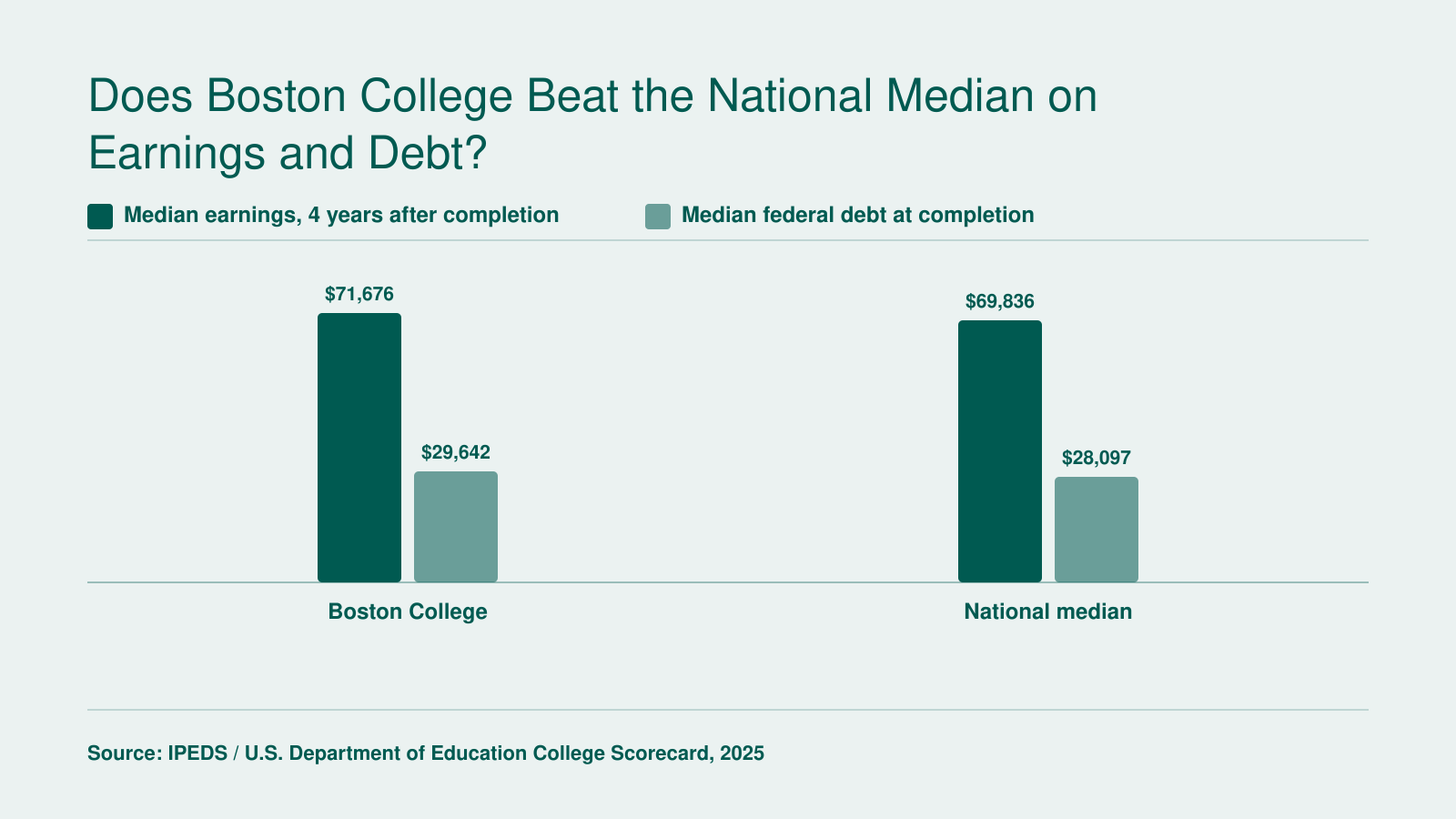
Does Boston College Beat the National Median on Earnings and Debt?
Boston College's graduates in educational leadership and administration earn slightly more than the national midpoint for the field four years after finishing, and they borrow slightly more to get there. The university awarded 47 master's degrees in this field in 2025, about 3% of its 1,516 master's degrees, ranking #81 of 568 institutions nationally by degrees awarded. Nationally the field is wide: a directory of this program lists 454 schools, 356 of them offering an online or hybrid route, including 10 in Massachusetts.
Careers and Salary After the Lynch School M.Ed.
A Lynch School M.Ed. can move you into school leadership, but the salary payoff follows a district calendar rather than a graduation date.
Where graduates actually land
Boston College's program page lists recent alumni in roles such as master teacher, program support coordinator, dean of new faculty, director of identity and mission, and associate director of admission, at employers including Thayer Academy, Newton Country Day School, Boston College High School, Bridge Boston, The Derryfield School, and Chamberlain International School. The department frames the wider career map as school principal, vice principal, superintendent, curriculum director, and dean of students, alongside central-office, higher education administration, and policy roles. Boston College does not publish a placement rate or the share entering administrator positions, so treat those destinations as intended outcomes rather than measured placements.
Two salary numbers that answer different questions
Four years after completion (federal College Scorecard): median earnings of $71,676 for Boston College master's graduates in educational administration and supervision, against a national median of $69,836, with median federal debt of $29,642.
Working administrators in Massachusetts (School Administrator Salary in Massachusetts, October 1, 2026): mean annual wage of $119,918, a middle range of $105,320 to $134,912, and a 90th percentile of $148,564.
The first describes early-career graduates across the field, many of whom are still teachers or coordinators. The second describes people already holding administrator titles. Neither is a starting salary for this M.Ed., and the two should not be averaged.
Timing and the small-cohort trade-off
Massachusetts principal and administrator roles generally expect a state license plus several years of classroom or teacher-leader experience, so most graduates move into leadership over a multi-year arc rather than immediately. Boston College awarded 47 master's degrees in this field in 2025, which makes for a tight cohort and a close alumni network but also means fewer graduates in any one district or region to call on when a position opens. The four-year earnings figure also understates the ceiling: principal, director, and superintendent tracks pay well above it once experience and educational leadership master's licensure by state are in place.
Is Boston College's Educational Leadership M.Ed. Worth It?
Median earnings four years after completing Boston College's educational leadership master's were $71,676, against median federal debt of $29,642 at graduation, according to IPEDS / U.S. Department of Education College Scorecard figures. That is roughly $2.40 in annual earnings for every $1 borrowed, a workable ratio but not one that settles the decision by itself.
When the Answer Is Yes
The degree earns its price when three things line up: you need a Massachusetts principal or administrator license, the cohort-based Catholic mission is a real fit rather than a brochure line, and $29,642 in median federal borrowing is absorbable on an educator's salary. Boston College awarded 47 master's degrees in this field in 2025, enough to sustain genuine cohorts without turning seminars into lecture halls.
Where the Salary Case Is Thinner
The premium over the national median of $69,836 is $1,840 a year, about 2.6 percent. If you are enrolling mainly to raise your pay, that is a modest return against a school-wide average graduate tuition and fees of $37,520 per year (IPEDS 2024; individual programs set their own rates). The return that matters is licensure access and the mobility a principal or administrator credential provides, not a first-year pay bump.
Who Should Look Elsewhere
Fully online or asynchronous learners: confirm delivery format early, because the cohort structure shapes the calendar.
Cost-first comparers: a lower-priced state program with the same license outcome may serve you better.
People outside school settings: the cohort model pays off in districts and Catholic schools that recognize it.
Three Questions for Admissions
Total cost of attendance: tuition plus fees plus health insurance across the full credit load, not just the per-credit rate.
Licensure recommendation: whether completion leads to a Massachusetts administrator endorsement, and in which track.
Part-time timeline: how many terms a part-time student needs and whether the cohort sequence locks it.
Next Step
Ask admissions to send, in writing, the state licensure disclosure for your intended license and a line-item cost sheet for the whole program. Set both beside your district's salary schedule before you deposit.
Frequently Asked Questions About Boston College's Educational Leadership M.Ed.
Prospective students tend to ask the same handful of questions about Boston College's Lynch School M.Ed. in Educational Leadership and Policy: whether it leads to a principal license, what it costs, how it is delivered, who gets in, and what the Catholic Leadership Cohort involves. The answers below draw on Boston College's own program and tuition pages.
Does Boston College's M.Ed. in Educational Leadership lead to principal licensure?
Not currently through the principal pathway. Boston College has paused its principal and administrative licensure track indefinitely and is not accepting applications for 2027. The M.Ed. in Educational Leadership and Policy remains available through other concentrations, and Boston College is an approved educator-preparation program, but current materials do not establish that the enrolling pathway leads to principal licensure while that track is paused.
How much does Boston College's educational leadership M.Ed. cost?
The 30-credit program carries an estimated total tuition of $57,240 at 2026-2027 rates, before fees and other expenses; rates are set annually and typically rise each year. Boston College's tuition page separately lists $1,424 per credit for the Catholic Leadership Cohort in 2026-2027, so confirm the rate for your specific track before you budget.
Is Boston College's educational leadership program available online?
Yes, in part. Boston College offers online and hybrid options for the M.Ed. in Educational Leadership and Policy, and the Catholic Leadership Cohort is delivered online. Published materials do not confirm that every concentration or general-track course can be finished fully online, so check the delivery format of the specific track you intend to enter.
What are the admission requirements for Boston College's M.Ed. in Educational Leadership?
Applicants need a bachelor's degree and transcripts from every college or university they have attended. The GRE is accepted but not required, and the $75 application fee is currently waived. Confirm any additional materials, such as essays or recommendations, directly with the Lynch School admissions office before you apply.
What is the Catholic Leadership Cohort at Boston College?
It is a selective cohort run by Boston College's Barbara and Patrick Roche Center for Catholic Education for sitting, emerging, and aspiring Catholic-school leaders, who earn the Lynch School M.Ed. It spans 20 months and 30 credits, including 12 credits focused on Catholic education leadership plus four retreats. The next cohort begins in fall 2028, with applications due September 1, 2027.