Best MBA/MPH Programs in New Jersey
Compare 7 accredited MBA/MPH programs in New Jersey at 4 schools, with graduate earnings, cost, debt, and completion data from IPEDS and the U.S. College Scorecard.

An MBA/MPH pairs business school coursework with an MPH program curriculum: 84 total credits at Rutgers, 63 at The College of New Jersey. New Jersey's hospital systems, pharmaceutical firms, and insurers hire for that combination, management skill plus epidemiology and health policy.
No program on this list runs fully online; the options are campus and hybrid. Rutgers dual degree graduates report median earnings near $67,600 a year after finishing, against about $41,000 in median debt. The degree pays, but the timeline on that payoff is the real variable, compare Most Affordable MBA/MPH Programs before you commit.
Key Points
- None of these MBA/MPH programs can be completed fully online; the flexible options are hybrid.
- TCNJ's 63-credit joint degree runs about $73,720.71 in tuition alone, before fees.
- Rutgers charges out-of-state students roughly $14,400 more per year than New Jersey residents.
Best MBA/MPH Schools in New Jersey: 2027 Rankings
Schools are ordered by graduate outcomes, net price, debt, and program completions. Each card notes MBA (AACSB) and MPH (CEPH) accreditation where research confirms it. Graduation rates describe each school as a whole, not the dual degree alone.
Rutgers University
#1New Brunswick, NJ · ~$23,000/yr (est.)
Best for: Health care managers studying part-time
Rutgers New Brunswick runs its MBA/MPH jointly through Rutgers Business School and the School of Public Health, and the school graduates about 84% of its students. Rutgers Business School is AACSB-accredited, and the School of Public Health holds CEPH accreditation through July 2031. Health Systems and Policy is the only MPH concentration offered with the MBA, which suits students aiming at hospital and health-system leadership.
- 84 total credits across both degrees
- 15 credits in Health Systems and Policy core courses
- 6 credits of fieldwork
- Full-time and part-time options
- GMAT or GRE required
- Calculus and statistics prerequisites
- Separate applications to both schools
- One year of management experience preferred
The College of New Jersey
#2Ewing, NJ · ~$18,000/yr (est.)
Best for: Analytics-minded students seeking epidemiology focus
TCNJ in Ewing offers a two-year joint MBA/MPH that pairs a business analytics MBA with a public health concentration, and the school graduates about 86% of its students. Its School of Business is AACSB-accredited, and its public health programs are CEPH-accredited, though the exact accreditation terms were not confirmed. The 63-credit total is lower than the Rutgers dual degree, and the program mixes on-campus and online learning.
- MBA specialized in business analytics
- MPH in epidemiology and health analytics
- 63 total credits: 30 MBA and 33 MPH
- Two-year program
- MBA in business analytics paired with an MPH in health communication
- Joint MBA and MPH degree
- Two-year track with 63 total credits
Rutgers University-Newark
#3Newark, NJ · ~$23,000/yr (est.)
Best for: Commuters near Newark's health-sciences campus
Rutgers Newark delivers the same Rutgers School of Public Health and Rutgers Business School dual degree as New Brunswick, so the AACSB and CEPH accreditation described above applies here too. The school graduates about 64% of its students overall. Classes are held on campus, near Rutgers' Newark health-sciences environment.
- 84 total credits
- Health Systems and Policy concentration
- 6-credit fieldwork component
- On-campus classes with full-time or part-time pacing
- GMAT or GRE required
- Two separate applications needed
Montclair State University
#4Montclair, NJ · ~$16,000/yr (est.)
Montclair State pairs its College for Community Health with the Feliciano School of Business, with a focus on health equity and healthcare management. The MPH is CEPH-accredited, but AACSB status for the business school could not be confirmed here, so verify it before applying. The school graduates about 65% of its students, and some courses count toward both degrees for an expedited path.
- Health Systems Administration and Policy concentration
- Courses count toward both degrees for an expedited path
- GRE listed, with a waiver available for high GPA
- 2.3 minimum GPA and two recommendation letters
- Rolling admissions with fall and spring starts
- Application fee waiver available
Cost & outcomes by school
Federal data for the highest-earning MBA/MPH programs, independent of the ranking above. Earnings are this field's master's graduates four years after completing, where the Scorecard reports them.
| School | Earnings | Tuition / yr | Debt | Grads/yr | Format |
|---|---|---|---|---|---|
| Rutgers University NJ | $85,904 | $23,241 | $41,000 | 253 | Campus |
| Rutgers University-Newark NJ | $85,904 | $23,221 | $41,000 | — | Campus |
| Montclair State University NJ | $69,383 | $16,056 | — | 33 | Hybrid |
| The College of New Jersey NJ | — | $18,349 | — | 21 | Hybrid |
Sources: U.S. Department of Education. Tuition and graduates: IPEDS. Earnings and debt: College Scorecard, this field's master's graduates; a dash means no figure is reported.
Online and Hybrid MBA/MPH Options in New Jersey
None of the MBA/MPH programs here can be completed fully online. The flexible options are hybrid, but even those require campus attendance at set points.
The College of New Jersey runs its MBA/MPH dual degree as a full-time, two-year hybrid program totaling 63 credits (30 MBA, 33 MPH).1 TCNJ's MBA model requires two in-person Saturday residencies each fall, spring, and summer term, while winter coursework is fully online.2 Even if most of your weeks are remote, plan around those Saturdays.
Montclair State University offers an accelerated MBA/MPH with a concentration in Health Systems Administration and Policy, in both on-campus and hybrid formats. Ask admissions for the combined timeline, because the dual-degree page does not spell it out.
Rutgers University and Rutgers University-Newark list the dual degree as a campus program. Rutgers also notes that its dual MBA programs are typically full-time and may not suit part-time study.
If you are employed, confirm before you commit whether core MBA courses run in evening or weekend sections.
Which New Jersey MBA/MPH Programs Waive the GMAT or GRE?
Testing rules for the MBA/MPH vary among Master's Programs in New Jersey, and sometimes from the standalone MBA at the same school.
- Rutgers: No MBA/MPH-specific page or waiver criteria are published. Rutgers Business School requires a score for dual degrees other than PharmD/MBA, so assume a score is needed and confirm with admissions. Its full-time MBA allows waiver requests.
- The College of New Jersey: The MBA/MPH requires the GMAT or GRE, taken within five years, with targets of 540 or 310. Exemptions cover an undergraduate business GPA of 3.4 or higher, an advanced degree, or military service; others are reviewed case by case. The standalone MBA is among No-GRE master's programs and does not require a test.1
- Montclair State University: The dual-degree page lists the GRE and waives it automatically with a prior bachelor's or master's at a 2.75 cumulative GPA. It publishes no GMAT policy for the dual degree, so ask admissions. The standalone MBA requires no test.
Policies change by cycle, so check the admissions page for your entry term.
MBA/MPH Admissions Requirements and Application Deadlines
Requirements vary by school, and deadlines change each cycle, so confirm dates on each admissions page before you apply.
- Degree and GPAAll three schools require a bachelor's degree. Montclair State University accepts a U.S. bachelor's equivalent and has an equivalency process for international applicants. Montclair's 2.75 GPA marks an automatic GRE waiver, not a stated admission minimum. TCNJ also lists GPA only as test-score guidance.
- PrerequisitesThe sources name no required prerequisite courses or majors. Brush up on statistics and quantitative skills anyway.
- Application structureRutgers requires separate applications to Public Health (paper) and Business (online). Dual status follows admission to both. Montclair describes one online application with a $60 fee or waiver. TCNJ's pages don't spell it out, so ask Graduate Enrollment. Ask each program whether you can add the second degree after enrolling.
- Start terms and deadlinesRutgers and Montclair offer Fall and Spring starts. Rutgers' MPH Fall priority date is January 15, with a regular deadline of July 1. Montclair lists a Spring date of October 17 and a Fall priority date of April 1. TCNJ is Fall-only, with a dual deadline of August 6 and a general MBA priority date of April 1.
- Experience and materialsEach school requires a resume and two recommendations. Montclair asks for a 500–1,000-word statement. No minimum work experience is stated. Rutgers requires the GRE or GMAT, and TCNJ requires one or the other within five years unless you qualify for an exemption.
Related Articles
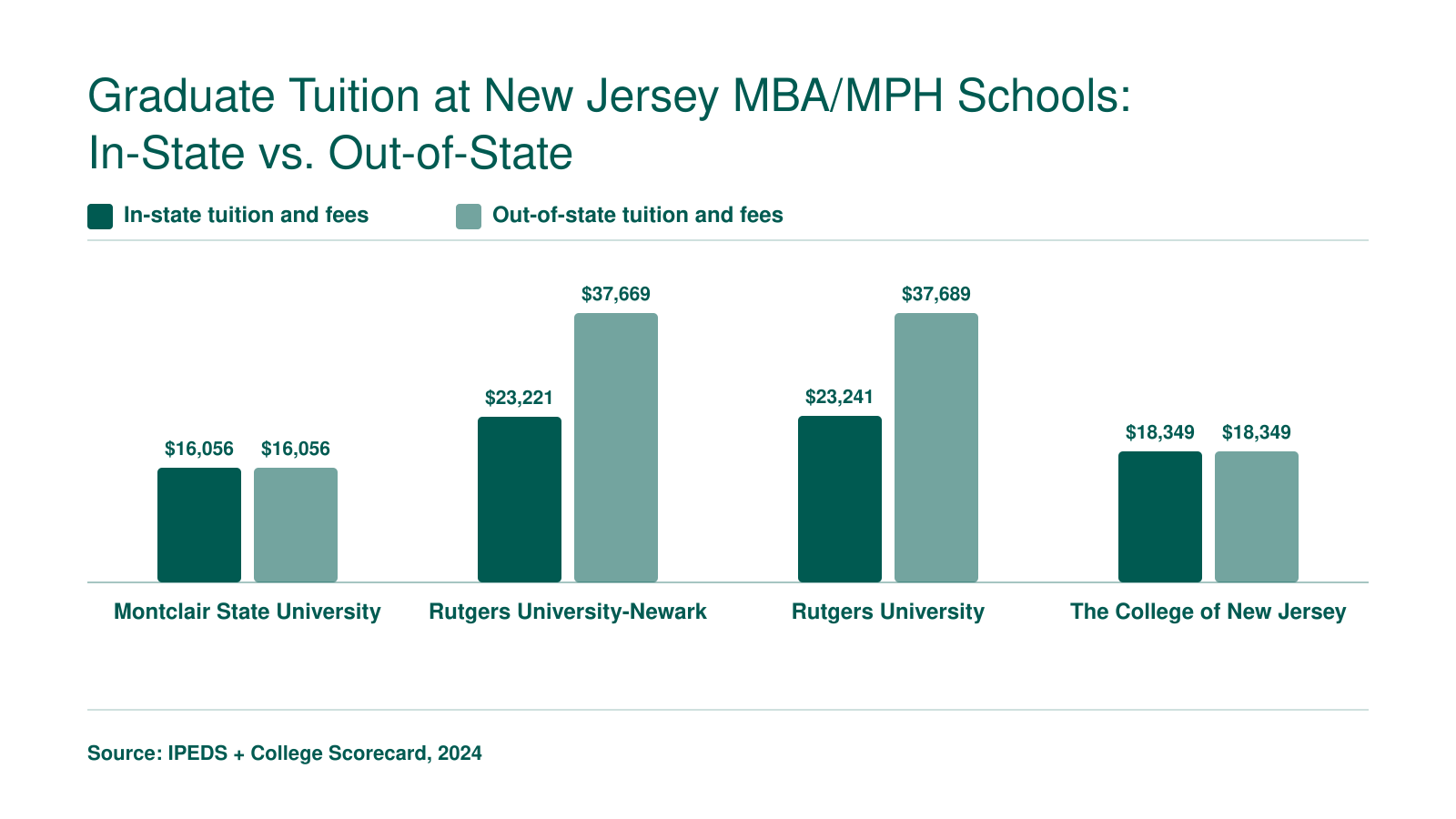
Graduate Tuition at New Jersey MBA/MPH Schools: In-State vs. Out-of-State
Annual graduate tuition and fees vary widely across these schools, and residency matters most at Rutgers. Both Rutgers campuses charge out-of-state students about $14,400 more per year, while Montclair State University and The College of New Jersey publish one rate for both groups. These are annual published rates, not the total cost of a dual degree, which runs several semesters longer.
MBA/MPH Costs, Net Price, and New Jersey Employer Demand for MBA Graduates
Tuition is the clearest separator here. TCNJ charges $1,170.17 per credit for 63 credits, a $73,720.71 tuition-only estimate before fees or living costs. Montclair State publishes $875 per credit plus $37.02 mandatory and $115.12 program fees per credit, totaling about $66,251 for 64.5 credits. Rutgers does not publish a current per-credit rate for its MBA/MPH; the program requires up to 84 credits, so no defensible total can be calculated without asking admissions.
The published totals run far above school-wide average net price after aid. Montclair's average net price is roughly $15,600, TCNJ's about $27,600, and Rutgers's ranges near $19,700 at Newark and $24,400 in New Brunswick. Those are institutional averages, not program-specific guarantees.
On the demand side, New Jersey has a dense cluster of hospitals, health systems, pharmaceutical and life-science companies, insurers, government agencies, and nonprofits, the kinds of employers an MBA in Healthcare Administration in New Jersey graduate typically targets. Program pages cite these as the typical settings for graduates, though they stop short of naming individual hiring employers. The return favors students who lock in aid at Montclair or Rutgers, while TCNJ's higher sticker only pays off if its analytics concentrations fit an explicit MBA in Business Analytics in New Jersey career target.
MBA/MPH Concentrations, Practicums, and Capstones in New Jersey
The concentration is the public health specialty paired with the MBA; the field work is the hands-on requirement attached to it. Rutgers University and Rutgers University-Newark both pair the MBA with the Health Systems and Policy concentration, and Rutgers says the dual degree currently participates only with that track. Montclair State University lists Health Systems Administration and Policy for its dual degree. The College of New Jersey leans toward analytics, with business analytics master's programs and Epidemiology and Health Analytics listed in its 63-credit program (30 MBA credits, 33 MPH credits).
Rutgers is the most specific on field work. Its 84-credit dual degree includes 6 field-work credits, including a 0-credit Applied Practice Experience (PRAC 0715) and a separate 3-credit Practicum Capstone (PRAC 0716).1 Hour totals were not stated, and practicum details for TCNJ and Montclair were not confirmed.
If you work full-time, ask each admissions office for expected practicum hours and whether your employer's work can count. Rutgers also advises students who want MBA-level internships through its career office to finish the MPH first and start the MBA second, so plan that sequence early.
Career Outcomes and Salary Data for MBA/MPH Graduates
The question is not whether a dual degree pays off relative to other best MBA programs in NJ, but how long the payoff takes. At Rutgers University and Rutgers University-Newark, graduates of the public health and business dual degree report median earnings of $67,571 one year after finishing, $85,904 four years after finishing, and $89,841 at the five-year mark. Median debt for that program is $41,000, or roughly $466 a month on a standard 10-year repayment schedule, which stays under 10 percent of a typical first-year salary. Montclair State University graduates report $61,438 one year after finishing and $69,383 four years out.
Those figures track the roles the credential actually feeds: operations and service-line management inside hospital systems, a Master's in Healthcare Administration in New Jersey specialty, market access and strategy work at New Jersey's pharmaceutical and device employers, healthcare consulting, county and state policy positions, and executive roles at nonprofits and foundations. Consulting and pharma tend to pull the top of the range; policy and nonprofit leadership usually pay less up front but offer steadier advancement.
A dual MBA/MPH pays off only when graduate earnings justify the net price and debt you take on, so compare outcomes, not prestige.
Compare MBA/MPH programs on the data that matters
Explore more MBA specializations or browse every graduate field.
All MBA programs