Most Affordable MBA/MPH Programs
Compare 50+ accredited most affordable MBA/MPH programs at 40+ schools, with graduate earnings, cost, debt, and completion data from IPEDS and the U.S. College Scorecard.

How much does an MBA/MPH dual degree cost compared with earning the two master's degrees separately? Usually less, because shared credits trim the total. UT San Antonio counts 9 credits toward both its 36-credit MBA and 45-credit MPH, and FIU lists $48,900 in total tuition for a 63-credit online MBA/MPH dual degree program.
Among the schools ranked here, listed in-state tuition runs from roughly $7,200 to $17,600, and average net price at these institutions falls between about $7,000 and $13,900.
Residency still drives the bill: nonresident tuition reaches about $34,400.
Key Points
- In 2027, the lowest in-state tuition here is about $7,170 at UTEP.
- Median earnings four years after finishing reach $110,900 at these schools.
- Confirm AACSB and CEPH accreditation before you apply.
Best Affordable MBA/MPH Schools: The Top 10
These ten schools stand out for combining graduate business and public health training at a lower net cost than many peers. Each entry highlights the program format, shared-credit shortcuts, and career-relevant applied experiences that can make the dual degree faster or more affordable. Use the list to compare total cost, delivery method, and fit before you commit.
Florida International University
#1Miami, FL · ~$11,000/yr (est.)
Best for: Working professionals wanting online asynchronous
FIU's Professional MBA/MPH Generalist pairs business strategy with public health in a fully online, asynchronous format. The integrated 63-credit pathway reduces time and credits compared with earning both degrees separately, and students apply to both programs independently. Graduates are prepared for leadership roles in healthcare organizations, policy, and consulting.
- $48,900 total program tuition
- 63 total credit hours
- Fully online asynchronous classes
- Integrated pathway cuts time and credits
- Apply to both programs separately
- MPH application via SOPHAS
The University of Texas at El Paso
#2El Paso, TX · $5,000 – $10,000/yr (est.)
Best for: Texas residents wanting shared-credit efficiency
UTEP's MBA/MPH is a partnership with UTHealth Houston School of Public Health that lets students transfer 12 MBA credits into the MPH, lowering duplicate coursework. The hybrid program can be completed in person, virtually, or online, and the MPH-Customized plan allows tailored public-health coursework. Applicants use SOPHAS Express and may meet deadlines in fall or spring.
- Partner with UTHealth Houston
- Transfer 12 MBA credits into MPH
- 33 MPH credit hours required at UTHealth
- 18 hours of MPH core
- 3-credit practicum included
- Hybrid in-person, virtual, or online
University of California-Los Angeles
#3Los Angeles, CA · ~$14,000/yr (est.)
Best for: Health policy and management professionals preferring campus
UCLA offers two concurrent MBA/MPH tracks through the Fielding School of Public Health and Anderson School of Management. Students can pair the MBA with an MPH in Health Policy or Health Management, both delivered onsite in a three-year format. The program includes a summer internship and consulting report, with strong career outcomes in healthcare leadership and consulting.
- Health Policy concentration
- 3-year concurrent degree
- 78 quarter-credit units
- Onsite weekday classes
- Summer internship and consulting report
- Careers in consulting or hospital administration
- Health Management concentration
- 3-year concurrent program
- 78 quarter-credit units
- Prior work experience valued
- Consulting report capstone
- Summer internship required
University of California-Berkeley
#4Berkeley, CA · ~$16,000/yr (est.)
UC Berkeley's concurrent MBA/MPH blends Haas School of Business training with Berkeley Public Health, focusing on health policy and management. The 2.5-year program includes two full-time summer internships and access to a large alumni network and dual career services. Graduates pursue roles in healthcare leadership, policy, and management.
- 2.5-year concurrent degree
- Health Policy and Management concentration
- Two full-time summer internships
- Large alumni community over 35 years
- Access to dual career services
The University of Texas at San Antonio
#5San Antonio, TX · $10,000 – $29,000/yr (est.)
UTSA's MBA/MPH dual degree combines a 36-credit MBA with a 45-credit MPH, sharing up to 9 credit hours to finish in as little as three years. The campus program requires separate applications and is not open to Online or One-Year MBA students. Recruiters include University Hospital and CHRISTUS.
- 36-credit MBA plus 45-credit MPH
- 9 shared credits across both degrees
- Complete in as little as three years
- 3.0 GPA minimum
- Separate applications required
- Up to three public health courses shared
The University of Texas Permian Basin
#6Odessa, TX · ~$9,000/yr (est.)
UT Permian Basin's MBA/MPH dual degree is a collaboration with UTHealth Houston that integrates business and public health coursework. The 60-credit hybrid program offers shared coursework and an Integrative Learning Experience, and is designed for working professionals. The program carries AACSB and CEPH accreditation per its published materials.
- AACSB and CEPH accredited
- 60 total credit hours
- Collaboration with UTHealth Houston
- Shared coursework options
- Integrative Learning Experience required
- Practicum component included
University of Illinois Chicago
#7Chicago, IL · ~$18,000/yr (est.)
UIC's MBA/MPH lets students combine one of 12 MBA concentrations with one of eight MPH programs, including epidemiology, community health sciences, and health policy. The campus program requires separate applications to the business and public health schools. It includes an applied practice experience and capstone integrative learning experience.
- 12 MBA concentrations available
- 8 MPH programs to choose from
- Capstone and applied practice experience
- Separate applications for MBA and MPH
- Interprofessional education component
University of Georgia
#8Athens, GA · ~$11,000/yr (est.)
UGA's MBA/MPH is offered with the Terry College of Business and the College of Public Health, focusing on health policy and management. The three-year accelerated program spends the first year in MPH, second in MBA, and third integrated. It includes an internship and applied practice experience.
- Health Policy and Management concentration
- 3-year accelerated program
- First year in MPH, second in MBA
- Internship and applied practice required
- Apply first to MPH, then Terry College
University of Michigan-Flint
#9Flint, MI · $14,000 – $21,000/yr (est.)
UM-Flint's MPH/MBA dual degree blends public health expertise with business acumen, offering hybrid online and on-campus attendance through Hyperflex technology. Up to 12 credits cross-count toward both degrees, and the program is CEPH-accredited. Graduates pursue roles in population health, emergency preparedness, and healthcare management.
- 12 credits cross-count toward both degrees
- Hybrid online and on-campus via Hyperflex
- Designed for public health management
- Independent degrees awarded
The University of Texas Health Science Center at Houston
#10Houston, TX · $11,000 – $34,000/yr (est.)
UTHealth Houston offers an online MBA/MPH dual degree with a healthcare management focus, designed for working professionals. The flexible program covers public health principles and business strategy, and requires a bachelor's degree and work experience. It is CEPH-accredited.
- Online dual degree
- Healthcare management focus
- Flexible for working professionals
- CEPH accredited
- Bachelor's degree and work experience required
Cost & outcomes by school
Federal data for the highest-earning MBA/MPH programs, independent of the ranking above. Earnings are this field's master's graduates four years after completing, where the Scorecard reports them.
| School | Earnings | Tuition / yr | Debt | Grads/yr | Format |
|---|---|---|---|---|---|
| University of California-Los Angeles CA | $110,900 | $14,476 | $52,445 | 198 | Campus |
| Yale University CT | $105,402 | $49,500 | $62,532 | 160 | Campus |
| Case Western Reserve University OH | $102,438 | $53,980 | $69,447 | 36 | Campus |
| Johns Hopkins University MD | $99,605 | $64,730 | $65,952 | 127 | Campus |
| Columbia University in the City of New York NY | $98,728 | $57,973 | $72,167 | 350 | Campus |
| University of Virginia VA | $92,024 | $23,526 | $45,801 | 52 | Campus |
| Claremont Graduate University CA | $91,103 | $37,180 | $92,618 | 11 | Hybrid |
| University of Alabama at Birmingham AL | $91,073 | $8,640 | $32,000 | 276 | Hybrid |
| University of Pennsylvania PA | $90,435 | $47,844 | $66,000 | 59 | Campus |
| University of Illinois Chicago IL | $89,402 | $17,550 | $45,712 | 196 | Campus |
| Emory University GA | $88,896 | $48,750 | $66,000 | 136 | Campus |
| Boston University MA | $88,820 | $67,626 | $62,334 | 265 | Campus |
Sources: U.S. Department of Education. Tuition and graduates: IPEDS. Earnings and debt: College Scorecard, this field's master's graduates; a dash means no figure is reported.
Cost, debt & payoff
Median earnings of this field's master's graduates (4 yrs after completing) vs. their median federal loan debt · U.S. College Scorecard
Across these programs the median graduate earns about $86,065 and finishes with roughly $47,787 in debt — a ratio that clears a common rule of thumb (keep debt below first-year salary). Tuition and debt vary widely school to school, so check the per-school figures in the table above before you shortlist.
How Much Does an MBA/MPH Dual Degree Cost After Aid?
At UTEP, the lowest listed in-state tuition among the schools here is about $7,170, and the out-of-state rate is about $16,620, a residency gap of roughly $9,500. That gap repeats elsewhere: UM-Flint's listed tuition runs about $6,900 higher for nonresidents, and UIC's nonresident rate is roughly $10,200 higher. A school's published average net price after aid is an institution-wide figure across all aid recipients, so it should be read as a starting point, not a promised bill for a student pursuing an MBA/MPH dual degree.
Aid that lowers the real price
Assistantships and employer benefits can change the calculation. Northern Arizona University describes a 20-hour appointment as covering full resident tuition (excluding fees) and a 10-hour one as covering half. At Penn, eligible employees can receive full tuition and general/technology fee coverage up to credit-unit limits, though graduate tuition above an annual threshold may be taxable and cannot be combined with MPH scholarships.
Dual-degree credit savings
Shared credits typically cut about a year of study. FIU advertises a 63-credit integrated pathway. UT San Antonio lists a 36-credit MBA program plus a 45-credit MPH program with 9 shared credits, reducing 81 separate credits to 72 in as little as three years. UT Permian Basin's dual degree is 45 total credits, and UTEP transfers 12 MBA credits into the MPH.
AACSB and CEPH Accreditation: Which Programs Have Both
The best MBA/MPH dual degrees carry two separate accreditations, one for each half of the credential, and you should confirm both before you apply. AACSB accreditation of the business school is the signal employers and recruiters look for on the management side. CEPH accreditation of the public health school or program is what matters for your career: many public health jobs require a degree from a CEPH-accredited program, and you need that credential to sit for the Certified in Public Health (CPH) exam.
Among the schools ranked here, the University of Texas Permian Basin states that its dual degree draws on an AACSB-accredited business school and a CEPH-accredited public health partner (UTHealth Houston). Several other programs sit inside well-established business and public health colleges, but accreditation status can change, so treat any single page as a starting point, not proof.
Verify It Yourself
- Business side: Search the school's name in the AACSB accredited-institution directory.
- Public health side: Search the school or program in the CEPH directory, which lists current accreditation dates.
Do both searches before you commit. A two-minute check protects a two-year investment.
Related Articles
Online vs. Campus MBA/MPH: Practicums, Residencies, and Hidden Costs
Who is actually online
Fully online dual degrees exist: FIU runs an asynchronous professional MBA/MPH, and UTHealth Houston offers its dual degree online. UTEP, UT Permian Basin, and UM-Flint use hybrid formats, while UCLA, Berkeley, UIC, UGA, and UT San Antonio keep coursework on campus.
Online rarely means zero travel
The MPH half almost always carries supervised field work. UTEP includes a 3-credit practicum, UT Permian Basin lists both a practicum and an integrative learning experience, and UIC requires an applied practice experience alongside its capstone. Campus programs can be heavier still: Berkeley builds in two full-time summer internships and UCLA a summer internship with a consulting report. Field requirements across public health commonly land between roughly 100 and 240 hours, sometimes more, and some online MPH formats still ask for a few on-site credits. Confirm the specifics with each program before you budget.
Budget for the field hours
Several hundred supervised hours mean commuting, scheduling around a job, and possibly unpaid time. One practical move: ask whether the practicum can be completed at your current employer, which some schools permit when the project sits outside your normal duties.
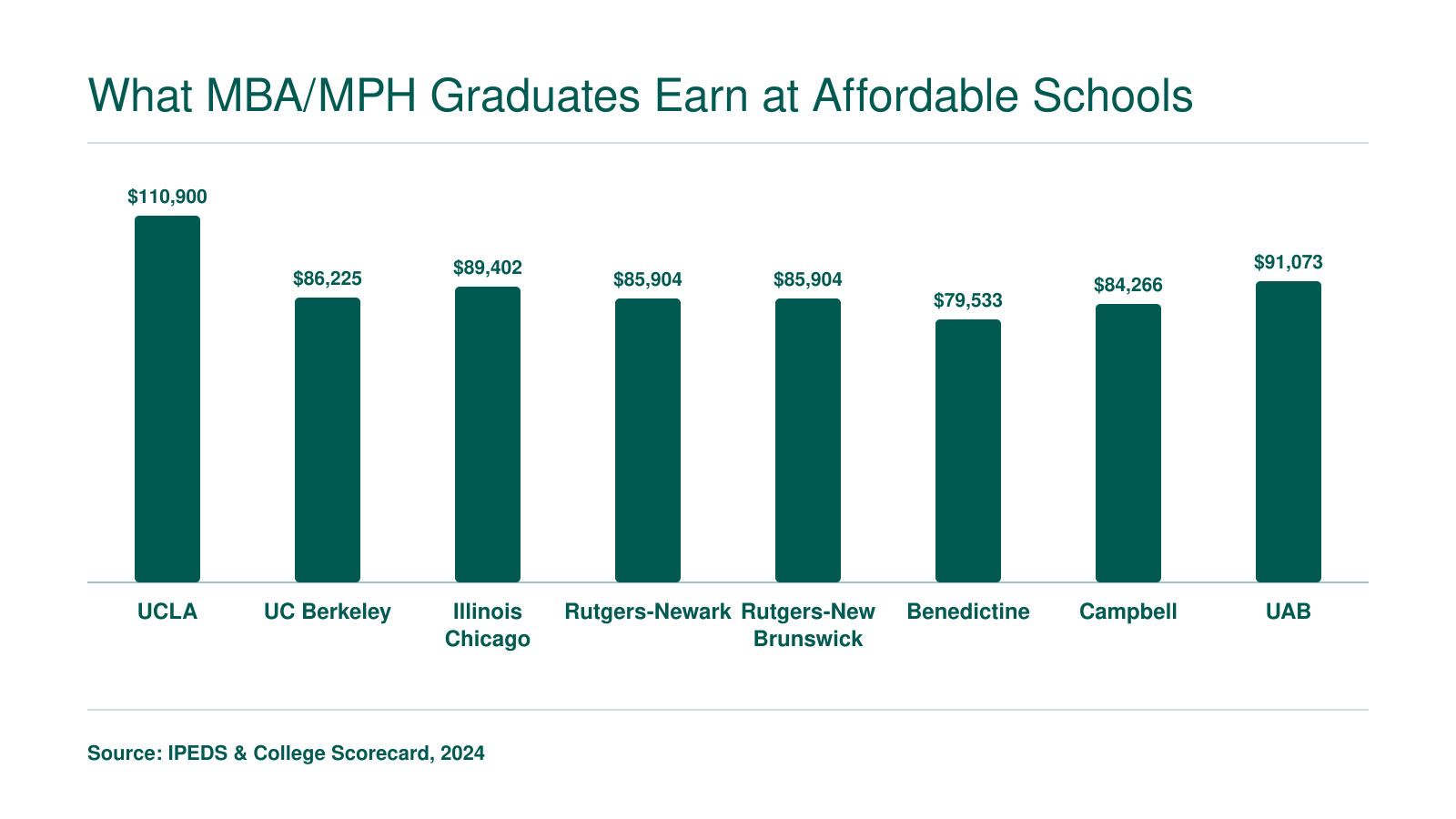
What MBA/MPH Graduates Earn at Affordable Schools
Median earnings four years after finishing range from $79,533 to $110,900 across the MBA/MPH programs below. Median federal debt ranges from $32,000 to $78,500, so the lower-cost options are not automatically the lowest-paying.
MBA/MPH programs by state
MBA/MPH Affordability: Frequently Asked Questions
Affordability questions usually come down to sticker price, hidden costs, test requirements, and logistics. Here are concise answers to the questions prospective MBA/MPH students ask most.
What is the cheapest MBA/MPH program?
Can you complete an MBA/MPH fully online with no campus visits?
Do MBA/MPH programs require the GMAT or GRE?
What prerequisites and deadlines should applicants plan for?
Compare MBA/MPH programs on the data that matters
Explore more MBA specializations or browse every graduate field.
All MBA programs