Best Master's in MBA/MSML or MSML/MBA Programs
Compare 5 accredited MBA/MSML programs, with graduate earnings, cost, debt, and completion data from IPEDS and the U.S. College Scorecard.

Oakland University lets students double-count 15 credits across its MBA and its MS in Safety Management, inside a 56-credit-hour program. That is the appeal of an MBA/MSML-style dual degree: broad business fundamentals plus people-leadership depth, usually in less time and for less money than earning the two separately.
The catch is scarcity. Only a small number of schools offer a genuinely integrated pathway, and the second degree often carries a different name, such as the MBA/MSL pairings at Louisiana Christian University and Pfeiffer University. The shared-credit count, not the label, determines what you save. Programs that look alike in a catalog can differ by a full semester of coursework.
Key Points
- No ranked school carries the exact MSML label; each pairs the MBA with a related management master's.
- Every course counted toward both degrees saves tuition and cuts a term from the calendar.
- In GMAC's 2026 recruiter survey, 64% of employers prized communication skills over leadership at 53%.
Ranked: The Best MBA/MSML Dual Degree Schools
Only three schools in our data pair an MBA with a closely related management or leadership master's, so this list has three entries rather than ten. None carries the exact MSML label: they pair the MBA with a Safety Management or Strategic Leadership degree, so confirm the details with each admissions office. Also worth checking is the University of Houston C. T. Bauer College of Business, which advertises an MBA/MS Management & Leadership dual degree. There, 6 MBA credits apply toward the MS and 9 MS credits apply toward the MBA, with completion in about two and a half to three years.
Oakland University
#1Rochester Hills, MI · ~$22,000/yr (est.)
Best for: Safety professionals moving into management
Oakland University in Rochester Hills, Michigan, offers a dual MS in Safety Management and MBA that it describes as the first of its kind in the U.S. It is built for environmental health and safety professionals moving into senior management. At 56 credits with 15 double-counted toward both degrees, and a fully online option at in-state rates for non-residents, it has the lowest average net price of the three schools, about $9,120. The school's graduation rate is about 58%, the highest here. The partnership between the health sciences and business schools was publicly announced in September 2026, so it is a newly formalized offering.
- 56 total credit hours
- 15 credits (5 classes) double-count toward both degrees
- Fully online option available
- In-state rates for non-residents
- Starts fall, winter or summer
- Acceptance into both the MSSM and MBA programs required
- Prior business coursework may waive one 3-credit MBA core class
- 3.0 GPA to graduate; six-year limit to finish
Louisiana Christian University
#2Pineville, LA · ~$8,000/yr (est.)
Best for: Students seeking a faith-based campus MBA
Louisiana Christian University in Pineville awards the MBA and the Master of Strategic Leadership together through its business school. Students complete at least 49 credits of unique coursework and earn both degrees in one course of study. Its average net price is about $13,113, the second lowest of the three. The school's graduation rate is about 44%, and the MBA is reported to allow starts in any semester, full or part time. The curriculum adds Christian ethical formation to business study.
- 49 total credit hours
- MBA and MSL earned together in one course of study
- Meets every requirement of both degrees
- On-campus delivery
- Listed in the 2025-2026 graduate catalog under the School of Business
Pfeiffer University
#3Misenheimer, NC · ~$12,000/yr (est.)
Best for: Experienced professionals who may skip entrance exams
Pfeiffer University in Misenheimer, North Carolina, has offered a dual MBA/MSL on campus, with flexible prerequisite timing for students admitted before finishing them. Its average net price is about $19,076, the highest of the three, and the school's graduation rate is about 35%. Pfeiffer's 2026-27 graduate catalog lists an MBA/MSOC joint degree instead, so confirm that the MBA/MSL is still open to new students before applying.
- Entrance exam preferred: GRE, GMAT or Miller Analogies Test
- Exam waived with a graduate degree
- Exam also waived with a 2.8 GPA plus 5-7 years of work experience
- Three letters of recommendation
- Prerequisites may be finished by the end of the first year
- Seven-year maximum time to degree
Cost & outcomes by school
Federal data for the highest-earning MBA/MSML programs, independent of the ranking above. Earnings are this field's master's graduates four years after completing, where the Scorecard reports them.
| School | Earnings | Tuition / yr | Debt | Grads/yr | Format |
|---|---|---|---|---|---|
| Louisiana Christian University LA | — | $8,086 | — | 8 | Campus |
| Grand Canyon University AZ | — | $10,015 | — | — | Online |
| University of Houston TX | — | $10,051 | — | — | Campus |
| Pfeiffer University NC | — | $12,240 | — | — | Campus |
| Oakland University MI | — | $21,960 | — | — | Online |
Sources: U.S. Department of Education. Tuition and graduates: IPEDS. Earnings and debt: College Scorecard, this field's master's graduates; a dash means no figure is reported.
How We Ranked MBA/MSML Dual Degree Schools
What actually goes into these Best MBA Programs rankings, and where do the numbers come from? We build on verifiable federal data, not marketing brochures or reputation surveys. Schools don't earn a spot here because they advertise well or carry a famous name. They earn it because the public record shows what students pay and what they get back.
The Factors We Weigh
- Graduate tuition: What the program charges before aid, so you can compare sticker prices across formats and regions.
- Average net price after aid: What students typically pay once grants and scholarships are applied, which is often far below the published rate.
- Graduation and retention rates: Whether students who start tend to finish and come back year over year.
- Earnings and debt: Graduate earnings and typical borrowing where those figures are published at the program level.
- Delivery format: On-campus, hybrid, and Online MBA options, so the ranking reflects how you actually plan to study.
What These Numbers Can and Can't Tell You
We're upfront about the limits. Graduation rates and net price are reported institution-wide, not for the dual degree alone, so they describe the school more than the specific program. Program-level earnings are not published for every school, and when that data isn't available we say so rather than guess.
Even the cleanest data can't measure fit. Only you know whether a school's schedule works around your job, whether its culture suits you, and whether the faculty match your goals. Treat this ranking as a starting shortlist, then read the format and admissions sections below to pressure-test each option against your own life.
What Is an MBA/MSML Dual Degree, and How Do Shared Credits Work?
The tradeoff at the heart of this pathway is credits versus calendar: every course two degrees agree to count twice is tuition you don't pay and a term you don't spend. Get that number wrong, and a dual degree becomes two full programs stacked on top of each other.
Two degrees, one plan of study
The MBA side delivers broad functional training: accounting, finance, marketing, operations, strategy. The MS in Management and Leadership side goes narrower and deeper into how people and organizations actually behave, covering organizational behavior, organizational leadership, talent development, and change management. Paired, they're meant to be run under a single coordinated plan of study rather than two unrelated applications, so advisors can map which requirements satisfy both sets of rules.
How the credit overlap actually works
The cleanest published example comes from the University of Houston's Bauer College of Business, whose MBA/MS Management and Leadership dual degree applies 6 MBA credit hours toward the MS and 9 MS credit hours toward the MBA: 15 credits of cross-application in total.1 Bauer puts completion of both degrees at roughly 2.5 to 3 years.1 Note that schools vary widely here, as they do across MBA/MSW dual degree programs, and many publish a sharing cap without naming exactly which courses double-count, so the headline number is a starting point, not the full story.
Concurrent or sequential?
Some programs expect you to run both degrees in overlapping terms. Others let you finish one and transfer credits into the second. Bauer takes a middle position: it advises that students not complete more than 50% of the first degree's credit hours before enrolling in the second, which pushes toward integrated progression rather than a clean finish-then-add sequence.1 Other universities require at least one term of simultaneous enrollment for shared credits to apply.
What to ask before you commit
Ask every admissions office three things in writing: how many credits overlap, which specific courses they are, and whether you must be enrolled in both programs at the same time for the overlap to count. That answer drives your real cost and your real finish date more than any brochure figure.
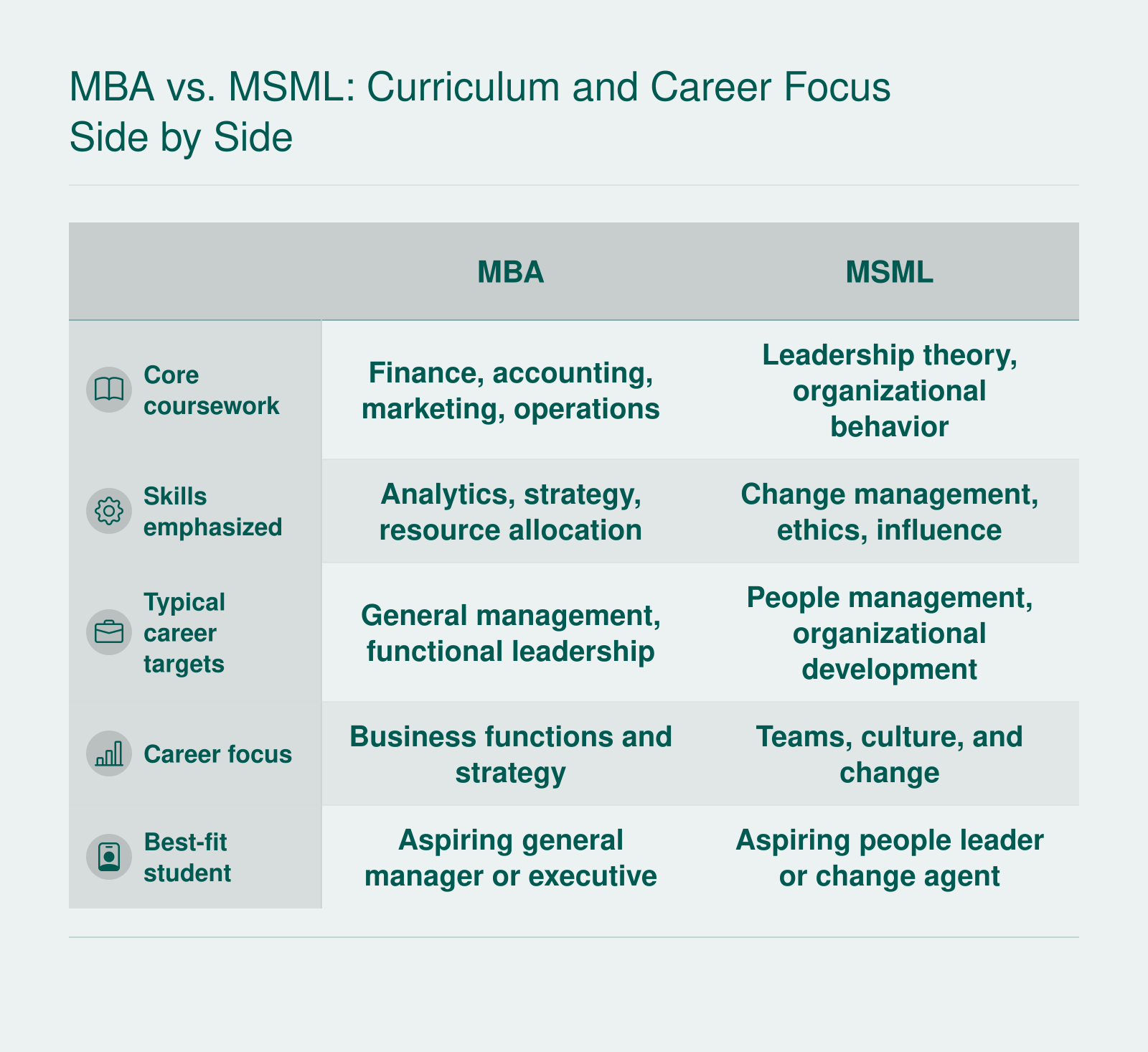
MBA vs. MSML: Curriculum and Career Focus Side by Side
The MBA and the MSML overlap less than their titles suggest. One builds the quantitative and functional toolkit of business, while the other develops the leadership layer. The pairing works because the MBA supplies the hard business toolkit and the MSML deepens how you lead people through it.
Related Articles
MBA/MSML Dual Degree Cost: Tuition, Net Price, and Shared-Credit Savings
The table lists the lowest-cost options first, by average net price from IPEDS and College Scorecard data. Per-credit MBA rates at other business schools vary widely: Lenoir-Rhyne publishes $710 (about $25,560 total for its MBA), Quinnipiac $1,165 ($1,085 online), Robert Morris $1,150, WashU Olin Flex $1,700, Northeastern $1,931 ($923 for its online MBA), and Suffolk $1,970. These are MBA rates, not confirmed MBA/MSML pricing, and combined-degree totals are rarely published. The savings logic is credits saved times the per-credit rate. Oakland double-counts 15 credits toward both degrees, so at an illustrative $1,970 per credit (Suffolk's MBA rate, not Oakland's) that is about $29,550 of avoided tuition, and at $710 it is about $10,650. Net price is an institution-wide average after aid, so treat it as a guide rather than a quote. Employer tuition assistance can change the math, so confirm current rates, fees, and any combined-degree pricing with each bursar.
| School | Dual Program | Graduate Tuition (In-State / Out-of-State) | Average Net Price | Format | Total Credits |
|---|---|---|---|---|---|
| Oakland University (MI) | MS in Safety Management and MBA | $21,960 / $24,648 | $9,120 | Online option available | 56 (15 double-counted) |
| Louisiana Christian University (LA) | MBA/MSL (Master of Strategic Leadership) | $8,086 / $8,086 | $13,113 | On campus | 49 |
| Pfeiffer University (NC) | MBA/MSL | $12,240 / $12,240 | $19,076 | On campus | N/A |
Is an MBA/MSML Dual Degree Worth It? Earnings, Debt, and ROI
The case for a second credential on top of an MBA now rests more on arithmetic than on prestige. The strongest-value schools on this list show the following numbers.
What the Numbers Show
Program-level earnings and debt are not yet published for these dual degrees. The figures below are school-wide: median earnings about 10 years after students first enrolled, and median debt for graduates across the whole institution. They are a rough guide, not a verdict on the dual program itself. A 10-year monthly loan payment is not reported for these programs either.
- Oakland University (MI): about $58,612 in median earnings 10 years after entry, against $22,750 in median graduate debt.
- Louisiana Christian University (LA): about $51,700 in earnings over the same window, against $21,875 in debt.
- Pfeiffer University (NC): about $51,562 in earnings, against $26,163 in debt.
Reading the ROI Ratio
The ratio is simply earnings divided by graduate debt. Oakland comes out near 2.6, Louisiana Christian near 2.4, and Pfeiffer near 2.0. A higher number means each dollar borrowed sits against more later income. It says nothing about your own salary, and it blends every graduate field at each school, so use it to compare schools, not to forecast your paycheck.
Who Gets the Most Out of It
The dual degree pays off most for people aiming at management roles where both financial acumen and people leadership get evaluated: operations leads, program directors, and executives who must read a budget and also run a team. If that describes your next job, pairing the MBA with a leadership or management master's gives you both credentials in one plan of study.
The Trade-Off
A second degree means more credits and more time than a standalone General MBA. Oakland's safety management and MBA track runs 56 total credit hours, though 15 can count toward both degrees. Louisiana Christian's combined MBA/MSL requires 49. Shared credits soften the extra cost but do not erase it. Prior business coursework can sometimes waive a core class, so ask about that before you enroll.
The test is specific: can you name the job where the second credential changes who gets hired or promoted? If so, the added tuition has a purpose. If not, one of the affordable MBA programs is the better value.
In GMAC's 2026 Corporate Recruiters Survey, 64% of global employers named communication skills among the most important future skills for business school graduates, ahead of leadership skills at 53%. For MBA/MSML students, that suggests technical depth works best when paired with the ability to explain it.
How to Apply to an MBA/MSML Dual Degree Program
Requirements differ by school, and the sources do not establish a single standard for MBA/MSML pairings specifically. Treat the points below as what the ranked schools publish, and confirm current-cycle details on each program's site.
- Degree and GPAA bachelor's degree is the baseline; Texas McCombs asks for one from a regionally accredited U.S. or comparable foreign institution. None of the schools here state a minimum GPA. Columbia and Wharton advise reporting grades as they appear on your transcript rather than converting them to a 4.0 scale.
- GMAT/GREPolicies split. Columbia requires the GMAT, GRE, or another accepted test, and Colorado Leeds requires the GMAT or GRE with limited waivers. UT Dallas requires a test or waiver for the MBA but is test-optional for the MS, and it never asks for two separate scores. Texas McCombs dual-degree applicants do not submit a test. Wharton's requirement varies by partner school.
- Work experienceColumbia and Colorado Leeds both list at least two years of professional experience; Columbia says most admitted students have three to seven. UT Dallas and Texas McCombs state no expectation.
- One application or twoExpect separate applications at most schools. Columbia uses a dedicated MBAxMS application, and you can apply to only one Columbia program. Wharton and Colorado Leeds require separate applications to each program, with Leeds also requiring a Dual MBA application. At UT Dallas, the entry point (MBA or MS) determines how test scores carry over.
- Supporting materialsPlan on transcripts, a resume, an essay or statement of purpose, and recommendations. Columbia asks for two recommendations and evidence of quantitative preparation, including calculus, linear algebra, probability, and statistics. Colorado Leeds asks for one or two recommendations and charges a $70 application fee.
MBA/MSML programs by state
MBA/MSML Dual Degree FAQs
These answers cover the questions readers ask most often when weighing an MBA with an MSML. Policies differ by school, so treat the guidance below as a starting point and confirm details with each admissions office.
Can I add the MSML after finishing my MBA, or do I have to enroll in both at once?
How much longer does the dual degree take than a standalone MBA?
Is an MSML the same as an MS in Organizational Leadership?
Will employer tuition assistance cover both degrees?
Compare MBA/MSML programs on the data that matters
Explore more MBA specializations or browse every graduate field.
All MBA programs