Best MSN/MBA Dual Degree Programs
Compare 70+ accredited MSN/MBA programs, with graduate earnings, cost, debt, and completion data from IPEDS and the U.S. College Scorecard.

Taking an MSN and an MBA back to back can mean 78 credit hours or more. A dual degree program overlaps the two. Texas Tech's version cuts that 78 hours to 57, and Southern Utah's online MBA track totals 51 credits at $25,704 in tuition.
For a working nurse heading toward leadership, the payoff is clinical credibility and business training earned together, not in sequence.
The catch is that cost and format vary widely. Fairfield requires 62 credits on campus, while Indiana Wesleyan charges $595 per credit online, so credit count and per-credit price have to be weighed together.
Key Points
- Program-level graduate earnings for MSN/MBA tracks are not yet published, so weigh net price and debt.
- Most programs here deliver coursework online, but practicum placement and residency rules still differ by school.
- Applicants typically need an active RN license and clinical experience, while GRE and GMAT requirements vary by school.
Best MSN/MBA Dual Degree Programs: Our 2027 Rankings
Our top MSN/MBA dual degree programs separate themselves by pairing strong nursing leadership training with measurable earnings outcomes, flexible online or hybrid delivery, and transparent costs. The strongest entries combine accredited nursing coursework with an MBA concentration that mirrors real healthcare management responsibilities, rather than treating the business degree as an add-on. The programs at the top offer the clearest value for working nurses who need to balance clinical credibility, job-market payoff, and schedule flexibility.
Texas Tech University Health Sciences Center
#1Lubbock, TX · ~$7,000/yr (est.)
Best for: Nurses targeting health systems leadership
Texas Tech's dual MSN/MBA stands out for its formal partnership between the nursing school and Texas Tech University's Rawls College of Business, compressing 78 credits into 57 through pre-approved dual-credit and transfer hours. The nursing track focuses on administration, while the MBA centers on health organization management, making it a direct route for nurses targeting executive health systems roles. With online coursework and CCNE accreditation, the program is designed for working professionals who need both clinical leadership and business fundamentals.
- 57 total credit hours after dual-credit reductions
- 21 hours of shared dual credits across both degrees
- Nursing Administration MSN concentration
- Health Organization Management MBA concentration
- 3.0 GPA required for admission
- Separate applications to both TTUHSC and TTU Rawls College
- Online course delivery
- CCNE accredited nursing program
Drexel University
#2Philadelphia, PA · ~$39,000/yr (est.)
Best for: Working RNs needing flexible part-time scheduling
Drexel's online MSN/MBA emphasizes leadership in health systems management, blending advanced nursing practice with the business strategy needed for senior healthcare roles. The part-time, 82-quarter-credit structure is built around four 10-week quarters annually, giving working nurses multiple entry points and a flexible calendar. Admission requires a BSN, a 3.0 GPA, an interview, and current RN licensure, with no standardized tests.
- 82 quarter credits in a part-time structure
- Online, flexible curriculum for working nurses
- BSN degree required for admission
- 3.0 GPA or higher needed
- Two professional references required
- Personal statement and interview required
- Current RN license required
- No standardized tests required
Miami University
#3Oxford, OH · $17,000 – $38,000/yr (est.)
Best for: Family nurse practitioners adding business credentials
Miami University offers two online MSN/MBA tracks, a Family Nurse Practitioner pathway for primary care and a Nurse Executive Leadership pathway for management-focused nurses. Both combine nursing coursework with MBA classes in finance, marketing, and management, and include hands-on clinical or practicum experiences. The FNP track prepares students for national certification and on-campus workshop components support real-world skill-building.
- Online program delivery
- Family Nurse Practitioner concentration
- Clinical practicum hours included
- Focus on primary care skills
- Covers billing and coding
- Requires BSN and active RN license
- On-campus workshop components
- Prepares for national certification
- Nurse Executive Leadership track
- 36 total credit hours
- On-campus workshops included
- Covers healthcare budgeting
- Teaches human resource management
- Strategic planning and data analytics
- Capstone project required
Rowan University
#4Glassboro, NJ · ~$19,000/yr (est.)
Rowan's hybrid MBA/MSN uses a nine-credit Business Certificate of Graduate Study as a stepping stone into the MBA, with credits transferring directly into the degree. The streamlined pathway waives application fees and undergraduate transcripts for MSN candidates, and GMAT and recommendation-letter requirements can be waived for qualified MBA applicants. This makes it a practical, lower-friction option for nurses who want to test the business side before committing fully.
- Hybrid online and campus scheduling
- Nine-credit Business Certificate of Graduate Study pathway
- Certificate credits transfer into the MBA
- Application fee waived for MSN candidates
- GMAT waiver available for MBA
- 36 total MBA credits required
- $1,095 per credit hour tuition
- CCNE accredited
Fairfield University
#5Fairfield, CT · ~$21,000/yr (est.)
Fairfield's campus-based dual degree integrates 62 credits across the Egan School of Nursing and Dolan School of Business, leading to both an MSN and an MBA in one coordinated plan. Coursework spans health policy, finance, marketing, information technology, and systems leadership, with a master's Leadership Practicum built in. Admission requires a BSN with at least a 3.3 GPA and positions graduates for executive healthcare leadership.
- 62 total credits required
- Campus-based program format
- BSN with 3.3 GPA required for admission
- Nursing and business courses combined
- Courses in accounting and finance
- Master's Leadership Practicum included
- Three-year plan of study
- CCNE accredited
Indiana Wesleyan University
#6Marion, IN · ~$11,000/yr (est.)
Indiana Wesleyan's 60-credit MSN/MBA is fully online and priced at $595 per credit hour, with locked tuition rates and a five-year maximum completion window. The curriculum pairs advanced nursing courses in epidemiology and pharmacology with business topics like financial reporting and human resource management. Applicants need a BSN, a 3.0 GPA, three professional references, and an unencumbered nursing license, and the program integrates a leadership capstone practicum.
- 60 credit hours
- $595 per credit hour
- Fully online program
- BSN degree required
- 3.0 GPA admission requirement
- Three professional references needed
- Unencumbered nursing license required
- Five-year maximum completion period
Lewis University
#7Romeoville, IL · ~$16,000/yr (est.)
Lewis University offers an accelerated hybrid MSN/MBA focused on healthcare systems leadership, with employer tuition assistance and an IONL partnership discount among its cost-saving features. The program is designed for working adults and requires a BSN, current RN license, a 3.0 GPA, and foundational statistics and nursing research coursework. Graduates build skills in budgeting, population health, informatics, and evidence-based performance improvement.
- Hybrid program format
- Healthcare Systems Leadership concentration
- Accelerated dual degree
- Employer tuition assistance available
- Alumni scholarship available
- BSN and RN license required
- 3.0 minimum GPA required
- Statistics and nursing research prerequisites
Molloy University
#8Rockville Centre, NY · ~$28,000/yr (est.)
Molloy's 60-credit hybrid dual degree combines an MS in Nursing Administration with Informatics and an MBA in Healthcare, splitting 42 nursing administration credits with 18 business management credits. Admission requires a BSN, a 3.0 GPA, RN licensure, and one year of clinical experience, with part-time and full-time scheduling available. The blend of informatics and business management prepares nurses for data-informed leadership roles in healthcare settings.
- 60 credits total
- 42 nursing administration credits
- 18 business management credits
- Hybrid delivery format
- BSN required for admission
- 3.0 GPA minimum
- RN licensure required
- One year clinical experience required
Messiah University
#9Mechanicsburg, PA · $10,000 – $15,000/yr (est.)
Messiah University's 61-credit online MSN/MBA in nursing leadership costs $800 per credit with no hidden fees and includes 180 clinical practicum hours. Flexible 6-, 8-, or 16-week sessions and no application fee lower the barriers for working nurses. The program holds CCNE and ACBSP accreditation and emphasizes a practical healthcare leadership focus from a Christian faith perspective.
- 61 total credits
- $800 per credit tuition
- No hidden fees
- 100% online coursework
- 180 clinical practicum hours
- Four-year completion time
- Flexible session lengths
- No application fee
Southern Utah University
#10Cedar City, UT · $9,000 – $25,000/yr (est.)
Southern Utah University's online MSN/MBA dual degree requires 51 credit hours and can be finished in as few as 18 months for a published total tuition of $25,704, with no GMAT or GRE required. The program accepts nurses with a BSN, an active RN license, and a minimum 2.5 GPA, and includes 90 clinical hours that can be completed at the student's workplace. AACSB business accreditation and CCNE nursing accreditation anchor the dual-degree value.
- Online program format
- 51 credit hours total
- As few as 18 months duration
- Total tuition $25,704
- No GMAT or GRE required
- BSN from accredited institution required
- Minimum 2.5 GPA required
- 90 clinical hours at workplace
Cost & outcomes by school
Federal data for the highest-earning MSN/MBA programs, independent of the ranking above. Earnings are this field's master's graduates four years after completing, where the Scorecard reports them.
| School | Earnings | Tuition / yr | Debt | Grads/yr | Format |
|---|---|---|---|---|---|
| Molloy University NY | $148,040 | $27,520 | $45,750 | 104 | Hybrid |
| Barry University FL | $145,767 | $19,650 | $82,000 | 32 | Campus |
| Rowan University NJ | $134,810 | $18,607 | — | 41 | Hybrid |
| Commonwealth University of Pennsylvania PA | $129,202 | $12,140 | $50,714 | 22 | Online |
| Fairfield University CT | $128,250 | $21,448 | — | 31 | Campus |
| The University of Texas at Tyler TX | $127,762 | $8,480 | $38,076 | 87 | Online |
| Colorado State University Pueblo CO | $126,927 | $10,064 | $41,000 | 21 | Campus |
| Drexel University PA | $126,827 | $39,261 | $51,250 | 303 | Online |
| Texas Tech University Health Sciences Center TX | $126,759 | $7,153 | $50,275 | 162 | Online |
| D'Youville University NY | $124,200 | $23,300 | $41,000 | 92 | Campus |
| University of Mary ND | $124,187 | $12,372 | $18,923 | 24 | Online |
| Grand Canyon University AZ | $123,688 | $10,015 | $32,443 | 1,394 | Online |
Sources: U.S. Department of Education. Tuition and graduates: IPEDS. Earnings and debt: College Scorecard, this field's master's graduates; a dash means no figure is reported.
Cost, debt & payoff
Median earnings of this field's master's graduates (4 yrs after completing) vs. their median federal loan debt · U.S. College Scorecard
Across these programs the median graduate earns about $117,859 and finishes with roughly $41,000 in debt — a ratio that clears a common rule of thumb (keep debt below first-year salary). Tuition and debt vary widely school to school, so check the per-school figures in the table above before you shortlist.
The Outcomes Data Behind Our Picks
Federal outcomes data now reaches further into graduate education than it once did, but for niche dual degrees like the MSN/MBA, it still arrives in pieces. Each figure behind our picks answers a question a nurse should ask before trading tuition dollars for a shot at a nurse executive leadership paycheck:
- What will it cost? Graduate tuition and average net price after aid, drawn from federal IPEDS and College Scorecard data.
- Will it pay off? Program-level earnings and debt, where the government publishes them.
- Do students finish? Institution-wide completion rates.
Two of these need careful reading. Net price is a school-wide average, not a personal quote. Southern Utah University's figure of roughly $10,500 and Fairfield University's roughly $48,100 show relative cost, not your actual bill. Graduation rates likewise describe the whole school, not the nursing or MBA program cohort you would join.
For many MSN/MBA tracks, the federal government does not report program-level earnings, often because the cohorts are too small to report. Those programs were still eligible and were judged on the cost, debt, and completion data that does exist.
What Is an MSN/MBA Dual Degree, and How Do the Credits Overlap?
The MSN/MBA is one integrated program that awards two separate degrees: a Master of Science in Nursing (MSN in Nursing Administration), almost always in a leadership, administration, or health systems track, plus a Master of Business Administration. You apply once, enroll once, and graduate with both credentials.
The credit math
The appeal is overlap. A set of core courses counts toward both degrees at the same time, so the combined total lands well below what two separate programs would demand. Johns Hopkins publishes a 61-credit dual program built from 25 nursing credits and 36 business credits, with 18 credits doing double duty, plus 504 practicum hours. Hopkins lists a slightly higher total for students on the part-time plan, so confirm the count against the catalogue for your intended pace. Dual programs generally run 60 to 72 credits, with shared coursework trimming roughly 12 to 18 credits. Earning a standalone MSN (typically 36 to 48 credits) and a standalone MBA (typically 48 to 60) in sequence usually means 84 to 108 credits total.
Timeline and scope
Full-time students generally finish in two to four years; Hopkins lists two years full-time and three to six part-time, which is the common range for working nurses.
Be clear about what this degree is not. It prepares you to run units, departments, and budgets, not to practice as a Family Nurse Practitioner (FNP) or other APRN. Nurses already holding an MSN sometimes pursue a standalone MBA instead, which makes sense when the clinical master's is done and only the business training is missing.
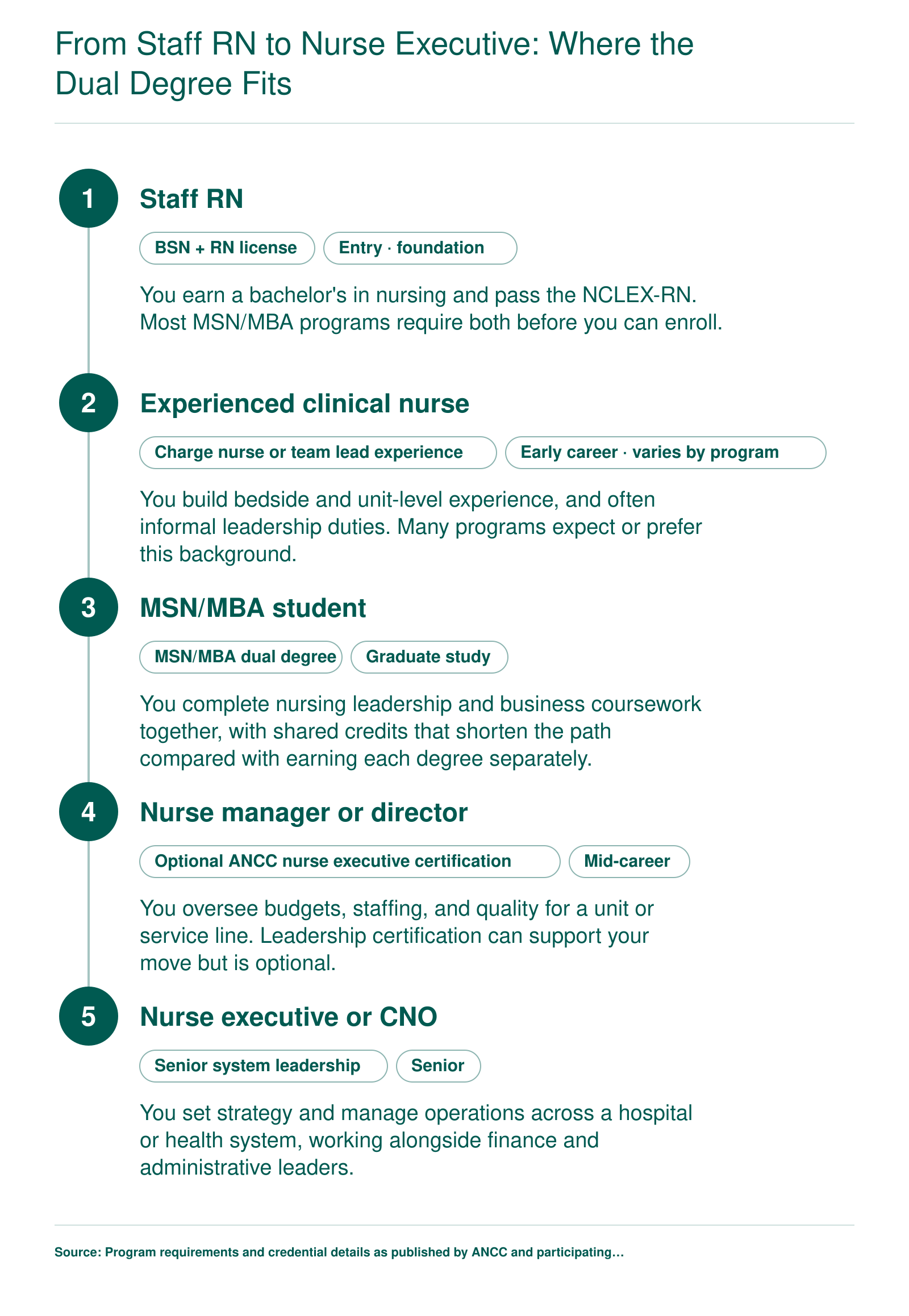
From Staff RN to Nurse Executive: Where the Dual Degree Fits
The MSN/MBA is built for nurses who want to move from running a unit to steering a health system. Each step below builds on the one before it, and the dual degree sits at the point where clinical credibility meets business training.
Related Articles
Choosing a Format: Online, Hybrid, or On-Campus MSN/MBA Programs
Most of the schools here deliver coursework online, so the real differences are residencies, synchronous sessions, and who finds your practicum site. Hybrid options add occasional residency components, while a traditional on-campus format ties you to fixed class times and a single location. Always confirm your state is eligible before applying. For working nurses on 12-hour shifts, pick a fully online program with no residency and get written confirmation of who secures your practicum site.
| Program | Format | Schedule and residency | Practicum hours | Who arranges placement | State limits |
|---|---|---|---|---|---|
| Indiana Wesleyan University | Fully online | 100% online, no on-campus residency | 520 hours | You identify and secure sites, subject to School of Nursing approval | Not stated by the program |
| Kent State University | Fully online | 100% online, never required on campus | 300 hours | Completed with healthcare administrators and executives in your home state | May not be offered in certain states; state laws can limit the program or practicum courses; valid RN license required |
| Grand Canyon University | Online coursework, in-person practicum | Online classes plus a practicum at an approved local site | 150 hours | Coordinated by the program based on your location, approved settings, and qualified preceptors | Not stated by the program |
| Johns Hopkins University | Online or hybrid-style options | Synchronous and asynchronous sessions; some MBA courses may include a residency that can be completed virtually | 504 hours across three practicum courses | Depends on your focus, site and preceptor availability, and program needs | Not stated by the program |
| Texas Tech University Health Sciences Center | Fully online | Online courses and online-supported practicum experiences | Not stated by the program | Not stated by the program | Not stated by the program |
| University of Alabama at Birmingham | Check current format with the school | Confirm class schedule and any campus requirements directly | Not stated by the program | Not stated by the program | Unencumbered, unrestricted nursing license required in the state where you will do the practicum |
Online formats buy you flexibility and often a lower total cost, but you give up the in-person cohort where many future nurse executives build their first leadership network.
What You Need to Apply: RN License, Experience, and Test Policies
Requirements vary by school, so confirm details with each admissions office. These are the patterns across the programs here.
- Accredited BSN (and bridge options)Most programs expect a BSN from an accredited nursing program. Liberty University lets an RN with a non-nursing bachelor's complete BSN bridge courses in the first MSN year. Indiana Wesleyan University may admit a non-nursing bachelor's holder with 10 years of recent nursing practice by portfolio review.
- Active, unencumbered RN licenseSchools generally require a current, unrestricted RN license, often in the state where you complete your practicum. Herzing University accepts a multistate compact license held by a resident of a compact state.
- Clinical experienceThere is no universal minimum. Lamar University requires none, and most schools here do not state a minimum. Indiana Wesleyan's portfolio route is the exception, requiring 10 years of recent practice.
- Minimum GPAMost programs ask for a 3.0 undergraduate GPA. Benedictine University sets 2.75 and Southern Utah University 2.5. Southern Utah admits some applicants in the 2.5–3.29 range with conditions. Lamar, Texas Tech, and Mount Mercy also require grades of C or better (B or better at Mount Mercy) in undergraduate statistics.
- GMAT/GRE policyBenedictine, Southern Utah, and Herzing require neither test. UAB asks for GRE or GMAT scores only if your GPA is below 3.2, and a graduate degree with at least a 3.0 GPA may waive the test. Check the other schools directly.
- Resume, essays, and recommendationsPlan on a current resume, a personal or goal statement, and professional references. Prepare these early, since nursing leadership and business goals both need to come through clearly.
MSN/MBA programs by state
MSN/MBA Dual Degree FAQs
These answers cover cost, career payoff, admissions, and timing for MSN/MBA programs. Deadlines and test policies change, so confirm current details with each school before you apply.
How much does an MSN/MBA dual degree typically cost in total?
Does an MSN/MBA pay off for nurses moving into management?
What roles do MSN/MBA graduates usually move into?
How many years does a part-time MSN/MBA dual degree usually take?
Is an active RN license required before enrolling in an MSN/MBA?
Do MSN/MBA programs still ask for the GMAT or GRE?
When are application deadlines for MSN/MBA dual degree programs?
Can you finish a standalone MSN first and add an MBA later instead of enrolling in a dual degree?
Compare MSN/MBA programs on the data that matters
Explore more Nursing specializations or browse every graduate field.
All Nursing programs