Most Affordable MSN/MBA Dual Degree Programs
Compare 70+ accredited most affordable MSN/MBA programs, with graduate earnings, cost, debt, and completion data from IPEDS and the U.S. College Scorecard.

Two separate master's degrees mean double the tuition and far more time, which is why nurse managers who want business training look at dual programs first. Colorado State University Pueblo, for example, shares 18 credits between its MSN and MBA, for 54 credit hours in all.
Even among affordable options the spread is real: graduate tuition runs from $7,658 at East Carolina University to $12,125 at Gardner-Webb University. Credit load and clinical hours then decide the final bill.
Key Points
- Rankings filter by average net price after grants, not advertised tuition.
- Check for CCNE or ACEN and AACSB accreditation before enrolling.
- Employer tuition reimbursement up to $5,250 yearly often cuts the bill most.
10 Most Affordable MSN/MBA Dual Degree Programs for 2027
These 10 programs pair advanced nursing leadership with business administration at prices that respect a working nurse's budget. Use the cards to compare credit loads, clinical requirements, and graduation rates as you narrow your list.
Southern Utah University
#1Cedar City, UT · $9,000 – $25,000/yr (est.)
Best for: Online learners wanting quick completion
Southern Utah University pairs an MSN in Nursing Leadership and Administration with an MBA in 51 credits that most students finish in 18 months. The program is delivered online in seven-week courses and includes 90 clinical hours at the student's workplace. No GMAT or GRE is required, and the school has a graduation rate of 60.7%.
- 51 credit hours total
- Can be completed in as few as 18 months
- Seven-week online course structure
- 90 clinical hours at your workplace
- No GMAT or GRE required
- CCNE and AACSB accredited
The University of Texas at Tyler
#2Tyler, TX · ~$8,000/yr (est.)
Best for: Working nurses needing test-optional admission
UT Tyler's coordinated MSN-MBA uses shared coursework so students earn both degrees in 63 credit hours. Admission requires a BSN and a 3.0 GPA, and GMAT scores may be waived for applicants with a strong record. The school has a graduation rate of 54.1%.
- 63 credit hours total
- Online delivery format
- GMAT required, waiver possible with strong GPA
- Requires BSN and 3.0 GPA
- Scholarships and financial support available
Lamar University
#3Beaumont, TX · ~$9,000/yr (est.)
Best for: Rural nurses seeking online flexibility
Lamar University's online MSN-MBA dual degree requires 61 credit hours, with nine nursing credits counting toward the MBA to reduce time and cost. The program typically takes about three years to complete and is designed for working nurses moving into hospital administration. The school has a graduation rate of 37.3%.
- 61 credit hours total
- 37 MSN credits, 9 shared toward MBA
- Approximately three years to complete
- $26,909 total tuition
- BSN and 3.0 GPA required
- No clinical experience required
- ACEN accredited
Colorado State University Pueblo
#4Pueblo, CO · ~$10,000/yr (est.)
Colorado State University Pueblo combines the Nurse Manager and Leader MSN with the MBA in a 54-credit pathway that shares 18 credits between both degrees. The program is test optional, and admitted nursing students do not take the GMAT. The school has a graduation rate of 39.7%.
- 54 total credit hours
- 18 nursing, 18 shared, 18 business credits
- No entrance exam, test optional
- Active Colorado RN license or compact residency required
- Capstone required
- Leveling courses cost $100 each
- All courses require a B or better
East Carolina University
#5Greenville, NC · ~$8,000/yr (est.)
East Carolina University's 64-semester-hour MSN/MBA offers a Health Systems Leadership concentration entirely online. Applicants need a BSN, a 2.7 GPA, an RN license, and five years of nursing experience, with no GRE or MAT required. The school has a graduation rate of 62.6%.
- 64 semester hours total
- 100% online delivery
- Health Systems Leadership concentration
- No GRE or MAT required
- Requires BSN, 2.7 GPA, and RN license
- Five years of nursing experience required
Wilmington University
#6New Castle, DE · ~$10,000/yr (est.)
Wilmington University pairs a CCNE-accredited MSN with an MBA in Healthcare Administration in 51 credits and 17 courses. The program charges the same low in-state tuition to all students regardless of residence, and seven-week classes can be taken in person, online, or hybrid. The school has a graduation rate of 19.8%.
- 51 total credits and 17 courses
- Typical 3-credit graduate course costs $1,692
- Seven-week classes in person, online, or hybrid
- Low in-state tuition for all students
- Three start dates per year
- MBA focus in Healthcare Administration
- Accelerates into a WilmU DNP
Spring Arbor University
#7Spring Arbor, MI · ~$8,000/yr (est.)
Spring Arbor University's online MSN-MBA dual degree requires 61 credits and 125 clinical hours, with an asynchronous format and one four-day campus residency. Tuition is $810 per credit, and the program can be finished in as few as two years and ten months. The school has a graduation rate of 63.5%.
- 61 credit hours and 125 clinical hours
- As few as two years and ten months
- $810 per credit hour
- Asynchronous online classes with seven-week courses
- One four-day campus residency required
- No entrance exam required
- 3.0 GPA over most recent 60 credits
- CCNE accredited
Grand Canyon University
#8Phoenix, AZ · ~$10,000/yr (est.)
Grand Canyon University's MSN-MBA in Nursing Leadership in Health Care Systems requires 74 credits and is delivered online in eight-week courses. The program includes a 16-week practicum, and tuition is $665 per credit online. The school has a graduation rate of 43.5%.
- 74 total credits required
- Online program delivery
- Eight-week course length
- 16-week practicum included
- $665 per credit online
- Requires BSN and active RN license
- CCNE accredited
Post University
#9Waterbury, CT · ~$8,000/yr (est.)
Post University's MSN/MBA-Healthcare dual degree is a 60-credit, 42-month online program with monthly start dates. Students can choose traditional eight-week terms or a self-paced SIMPath format. The school has a graduation rate of 24.9%.
- 60 credit hours total
- 42-month program length
- Online with monthly start dates
- Term Based 8-week terms or self-paced SIMPath
- Requires RN licensure
- CCNE accredited
Gardner-Webb University
#10Boiling Springs, NC · ~$12,000/yr (est.)
Gardner-Webb University's MSN/MBA requires 54 credits, with 24 nursing credits and 30 business credits, and is offered online with August or January start dates. The program emphasizes finance, operations, marketing, and management for healthcare leadership. The school has a graduation rate of 55.4%.
- 54 credit hour program
- 24 nursing credits and 30 business credits
- Online program format
- Start dates in August or January
Cost & outcomes by school
Federal data for the highest-earning MSN/MBA programs, independent of the ranking above. Earnings are this field's master's graduates four years after completing, where the Scorecard reports them.
| School | Earnings | Tuition / yr | Debt | Grads/yr | Format |
|---|---|---|---|---|---|
| Molloy University NY | $148,040 | $27,520 | $45,750 | 104 | Hybrid |
| Barry University FL | $145,767 | $19,650 | $82,000 | 32 | Campus |
| Rowan University NJ | $134,810 | $18,607 | — | 41 | Hybrid |
| Commonwealth University of Pennsylvania PA | $129,202 | $12,140 | $50,714 | 22 | Online |
| Fairfield University CT | $128,250 | $21,448 | — | 31 | Campus |
| The University of Texas at Tyler TX | $127,762 | $8,480 | $38,076 | 87 | Online |
| Colorado State University Pueblo CO | $126,927 | $10,064 | $41,000 | 21 | Campus |
| Drexel University PA | $126,827 | $39,261 | $51,250 | 303 | Online |
| Texas Tech University Health Sciences Center TX | $126,759 | $7,153 | $50,275 | 162 | Online |
| D'Youville University NY | $124,200 | $23,300 | $41,000 | 92 | Campus |
| University of Mary ND | $124,187 | $12,372 | $18,923 | 24 | Online |
| Grand Canyon University AZ | $123,688 | $10,015 | $32,443 | 1,394 | Online |
Sources: U.S. Department of Education. Tuition and graduates: IPEDS. Earnings and debt: College Scorecard, this field's master's graduates; a dash means no figure is reported.
Cost, debt & payoff
Median earnings of this field's master's graduates (4 yrs after completing) vs. their median federal loan debt · U.S. College Scorecard
Across these programs the median graduate earns about $117,859 and finishes with roughly $41,000 in debt — a ratio that clears a common rule of thumb (keep debt below first-year salary). Tuition and debt vary widely school to school, so check the per-school figures in the table above before you shortlist.
Price First, Then Proof: The Yardstick Behind This List
Cheap tuition alone proves little if students borrow heavily or leave before finishing. A low sticker price means little if the net cost after grants still forces six-figure debt, even among many affordable MBA programs. That is why the filter here leads with average net price after aid and financial-aid indicators, while graduate tuition and fees serve as a secondary check rather than the drawcard.
The numbers come from College Scorecard and IPEDS institution data. Net price is an institution-wide average, and graduation rates are school-wide, so they describe each campus overall, not any single MSN/MBA track. Graduate students often receive different aid than undergraduates, so treat that average as a starting point, not a personal quote.
Because per-credit rates and mandatory fees shift every academic year, confirm the current breakdown directly with each school before you budget for an MSN/MBA Dual Degree.
What an MSN/MBA Really Costs, and How Shared and Transfer Credits Lower It
Two separate degrees or one MSN/MBA dual degree program: that single choice moves the price more than any scholarship will.
The arithmetic
Start with per-credit tuition times total credits, then add mandatory fees. Technology or distance-learning charges, clinical and practicum fees, and a graduation fee are the usual categories, though schools rarely publish a clean schedule showing which apply per term versus once. Lamar University reports a total program cost of $26,909 across 61 credit hours, with university fees folded into published tuition. Use any school's own number cautiously and ask what the quoted figure excludes.
What shared credits actually save
Dual programs cross-count coursework rather than stacking two full degrees. Lewis University's dual MSN/MBA catalog lists a 33-hour MSN and 30-hour MBA totaling 63 hours together. Texas Tech University Health Sciences Center's MSN/MBA Dual Degree Program lists 59 dual hours against 78 taken separately. Purdue Global reports 88 quarter credits jointly versus 120 apart. At typical per-credit rates, 19 to 32 fewer credits is a meaningful four- or five-figure reduction.
Transfer credit
Caps, minimum grades (commonly a B) and age limits on prior coursework vary and need direct confirmation. Texas Tech pre-approves 21 transfer hours for dual use. Weigh your final total against the earnings figures that follow.
Related Articles
CCNE, ACEN, AACSB and Practicum Hours: Checks That Protect Your Investment
The lowest tuition means nothing if the degrees don't clear employer screens, state licensing expectations, or a future DNP application. Check both layers of MSN/MBA dual degree accreditation before you pay. The nursing portion should hold CCNE or ACEN accreditation. The business portion should hold AACSB, ACBSP, or IACBE accreditation. Employers and doctoral nursing programs each look for the specialized seal, so institutional or regional status alone is not enough. You can confirm all of this in about two minutes with the CCNE directory, the ACEN directory, and the AACSB school search.
Clinical expectations differ by track. Leadership and administration MSN/MBA paths usually require an administrative or executive practicum, often in the range of 100 to 500 hours, not hands-on patient care. FNP/MBA combinations commonly require 500 or more supervised direct care hours, though totals vary by school and state. Before enrolling, ask who arranges the preceptor. Some online programs leave that to you, and finding a qualified nurse leader or physician supervisor is a hidden time cost.
The Payoff Number: Earnings After Finishing a Ranked Program
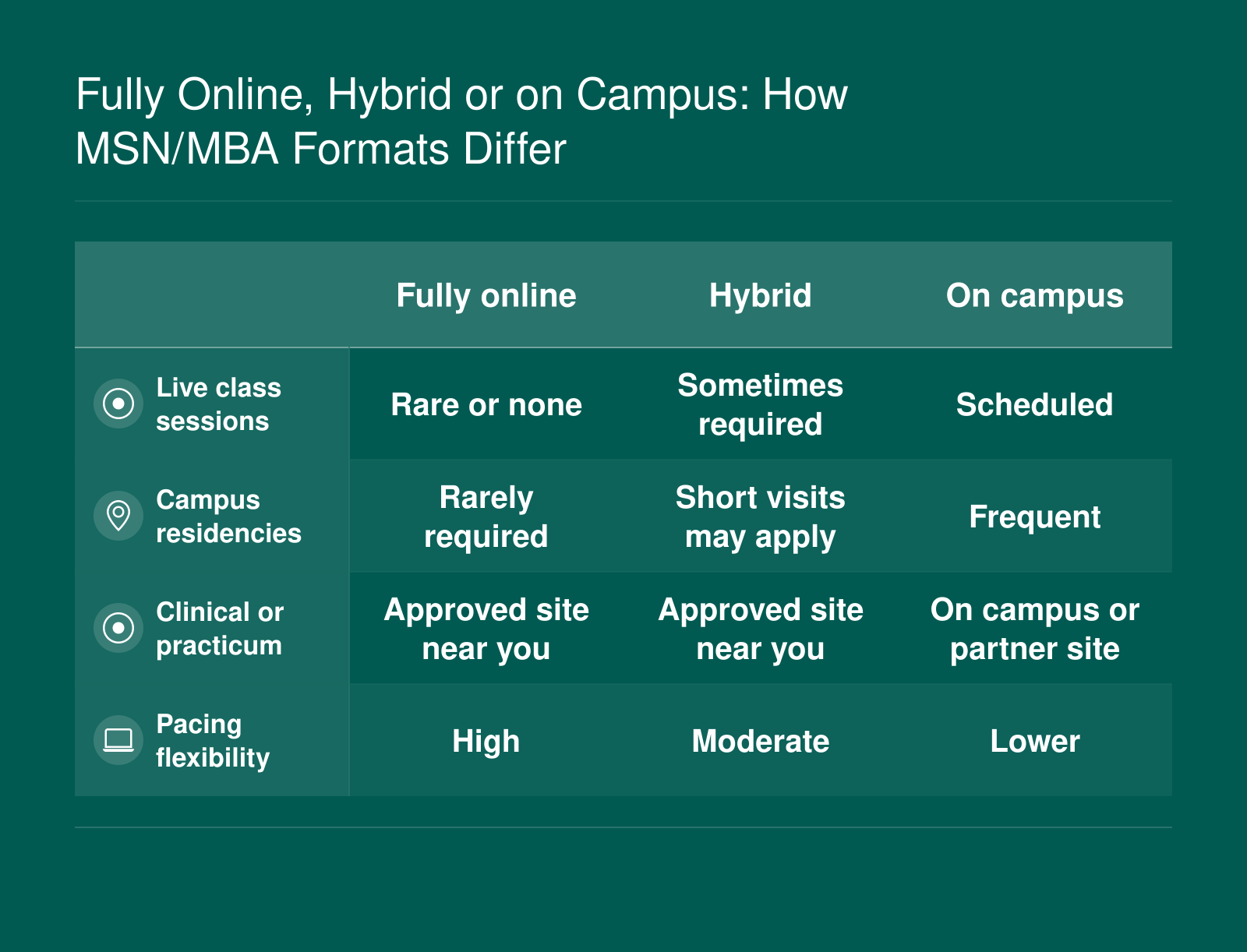
Fully Online, Hybrid or on Campus: How MSN/MBA Formats Differ
The ranked programs include fully online, hybrid, and on-campus formats. Out-of-state online students should confirm state authorization before enrolling, since nursing boards may require approval before clinical placements begin.
Getting in: Prerequisites and Deadlines for MSN/MBA Applicants
MSN/MBA admission requirements vary by school, but these are the common checkpoints.
- BSN prerequisiteA bachelor’s in nursing from a CCNE- or ACEN-accredited program is typical; Liberty accepts any bachelor’s degree.
- RN licenseAn active, unencumbered RN license in the state of the practicum is required by Marymount, Mount Saint Mary’s, Lamar, and Drexel.
- Minimum GPAMinimums range from 2.5 at Southern Utah University to 3.0 at several listed programs; Benedictine uses 2.75.
- Entrance examsUAB requires GRE or GMAT. Benedictine and Southern Utah require none; Lamar’s MBA waiver may require a 3.0 GPA and four-plus years of professional experience.
- Nursing experienceMount Saint Mary’s expects at least one year; Lamar sets no minimum work requirement; Drexel requires no specific clinical or volunteer experience.
- Deadlines and documentsFixed deadlines: Benedictine Dec. 9, 2026; Lamar Dec. 29, 2026; Southern Utah Dec. 30, 2026; UAB Dec. 31, 2026. Mount Saint Mary’s uses priority dates Mar. 1 and Nov. 1. Applications generally include a résumé, references, and personal statement.
Shrinking the Bill: Scholarships, Employer Aid and Military Discounts
Working RNs can shrink an MSN/MBA bill through two routes: predictable employer tuition reimbursement and competitive one-time awards. Employer aid is the stronger lever. Many health systems reimburse graduate tuition up to the IRS Section 127 tax-free threshold, often $5,250 a year, so check your plan's cap and whether an MSN/MBA qualifies.
On the scholarship side, the NurseThink-AACN Scholarship awards $5,000 twice a year to master's and doctoral nursing students at AACN member schools, and the Certiphi-GNSA Scholarship gives $10,000 to two members. The NSNA Foundation lists graduate awards that shift annually, and HRSA's NURSE Corps covers tuition, fees, and a monthly stipend for full-time students who later serve at a Critical Shortage Facility.
Veterans and service members may combine GI Bill and Yellow Ribbon benefits with per-credit military rates at some online programs, though stacking rules vary. For gaps, federal Direct Unsubsidized Loans now allow up to $20,500 a year for graduate students, with a lifetime cap of $100,0001; Grad PLUS borrowing may be limited to certain exceptions for 2026-2027.2
MSN/MBA programs by state
Compare MSN/MBA programs on the data that matters
Explore more Nursing specializations or browse every graduate field.
All Nursing programs